Excavator
294 models
 Backhoe Loader
51 models
 Crane
68 models
 Concrete Mixer
79 models
 Wheel Loader
54 models
 Compactor / Roller
45 models
 Motor Grader
42 models
 Dozer
41 models
 Concrete Pump
66 models
 Skid Steer Loader
11 models
 Telehandler
13 models


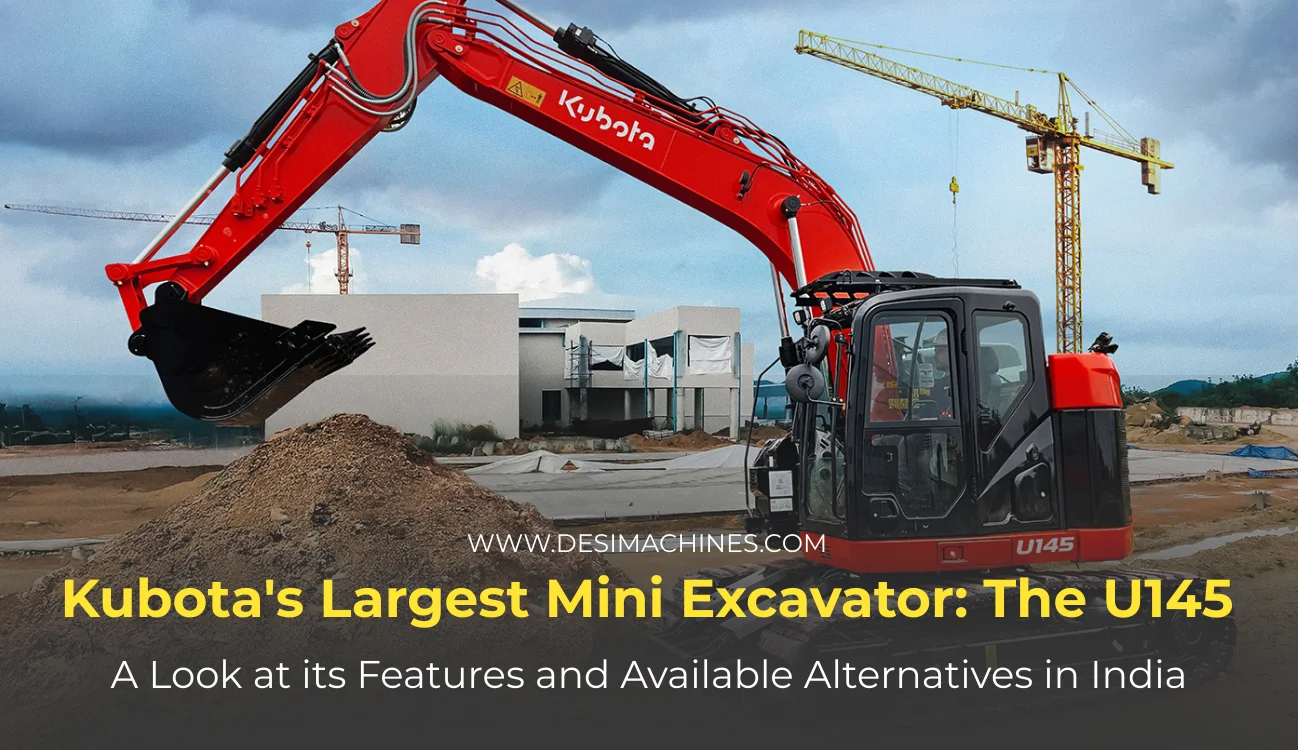
The Kubota U145 is a 14,500–15,200 kg short-tail-swing hydraulic excavator rated at 76.4 kW, shown at Bauma 2025 and going on sale in Europe from spring 2026. It is not a mini excavator — Kubota defines those as under 6 tonnes, and the largest excavator Kubota builds itself is in the 8-tonne class — and it is not a Kubota design: it is supplied by Sumitomo Construction Machinery under an OEM agreement. There is no announced India launch date. If you are costing a machine in this weight class here, the listed 13–14 tonne options run about ₹40–54 lakh as of September 2026.
The construction machinery sector is undergoing a make-or-break period in which innovation, sustainability, and productivity are determining competitiveness. At the center of it all is Kubota, a brand worldwide famous for its durable mini excavators and compact construction equipment. However, at Bauma 2025, Kubota made its dramatic entry into unfamiliar territory when it unveiled its biggest-ever excavator, a 14-ton giant in the form of U145.
This is not another product release. It is a meaningful change in Kubota’s brand identity, shifting from a leading brand in compact excavators and small excavators into the mid-to-heavy construction machinery segment. To contractor professionals, fleet operators, and builders globally, the U145 is an expression of a larger movement more demand for machines capable of balancing compact flexibility with a large-scale level of performance.
At Desi Machines, we simplify such developments for industry professionals. Our platform exists to provide transparency, comparisons, and insights so you can make informed machinery investments whether you’re evaluating a proven mini excavator or weighing up newly launched models like the Kubota U145.
Kubota at Bauma 2025: Making a Global Statement
Bauma in Munich is the biggest construction machinery trade show globally. All companies regard it as a podium for tomorrow’s solutions. Kubota’s recent launch of its U145 was one of this year’s most talked-about launches since it was a massive foray for it outside its traditional compact machine expertise.
According to the official statement from Kubota Corporation (Kubota News), the U145 is defined with superior lifting capacity, best-in-class fuel efficiency, and best-in-class operator comfort—all features now standard on mid-size excavation machines.
This move is particularly noteworthy because Kubota is not abandoning its dominance in compact machines—it’s simply broadening its reach. For decades, the brand’s mini excavators have been industry staples in urban development, landscaping, and utility projects. According to P.V. Dobson News, now, with the U145, Kubota is signaling its readiness to compete head-to-head with manufacturers already strong in mid-range excavators.
Kubota U145 Hydraulic Excavator: Key Features & Advantages
From first glance to technical details, the 14 ton U145 excavator machine is a fusion between power and accuracy.
- Weight & Power – A chassis weight of 14,500–15,200 kg and a rated output of 76.4 kW (ISO 9249), close to double Kubota’s own 8-tonne-class ceiling and squarely in mid-size project territory.
- Increased Reach – New design for greater reach and depth in digging, crucial in foundation excavations and in trenching.
- Fuel Efficiency – Kubota retains its ecotechnical engine focus for continued compliance with overseas emission standards.
- Operator Comfort – Adequate accommodation within an air-conditioned cabin with user-friendly controls enhances safety while reducing fatigue for longer operations.
- Versatility – Versatile for multiple attachments, extending its use beyond digging, it is ideal for grading, handling materials, and so forth.
Kubota U145 specifications
Kubota’s own announcement is the only primary source for this machine and it is deliberately short. These are the figures it publishes; anything beyond them is not confirmed.
| Specification | Kubota U145 |
|---|---|
| Model name | U145 |
| Chassis weight | 14,500 – 15,200 kg |
| Rated output | 76.4 kW (ISO 9249), about 102 hp |
| Configuration | Short tail swing |
| Supplied by | Sumitomo Construction Machinery, under an OEM agreement |
| Launch market | Europe, sales scheduled from spring 2026 |
| Intended uses | Civil engineering — residential land development, road construction, urban infrastructure |
| India availability | No announced launch date |
Is the Kubota U145 a mini excavator?
No, and the point is worth making plainly because the machine is widely written up as one. Kubota’s own definition, given in the same announcement, is that hydraulic excavators under 6 tonnes are mini excavators. At 14,500–15,200 kg the U145 is more than twice that, and it sits above the 8-tonne class that is the largest machine Kubota manufactures itself.
Two things follow for anyone comparing machines. The U145 is not the biggest Kubota mini excavator — that description belongs to Kubota’s own sub-6-tonne U and KX range, and the largest Kubota-built excavator of any size is an 8-tonne-class model. And the U145 is not a Kubota design: it is built by Sumitomo Construction Machinery and supplied to Kubota under an OEM agreement, so its engineering lineage is Sumitomo’s rather than the compact range’s.
Kubota’s Collaboration with Liebherr: A Strategic Step
As part of the Kubota U145 launch, Kubota announced its joint venture with Liebherr for making wheeled excavators—KW095 and KW115. Through this joint venture, Kubota is able to gain traction in yet another burgeoning segment. European construction sites are increasingly adopting wheeled excavators for their road mobility and flexibility in urban sites.
By collaborating with Liebherr, a globally respected heavy machinery enterprise, Kubota gains automatic credibility in the wheeled excavator machine marketplace. Such a combination of Kubota’s compact expertise and Liebherr’s technical expertise validates company’s ambitions for diversification.
Why Large Excavators Are Gaining Demand Globally
The U145 signals more than Kubota’s own expansion — it tracks a worldwide shift in the segment. Why are manufacturers making the change towards larger machines?
- Mega Infrastructure Projects – Around the world, governments are investing in highways, metro rails, airports, and bridges, which require machines with increased digging capacity.
- Time Efficiency – Larger machines have reduced cycle times, which improve project schedules.
- Cost Optimization – Although costs for fuel might prove greater, full productivity gains per unit decrease excavation costs.
- Versatility – With multiple attachments, modern excavators can switch roles quickly, replacing multiple machines on a site.
- Urban Expansion – When cities expand, there is a simultaneous increase in demand for small excavators in compact areas and large excavators for large groundwork.
The U145 thus fulfills a global demand by filling a gap in its otherwise strong mini- and compact-lineups.
How the Kubota U145 Stands Against Competitors
In the mid-sized excavator category, Kubota faces established giants like CAT, Komatsu, Hitachi, and JCB. How does it stand out?
- Kubota Reliability – Contractors count on Kubota for low-maintenance, durable mini excavators. To take that reputation into a larger machine equates to immediate appeal.
- Operator-Centric Focus – As everyone is fixated on raw power, Kubota pairs potency with user-friendly design.
- Strategic Differentiation – Contrary to companies that already provide several mid-size units, Kubota provides a single dedicated option (U145), maintaining product simplicity within its range.
For existing Kubota contractor operations, the U145 excavator is a next-step-logical upgrade path—keeping learning curves low while raising capability.
The Indian Market Perspective
It is important to note that the U145 is not yet available in India. For now, Kubota continues to dominate India’s compact mini excavator and utility equipment categories, which are better suited for:
- Urban metro projects
- Roadside maintenance
- Agricultural excavation needs
- Small-to-medium residential construction
The U145 excavation machine, however, remains the only model in this segment from Kubota, and once launched in India, it could serve major infrastructure projects where power and reach are critical.
Until then, Indian contractors can explore alternative brands for mid-range excavators while continuing to rely on Kubota’s compact machines for daily applications. At Desi Machines, we help you navigate these choices—comparing specifications, ROI, and availability across brands. At Desi Machines, even in the absence of the U145, you can explore mid-sized excavator alternatives from leading brands, such as:
What a machine in this class costs in India today
Because the U145 is not sold here, the honest answer to “Kubota U145 price in India” is that there is no Indian price to quote. What you can actually cost out is a listed machine in the same weight band. These are the 13–14 tonne models named above, with catalogue operating weights and current indicative bands.
| Model | Operating weight | Indicative price (Sep 2026) |
|---|---|---|
| JCB 130 | 12,800 kg | ₹41 – 44 lakh |
| Volvo EC140D | 13,130 kg | Quoted on request |
| Tata Hitachi ZAXIS 140H Ultra | 13,360 kg | ₹44 – 50 lakh |
| SANY SY140C-9/9S Quarry | 14,030 kg | ₹40 – 44 lakh |
| CAT 316 GC | 14,400 kg | ₹50 – 54 lakh |
Prices are indicative ranges as of September 2026 and move with variant, configuration, state levies and dealer. The Volvo EC140D is listed without a published price and is quoted on request. Confirm the current figure with our team before you buy or hire.
Read More: Top 10 20-Ton Excavators in 2025: Features & Comparisons
Why Mini Excavators Remain Indispensable
Even with the excitement surrounding the U145, mini excavators remain Kubota’s backbone—and the most practical machines for many Indian contractors.
Advantages of Mini Excavators:
- Compact Size – Ideal for narrow sites and city centres.
- Fuel Efficiency – Lower cost of operation relative to large machinery.
- Ease of Transport – Can be transported between sites on shorter trailers.
- Versatility – Hydraulic breakers, augers, and buckets can be installed in it.
- Lower Capital Investment – Less expensive contractor’s entry-level machine.
In India, where diverse project scales exist, the combination of small excavators for city projects and larger machines like the U145 (once available) for mega projects will form the future of fleet strategies.
The ROI Factor: What Contractors Should Consider
Whether you are purchasing a mini excavator or are thinking ahead about adopting a machine like a U145, ROI is ultimately on the line. Contractors should consider:
- Purchase Price vs. Project Scope – Bigger machines require greater capital upfront but pay back with quicker project turnover.
- Fuel & Maintenance Costs – Kubota equipment has a reputation for lower lifecycle expenses.
- Utilization Rates – A correctly-matched machine guarantees steady use in several projects.
- Resale Value – The Kubota brand offers a strong resale demand in the aftermarkets.
At Desi Machines, we give you clear information, specifications, and cost details so you can make decisions based on ROI confidently.
How Desi Machines Strengthens Your Decisions
Our platform exists to empower industry stakeholders by bridging the knowledge and accessibility gap in heavy equipment procurement. Here’s what makes us authoritative:
- Comprehensive Listings – We list everything from mini excavators to graders and cranes.
- In-Depth Comparisons – Compare specs, price, and features side by side between different brands and models.
- Financing Solutions – Get access to competitive financial solutions for your business.
- Insurance Partnerships – Safeguard your investment with appropriate insurance solutions.
- Trusted Knowledge Hub – Beyond listings, we also offer expert blogs, guides, and news so you stay up-to-date on industry developments.
By aggregating equipment data with unmatched clarity, Desi Machines gives you the specifications and prices side by side.
Where the U145 Stands in 2026
More than a year on from the Bauma 2025 launch, the U145 still has no announced India launch date, and Kubota’s Indian range remains centred on the compact models that suit metro, agriculture and residential work. For an Indian buyer that makes the U145 a reference point rather than a purchase option: it shows where the compact segment is heading, but the machine to actually cost out today is a listed mini excavator in the same weight class. Check the current price bands by size class before you compare, and confirm any launch timing with our team rather than the show coverage.
Specifications vary by variant and model year — confirm the exact configuration with our team before you buy or hire.
What Kubota’s U145 means for mid-size buyers
The Bauma 2025 unveiling of the U145 by Kubota is more than a product unveiling; it is a glimpse at what is next for the construction industry. As much as the U145 strengthens Kubota’s presence in the mid-size excavator marketplace, mini excavators and compact construction equipment are still at the forefront of daily operations, most notably in India. To contractors, fleet owners, and construction builders, their focus is less about finding a machine; it is about finding a machine with the ability to produce performance, a return on investment, as well as longevity in the end.
At Desi Machines, we introduce simplicity and expertise into that buying decision. Whether you are comparing a mini compact excavator or researching larger units such as the U145, we provide you with clear information, options for financing, and full support. Explore Desi Machines, a platform for heavy construction equipment built to make that comparison quick.