Key Facts
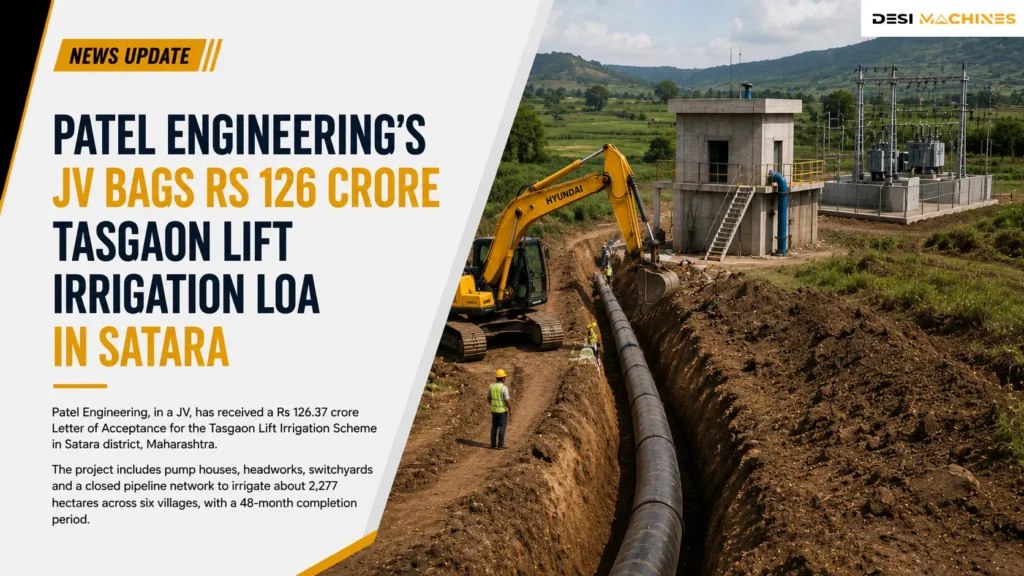
- Patel Engineering, with a JV partner, received a Rs 126.37 crore Letter of Acceptance for the Tasgaon Lift Irrigation Scheme in Satara, Maharashtra (disclosed 15 June 2026; reported by Upstox and Business Standard).
- Patel Engineering’s share is Rs 64.45 crore; the contract carries a 48-month completion period.
- Scope: pump houses, headworks, switchyards and a closed (buried) pipeline distribution network serving about 2,277 hectares across six villages in Satara Taluka.
- The JV was declared lowest bidder (L1) on 23 February 2026; the formal LoA followed on 15 June 2026.
What happened
Patel Engineering, in a joint venture, has won a Rs 126.37 crore Letter of Acceptance for the Tasgaon Lift Irrigation Scheme in Satara district, the company told the exchanges on 15 June 2026 (reported by Upstox and Business Standard). Patel Engineering’s own share is Rs 64.45 crore. The work covers pump houses, headworks, switchyards and a closed pipeline distribution network across roughly 2,277 hectares in six villages, with a 48-month build period. The JV had been named L1 back in February; the formal award came through in mid-June.
What does a lift irrigation scheme mean for equipment buyers?
A lift irrigation scheme is a different animal from a dam or a highway. Water is pumped uphill into pump houses, then pushed through long runs of buried pipe, so the equipment bill leans toward earthwork and trenching rather than heavy lifting. Expect steady demand for 20-tonne class excavators and backhoe loaders to dig pipeline trenches and pump-house foundations across a spread-out command area, plus soil compactors and rollers for backfill, and concrete equipment for the pump houses, headworks and switchyard structures. Pipe handling pulls in some light cranes and material handlers. It is a four-year job — and that horizon is the part that matters for utilisation.
For buyers and rental operators working the Satara-Pune-Sangli belt, the read is simple. Spread-out rural pipeline work favours mid-size, fuel-efficient excavators you can shift between reaches, and it rewards owning the always-busy machines while renting the peak-need kit. The wider point: Maharashtra keeps a deep pipeline of lift-irrigation and canal schemes, so this is less a one-off than a category worth tracking — the kind of repeat, milestone-paid work where a machinery loan on a 20-tonne excavator can pay for itself if you line up two or three schemes back to back.
DesiMachines view: one Rs 126 crore scheme will not move national equipment prices, but clustered lift-irrigation work in western Maharashtra typically keeps mid-size excavators, backhoe loaders and compaction kit busy, and likely firms up local rental rates once trenching starts in earnest.
What to watch:
- Subcontracting — pipeline and earthwork packages are usually sublet, and that is where machines actually get hired.
- The state’s next lift-irrigation and canal tenders, which decide whether this is steady work or a one-off.
- Monsoon timing in the Krishna basin, which sets when trenching and concreting demand peaks.
Machines, tenders and news for this industry: Irrigation and Dams

 Excavator
294 models
Excavator
294 models  Backhoe Loader
51 models
Backhoe Loader
51 models  Crane
68 models
Crane
68 models  Concrete Mixer
79 models
Concrete Mixer
79 models  Wheel Loader
54 models
Wheel Loader
54 models  Compactor / Roller
45 models
Compactor / Roller
45 models  Motor Grader
42 models
Motor Grader
42 models  Dozer
41 models
Dozer
41 models  Concrete Pump
66 models
Concrete Pump
66 models  Skid Steer Loader
11 models
Skid Steer Loader
11 models  Telehandler
13 models
Telehandler
13 models