
 Excavator
294 models
Excavator
294 models  Backhoe Loader
51 models
Backhoe Loader
51 models  Crane
68 models
Crane
68 models  Concrete Mixer
79 models
Concrete Mixer
79 models  Wheel Loader
54 models
Wheel Loader
54 models  Compactor / Roller
45 models
Compactor / Roller
45 models  Motor Grader
42 models
Motor Grader
42 models  Dozer
41 models
Dozer
41 models  Concrete Pump
66 models
Concrete Pump
66 models  Skid Steer Loader
11 models
Skid Steer Loader
11 models  Telehandler
13 models
Telehandler
13 models 


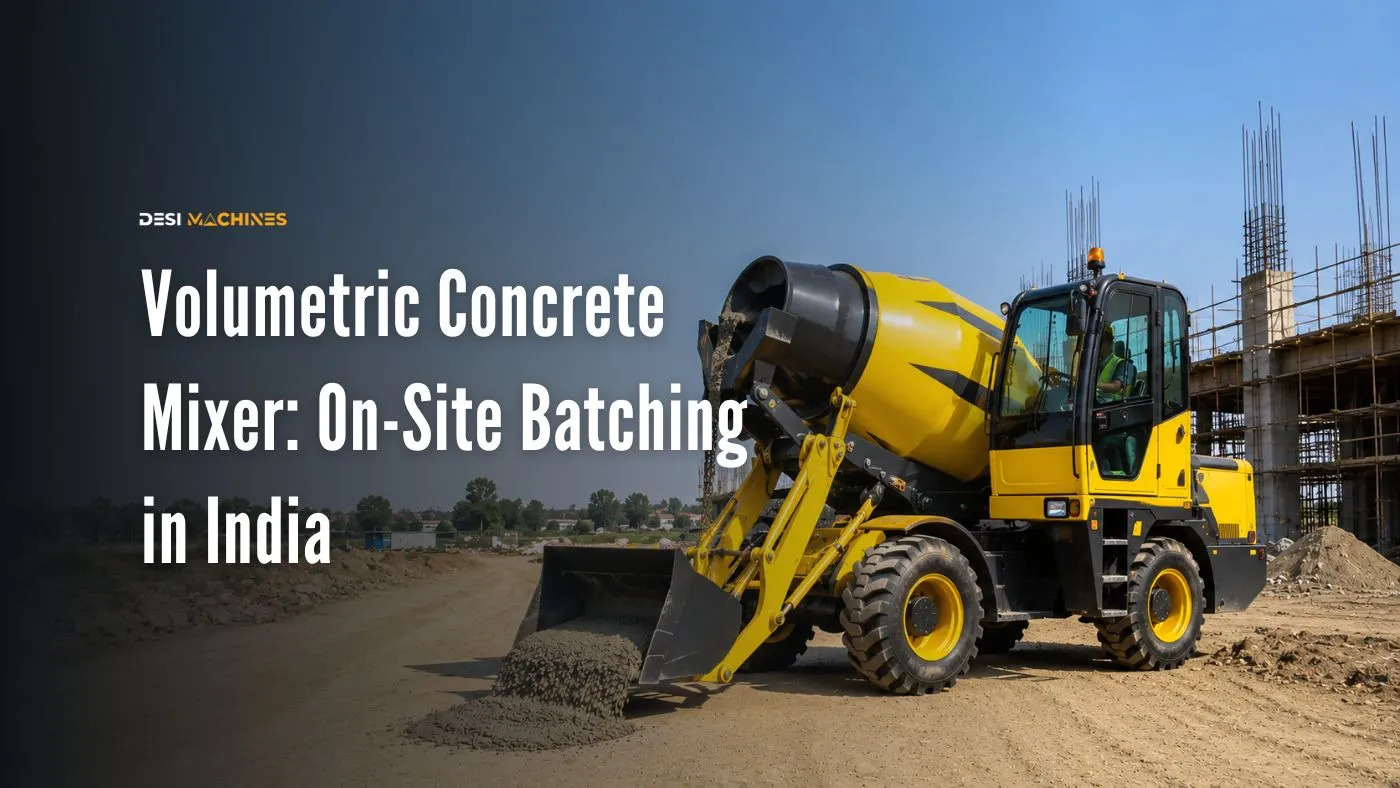
A volumetric concrete mixer is a machine that carries cement, sand, stone (aggregate) and water separately, and mixes fresh concrete right on the site, only as much as you need, when you need it. Nothing is mixed at a factory and driven to you. The machine does the batching (measuring the ingredients) and the mixing on the spot, so the concrete is always fresh. Which cement goes into that batch is a separate decision, and the guide to the best cement in India works through OPC, PPC and PSC and where each one belongs.
In India, the machine that does exactly this job (load its own material, batch it and mix on-site) is called the self-loading concrete mixer (SLCM). So when an Indian contractor talks about “on-site batching” or “site pe hi concrete banana”, he usually means a self-loading mixer. This guide explains the idea in plain language, shows how it is different from a transit mixer and a small drum mixer, and gives real India prices so you can decide if it suits your work.
What is a volumetric concrete mixer?
A volumetric concrete mixer is a mobile machine that stores the raw materials in separate compartments and mixes concrete on demand. “Volumetric” simply means it measures ingredients by volume (bucket loads and set proportions) as it goes, instead of delivering one fixed load that was mixed hours earlier.
Think of the difference like this. A ready-mix (transit) truck is like getting cooked food delivered from a restaurant, made somewhere else and to be used before it sets. A volumetric mixer is like a kitchen on wheels, where the raw material sits on the machine, and you cook only the plates you need, fresh each time. If you stop for two hours, no concrete is wasted, because you only mixed what you poured.
This “make it as you use it” idea is why these machines suit sites that pour concrete in small, spread-out lots through the day, such as a village road, a house foundation, a canal lining, or scattered footings, rather than one big continuous pour.
How does a volumetric (self-loading) mixer work?
A self-loading mixer works in four simple steps, and one operator can run the whole cycle from the driver’s seat:
- Self-loading: a front bucket scoops sand and aggregate from your stockpile into the machine, so you need no separate loader or extra labour.
- Weighing and batching: the machine measures the material (many models have a weighing system), so every batch keeps the same cement-sand-aggregate proportion.
- Mixing: a rotating drum mixes cement, sand, aggregate and water into fresh concrete, usually in a few minutes per batch.
- Driving and pouring: the same machine drives on its own four wheels to the pour point and discharges the concrete, often with a swivel drum that can turn to either side.
Because one machine loads, batches, mixes and pours, you save on a separate mixer, a separate loader, and a lot of labour. A common small machine mixes roughly 1 cubic metre (1 cum, about 2.5 tonnes of concrete) per batch; bigger machines mix more. Over a full day, a small self-loading mixer can comfortably produce enough concrete for most house and small-road jobs.
How much concrete can a self-loading mixer make in a day?
A small self-loading mixer that batches about 1 cubic metre (1 cum) at a time can realistically make roughly 25–40 cubic metres of concrete in a normal working day, and a larger machine makes more. This is an indicative figure, not a promise, because the real output depends on your site.
The reason is the cycle time. One full round of loading the material, mixing, driving to the pour point and discharging takes about 15 to 20 minutes for a small machine. That works out to three or four batches an hour, so three to four cum an hour. Over a seven to eight hour day, with breaks and travel, a small machine commonly delivers 25 to 40 cum.
Three things decide whether you land at the low end or the high end: how far the material stockpile is from the pour point (short distance means faster cycles), how ready your labour and shuttering are, and the mix you are making (a stiffer mix takes a little longer). For most house foundations, small culverts and village roads, even the low end is more than enough concrete for a day’s work.
Volumetric vs transit mixer vs drum mixer: what’s the difference?
These three are often mixed up, but they do different jobs. A volumetric (self-loading) mixer batches and mixes on-site; a transit mixer only carries ready-mixed concrete from a plant; a small drum mixer just mixes what you hand-feed it. Here is a plain comparison:
| Point | Volumetric / Self-Loading Mixer | Transit Mixer (RMC) | Small Drum Mixer |
|---|---|---|---|
| Where concrete is mixed | On your site, freshly | At an RMC plant, then delivered | On site, but you feed it by hand |
| Batching | Machine measures and mixes | Fixed load, already mixed | No batching; manual proportions |
| Loads its own material | Yes, own bucket | No | No, filled by labour |
| Best for | Small, scattered daily pours | Large, continuous pours | Very small jobs, tight budgets |
| Typical output | Batches of about 1 cum and up | 6–9 cum per trip | A few bags at a time |
| Waste risk | Low; you mix only what you pour | Higher; must use before it sets | Low, but slow |
To read more on how ready-mix delivery machines work, see our guide on concrete mixer trucks (transit mixers), and for the full family of machines see concrete mixer types.
Which machine does on-site batching in India? The self-loading mixer
In the Indian market, the self-loading concrete mixer is the practical face of the volumetric idea. It is popular because our sites are often small, spread out, and far from a ready-mix (RMC) plant. A self-loading mixer lets a contractor carry his own concrete-making machine to the site and pour fresh concrete without depending on delivery trucks.
Well-known machines you will see on Indian sites include the Ajax Argo series, Schwing Stetter SLM range, Conmat CSLM, Macons MST, Apollo Carmix, Universal, John, Tarle, Venus and Bull. These come in two broad drum sizes: a smaller class that mixes about 1 cubic metre (1 cum) per batch, and a larger class that mixes closer to 4 cubic metres. You can see the full range and live prices on our self-loading concrete mixers page.
Foreign names like “volumetric mixer” or brands built for Western sites are useful to know as background, but for buying in India the sensible choice is a self-loading mixer that has a local dealer and easy spare parts. That is what keeps the machine running through the year.
See our full range of self-loading concrete mixers with prices »
Is a self-loading (volumetric) mixer worth it for a small contractor?
For many small and mid-size contractors, yes, but not for every job. The machine earns its keep when you pour concrete in small amounts through the day, at many points, and want fresh concrete each time without booking a big RMC delivery.
Where a self-loading mixer helps:
- Freshness and no waste: you mix only what you pour, so nothing sets and goes to waste.
- Less labour and fewer machines: one operator, one machine, with no separate loader and no gang of mixing labour.
- Reach: it drives on its own wheels into narrow lanes and rough village sites where a big transit truck cannot go.
- Rental income: many owners rent the machine out by the day when their own work is slow.
Where a transit mixer or RMC is the better choice: one large continuous pour, like a full slab or a bridge deck, where you need many cubic metres in a few hours. For that, ready-mix delivery is faster and cheaper per cum. Our transit mixer guide explains when to go that way, and you can compare both on the concrete mixer archive.
What does a self-loading concrete mixer cost in India?
A self-loading concrete mixer in India costs roughly ₹27–52 Lakh (indicative, ex-showroom, as of July 2026), depending on drum size and brand. The smaller 1 cum class is the popular starting point for most contractors; the 4 cum class is for bigger, steadier work. Here is an indicative band from machines listed on our own site:
| Class | Batch size | Indicative price (ex-showroom, Jul 2026) | Example models on our site |
|---|---|---|---|
| Small drum class | About 1 cum (~2.5 tonnes) per batch | ₹27–35 Lakh | Universal SLM-2, Schwing Stetter SLM 2100, Conmat CSLM 2800, Ajax Argo 2000/2500 |
| Large drum class | Around 4 cum per batch | ₹38–52 Lakh | Ajax Argo 3000/4800, Conmat CSLM 4300, John SLCM 4.3, Fiori DBS 4300 |
These are indicative ranges to help you plan a budget; the on-road figure changes with variant, dealer, state taxes and the month. Always confirm the live price with our team before you decide. Where a machine is not listed with a price on our site, treat it as price-on-request.
Most contractors do not pay the full amount upfront. A self-loading mixer is usually bought on a loan (EMI), where you put down a part and pay the rest monthly, ideally from the machine’s own earnings. If you are weighing the monthly cost against your daily concrete work, our construction equipment finance section explains how loan and EMI options work for machines like this. For a brand-by-brand look, our older write-up on the best self-loading concrete mixer brands in India is a good next read, and the broad concrete equipment guide puts mixers, pumps and batching together in one place.
Disclaimer: Prices, specifications and features are indicative, vary by variant, location and date, and should always be confirmed with the official OEM or authorised dealer before any purchase decision. DesiMachines is not liable for decisions taken on the basis of information that may have changed after publication.
Machines, tenders and news for this industry: Ready-Mix Concrete