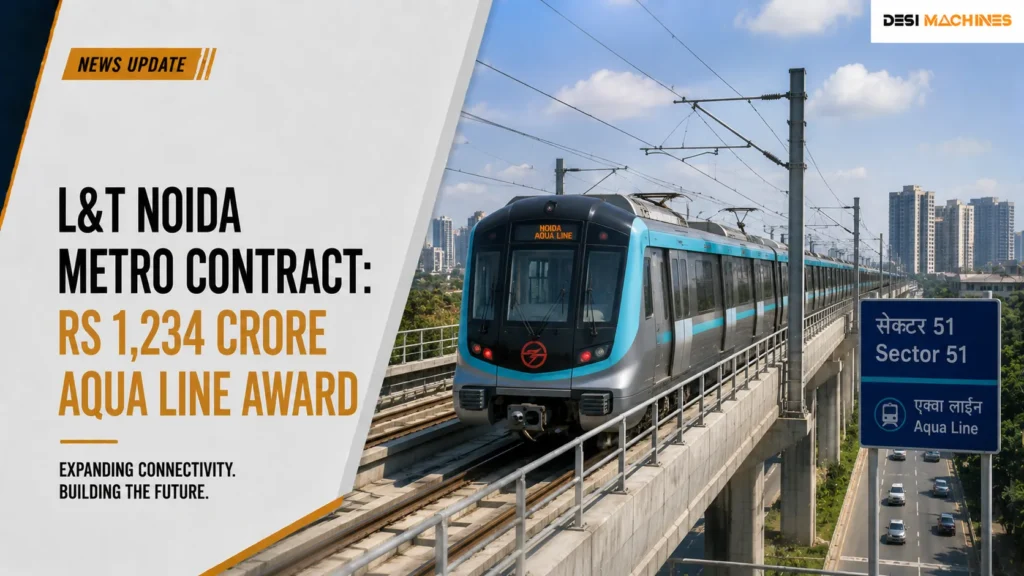
Noida Metro Rail Corporation has handed Larsen & Toubro the civil package for both Aqua Line extensions: the elevated viaduct plus 10 elevated stations, for Rs 1,234 crore. For fleet owners in western Uttar Pradesh the contract value is not the useful number. The three-year build window and the seven-name bidder list are.
The quick facts
- NMRC has awarded L&T the design-and-construction package for the elevated viaduct and 10 elevated stations on the Aqua Line extensions, valued at Rs 1,234 crore.
- L&T bid about 2.6 per cent under NMRC’s Rs 1,267 crore estimate and finished L1 in a field of seven qualified bidders.
- Scope spans Botanical Garden to Sector 142 (11.56 km elevated, eight stations) and the Greater Noida depot to Boraki (roughly 2.6 km, two stations) feeding the planned Boraki multimodal hub.
- Completion period: 1,096 days, so a little over three years from the appointed date.
What NMRC awarded
Metro Rail News reported the award on Friday, days after the bid opening put L&T at the top of the table. The order behind it is worth reading, because it is a map of who is hunting civil work in the National Capital Region: Rail Vikas Nigam at L2, Cemindia Projects L3, J Kumar Infraprojects L4, Dilip Buildcon L5, Afcons Infrastructure L6 and KEC International L7. Two more firms were rejected at the technical stage. Nine serious bids on one metro package is a crowded tender by any reading.
What it means for equipment buyers
Both corridors are elevated, which settles the fleet question before anyone tenders a sub-package. There is no tunnel boring machine in this job. What 14-odd kilometres of viaduct and ten stations pull is a piling-led fleet: hydraulic rotary rigs sinking bored cast-in-situ piles under every pier and station, crawler cranes dropping reinforcement cages and later handling segments or girders, a casting yard running batching plants with transit mixers and boom pumps, backhoe loaders on pile caps and utility diversion, tippers shifting spoil, and small tandem rollers restoring the road afterwards. Mid-size excavators work the pier foundations and drainage, not a mass-earthwork front.
Our take: temper the demand read. L&T owns a deep plant fleet of its own, so a package this size converts into less open hire demand than the headline suggests. The pull-through for outside owners sits in subcontracted pile boring, the casting yard, utility diversion under a congested Noida alignment, and aggregate and ready-mix supply. And a bid 2.6 per cent below the client’s own estimate is a tight bid. Tight bids get recovered downstream, so price sub-contract work on realistic utilisation rather than on the headline crore.
The losing side may matter more to hire rates. RVNL, J Kumar, Dilip Buildcon, Afcons and KEC all built bid teams for this work and did not get it. That plant is still looking for a home, and in Uttar Pradesh that usually shows up as softer rates around Noida and Ghaziabad well before it shows up in a national number.
What to watch
- The signed agreement and appointed date. Pile boring rarely begins before casting-yard land is actually handed over.
- Whether L&T runs one casting yard or two, given the two corridors sit far apart on the map.
- The station finishing and systems packages, tendered separately later, which pull a different fleet: small cranes, hoists and aerial work platforms.
Pricing a machine for a metro package? Compare piling-support and concreting fleets on DesiMachines, then check what the EMI actually looks like before you commit. Start with our equipment finance hub.
FAQ
Which machines does an elevated metro viaduct need most?
Hydraulic rotary piling rigs, crawler cranes, batching plants with transit mixers and boom pumps, backhoe loaders for pile caps and utility work, tippers, and light compaction for road restoration. No tunnel boring machine, because the alignment is above ground.
When would equipment demand actually start on this contract?
After the agreement is signed and the appointed date is set. The first visible wave is casting-yard set-up and pile boring, which typically follows within a quarter or two rather than immediately.
Is Rs 1,234 crore the whole project cost?
No. That is the civil package for the viaduct and stations. Track laying, rolling stock, signalling and station systems are procured separately, so the project cost sanctioned for these corridors is higher.
Related on DesiMachines: Afcons wins a Rs 1,918 crore Mumbai desalinated water tunnel order
Source: Metro Rail News

 Excavator
294 models
Excavator
294 models  Backhoe Loader
51 models
Backhoe Loader
51 models  Crane
68 models
Crane
68 models  Concrete Mixer
79 models
Concrete Mixer
79 models  Wheel Loader
54 models
Wheel Loader
54 models  Compactor / Roller
45 models
Compactor / Roller
45 models  Motor Grader
42 models
Motor Grader
42 models  Concrete Pump
66 models
Concrete Pump
66 models  Skid Steer Loader
11 models
Skid Steer Loader
11 models  Telehandler
13 models
Telehandler
13 models  Dozer
Dozer