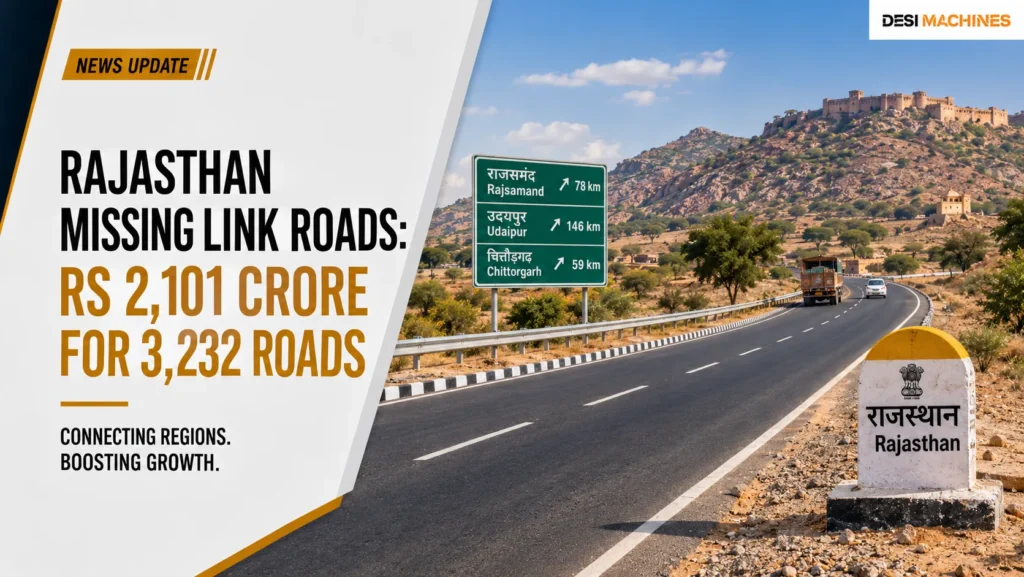
Rajasthan has sanctioned Rs 2,101 crore to build 3,232 non-patchable and missing-link roads running to 6,418 km. Divide those figures and the buyer story falls out on its own: roughly Rs 33 lakh a kilometre, across packages averaging just under two kilometres each. That is renewal and rural-link work headed to hundreds of small contractors, and it pulls a very different set of machines from the headline crore figure.
The quick facts
- Administrative and financial sanction issued on 5 August 2026 for 3,232 non-patchable and missing-link roads across Rajasthan.
- Rs 2,101 crore covering 6,418.43 km, spread across 187 assembly constituencies; the Public Works Department will execute.
- The works implement an announcement made in the state’s 2026-27 budget.
- Jaipur Rural’s 17 constituencies alone take 269 roads over 379 km at Rs 185.24 crore.
What Rajasthan sanctioned
The approval was reported on 5 August by Pratahkal’s Jaipur bureau and by Khaskhabar, and picked up the following day by Business Standard, which added a district example: 54 roads totalling 145.95 km across three constituencies in Balotra. Carriers put the outlay at Rs 2,101.15 crore and Rs 2,101.16 crore, so we are using the rounded Rs 2,101 crore all of them agree on. This is a sanction, not a contract award; the PWD divisions still have to tender the work.
What does Rs 33 lakh a kilometre actually buy?
Run the division before believing any road headline. Rs 2,101 crore over 6,418.43 km works out at about Rs 32.7 lakh per km. Widening-and-strengthening jobs in this country typically price at Rs 5 crore to Rs 6 crore a km, and greenfield runs far higher. At a fifteenth of that, this is work on existing formation: side drains and shoulders, a granular sub-base and wet-mix layer, a thin bituminous surface, and small culverts where a link is genuinely missing. There is no mass earthmoving in it.
What it means for buyers
Compaction, not excavation, is where most of the value sits. Soil compactors and tandem rollers get the heaviest utilisation, because layer control is essentially the whole job at this cost level. Motor graders follow, trimming granular layers over thousands of short stretches. Backhoe loaders do the drains, shoulders, culvert pits and utility work, tippers handle haulage from quarries and mixing plants, and small mechanical pavers finish the surface. A 20-tonne class excavator has very little to do here.
The package count matters more than the total. Averaged out, each of the 3,232 works is about Rs 65 lakh and under two km long, which puts them squarely with small PWD-registered contractors rather than large EPC firms. The mix does vary by district: Jaipur Rural’s slice prices nearer Rs 49 lakh per km, while the Balotra example works out closer to Rs 24 lakh per km, which reads as almost pure resurfacing.
Our take: we would not read this as a new-machine order pipeline. A contractor holding a Rs 65 lakh package cannot amortise a new grader against it, so the pull most likely lands on the rental market and on second-hand iron, particularly backhoe loaders and rollers of the kind JCB, ACE and Escorts Kubota already sell most of into this segment (those three took the largest shares of July’s wheeled construction equipment retail). Fleet owners around Jaipur, Balotra and the western districts have a reasonable case for adding hire units before tenders drop. Buying new against a single package would be premature.
What to watch
- When the PWD divisions actually float the tenders, and whether the works get bundled into larger packages or stay as single-road contracts.
- Rajasthan’s road season effectively begins once the monsoon clears, so real mobilisation is more likely from October than from August.
- Compactor and grader hire rates in the affected districts, which are the first place a programme of this shape shows up.
FAQ
What is a non-patchable road?
It is a public works term for a road that has deteriorated past the point where patch repair is worth doing, so the surface and often the granular layers below it have to be rebuilt rather than mended.
Which machines does this sanction actually pull?
Mostly soil compactors and tandem rollers, motor graders, backhoe loaders, tippers and small pavers. The cost per kilometre is far too low for mass earthmoving, so large excavators are not the machine class this work needs.
When can contractors expect the tenders?
The state has issued the sanction, not the contracts. Tendering runs through PWD divisions across the 187 constituencies, and work in Rajasthan generally picks up after the monsoon.
Related on DesiMachines: Odisha Rural Road Projects 2026: Rs 32,067 Crore Approved
Source: Pratahkal

 Excavator
294 models
Excavator
294 models  Backhoe Loader
51 models
Backhoe Loader
51 models  Crane
68 models
Crane
68 models  Concrete Mixer
79 models
Concrete Mixer
79 models  Wheel Loader
54 models
Wheel Loader
54 models  Compactor / Roller
45 models
Compactor / Roller
45 models  Motor Grader
42 models
Motor Grader
42 models  Concrete Pump
66 models
Concrete Pump
66 models  Skid Steer Loader
11 models
Skid Steer Loader
11 models  Telehandler
13 models
Telehandler
13 models