
 Excavator
294 models
Excavator
294 models  Backhoe Loader
51 models
Backhoe Loader
51 models  Crane
68 models
Crane
68 models  Concrete Mixer
79 models
Concrete Mixer
79 models  Wheel Loader
54 models
Wheel Loader
54 models  Compactor / Roller
45 models
Compactor / Roller
45 models  Motor Grader
42 models
Motor Grader
42 models 
 Concrete Pump
66 models
Concrete Pump
66 models  Skid Steer Loader
11 models
Skid Steer Loader
11 models 


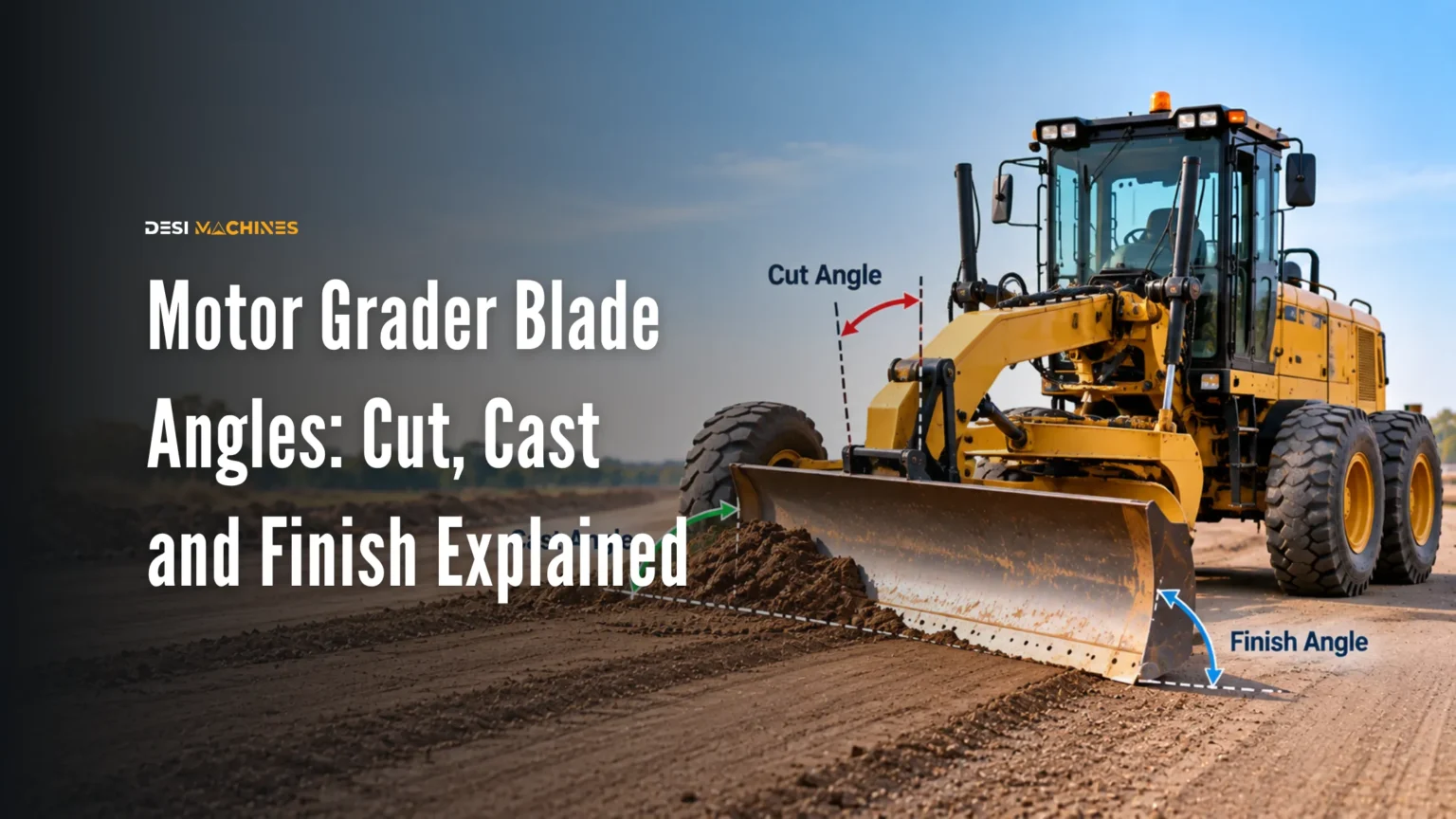
A motor grader blade angle is the setting the operator gives the moldboard so that soil behaves the way the job needs. There are three separate angles, and mixing them up is the most common reason a new operator cannot get a road to finish flat. The blade angle is how far the blade is swung across the machine, and it decides whether soil is pushed ahead or rolled sideways. The pitch angle is how far the blade is tipped forward or back, and it decides whether the blade cuts hard or floats and finishes. The tilt is one end lifted higher than the other, and it cuts the camber and the drain slope.
This guide explains what each angle does, when to use it, and what the machines actually publish. The figures come from the 42 motor graders listed on DesiMachines, of which 29 publish a blade pitch angle in their specifications.
What are the three blade angles on a motor grader?
They are three different movements of the same moldboard, and each one is set by a different control. A grader’s blade can move in six ways in all, which is set out in the guide to how a motor grader works. Three of those six are angles, and they are the ones that decide the finish.
| Angle | What moves | What it controls | What the machines publish |
|---|---|---|---|
| Blade angle (plan view) | The circle swings the blade left or right across the machine | Whether soil is pushed straight ahead or rolls along the blade and off the end into a windrow | Set by circle rotation, which is a full 360° on a modern grader; the angle itself is an operator setting, not a fixed spec figure |
| Pitch angle (side view) | The top of the blade tips forward or back | How aggressively the cutting edge bites: forward pitch cuts and mixes, backward pitch floats and finishes | Published by 29 of the 42 graders we list. The common setting is 40° forward and 5° backward |
| Tilt or lean (front view) | One end of the blade is raised above the other | The cross-slope, so the camber of a road and the fall of a side drain | Comes from lifting the two blade ends independently; the cutting depth range behind it is published by 35 of the 42 |
Get these three straight and the rest of grading is practice. Get them mixed up and you will spend the afternoon pushing a heap of soil around instead of finishing the layer.
What blade angle should you use for cutting, casting and finishing?
The rule is simple: the more the blade is swung across the machine, the faster soil leaves the blade sideways, and the less it piles up in front. Grading work sorts into three jobs, and each wants a different amount of swing.
Cutting. The blade is set closer to square across the machine so it takes a bite and holds material against it. This is virgin ground, a hard shoulder, or a first pass through a stiff layer. The machine works hard, the engine loads up, and soil builds in front of the blade.
Casting, which is what most road grading actually is. The blade is swung well across so material rolls along the face and rolls off the trailing end into a windrow, a long ridge running down the road. This is how a grader moves soil sideways without stopping. Less material builds in front, so the machine pulls easier and travels faster.
Finishing. The blade is swung only slightly, carries almost no material, and simply shaves the high spots off to leave a flat surface. This is the pass before the roller comes in, and it is the one that decides whether the surface accepts compaction evenly.
Notice what changes with the swing: cutting depth, how much load goes through the machine, and how far the material travels sideways in one pass. That last one is what determines how many passes a job takes, which is worked out in motor grader productivity and output.
Choosing a grader? Compare live motor grader models and blade sizes and connect with a dealer.
What is blade pitch on a motor grader, and what should it be set to?
Pitch is the forward or backward lean of the blade seen from the side, and unlike the swing angle it is a figure the manufacturers actually publish. Pitching the top of the blade forward pushes the cutting edge into the ground and makes it bite. Pitching it back lets the edge ride and shave rather than dig.
Across the 29 machines that publish it, 24 give a forward and backward pair, and the industry has converged on one setting more than any other.
| Published blade pitch angle | Machines | Examples from our listings |
|---|---|---|
| 40° forward, 5° backward | 16 of 29 | Cat 120, Komatsu GD555, Mahindra Roadmaster G90, SANY SMG200C-8, Cat 16M3 |
| 45° to 53° forward, 3° to 7° backward | 5 of 29 | Komatsu GD955-7 at 53° forward and 3° back; Komatsu GD705-5 and GD755-5R at 45° forward and 7° back; BEML BG825 at 49° forward |
| 35° to 40° forward, 0° to 3° backward | 3 of 29 | Fine FMG 130 at 35° forward; Komatsu GD535-6 at 40° forward and 3° back; Cat 24M at 40° forward and no backward pitch published |
| A single figure or a range, measured a different way | 5 of 29 | Three SDLG machines publish 90°, ACE AG 176 publishes 42°, and Shantui SG15-G publishes a 22° to 73° range. These are not the same measurement as the forward-and-back pair, so do not read them against it |
Two things to take from that table. First, if a machine’s sheet says “40° forward, 5° backward” it is the ordinary industry setting and there is nothing unusual about the machine. Second, a specification sheet can measure the same property in two ways, so compare a pitch figure only against another figure published the same way. That trap runs through most spec comparisons and is covered more generally in the motor grader buying guide.
In practice an operator uses only a small part of that published range. Forward pitch for the cutting pass, near-neutral for casting, and a touch of backward pitch for the finish pass so the edge shaves instead of digging in.
How does the blade tilt cut a road camber?
By lifting one end of the blade higher than the other, so the pass leaves the middle of the road higher than the edges. That fall is the camber, and it is the only reason rainwater leaves the surface instead of soaking into the layers under it. On a curve the blade holds one tilt across the whole width instead, to build the bank explained in the guide to superelevation in road design. How much fall each type of road needs, from 2 per cent on a concrete road to 5 per cent on an earth road in a wet district, is set out in the guide to camber in road construction.
The two blade ends are raised and lowered by separate hydraulic cylinders, which is what allows the tilt in the first place. How deep the blade can go and how high it can lift are the figures that set the limits of that movement, and both are published: maximum cutting depth on 35 of the 42 machines we list, and maximum lift above ground on 40 of 42. Those spans by size class are in the guide to motor grader cutting depth and blade reach.
For drain and ditch work the blade goes further, rotating past the wheel line so it can cut a bank. Two published figures matter there. Moldboard side shift is how far the blade slides left or right of centre, published by 27 machines and running from 510 mm to 1,524 mm on the road-class machines. Maximum shoulder reach is how far the blade can work beyond the wheels, published by 24 machines, from 489.5 mm on the Mahindra Roadmaster class up to 3,228 mm on the largest mining graders. If your work includes side drains, that second figure is worth checking before you buy, because it decides whether the wheels have to leave the road surface.
Does blade length change what angles you can use?
Yes, and it is the figure that quietly limits everything else. All 42 graders on our lists publish a blade length, and the span is wide: from 2,600 mm on the smallest Mahindra machines to 7,300 mm on the Cat 24M, with a median of 3,660 mm.
A longer blade covers more width in one pass, but swinging it across the machine costs width fast. Swing a blade hard and its effective cutting width shrinks, because you are presenting it at an angle to the direction of travel. On a narrow rural road a 3,000 mm blade swung for casting may leave you covering barely two metres per pass, which is why a small grader on a village road takes more passes than the arithmetic suggests.
Articulation gives some of that width back. Most of our listings publish a steering angle, and 25 of the 35 that do give either 45° or 50°. Bending the machine at the middle lets the rear wheels run on firm ground while the blade works out at the edge, which matters on soft shoulders and freshly laid material.
Blade length also tracks machine size, so the choice is really a size-class choice. The weights and dimensions behind that are in motor grader weight and dimensions, and the job-by-job picture is in motor grader applications.
What goes wrong when the angles are set badly?
Four failures cover almost everything a new operator runs into.
Soil piles up in front of the blade and the machine bogs. The blade is too square across the machine for the amount of material being cut. Swing it further so the soil rolls off the end instead of building.
The surface comes out wavy. Usually too much forward pitch on the finish pass, so the edge digs in and out instead of shaving. Ease the pitch back and take a lighter cut.
Water stands on the finished road. The tilt was not enough, or it was lost during the last pass. A road that looks flat is a road that will hold water, and standing water is what destroys a new surface before traffic even does.
The windrow ends up in the wrong place. The blade was swung the wrong way for the direction of travel, so material is being cast towards the centre when it should go to the shoulder, or the reverse. Plan which side the windrow needs to end on before starting the pass.
None of these are machine faults, which is worth saying plainly, because they are often reported as one. Genuine hydraulic problems show up as a blade that will not hold its setting under load rather than as a poor finish.
How do you confirm the angles for your own machine?
Read the machine’s own specification sheet, not a class average. Blade pitch, side shift, shoulder reach and cutting depth all vary by model, and 13 of the 42 graders we list publish no pitch figure at all, so the sheet may simply not carry it.
Three checks are worth doing before you commit to a machine. Ask for the pitch range in the forward-and-back form, so you can compare it against the 40° and 5° that most machines publish. Ask for the shoulder reach if drains are part of your work. And confirm the blade length against the width of the roads you actually build, because that is the number that sets your pass count.
If you are buying used, check that the blade still holds its angle setting under load and that the circle turns smoothly through its full rotation, since worn circle teeth are an expensive repair. The wider used-machine checklist is in the used motor grader buying guide.
Motor grader blade angles, in short
A motor grader blade angle is really three settings. Swing the blade across the machine to control whether soil is pushed ahead or cast sideways into a windrow: close to square for cutting, well across for casting, barely swung for the finish pass. Pitch the blade forward to bite and back to shave; 16 of the 29 graders we list that publish a pitch figure give 40° forward and 5° backward, and the rest sit between 35° and 53° forward. Tilt one end above the other to cut the camber that carries water off the road.
The published figures worth checking before you buy are blade length (2,600 mm to 7,300 mm across our listings), maximum cutting depth, moldboard side shift and shoulder reach. Compare live motor graders and the rollers that follow them, or start from the complete guide to motor graders in India.
Read next: Motor grader cutting depth and blade reach and motor grader vs bulldozer. For where the grader sits in the sequence of a road job, see road construction equipment in India.
Specification figures in this guide are taken from the machine listings on DesiMachines as of September 2026, and coverage counts state how many of the 42 listed motor graders publish each figure. Prices, specifications and features are indicative, vary by variant, location and date, and should always be confirmed with the official OEM or authorised dealer before any purchase decision. DesiMachines is not liable for decisions taken on the basis of information that may have changed after publication.