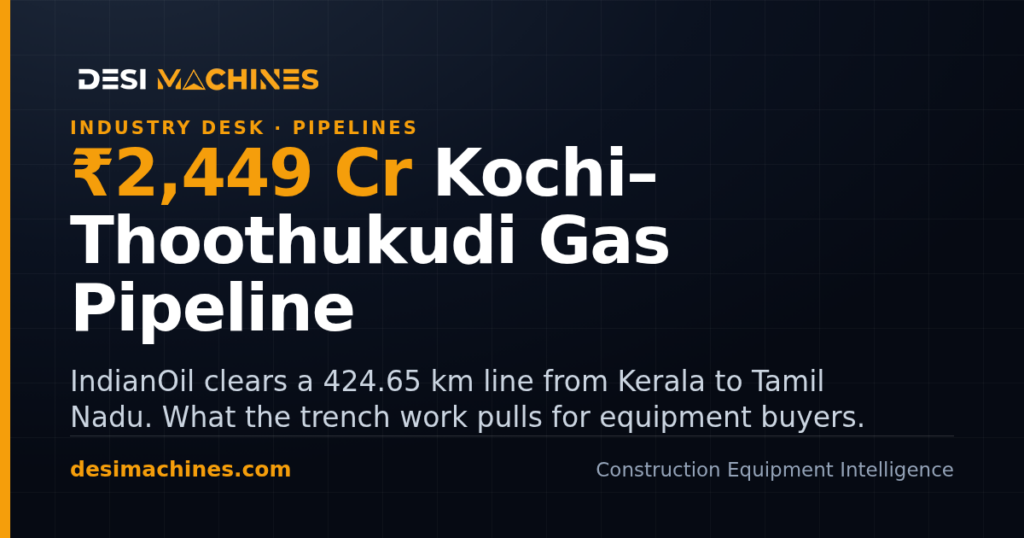
IndianOil has put a sanctioned number behind a 425 km gas line running from Kerala into southern Tamil Nadu. For anyone who owns or hires earthmoving iron, the interesting part is not the pipe. It is the trench, where the trench goes, and how long the work front stays in one place.
The quick facts
- Rs 2,448.70 crore approved at IndianOil’s board meeting on 21 September 2026 for the Kochi-Kanyakumari-Thoothukudi Natural Gas Pipeline.
- 424.65 km, running from the Kochi LNG terminal in Kerala to Thoothukudi in Tamil Nadu via Kanyakumari.
- 6.84 MMSCMD design capacity, including a minimum common carrier capacity of 1.71 MMSCMD booked for third parties.
- PNGRB authorised IndianOil for this route on 17 April 2026 after competitive bidding. No construction schedule, commissioning date or contractor has been disclosed.
What IndianOil approved
The board cleared the investment on 21 September. The line will move regasified LNG out of the Kochi terminal to demand centres across Kerala and southern Tamil Nadu. GKToday and EquityPandit, among the desks that carried the filing, print the same cost, length and capacity figures. The regulatory half was settled months earlier, when the petroleum regulator authorised IndianOil in April following a bid process. What changed this week is that the route now has money attached to it.
What does Rs 5.77 crore a km actually buy?
Divide the sanction by the route and you get Rs 5.77 crore per km. Do not read that as a machine-demand rate. On a cross-country gas line most of the value sits in line pipe, coating, valves, metering, SCADA and the terminal and station equipment at either end. Trenching, lowering-in, backfill and right-of-way restoration are a minority share of the total. A Rs 2,449 crore pipeline pulls a good deal less iron than a Rs 2,449 crore road package would, and saying so is more useful than pretending otherwise.
What it means for buyers
What the job does pull is a spread: a moving work front that advances along the route and then leaves. Crawler excavators in the 20-tonne class cut the trench. Backhoe loaders do the crossings, tie-ins and valve station pits, which is most of the fiddly work on any buried line. Compactors and tippers handle padding, backfill and putting the corridor back. Cranes work the terminal and station sites rather than the route itself.
The two halves of this alignment are not one job. The Kerala leg is wet, densely settled and narrow on right of way, which caps machine size and pushes more of the crossings to trenchless methods. The Tamil Nadu leg south of Kanyakumari is drier and more open, which favours conventional open-cut and longer daily spread runs. Two fleets, one contract.
Our take: this is a utilisation story, not a purchase story. A spread works hard while it is in front of you and then moves 40 km down the line. That economics favours hiring the excavator, backhoe and compaction classes rather than buying against a single job, and the specialist lowering-in kit tends to sit with the spread contractor already. The one number worth watching is the 1.71 MMSCMD common carrier share, because capacity reserved for third parties points at city gas and industrial offtake along the corridor, and that follow-on work is street trenching, which is backhoe-loader country.
What to watch
- IndianOil floating the EPC or spread packages. The board approval is the money stage; the tender is the stage that reaches contractors.
- Any disclosed construction schedule or commissioning date, since none exists on the record yet.
- City gas distribution awards along the Kerala and southern Tamil Nadu corridor, which is where the small-machine work will land.
Planning for a project like this? Compare excavator and backhoe loader options on DesiMachines, or check equipment finance before you commit to a machine ahead of the tender stage.
FAQ
Has any contractor been named for the Kochi-Thoothukudi pipeline?
No. IndianOil’s announcement carried the cost, length and capacity but no contractor, no construction schedule and no commissioning date. Those come at the tender stage.
Why does a Rs 2,449 crore pipeline need fewer machines than a road of the same value?
Because the spend profile is different. Line pipe, coating, valves and station equipment take most of the budget on a gas line, while a road package spends far more of its value on earthwork, structures and pavement, all of which are machine hours.
Which machine classes does a buried gas pipeline actually use?
Mainly 20-tonne class crawler excavators for trenching, backhoe loaders for crossings and valve pits, compactors and tippers for backfill and restoration, and cranes at the terminal and station sites.
Related on DesiMachines: Dilip Buildcon LPG Pipeline Project: Rs 1,800 Crore LOI from PNGRB
Source: GKToday

 Excavator
294 models
Excavator
294 models  Backhoe Loader
51 models
Backhoe Loader
51 models  Crane
68 models
Crane
68 models  Concrete Mixer
79 models
Concrete Mixer
79 models  Wheel Loader
54 models
Wheel Loader
54 models  Compactor / Roller
45 models
Compactor / Roller
45 models  Motor Grader
42 models
Motor Grader
42 models  Concrete Pump
66 models
Concrete Pump
66 models  Skid Steer Loader
11 models
Skid Steer Loader
11 models  Telehandler
13 models
Telehandler
13 models  Dozer
Dozer