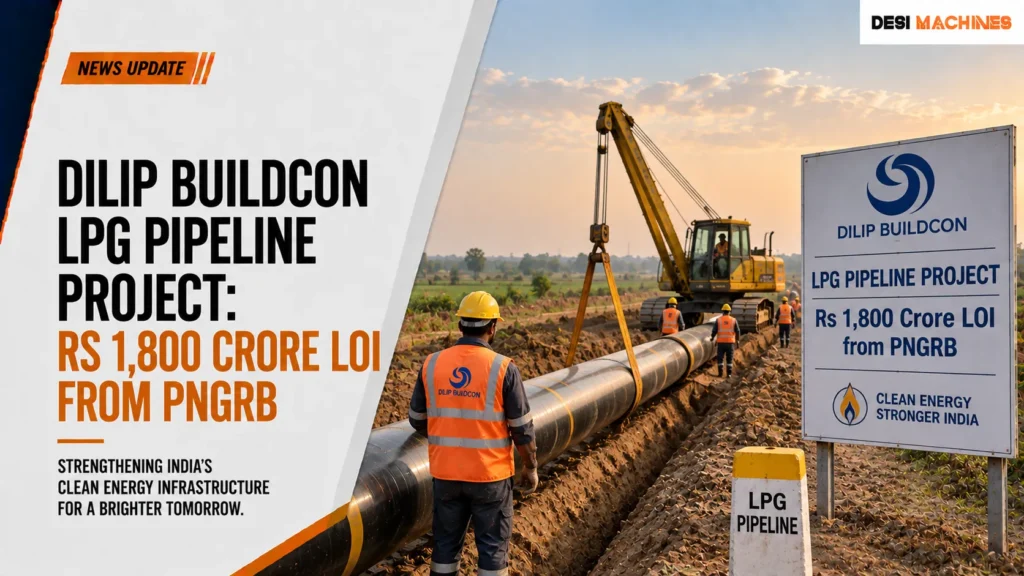
Dilip Buildcon has been picked to build and then run an LPG pipeline from Paradip in Odisha to Raipur in Chhattisgarh, with a construction slice worth about Rs 1,800 crore excluding GST. For anyone who owns or hires earthmoving iron in eastern India, the headline number is not the useful part. What matters is how much of it turns into machine hours, and where the spread will sit for the next three years.
Update, 7 October 2026: the regulator has now issued the formal grant of authorisation, four weeks after the letter of intent. Dilip Buildcon disclosed it on the morning of 7 October and Upstox and EquityPandit both carried it. Route length, pipe diameter and capacity are still unpublished.
The quick facts
- The Petroleum and Natural Gas Regulatory Board issued Dilip Buildcon a letter of intent on 9 September and the formal grant of authorisation on 7 October for an LPG pipeline between Paradip in Odisha and Raipur in Chhattisgarh.
- The engineering, procurement and construction opportunity is put at roughly Rs 1,800 crore excluding GST (company-stated).
- The work sits in a special purpose vehicle in which Dilip Buildcon holds 100 per cent equity.
- Execution period 36 months, then a 25-year operating period as a common carrier earning the pipeline transportation tariff.
What Dilip Buildcon disclosed
The first disclosure reached the wires late on 9 September and was carried by Business Today and a row of market desks the next morning. It names the regulator as the awarding body, puts the Rs 1,800 crore on the EPC opportunity excluding GST, and describes the scope as design, finance, development, construction, operation and maintenance. The 7 October filing adds the operating model: the line will carry LPG to oil marketing companies’ bottling plants in place of road tankers, eligible users can book capacity on it, and Dilip Buildcon will not buy, trade or sell LPG itself. No pipeline length, diameter or route map has been published. One carrier attached a length of 470 circuit kilometres to the pipeline in September; that figure belongs to a Karnataka power transmission asset, and circuit kilometres is a transmission unit anyway. We have left the length out.
What does a fuel pipeline actually pull?
A cross-country liquid pipeline is a linear earthwork job, not a plant job. The right-of-use corridor is cleared and graded by dozers and 20-tonne class tracked excavators; the trench is cut behind them, with breakers where the ground turns hard. Pipe is strung and lowered by side-boom pipelayers and pipe-handling cranes, then padded and backfilled by rollers and compactors. Road, rail and river crossings go in by horizontal directional drilling, with backhoe loaders digging the approach pits. Pump stations and the receipt terminal at either end are ordinary civil sites: piling, batching, lifting.
What it means for buyers
Set expectations against the money, though. On a fuel pipeline the larger share of capital goes into line pipe, coating, pumps, valves and instrumentation. Construction plant works a minority of Rs 1,800 crore, and nobody has published the split, so do not model this as an Rs 1,800 crore earthmoving job.
The ownership structure matters more than most buyers will notice. Dilip Buildcon is its own client here, holding all the equity in the SPV, and it runs one of the larger owned fleets in Indian road building. Open-hire pull-through from a self-executed job is thinner than a third-party award of the same value would give you. What does open up is spread-level subcontracting: trenching, backfill and reinstatement gangs taken on locally along the corridor, plus the crossing works.
Our take: the regional stacking is the real signal. Since late August this desk has logged four separate commitments landing in Odisha alone: four-laning packages awarded to Ashribad Engineering, a Rs 15,948.70 crore state transmission sanction, a Rs 8,653.04 crore deep borewell scheme, and now a pipeline spread starting at Paradip. They pull different machine classes, but they compete for the same operators, low-beds and workshop capacity. Hire rates in coastal Odisha have more reason to firm than to soften through 2027.
On timing, the qualifying word has moved. The authorisation closes the regulator’s side, but it is not an appointed date, and neither filing says when the 36-month execution period starts counting. Right-of-use land across two states is usually the slow part. Expect survey and corridor work before any trenching fleet, and treat main mobilisation as a 2027 question.
What to watch
- SPV incorporation and a stated start date for the 36-month execution period. That is the point at which mobilisation becomes forecastable.
- A published route length and pipe diameter. Both set trench volume, and therefore how many excavators the spread genuinely needs.
- Crossing counts along the Mahanadi belt and the Odisha to Chhattisgarh rail corridor. Every drilled crossing is a separate small mobilisation with its own hire window.
Planning for eastern India work? Compare excavator and compactor models by class and weight on DesiMachines, and check what is already out to bid on our opportunities desk before you commit to a purchase.
FAQ
Does an LPG pipeline need the same machines as a road project?
Partly. The trench and backfill work uses the same excavators, backhoe loaders and rollers. What is different is the pipe handling, which needs side-boom pipelayers, and the crossings, which need drilling rigs rather than a paving train.
How long is the Paradip to Raipur LPG pipeline?
It has not been disclosed. No route length, diameter or alignment map has been published with the letter of intent or the 7 October authorisation, and we have not carried a figure that was not stated.
When would equipment be needed on this job?
Not this quarter. The formal authorisation came on 7 October, but no start date for the 36-month execution period has been stated and right-of-use land still has to be secured, so main mobilisation is a 2027 question on current information.
Related on DesiMachines: Ashribad wins four Odisha four-laning packages worth Rs 538.51 crore
Source: Upstox

 Excavator
294 models
 Backhoe Loader
51 models
 Crane
68 models
 Concrete Mixer
79 models
 Wheel Loader
54 models
 Compactor / Roller
45 models
 Motor Grader
42 models
 Dozer
41 models
 Concrete Pump
66 models
 Skid Steer Loader
11 models
 Telehandler
13 models