Excavator
313 models
 Backhoe Loader
51 models
 Crane
68 models
 Concrete Mixer
79 models
 Wheel Loader
54 models
 Compactor / Roller
45 models
 Motor Grader
42 models

 Concrete Pump
66 models
 Skid Steer Loader
11 models


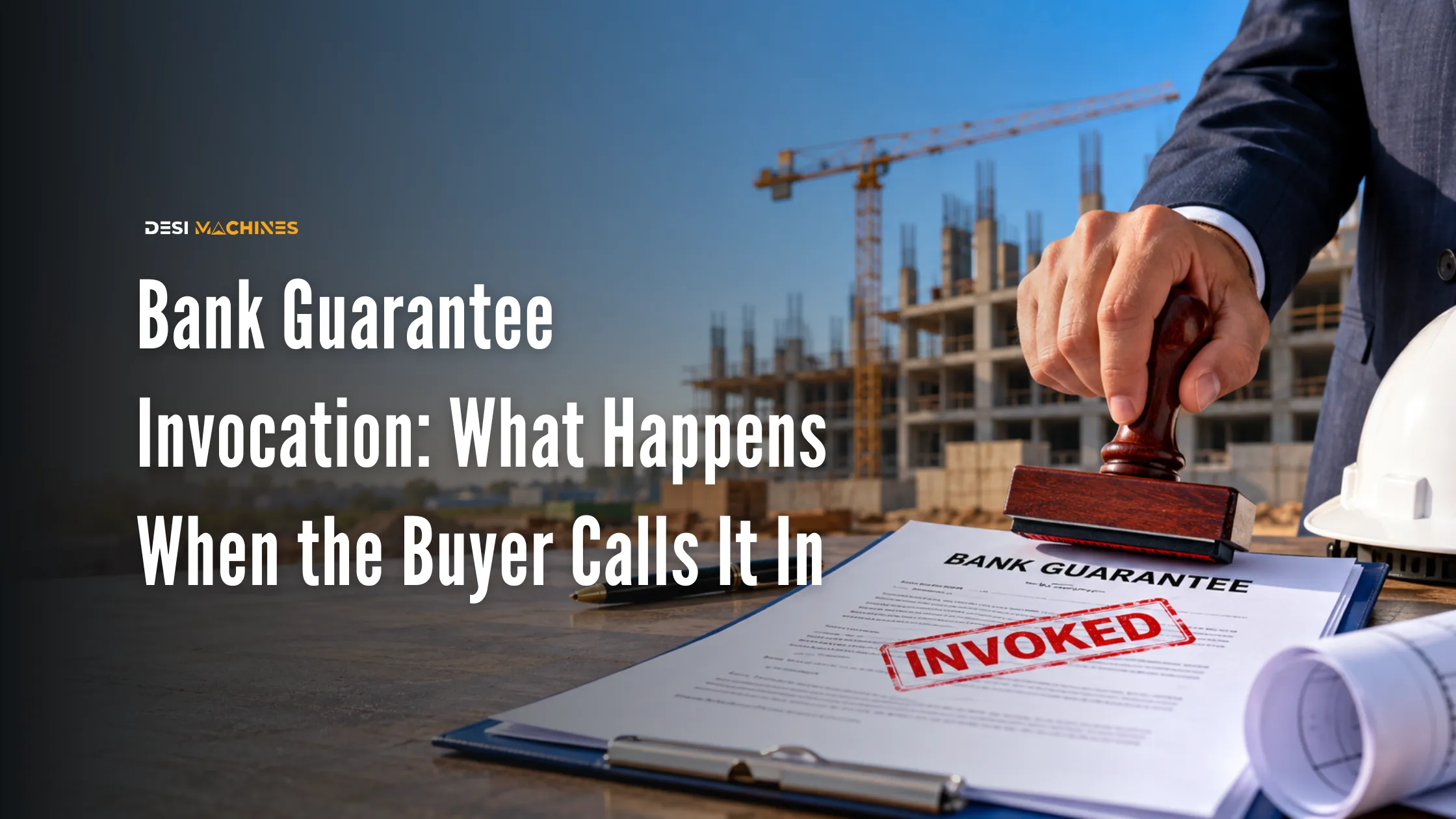
Bank guarantee invocation, or BG invocation, means the beneficiary of your guarantee formally demanding the guaranteed money from the bank that issued it. The first you hear of it is usually your bank, not the buyer. A bank guarantee invocation is a written demand from the employer to the bank that issued your guarantee, and if that guarantee is unconditional the bank pays on demand, without waiting to hear your side. Your dispute about the work does not pause it. The Supreme Court has repeatedly refused to let contractors stop encashment, and the only arguments that survive are narrow ones about fraud, irretrievable injustice, or a demand that does not match the guarantee’s own wording.
What a bank guarantee invocation actually is
When you furnish a performance bank guarantee on a contract, three parties are involved but only two of them are in the guarantee. There is your contract with the employer, and there is a separate promise from your bank to the employer. Invocation is the employer using the second one.
In plain terms, BG is short for bank guarantee, and to invoke it is to call on the bank to pay. A BG invoked means the beneficiary named in it, usually your employer or buyer, has sent the issuing bank a written demand for the guaranteed amount; encashment is the bank paying that demand. In Ansal Engineering Projects Ltd v Tehri Hydro Development Corporation Ltd the employer did exactly this with a letter of invocation calling on the bank to pay the amount in terms of the guarantee.
The banks are told the same thing by their regulator. The Reserve Bank of India (Commercial Banks – Credit Facilities) Directions, 2025, in the version updated to 15 July 2026, say a bank shall honour a guarantee it has issued as and when it is invoked in accordance with the terms and conditions of the guarantee deed, unless there is a court order restraining it.
The wording of that separate promise is what decides everything that follows. In Standard Chartered Bank v Heavy Engineering Corporation Ltd, decided on 18 December 2019 (Civil Appeal No. 9288 of 2019, reported at (2020) 13 SCC 574), the Supreme Court restated the position in the judgment: a bank guarantee is an independent contract between the bank and the beneficiary, and the bank is always obliged to honour it as long as it is unconditional and irrevocable.
The court went further on the bank’s own role. Once the demand was made in due compliance with the guarantees, it was not open to the bank to determine whether the invocation was justified, so long as the invocation was in terms of the guarantee. A demand once made obliges the bank to pay.
Read that as an owner rather than as a lawyer. The institution holding your money has no discretion to take your side, even if it wants to.
Why your dispute with the buyer changes nothing
This is where most contractors lose a week arguing the wrong case. You have a genuine grievance: the site was handed over late, the drawings changed, payment stalled. None of it is relevant to the bank.
The judgment is blunt about it. The dispute between the beneficiary and the party at whose instance the bank has given the guarantee is immaterial and is of no consequence. Quoting the earlier three-judge decision in Ansal Engineering Projects Ltd v Tehri Hydro Development Corporation Ltd, (1996) 5 SCC 450, the court recorded that the object is to inculcate respect for the free flow of commerce and trade and faith in commercial banking transactions unhedged by pending disputes between the beneficiary and the contractor.
So commerce is being protected here, not the buyer. The consequence for you is the same either way: the money moves first, and the merits are settled later, usually through arbitration under the contract, by which time you are funding the case out of your own pocket.
The three exceptions, and how narrow they are
Courts have carved out exceptions, and it is worth knowing them precisely, because they are quoted loosely by people selling you hope.
| The exception | What it actually requires |
|---|---|
| Fraud | Fraud of an egregious nature which would vitiate the very foundation of the guarantee, where the beneficiary seeks to take advantage of the situation |
| Irretrievable injustice | That allowing encashment would result in irretrievable harm or injustice to one of the parties |
| Special equities | Prima facie made out as a triable issue by strong evidence, the same standard a fraud plea must meet |
The wording in that table comes from more than one judgment. The fraud and irretrievable injustice tests are principles the court quoted from Gujarat Maritime Board v Larsen & Toubro Infrastructure Development Projects Ltd, (2016) 10 SCC 46, and its own holding names a clear case of fraud, irretrievable injustice or special equities. The strong-evidence requirement comes from Ansal, and it applies to fraud as much as to special equities.
Two details do the damage. The fraud has to go to the foundation of the guarantee itself, not to the performance of the building work, and the beneficiary must be the one seeking to take advantage of it. A buyer behaving unreasonably on site is not fraud in this sense.
And one of the Gujarat Maritime Board principles the court adopted is that courts should be slow in granting an order of injunction to restrain the realisation of a bank guarantee. You are asking a judge to do something the higher court has told them to be reluctant about.
The argument that does work
There is a fourth route and it is the one worth your attention, because it does not depend on proving anyone dishonest.
The court’s formulation was that it ordinarily should not interfere with the invocation or encashment so long as the invocation is in terms of the bank guarantee. That phrase is a condition, not just a description. If the demand does not comply with what your guarantee document requires, the invocation is defective on its own terms.
The court relied on an older decision that says it more bluntly. In Hindustan Construction Co Ltd v State of Bihar, (1999) 8 SCC 436, the invocation had to be in accordance with the terms of the bank guarantee, or else the invocation itself would be bad. The 2019 case also shows the limit of the argument. The employer’s first invocation letter there was per se inadequate and named no condition for invoking the guarantees, but its later letters told the bank about defective and short supply, and read together they were held to comply. A thin first letter does not end the matter if the employer completes the demand in time.
So before you argue about the job, read the two documents side by side and check the mechanical things. Was the demand signed by the person the guarantee names? Was it sent to the issuing branch the guarantee specifies? Does it state what the guarantee requires it to state? Did it arrive inside the claim period? These are unglamorous questions and they are the ones with a real answer.
The same discipline applies before you ever sign. A guarantee drafted as payable on demand and without demur is doing exactly what it says, and the time to negotiate that wording is at the tender stage, alongside the earnest money and security deposit terms, not after a demand lands. A deep discount can add a second guarantee to that list, the additional performance security some departments take when a quote sits far below their estimate.
What it costs you the day it happens
The face value is the smallest part of it for most owners.
Your margin money goes first, because that is what it was deposited against. The limit the guarantee occupied does not come back to you as free headroom; it has been drawn. And your bank now carries a record of a guarantee that was invoked and paid, which is the sort of thing that shapes the next sanction conversation rather than the current one.
If that limit is shared with the facility funding your machines, the squeeze reaches the yard within the month. Owners in this position often need to rebuild headroom quickly, and the honest options are a fresh equipment finance or working capital arrangement priced with the invocation disclosed, rather than a quiet application that unravels at the verification stage.
The first week after the demand lands
Order matters more than speed here.
Get the written demand itself, not a summary of it over the phone, and get the date it reached the bank. Put it against the guarantee text and test compliance line by line. Tell your bank in writing that you are examining the demand, without instructing them to dishonour it, because they cannot and the letter will read badly later.
Then look at your contract’s dispute clause and the limitation running on it, and start the recovery of what the employer owes you as a separate track. The guarantee money is gone for now. What you are protecting is the counterclaim.
Finally, check whether the employer has begun any parallel action. An invocation sometimes travels with a show-cause notice that can end in blacklisting, and that consequence outlasts the money by years.
If you are the one thinking of walking off an unpaid job, read termination of a construction contract by the contractor before you do, because a contractor leaving site is one of the commonest reasons an employer invokes the performance guarantee.
Treat a bank guarantee as cash already handed over
Treat a bank guarantee as cash you have already conditionally handed over, because that is how the law treats it. The bank pays on a compliant demand, your site dispute is irrelevant to that payment, and the exceptions are deliberately hard to reach.
What you can control sits earlier: the wording you accept, the validity and claim period you agree to, and whether the guarantee amount is one your business can absorb losing while an arbitration runs. Price that risk into the bid instead of discovering it afterwards. If you are weighing which government work is worth that exposure at all, start from the live tenders and contract opportunities and read the guarantee clause before the scope.
Rates, schemes, specifications and prices change — confirm current terms with the OEM, dealer, bank or insurer before deciding. Case law is summarised here for general understanding and is not legal advice on your contract.