Excavator
316 models
 Backhoe Loader
54 models
 Crane
68 models
 Concrete Mixer
79 models
 Wheel Loader
71 models
 Compactor / Roller
45 models
 Motor Grader
42 models

 Concrete Pump
66 models
 Skid Steer Loader
11 models


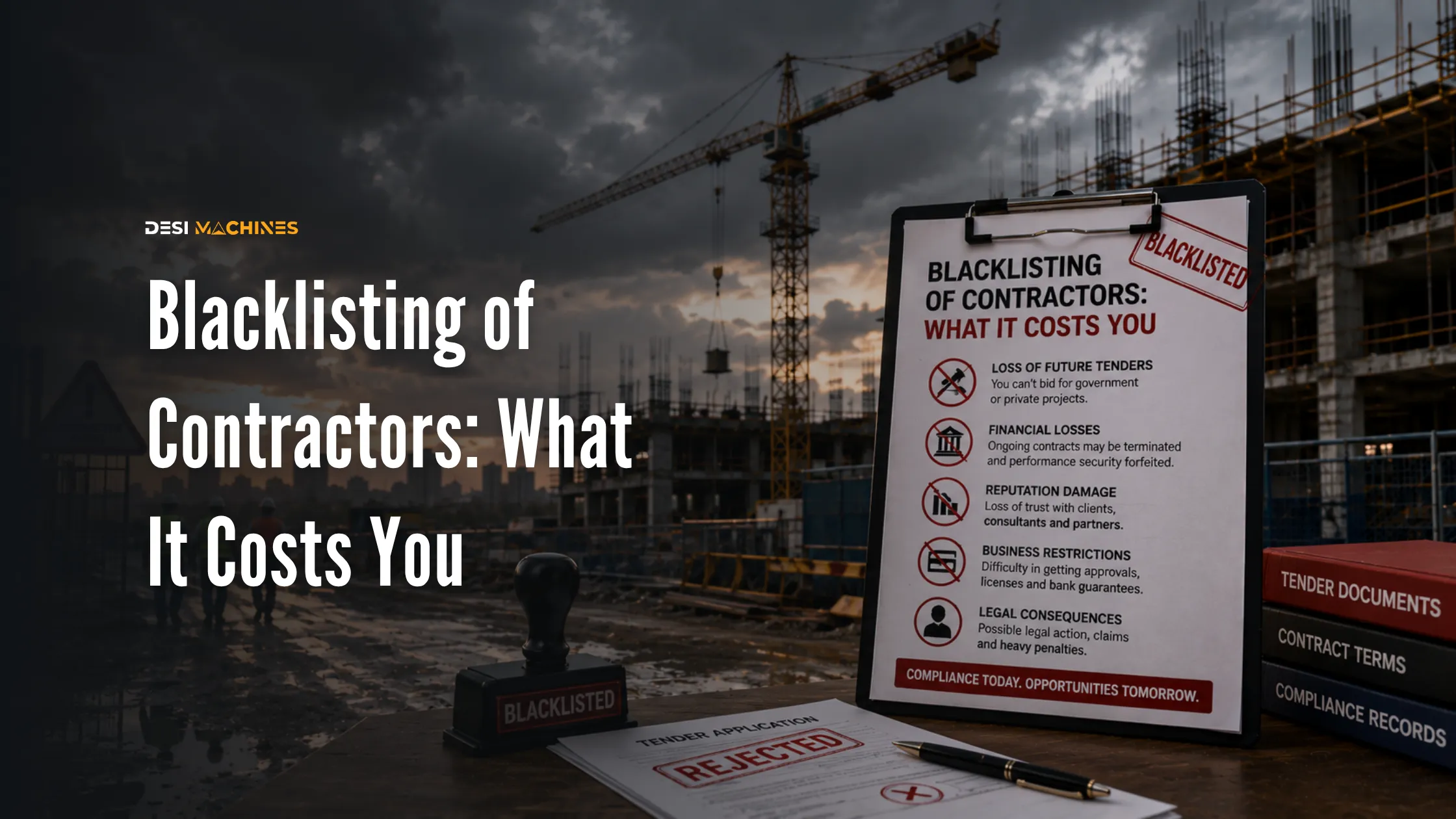
The blacklisting of contractors is a department’s decision to bar a firm from its tenders for a stated period. It is a separate consequence from losing the job: termination takes one contract, debarment takes every new contract with that buyer for the period of the order, which central government rules cap at two years for most defaults and three after a criminal conviction. The usual triggers are abandonment after award, failure to execute after the acceptance letter, and false documents. The stage that decides the outcome is the show-cause notice, and the wording of the final order decides whether the damage is limited to one buyer or follows you into every tender declaration you sign.
Most owners think about a contract going wrong in terms of the money on that contract. The security gets forfeited, the final bill is short, and the job is written off as a bad year.
Debarment is a different order of problem. It does not touch the money already lost. It removes your ability to earn the money you were counting on next.
What the blacklisting of contractors actually does
A debarment order bars you from participating in tenders of the authority that passed it, for the period the order names. Your machines and staff stay where they are, and contracts signed before the order keep running, but none of them can be put to work on a new contract with that buyer. The registration does not survive either: the model debarment order in the Finance Ministry’s Manual for Procurement of Works 2025 removes the firm and its allied firms from the buyer’s list of registered contractors, and CPWD’s enlistment rules of 2026 refuse any new enlistment or revalidation application until the period is over.
For a firm whose work comes mainly from one department or one state’s public works, that is close to a shutdown. The fleet still carries EMIs, and the front that was going to feed it is gone.
The second effect is the one owners underestimate. Tender forms almost always require a declaration that the bidder is not blacklisted or debarred by any government department or public sector undertaking. Once an order exists, every future bid needs a truthful answer to that question, and a bid that answers it falsely is in far worse trouble than a bid that discloses and explains.
The declaration is not a formality. Rule 175 of the General Financial Rules 2017 asks every bidder in central government procurement to disclose whether it has been debarred by any other procuring entity, and treats a false declaration as a breach of the code of integrity in its own right. Some buyers want it sworn: a September 2026 IIT Kanpur repair tender (NIT 43/Civil/D1/2026-27) asks for a notarised affidavit on Rs 100 stamp paper that the firm is not blacklisted, debarred or restrained by any central or state agency or PSU, and says a false one bars the firm from the institute’s tenders for good and, if found before work starts, costs it the agreement and its whole earnest money or performance guarantee. CPWD goes further again: its enlistment rules list debarment by any central government department, ministry or central public sector undertaking as a ground for debarring the firm from CPWD as well.
A single order can also reach further than the office that passed it. The Works Manual applies a ministry’s order to all its attached and subordinate offices, autonomous bodies and public sector undertakings, though it is not circulated to other ministries. When NHAI extended a three-year debarment to PNC Infratech in September 2026, the company disclosed that it could not bid for MoRTH, NHAI or their executing agencies for that period.
How long debarment lasts under the central rules
The period is written into the order, but the central rule books set the limits it has to sit inside.
| Rule book | Grounds | Who is covered | Period |
|---|---|---|---|
| General Financial Rules 2017, rule 151(i) and (ii) | Conviction under the Prevention of Corruption Act 1988, or under the Bharatiya Nyaya Sanhita or another law for causing loss of life or property or a threat to public health while executing a public procurement contract | Every procuring entity; the Department of Expenditure lists the firm on the Central Public Procurement Portal | Up to three years from the date of debarment |
| General Financial Rules 2017, rule 151(iii), and Works Manual 2025, para 8.7.2 | Breach of the code of integrity, or defaults such as sub-standard material, non-supply, abandonment of works, sub-standard work or breaking a bid securing declaration | The ministry or department that passed the order, with its offices, autonomous bodies and public sector undertakings | Up to two years, and ordinarily not less than six months |
| CPWD Rules for Enlistment of Contractors 2026, rule 13 | Twenty-five listed grounds, from failing to start or execute a work to forgery, abandonment and debarment by another central department | CPWD tenders, enlistment and revalidation | Six months to two years, or demotion to a lower class for three years |
| Government e-Marketplace, as recorded in Works Manual 2025, para 8.7.2 | Its own debarment, plus suspension on separate grounds under its incident management policy | Bids on the GeM portal | Up to two years |
The Supreme Court has put a limit of its own on the period. In Kulja Industries v BSNL, decided on 4 October 2013, BSNL had blacklisted a supplier for all time after accusing it of drawing money it was not owed. The court let the blacklisting stand but held that debarment is never permanent and that its length should depend on the gravity of the offence, and it sent the period back to BSNL to fix under written guidelines. Read the period in your own order against these limits: a term longer than the buyer’s rule book allows is the first point to raise.
What triggers it
The grounds are set out in the tender conditions and in each department’s own manual, so the list differs. Four appear almost everywhere.
| Trigger | What it looks like on site | How avoidable |
|---|---|---|
| Abandonment of work | Machines pulled off a live front and not returned; work stops without written notice | High |
| Failure to execute after award | Letter of acceptance issued, agreement not signed or security not furnished | High |
| False or forged documents | Borrowed experience certificates, altered turnover figures, a solvency letter that does not stand up | Entirely |
| Persistent poor performance | Repeated written warnings, quality rejections, deployment far below what was promised | Moderate |
The document cases deserve a separate warning. When a firm cannot clear an eligibility bar it sometimes borrows a completion certificate or dresses up a figure. That is treated as misrepresentation rather than as a site failure, and the response is usually harsher than anything a genuine delay would attract.
Both central rule books spell out the triggers. The Works Manual’s debarment guidelines name sub-standard material, non-supply of material, abandonment of works, sub-standard quality of work and failure to honour a bid securing declaration. CPWD’s 2026 list runs from (a) to (y): besides the defaults in the table above, it includes not starting a work after it is awarded, withdrawing a tender before award, forgery or falsified records, over-measurement in a bill, failing three times to collect and submit material samples, and not telling CPWD about a change of address within three months.
The honest route through an eligibility wall is the one built into the rules: the relaxations available to small enterprises, a joint venture where the tender permits it, or simply bidding within the capacity you can prove. The guide to the bid capacity formula covers how that ceiling is worked out, and the solvency certificate guide covers the document most often fudged.
The show-cause stage is the whole case
Departmental practice is to issue a show-cause notice before an order is passed. The notice should state the charge against you and the action proposed, and it gives a period for your reply: 15 days in the model notice at Annexure 15 of the Works Manual. A reasoned order follows.
The central rules write the hearing in. Rule 151 of the General Financial Rules says no bidder shall be debarred without a reasonable opportunity to represent against it, and the Works Manual adds a personal hearing if the firm asks for one. Its suggested timeline runs about 12 weeks from the department noticing the default to the final order, which must give the firm two weeks to appeal to the Secretary of the ministry. At CPWD the complaint goes to an Empowered Committee, whose member secretary issues the show-cause notice; the committee may hear you in person, must report within three months, and the enlisting authority decides.
The Supreme Court has set aside blacklisting orders where the notice did not say that blacklisting was proposed. In Gorkha Security Services v Govt of NCT of Delhi, (2014) 9 SCC 105, decided on 4 August 2014, the notice was for failing to commence and execute an awarded work; the court quashed the blacklisting because the notice had not proposed it, while leaving the department free to act again after a proper notice. In UMC Technologies v Food Corporation of India, decided on 16 November 2020, it quashed a five-year blacklisting on the same ground and held that a clause in the bid document mentioning blacklisting does not replace a clear statement in the notice. So read the notice for the action it proposes. If it proposes debarment, answer that as well as the charge: why the penalty is out of proportion to the default, and why a shorter period would do.
That reply is the stage where the matter is won or lost, and it is the stage owners most often treat casually. A notice arrives while three sites are running, somebody says the department is only posturing, and the period lapses.
Answer in writing, inside the period, and answer the charge that was actually made. If the charge is abandonment, the reply is the record of what stopped work: the front that was not handed over, the drawing awaited, the payment that stalled, the extension you applied for. If the charge is non-execution after award, the reply is the correspondence showing what you did and when.
This is the same contemporaneous file that decides a delay deduction. If you keep the record described in the guide to liquidated damages and extension of time, the reply mostly writes itself. If you did not keep it, no amount of argument at this stage substitutes for it.
Ask for what you are missing, too. If the notice refers to inspection reports or measurements you have not seen, request copies and record that you have asked.
The Works Manual’s model notice is built for this. It attaches the imputations against the firm and a list of the documents relied on, asks your reply to give specific reasons, mitigating factors and the corrective measures you will take, and asks whether you want an oral hearing. It also asks you to list your allied firms, because the debarment will reach them.
Risk and cost: the money side of the same default
Debarment deals with your future eligibility. The risk and cost clause deals with the money on the contract that failed, and the two can arrive together.
Under a risk and cost provision the department gets the balance work executed through another agency and recovers the difference in cost from you. If the balance work is retendered in a dearer market, the gap can be larger than anything you saved by walking away, and it is recoverable from your dues, your retention and your performance bank guarantee.
So the decision to abandon a bad job is rarely the clean exit it looks like at the time. Before pulling machines off a front, price the exit properly: forfeited security, the risk and cost exposure, and the chance that the buyer’s tenders close to you for up to two years, or longer where its own rules allow.
The machines are often where this starts. CPWD’s enlistment rules of 2026 make every applicant undertake to hire or otherwise procure the tools, plant and machinery a work needs if it does not own them, and a contractor who fails to deploy them, owned or hired, is liable to disciplinary action under the same rules. If the work needs a second excavator, another tipper or a roller you do not have free, hiring them through machines on rent for the weeks they are needed is usually cheaper than the debarment that short deployment can bring. The same logic runs the other way once an order is passed. Contracts already running are not affected, so the fleet stays busy until they close; after that, machines that depended on one buyer still carry their EMIs, and the plan for those months has to be private work or tenders from buyers the order does not cover.
Read the order, not the rumour
If an order is passed, get a certified copy and read three things in it.
Who it covers. The firm alone, or partners and sister concerns as well? Scope is decided by the wording, and it determines whether a related entity can still bid. Under the Works Manual and CPWD’s rules a debarment extends automatically to allied firms, and when a joint venture is debarred every partner named in the order is debarred with it. The Works Manual’s model notice treats a firm as allied where, among other tests, it shares all or most of your partners or directors, a partner holds a 20% profit share in it, or you own 20% or more of it or control it. Check any sister concern against that list, and read the guide to a joint venture for a tender before you bid in one.
How long it runs, and from which date. Under the Works Manual and CPWD’s rules the period runs from the date the order is issued, and other buyers apply it from the date it is uploaded on the issuing ministry’s website. Diarise the expiry: the order lapses on its own when the period ends, with no separate revocation needed.
What it covers. Tenders of that authority only, or something wider. This is the fact you will be declaring in every bid until it expires, so you need it exactly right rather than approximately right.
An order that is already passed also has a remedy path: a departmental appeal or representation, within whatever period the order or the manual allows. Under the Works Manual the final order gives two weeks to appeal to the Secretary, the appeal is meant to be decided in four, and the issuing authority can review or revoke an order early on new facts; at CPWD the Director General can revoke a debarment before it expires if the disability already suffered is enough. Get advice quickly rather than after the period runs out, because these windows are short.
Answer the blacklisting notice before it becomes an order
Blacklisting is the one contractual consequence that outlives the contract. It is triggered by a small number of predictable defaults, it is preceded by a notice that most firms answer too late or not at all, and its reach is decided by a few lines of wording in the final order.
Keep the site record while the trouble is happening, answer every notice inside its period in writing, and never solve an eligibility problem with a borrowed document. If you are choosing which work to chase, the guide to bidding for government construction tenders covers what to check before committing, and current work is listed on the tender opportunities page.
Rates, schemes, specifications and prices change, so confirm current terms with the OEM, dealer, bank or insurer before deciding. Debarment grounds, procedure and appeal routes are set by each department’s own rules and by your tender conditions; confirm them against the documents that apply to you, and take professional advice on any notice you receive. The rules quoted above are from the General Financial Rules 2017 as updated to 31 January 2026, the Works Manual 2025 and CPWD’s enlistment rules of 2026, checked in November 2026.