
 Excavator
294 models
Excavator
294 models  Backhoe Loader
51 models
Backhoe Loader
51 models  Crane
68 models
Crane
68 models  Concrete Mixer
79 models
Concrete Mixer
79 models  Wheel Loader
54 models
Wheel Loader
54 models  Compactor / Roller
45 models
Compactor / Roller
45 models  Motor Grader
42 models
Motor Grader
42 models  Concrete Pump
66 models
Concrete Pump
66 models  Skid Steer Loader
11 models
Skid Steer Loader
11 models  Telehandler
13 models
Telehandler
13 models  Dozer
Dozer 


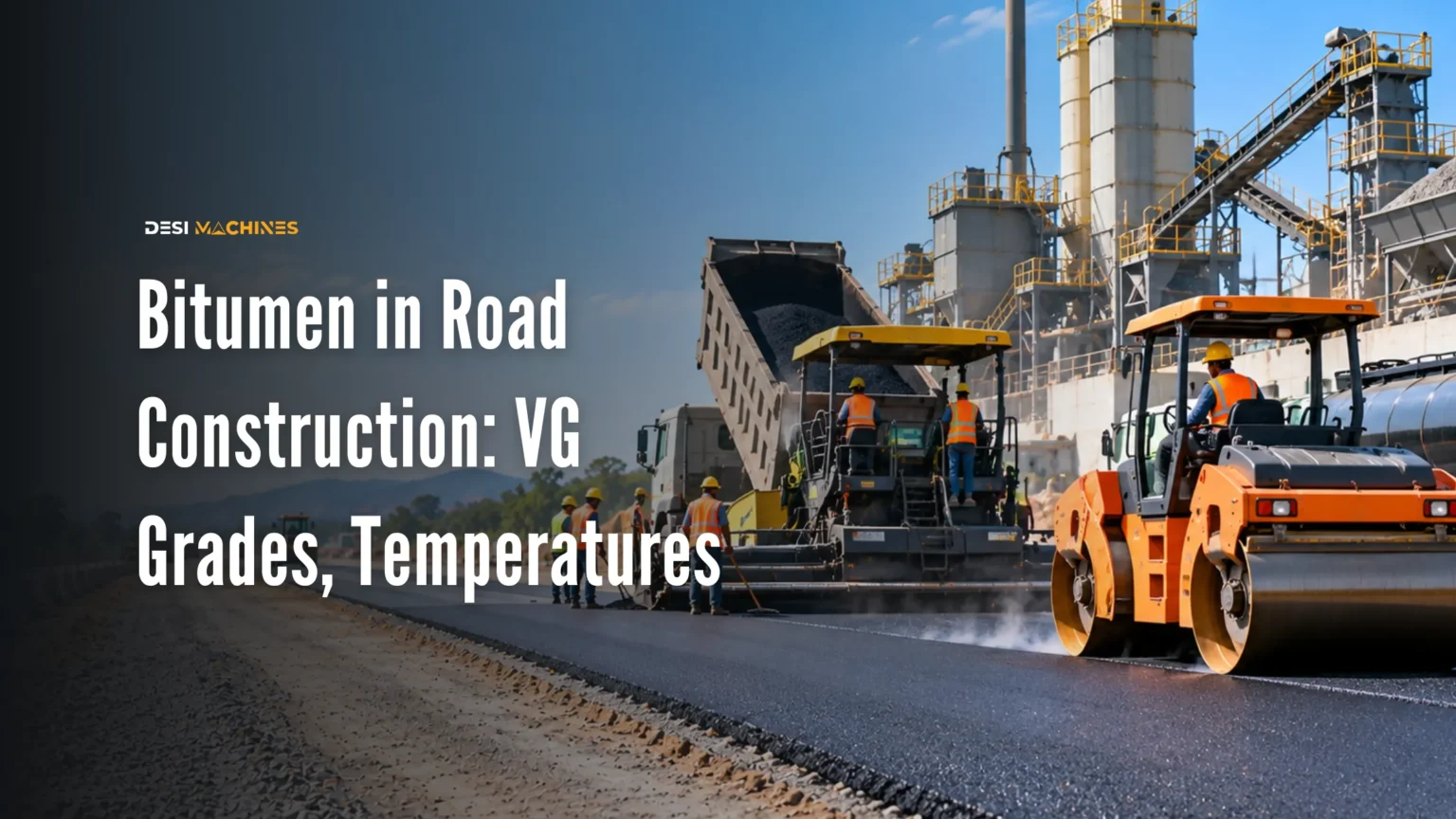
Bitumen road construction in India runs on four paving grades: VG-10, VG-20, VG-30 and VG-40. The grade is picked from the air temperature where the road is being built, not from the traffic it will carry. That catches most first-time contractors out, because it seems backwards until you understand what the binder is actually doing.
Every figure on this page comes from IS 73 : 2013, Paving Bitumen, the Bureau of Indian Standards specification that all four grades are defined by, read together with its 2019 and 2023 amendments. A lot of what circulates online still uses the grade names India stopped using in 2006, which is the single biggest source of confusion on this subject. This page sits in the road construction guide, which covers the other layers and materials a road is built from.
What is bitumen in road construction?
Bitumen is the black, sticky material left at the bottom when crude oil is refined, and in a road it works as the glue that holds stone chips together. It is not what carries the weight of a truck. The interlocked stone skeleton does that. Bitumen keeps the stones locked to each other, keeps water out of the layer, and lets the surface flex slightly instead of cracking.
Two words get mixed up here constantly. Tar is made from coal. Bitumen is made from petroleum. Indian roads are built with bitumen, and have been for generations, even though almost everyone still calls the result a tar road. If a supplier genuinely offers you tar for a road job, something is wrong with the offer.
The binder is only a small fraction of a bituminous layer by weight. The rest is graded stone and filler. How much binder goes in is set by the job mix formula for that particular layer, and it is not a figure anyone should decide on site.
Which bitumen grade is used in India?
IS 73 selects the grade from the design maximum air temperature at the site, and it gives four bands. This is the table that decides the answer for your road.
| Grade | Suitable for 7 day average maximum air temperature |
| VG-10 | Below 30 °C |
| VG-20 | 30 °C to 38 °C |
| VG-30 | 38 °C to 45 °C |
| VG-40 | Above 45 °C |
Read the temperature column carefully, because it is not today’s weather. The standard asks for the 7 day average maximum air temperature over a period of at least five years from the start of the design period. It is a long-run design figure for the location, and on a tendered road it will already be on the paperwork.
The logic behind the table is worth holding on to. A hotter place needs a stiffer binder, because heat softens bitumen and a binder that goes soft under a loaded tyre lets the surface move. A cold place needs a softer binder, because cold makes bitumen brittle and a stiff binder in the cold cracks. Most of the Indian plains cross 38 °C in summer, which is why VG-30 is the grade seen on the great majority of Indian road work, while hill and high-altitude jobs drop to VG-10.
What do VG-10, VG-20, VG-30 and VG-40 actually mean?
VG stands for viscosity grade, and the number tracks how stiff the binder is when measured at 60 °C. Viscosity is simply resistance to flowing: honey has high viscosity, water has low viscosity. The standard sets seven requirements for each grade, and the full table is below.
| Characteristic | VG-10 | VG-20 | VG-30 | VG-40 |
| Penetration at 25 °C, 100 g, 5 s, in 0.1 mm, minimum | 80 | 60 | 45 | 35 |
| Absolute viscosity at 60 °C, poises | 800 to 1,200 | 1,600 to 2,400 | 2,400 to 3,600 | 3,200 to 4,800 |
| Kinematic viscosity at 135 °C, cSt, minimum | 250 | 300 | 350 | 400 |
| Flash point, Cleveland open cup, °C, minimum | 220 | 220 | 220 | 220 |
| Solubility in trichloroethylene, per cent, minimum | 99.0 | 99.0 | 99.0 | 99.0 |
| Softening point, ring and ball, °C, minimum | 40 | 45 | 47 | 50 |
| Viscosity ratio at 60 °C after rolling thin film oven test, maximum | 4.0 | 4.0 | 4.0 | 4.0 |
| Ductility at 25 °C after rolling thin film oven test, cm, minimum | 75 | 50 | 40 | 25 |
Three of those rows tell you most of what you need. Penetration is how far a standard needle sinks into the bitumen in five seconds at 25 °C, measured in tenths of a millimetre, so a bigger number means a softer binder. Notice it runs downward across the grades, from 80 for VG-10 to 35 for VG-40. Softening point is the temperature at which the material starts to flow in a standard test, and it runs the other way, from 40 °C up to 50 °C. Absolute viscosity at 60 °C roughly doubles from one grade to the next.
The last two rows are ageing tests. A rolling thin film oven test deliberately ages a thin film of the binder with hot air to imitate what a hot-mix plant and a few years of sun will do to it. The viscosity ratio caps how much stiffer it is allowed to get. Ductility, measured on that aged sample, is how far a briquette of it can be stretched before it snaps, and the allowance falls from 75 cm for VG-10 to 25 cm for VG-40 because a stiffer binder is expected to be less stretchy.
What happened to 60/70 and 80/100 bitumen?
They were penetration grades, and India replaced them with viscosity grades in the third revision of IS 73 in 2006. The old names describe a penetration range measured at 25 °C. An 80/100 bitumen let the needle sink somewhere between 80 and 100 tenths of a millimetre, and 60/70 was stiffer.
The reason for the change is written into the standard’s own foreword. How a binder behaves at high temperature is what decides whether a road ruts in summer, and that is measured far better by viscosity at 60 °C than by a needle at 25 °C. Around 60 °C is about as hot as a road surface gets in the Indian sun, so the test now happens at the temperature that matters. The change also cut the number of tests down to seven and dropped some older measurements that added cost without adding information.
You can see roughly where the old names sat by reading the penetration row above. VG-10 has to penetrate at least 80, which is where 80/100 used to live, and VG-30’s minimum of 45 sits just below the old 60/70 band. Treat that as a rough guide and nothing more. It is not an official equivalence, the grades are defined on different properties, and a tender asking for VG-30 has to be answered with VG-30.
The practical version is short. If a supplier quotes you 60/70 or 80/100, they are using a name India retired two decades ago. Ask which VG grade it is and ask for the test certificate against IS 73.
At what temperature is bitumen mixed, laid and rolled?
IS 73 fixes three temperature anchors, and the exact working window for your mix comes from the job mix formula on top of them. The standard measures kinematic viscosity at 135 °C, which is the reference point for how the binder pumps and coats stone, and that is why hot-mix plants work in that region rather than somewhere hotter.
The two limits are safety limits. The binder must not foam when heated to 175 °C, and its flash point has to be at least 220 °C. Foaming means water trapped in the binder flashing to steam, which is dangerous around an open tanker and ruins the coating on the stone. The flash point is the temperature at which the vapour above hot bitumen can catch light. Neither is a target to work near.
On site the discipline is about the clock as much as the thermometer. The mix has to leave the plant hot enough that it still spreads properly when the paver reaches it, and rolling has to be finished before the layer cools to the point where it stops moving under the drum. A layer rolled too cold never reaches its density, whatever grade of bitumen went into it. The specific mixing, laying and rolling temperatures for each mix are set out in the Ministry of Road Transport and Highways Specifications for Road and Bridge Works, Section 500, and on the approved job mix formula for the contract. They belong on the paperwork, not in anyone’s memory.
Where is bitumen emulsion used instead of hot bitumen?
Bitumen emulsion is bitumen broken into tiny droplets suspended in water, which lets it be sprayed cold instead of heated. After spraying, the water separates and evaporates, the droplets join back together, and what is left behind is the bitumen film. Anyone watching will see it change from brown to black as that happens.
Emulsion does the jobs where heating would be impractical or wasteful. A prime coat seals a granular base and gives the layer above something to grip. A tack coat goes between two bituminous layers so they bond into one instead of sliding apart. Patch repairs and small village-road work often use cold mix made with emulsion, because a bulk tanker of hot binder cannot be held at temperature for a few square metres of work. Emulsions are covered by their own Indian Standard rather than by IS 73, so a VG grade is not the right thing to ask for when you are buying one.
What goes wrong when the grade is wrong?
The failures come in two opposite shapes, and the standard names both. Binders with a high wax content, IS 73’s foreword notes, tend to become brittle in cold weather and to bleed in hot weather, which is exactly the pair of risks the grade selection table exists to manage.
A binder too soft for the site bleeds and moves. On a hot afternoon the surface goes tacky, ruts form in the wheel paths, and the material shoves into ridges where vehicles brake, which is why approaches to junctions and toll plazas fail first. A binder too stiff for the site cracks. In cold weather it cannot flex with the layer underneath, so cracking starts and then water gets in, and water in a bituminous layer takes the road apart quickly.
Worth saying plainly: the grade is only half of it. A correctly specified VG-30 laid on a dirty base, or rolled after it has cooled, will fail earlier than a cheaper job done in the right order. Compaction is where most of the durability is won or lost, and the guide to soil compaction methods covers how density is actually achieved in the layers below.
Which machines lay and compact a bitumen road?
A paver spreads the hot mix to level and thickness, and rollers do the rest in a set order. A tandem roller makes the first pass, called breakdown rolling, and returns at the end for the finish pass that closes the surface. A pneumatic tyre roller works in between, and its rubber tyres knead the mix rather than simply pressing it, which helps seal the surface.
The single drum machine most people picture as a road roller does not belong on the bitumen at all. A soil compactor builds the earth and stone layers underneath. Of the 45 compactors listed here, 20 are tandem rollers and 4 are pneumatic tyre rollers, and those 24 are the machines that touch a bituminous layer. Sizes run from small machines for village roads and patch work up to highway units, with models such as the L&T 990HFi and the Ammann ARX 90.2 at the highway end. Which machine handles which layer is set out in the guide to road construction equipment, and the full stack of layers a bitumen road is built from, including where the bituminous courses sit, is in the guide to road construction layers.
Choosing between a static and a vibrating drum matters on a thin bituminous layer, where too much vibration can crush the stone rather than lock it, and that trade-off is covered in static vs vibratory rollers.
If the road is being built in concrete instead, the binder question does not arise at all. That route runs through a CC road slab over a dry lean concrete sub-base, and the choice between the two is mostly about traffic, drainage and how long the road has to last.
What does bitumen cost, and how is it paid for?
Bitumen is sold by weight, from refineries and their authorised dealers, in bulk tankers or in drums. The rate tracks crude oil and changes often enough that any figure printed in a guide is stale within weeks, so no rate is quoted here. Ask a supplier for a current quotation against the VG grade you need, and ask what the drum or tanker rate includes.
On a tendered road the binder is usually not billed to you separately. It sits inside the rate for the bituminous item, quoted per square metre or per cubic metre of the finished layer, which already covers the stone, the binder, the plant, the transport and the rolling. On some contracts the client supplies the bitumen and issues it against the work done, in which case the paperwork matters more than the price.
Two things to check on every delivery, whoever is paying. The grade on the challan must match the grade in the specification, and there should be a test certificate against IS 73 for that consignment. A drum labelled by an old penetration grade is a reason to ask questions before it goes into the plant.
Bitumen in road construction: the short version
- India uses four paving grades, VG-10 to VG-40, defined by IS 73 : 2013.
- The grade comes from the site’s 7 day average maximum air temperature, not from traffic. Hotter site, stiffer binder.
- VG-30 covers 38 °C to 45 °C and suits most of the Indian plains. VG-10 is for sites below 30 °C.
- 60/70 and 80/100 are retired penetration grades. Ask for the VG grade and the test certificate.
- The binder is tested at 135 °C, must not foam at 175 °C, and has a flash point of at least 220 °C.
- Emulsion is the cold-spray form, used for prime coats, tack coats and patching, under a different standard.
- Too soft for the climate bleeds and ruts. Too stiff cracks. Poor compaction beats both of them for damage.
- Tandem and pneumatic tyre rollers work on bitumen. A single drum soil compactor works on the layers below it.
Next, read the guide to road construction layers to see where the bituminous courses sit in the stack, then compare tandem roller models and prices and talk to a dealer about the class your job needs.
Specifications quoted here are from IS 73 : 2013 with its 2019 and 2023 amendments, current at the time of writing. Prices, specifications and features are indicative, vary by variant, location and date, and should always be confirmed with the official OEM or authorised dealer before any purchase decision. DesiMachines is not liable for decisions taken on the basis of information that may have changed after publication.