
 Excavator
294 models
Excavator
294 models  Backhoe Loader
51 models
Backhoe Loader
51 models  Crane
68 models
Crane
68 models  Concrete Mixer
79 models
Concrete Mixer
79 models  Wheel Loader
54 models
Wheel Loader
54 models  Compactor / Roller
45 models
Compactor / Roller
45 models  Motor Grader
42 models
Motor Grader
42 models  Concrete Pump
66 models
Concrete Pump
66 models  Skid Steer Loader
11 models
Skid Steer Loader
11 models  Telehandler
13 models
Telehandler
13 models 


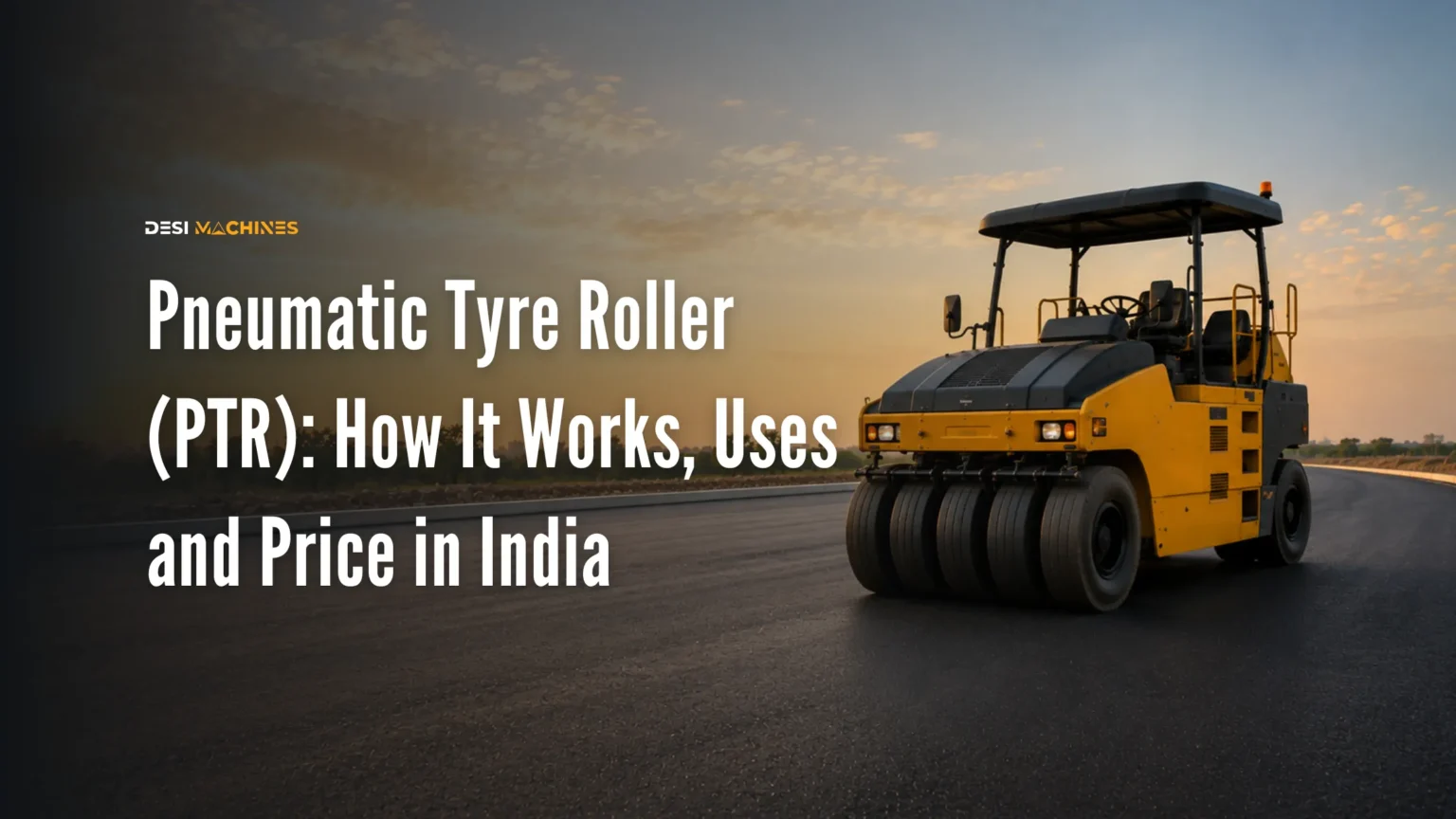
What is a pneumatic tyre roller, and what does PTR stand for?
PTR stands for pneumatic tyre roller. “Pneumatic” only means air-filled, the same word behind the pneumatic tyres on your tractor or truck. So a PTR is, quite literally, a rubber-tyred roller, and many site engineers call it exactly that.
The machine has a front row of tyres and a rear row, usually eight or nine tyres in total. The two rows are deliberately staggered, so the back tyres run over the narrow strips the front tyres missed. Manufacturers publish this as a tyre overlap figure of 42 mm to 63 mm across the machines sold here, and it is the reason a single pass covers the full working width with no untouched line down the middle.
Everything else about the machine is built around weight. A PTR has no vibration system at all. It is a purely static machine, and the only force it has is its own mass pressing down through the tyres. That is why the weight numbers matter so much on this machine and why buyers get confused by them, which is the next section.
If you are still placing this machine in the wider family, the types of compactors guide maps every category from hand-guided plates upward, and the road rollers guide goes deeper into drum and roller design.
How does a pneumatic roller compact the ground?
A pneumatic roller compacts by kneading, the same action as pressing dough with the heel of your hand, where the material gets squeezed downward and pushed sideways at the same time.
Here is why the rubber matters. A steel drum is rigid. It sits on the layer along a thin line of contact and presses straight down. A loaded rubber tyre does something different: it flattens where it touches the ground, so the contact patch is a broad footprint rather than a line, and as the tyre rolls forward that footprint moves and flexes. The material underneath gets worked from several directions instead of one. On a bituminous layer this closes the surface and locks the aggregate together; on a granular layer it re-arranges the particles so the smaller stones settle into the gaps between the bigger ones.
You control the strength of that kneading with two settings. The first is tyre pressure. Every machine here runs an adjustable range of roughly 2 to 8 bar. Drop the pressure and the tyre spreads into a wider, softer footprint that works the layer gently over a bigger area. Raise it and the footprint shrinks and the pressure concentrates, which bites harder into a stiff layer.
The second is ballast, and it is the setting most first-time buyers miss.
What is ballasting, and why are there two weights on the spec sheet?
Every PTR spec sheet lists two weights: an operating weight and a maximum ballasted weight. The gap between them is deliberate, and it is the machine’s main adjustment.
Operating weight is the machine as it stands, empty. Ballasted weight is what it becomes after you load the ballast compartment with water, sand or steel plates. On an L&T 2490 HD, for example, the machine weighs about 12,800 kg (12.8 Tonne) empty and can be taken up to 24,000 kg (24 Tonne) loaded, near enough double. A Dynapac CP275 goes from roughly 14,000 kg (14 Tonne) to 30,000 kg (30 Tonne).
That range exists because different layers want different pressure. A fresh, thin bituminous wearing course does not want 30 Tonne standing on it. It will shove and crack. A thick granular base course wants all the weight it can get. Instead of buying two machines you ballast one, and this is precisely why hiring a PTR and running it empty “because it rolls easier” quietly wastes the machine.
The number that actually does the work is neither of those two totals. It is the wheel load per tyre: the weight carried by one tyre, which is what the layer under it actually feels. Across the machines here that figure sits between about 2,890 kg and 3,333 kg per tyre. Ask for it by name when you compare machines, because a heavier machine spreading its weight over more tyres can press more gently than a lighter one on fewer tyres.
Where is a pneumatic tyre roller used on Indian road jobs?
The PTR’s main job in India is bituminous work, the *tar wala kaam*. It comes in behind the vibratory tandem roller on a dense bituminous or asphalt layer and does the intermediate and finishing rolling: sealing the surface, working the binder into the top, and removing the fine roller marks that a steel drum leaves.
It also earns its place on granular and sub-base layers, where the kneading action helps seat a well-graded material, and on sealing work over a primed or tack-coated surface. What it is not is a soil machine. Deep earth and stone layers need the downward hammer of vibration, which is the soil compactor‘s job, not this machine’s. The mechanics of that difference are covered in the soil compaction guide.
One feature on the spec sheet exists purely for bitumen work: the water spray system. Hot bitumen sticks to a dry rubber tyre and tears the fresh mat, so the machine sprays a thin film of water on every tyre while it works, and wipes it even with tyre wipers or coco mats. That is why these machines carry surprisingly large water tanks of 530 to 700 litres, and why running out of water mid-shift stops the job rather than just slowing it. Check that every nozzle is clear during the morning inspection; a single blocked nozzle marks the finished surface in a straight line you cannot roll out afterwards.
Pneumatic tyre roller vs vibratory and tandem rollers: which one for which layer?
These machines are not competitors. On a proper highway job they run one behind the other, and each one owns a stage.
| Machine | How it compacts | Where it works best | Typical stage |
|---|---|---|---|
| Soil compactor (single drum) | Vibration through one steel drum | Earth, stone, sub-base, embankment | First — building the base |
| Tandem roller (double drum) | Vibration through two steel drums | Bituminous layers, breakdown rolling | Second — first pass on fresh mat |
| Pneumatic tyre roller (PTR) | Static kneading through rubber tyres | Bituminous intermediate and finish, granular sealing | Third — sealing and finishing |
| Sheepsfoot roller | Vibration through projecting feet | Clay and cohesive soil | Specialist — clay embankment |
The short version: steel drums press and shake, rubber tyres knead. A vibratory roller builds density fast through the depth of a layer. A PTR works the top of the layer and closes it. Neither does the other’s job properly, which is why the rolling sequence on a highway contract names both.
For the underlying mechanics of vibration against dead weight, the static vs vibratory roller guide is the one to read next. If your work is internal roads, colony lanes and patch repairs rather than highway layers, a PTR is the wrong machine entirely and a mini roller will serve you far better.
What are the main pneumatic tyre roller specifications?
Four pneumatic tyre rollers are currently listed in India on DesiMachines. The table below is taken from the manufacturers’ published specifications as they stand in August 2026.
| Model | Engine power | Operating weight | Max ballasted weight | Tyres | Working width | Water tank |
|---|---|---|---|---|---|---|
| SANY SPR260C-10 PRO | 131 HP (98 kW) | 18,000 kg (18 Tonne) | 26,000 kg (26 Tonne) | 9 | 2,365 mm | 530 L |
| Dynapac CP275 | 125 HP (93 kW) | 14,000 kg (14 Tonne) | 30,000 kg (30 Tonne) | 8 | 2,370 mm | 600 L |
| L&T 2490 HD | 102 HP (76 kW) | 12,800 kg (12.8 Tonne) | 24,000 kg (24 Tonne) | 8 | 2,042 mm | 700 L |
| Volvo PT220 | 99 HP (74 kW) | 10,500 kg (10.5 Tonne) | 24,000 kg (24 Tonne) | 8 | 1,980 mm | 550 L |
Read that table by column and the trade-offs show up quickly. Working width decides how many passes it takes to cover a carriageway. The 2,370 mm Dynapac covers noticeably more ground per run than the 1,980 mm Volvo. Ballast range decides how versatile the machine is across layer types. Water tank capacity decides how long you can work before refilling, which on a remote stretch is a real scheduling constraint rather than a footnote.
Engine power is the number buyers over-weight on this machine. A PTR does not dig or push; it rolls at a working speed of about 7 to 8 km/h. The engine drives the machine and the spray pumps, and 99 HP is entirely adequate for that. Weight, tyre count and ballast range tell you far more about what the machine will actually do than horsepower does.
How many passes does a pneumatic roller need?
There is no fixed pass count that is honest to publish, and any number you see quoted without a site behind it is guesswork. The correct answer is that the rolling pattern comes from a trial strip.
A trial strip is a short test section laid with the same material, the same layer thickness and the same machines you will use for the real job. The site engineer rolls it, measures the density after each pass (*phera*), and stops when the density stops improving. That pass count, at that tyre pressure and that ballast setting, becomes the approved rolling pattern for the whole stretch. On any contract of size this is a specified procedure, not an optional one, and the consultant signs off on the result.
What you can plan around are the machine settings that feed into it: the tyre pressure you intend to run, the ballast you intend to carry, and the wheel load per tyre that combination produces. Those three are the levers. Rolling more passes than the trial strip established does not add density on a bituminous layer. Past a point it starts pushing the mat around and undoing the finish you rolled for.
What does a pneumatic tyre roller cost in India?
Prices for the machines listed here run from roughly ₹23.8 Lakh to ₹36.8 Lakh (indicative, as of August 2026), taken from our listings at the time of writing.
| Model | Operating weight | Indicative price (Aug 2026) |
|---|---|---|
| Dynapac CP275 | 14,000 kg (14 Tonne) | ₹23.8–26.3 Lakh |
| SANY SPR260C-10 PRO | 18,000 kg (18 Tonne) | ₹28.5–31.5 Lakh |
| L&T 2490 HD | 12,800 kg (12.8 Tonne) | ₹33.3–36.8 Lakh |
| Volvo PT220 | 10,500 kg (10.5 Tonne) | Price on request |
Notice that the price order does not follow the weight order. The lightest machine in the table is not the cheapest, and the heaviest is not the dearest. Emission norm, engine, hydrostatic drive quality, spray-system design and dealer support all move the figure, so comparing two PTRs on Tonnage alone will mislead you.
Before you commit, check the current listings for pneumatic tyre roller models and prices and talk to our team about your layer types and ballast needs. If the purchase needs funding, our equipment finance options cover loan and EMI structures for road machines. For a wider view of who builds compaction equipment in India, the roller compactor brands and models roundup compares the ranges brand by brand.
Should you buy a pneumatic tyre roller?
Buy one if bituminous surfacing is a regular part of your order book: highway contracts, state road work, airport or industrial paving. On that work the PTR is a specified machine, the rolling pattern names it, and you cannot substitute a steel-drum roller for it and still meet the surface requirement.
Think harder if your work is earthwork, village roads, internal colony lanes or building sites. There the machine will stand idle most months, and a soil compactor or a smaller tandem will carry more of your work. A PTR is a finishing specialist, and a specialist only pays when the speciality comes up often.
If it comes up two or three times a year, hire rather than buy. Rental on a PTR is common in every state that runs bituminous contracts, and the day rate against an idle ₹25 Lakh-plus machine is not a close call.
When you are ready to compare machines, browse the full range of compaction equipment and get the best current offer for your state.
The tyre sizes themselves, and how a pneumatic roller’s tyres compare with the rear tyres on a single-drum soil compactor, are set out in the guide to road roller tyre size.
Prices, specifications and features are indicative, vary by variant, location and date, and should always be confirmed with the official OEM or authorised dealer before any purchase decision. DesiMachines is not liable for decisions taken on the basis of information that may have changed after publication.