
 Excavator
294 models
Excavator
294 models  Backhoe Loader
51 models
Backhoe Loader
51 models  Crane
68 models
Crane
68 models  Concrete Mixer
79 models
Concrete Mixer
79 models  Wheel Loader
54 models
Wheel Loader
54 models  Compactor / Roller
45 models
Compactor / Roller
45 models  Motor Grader
42 models
Motor Grader
42 models  Dozer
41 models
Dozer
41 models  Concrete Pump
66 models
Concrete Pump
66 models  Skid Steer Loader
11 models
Skid Steer Loader
11 models  Telehandler
13 models
Telehandler
13 models 


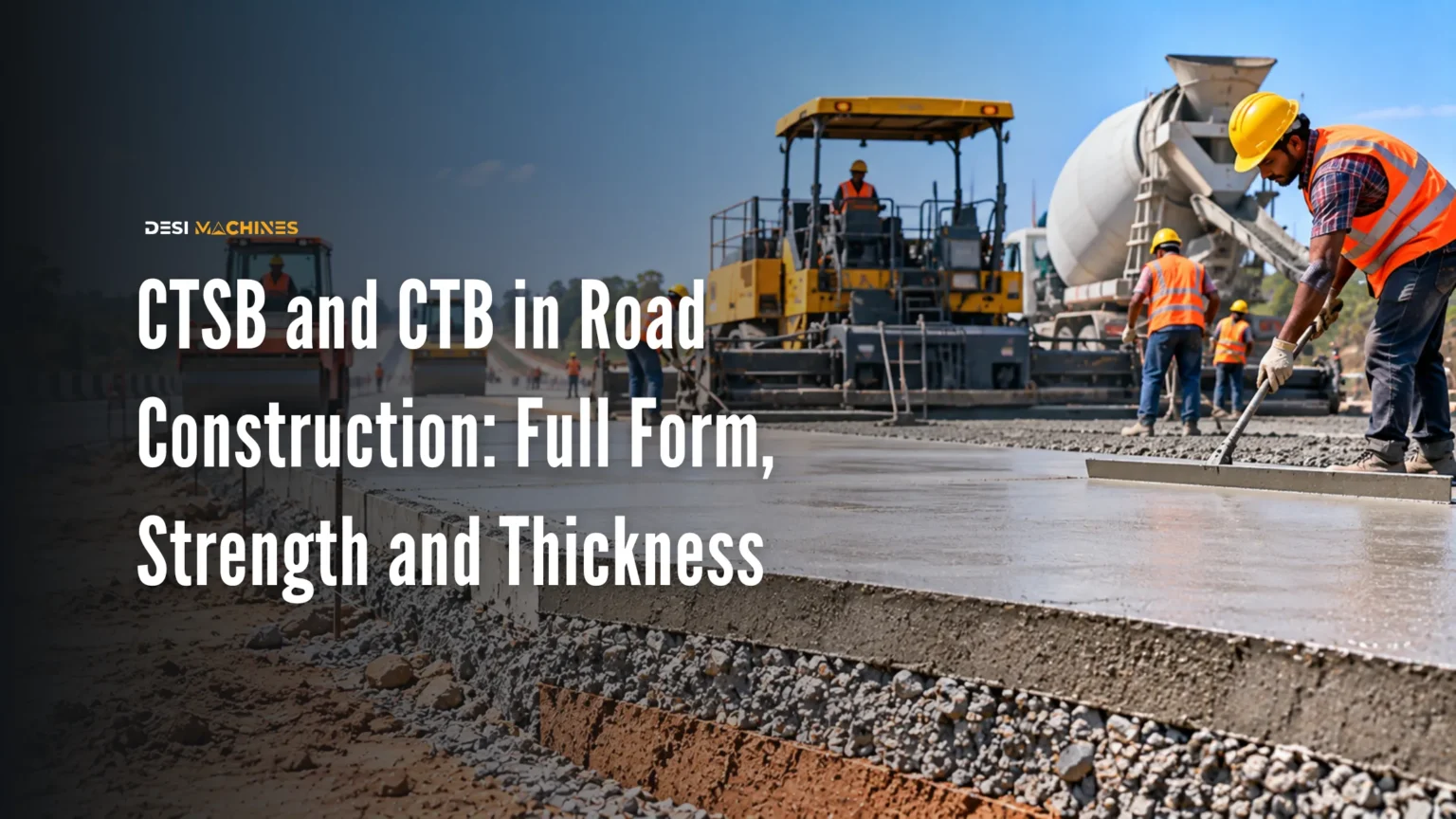
A cement treated sub-base has to reach 1.5 to 3.0 MPa of strength in seven days and be at least 200 mm thick, and the cement treated base laid over it needs 4.5 to 7 MPa and at least 100 mm. Those are the IRC:37-2018 figures, and they are what the letters CTSB and CTB stand for on an Indian highway drawing.
Spelled out, the CTSB full form in road construction is cement treated sub-base. CTB is cement treated base. Both are made from stone, gravel or local soil mixed with a small dose of cement, or lime and fly ash, plus water, then rolled hard and cured until the layer sets into a stiff, weak slab. MPa (megapascal) is the unit for that strength: 1 MPa is roughly 10 kg pressing on every square centimetre.
Where do CTSB and CTB sit in a road?
They take the places of two layers you may already know. A normal bituminous road has a granular sub-base (GSB) of loose graded stone on the soil, then a wet mix macadam (WMM) base, then the black bituminous layers on top. On a cement-treated design, the CTSB replaces the GSB and the CTB replaces the WMM base. IRC:37-2018, the Indian Roads Congress code for designing flexible (bituminous) pavements, allows the sub-base and base to be granular, cement treated, or a mix of the two.
There is one extra layer you only get with CTB. IRC:37 makes a crack relief layer compulsory between the CTB and the bitumen, for reasons covered further down. So a full cement-treated highway, from the bottom up, reads: subgrade soil, CTSB, CTB, crack relief layer, bituminous layers.
The IRC:37 worked example, drawn to scale
Section through a cement-treated flexible pavement (IRC:37-2018 example)
Bituminous layers
Crack relief layer (WMM)
CTB
CTSB
Subgrade soil
100 mm
100 mm
120 mm
250 mm
CBR 7%
The figure copies the worked example in Annex II of IRC:37-2018: 250 mm (25 cm) of CTSB, 120 mm of CTB, 100 mm of granular crack relief layer and 100 mm of bituminous layers, built on a subgrade with an effective California Bearing Ratio (CBR, the soaked soil strength test) of 7 per cent. The white lines in the CTB mark the shrinkage cracks that the crack relief layer is there to stop. The code uses this stack only to show how the fatigue check is done. It is an illustration, not a ready design for your road. The ordinary granular version of the same stack is set out in our guide to road construction layers in India.
How strong does CTSB and CTB have to be?
The strength test for both is the 7-day unconfined compressive strength, written UCS. A cylinder of the mixed material is moist-cured for seven days and crushed with no side support. The number it fails at is the UCS. IRC:37 sets these values:
| Layer | Strength (UCS) | Minimum thickness | Design modulus | Curing before the next layer |
|---|---|---|---|---|
| CTSB, normal | 1.5 to 3.0 MPa at 7 days | 200 mm | 600 MPa | 3 days minimum; 7 days if strength is not reached |
| CTSB, low strength (roads under 10 msa only) | 0.75 to 1.5 MPa | 200 mm | 400 MPa | Same as above |
| CTB | 4.5 to 7 MPa at 7 days with cement; at 28 days with lime or lime-fly ash | 100 mm | 5,000 MPa | 7 days minimum |
| Granular crack relief layer (WMM) | Not cement bound; compacted to 100% of modified Proctor density | 100 mm | 450 MPa | Not applicable |
Two terms in that table need a plain explanation. msa means million standard axles, the count of heavy axle loads a road is designed to carry over its life. The highway design example in IRC:37 itself works out to 131 msa; a road under 10 msa is a lightly trafficked one, and only there does IRC:37 allow the weaker CTSB. The design modulus is the stiffness the designer is allowed to assume.
That modulus row hides a detail worth knowing. Lab tests on cement-treated granular sub-base usually show 2,000 to 6,000 MPa. IRC:37 still tells designers to use only 600 MPa, because tippers carrying 30 to 35 tonnes of material drive over the sub-base during construction, and a low-strength cemented layer cracks under them. The code assumes the cracking will happen.
Three more limits come with the strength figures:
- Lab strength in the mix design must be at least 1.5 times the strength required in the field, because site mixing is never as even as the lab.
- For CTB, the material must survive 12 cycles of wetting and drying under IS 4332 Part IV and lose no more than 14 per cent of its weight. In cold and snowbound areas such as Ladakh, Himachal Pradesh and Arunachal Pradesh, a freeze-thaw test with the same 14 per cent limit is added.
- Flexural strength, the bending strength used for the fatigue check, is taken as 20 per cent of the 28-day UCS but capped at 1.40 MPa for cement-stabilised aggregate, 1.05 MPa for lime-fly ash-soil and 0.70 MPa for soil-cement.
The main roller on this work is a single-drum vibratory soil compactor. You can compare soil compactor models, specifications and prices and talk to a dealer before the job is priced.
How much cement goes into CTSB?
No Indian code fixes a single cement percentage for CTSB or CTB, and a quotation that names one without test results behind it is guessing. Under clause 403 of the MoRTH Specifications for Road and Bridge Works (Fifth Revision, 2013), the cement content is written into the contract after a mix design. The designer tries several cement contents, makes and cures specimens, and picks the dose that clears the 7-day UCS, the 12-cycle durability test, or both.
What the codes do fix are floors:
- For a cement and fly ash treated sub-base or base, MoRTH clause 403.2.6 asks for more than 2 per cent cement by weight of the cement and fly ash mix, designed to reach 1.75 MPa at 7 days.
- For cement-modified subgrade soil, IRC:SP:89-2010 Table 6 sets a minimum of 2 per cent cement and a laboratory CBR of at least 15 per cent. It allows as little as 0.5 per cent when better spreading and mixing equipment is used, and only after extensive lab testing.
The material you start with moves the number a long way. IRC:37 notes that fine-grained soil needs more cementitious additive to reach the same strength and tends to crack wider as it cures, while low-grade aggregates such as moorum and kankar give a lower stiffness at low cement contents. MoRTH accepts Ordinary Portland Cement, Portland Slag Cement or Portland Pozzolana Cement for stabilisation, to IS 269, IS 455 and IS 1489. Where ground slag is dosed separately into a mix rather than arriving pre-blended in a bagged slag cement, the replacement limits are set out in our guide to GGBS in concrete. Which of those three suits a given job is covered in our guide to choosing the right cement.
Before the cement is added, the material has to fit a grading band. MoRTH Table 400-4 sets it:
| IS sieve size | Per cent passing by mass |
|---|---|
| 53 mm | 100 |
| 37.5 mm | 95 to 100 |
| 19 mm | 45 to 100 |
| 9.5 mm | 35 to 100 |
| 4.75 mm | 25 to 100 |
| 600 micron | 8 to 65 |
| 300 micron | 5 to 40 |
| 75 micron | 0 to 10 |
The same clause caps the fines: if the part passing the 425 micron sieve is plastic, its liquid limit may not exceed 45 per cent and its plasticity index 20 per cent. Sub-base material also needs a uniformity coefficient of at least 5. IRC:37 separately points CTSB material to Grading IV of MoRTH Table 400-1, the granular sub-base gradings, so check which band your contract names.
Why does a CTB layer need a crack relief layer?
A cement-bound layer shrinks as it cures and cracks into blocks. Lay bitumen straight on top and every one of those cracks slowly works its way up to the surface, which is called reflection cracking. IRC:37 therefore makes a crack relief layer compulsory over any CTB, in one of two forms.
The first is 100 mm of dense graded crushed aggregate built to the MoRTH specification for WMM and compacted to 100 per cent of modified Proctor density. Being loose stone, it lets the CTB move without passing the crack upward. IRC:37 counts it as a structural layer in the design.
The second is a SAMI, a stress absorbing membrane interlayer. It is an elastomeric modified bitumen sprayed at 10 to 12 kg per 10 square metres and covered with 11.2 mm stone chips. It adds no structural strength, so the designer may not count its thickness. The binder grades involved are explained in our guide to bitumen grades for Indian roads.
How is a cement treated layer built on site?
The clock is what makes this work different from laying GSB. Once water meets cement, the mix starts to set, and MoRTH clause 403.3.5 says compaction must be finished within two hours of mixing, sooner in dry weather. Lime-stabilised soil gets three hours. A contractor who mixes more than the roller can finish in two hours pays for it in a layer that never reaches its strength.
The sequence MoRTH clause 403 sets out runs like this:
- Check the weather. No stabilisation when the air temperature in the shade is below 10°C.
- Pulverise the soil so that all of it passes a 26.5 mm sieve and at least 80 per cent passes 5.6 mm.
- Mix. In place with a rotavator or a similar mixer that works the full depth of the layer, or in a central plant. IRC:37 asks for plant mixing or a mechanised in-situ mixer for CTB. Hand mixing is allowed only where the width is too narrow for machines.
- Set the moisture between the optimum moisture content and 2 per cent above it, measured to IS 2720.
- Spread, level and roll, starting at the edges and working to the centre (on a one-way slope, from the inner edge out), until the density is at least 98 per cent of the maximum dry density. One stabilised layer is laid 100 mm thick at least and 200 mm at most when compacted.
- Cure for 7 days. IRC:37 lists a bitumen emulsion spray, wet jute mats or a periodic mist spray of water without flooding. No traffic runs on the layer unless the engineer allows it.
Then comes the test that can cost money. The finished layer is checked for its actual 7-day UCS on site. If it comes out lower than the design value, MoRTH clause 403.5 has the pavement design reviewed, and any extra thickness needed is built at the contractor’s own cost. Payment is by the cubic metre of finished layer in position.
A concrete road has its own cement-bound sub-base with different rules. Our guide to DLC, the dry lean concrete sub-base, covers that layer, which sits under a concrete slab where CTSB and CTB sit under bitumen.
Which machines build CTSB and CTB?
Four jobs need a machine: mixing, spreading, compacting and watering. Mixing is done by a rotavator or soil stabiliser working in place, or by a mixing plant feeding tippers. Spreading and trimming to level and camber (the cross-slope that sheds water) is a motor grader job. Water tankers set the moisture and keep the layer damp while it cures.
Compaction is done by a single-drum vibratory soil compactor. Of the 21 single-drum soil compactor models in the DesiMachines catalogue, 20 publish an operating weight, and 19 of those fall between 9,700 and 14,760 kg, the 10 to 15 tonne class. A few that buyers ask about most often:
| Model | Type | Operating weight | Drum width | Centrifugal force (high/low) |
|---|---|---|---|---|
| L&T 1190 | Soil compactor | 11,050 kg | 2,100 mm | 258/169 kN |
| Dynapac CA305 CEV-V | Soil compactor | 10,800 kg | 2,130 mm | 250/130 kN |
| CASE 1107NX | Soil compactor | 11,100 kg | 2,150 mm | 263/145 kN |
| Mahindra Roadmaster G9595 | Motor grader, 95 HP | 9,400 kg (gross vehicle weight) | Not applicable | Not applicable |
Centrifugal force is the push the vibrating drum adds on top of its own weight, which is what drives compaction down through a 200 mm layer. The two-hour limit decides how many rollers you need: work out how many square metres one roller can finish in two hours on your layer thickness, and never mix more than that. How these rollers work and how to size one is set out in our soil compactor guide.
When does a cement treated layer make sense?
IRC:37 lists what can go into a CTSB: soil, river bed material, natural gravel, reclaimed concrete aggregate, crushed stone, or a soil and aggregate mix. That list is the point. Where good crushed stone for a GSB and WMM has to travel a long way, binding nearby gravel or soil with a few per cent of cement can produce a stronger layer from material already on hand.
Three things count against it. The layer needs a mix design and site strength testing, which a granular layer does not. It needs a crack relief layer on top whenever a CTB is used. And it brings the two-hour compaction limit, which a small crew with one roller can miss. On a low-traffic road under 10 msa, IRC:37 permits the weaker 0.75 to 1.5 MPa CTSB; on major highways it does not.
For how the layer choice feeds through to the price of the road, see our guide to road construction cost per km in India. The whole sequence of road topics, from subgrade to surface, is collected in the road construction guide.
Before you buy or hire for a stabilised-layer job, compare live soil compactors and motor graders and connect with a dealer for availability in your state.
The two documents quoted most on this page are public. IRC:37-2018, Guidelines for the Design of Flexible Pavements carries the CTSB, CTB and crack relief clauses (7.3, 8.2 and 8.3), and the MoRTH Specifications for Road and Bridge Works, Fifth Revision carries clause 403 and Table 400-4.
Specification figures on this page are quoted from IRC:37-2018, IRC:SP:89-2010 and the MoRTH Specifications for Road and Bridge Works (Fifth Revision, 2013), as named beside each figure. Codes are revised, so confirm the edition named in your contract. Machine specifications are taken from our listings at the time of writing; prices, specifications and features are indicative, vary by variant, location and date, and should always be confirmed with the official OEM or authorised dealer before any purchase decision. Pavement thickness and mix design are decisions for the project engineer. DesiMachines is not liable for decisions taken on the basis of information that may have changed after publication.
Machines, tenders and news for this industry: Road Construction