
 Excavator
294 models
 Backhoe Loader
51 models
 Crane
68 models
 Concrete Mixer
79 models
 Wheel Loader
54 models
 Compactor / Roller
45 models
 Motor Grader
42 models
 Dozer
41 models
 Concrete Pump
66 models
 Skid Steer Loader
11 models
 Telehandler
13 models


An electric construction machine does the same digging, lifting and loading as a diesel one, but its hydraulic pumps are turned by an electric motor fed from a battery or a mains cable instead of by a diesel engine burning fuel. Everything past that point stays much the same: the boom, the arm, the bucket, the tracks and the hydraulic circuits are built the way they always were. Buyers asking about electric vs diesel construction equipment usually want three answers. Is it cheaper? Is it faster? Does it need less repair? Honestly: often yes, usually no, and partly.
This guide is for an owner or contractor working out whether an electric machine suits the jobs already on the books. The excavator case comes first, because that is where most of the demand sits today. Every figure below comes either from the spec sheet of a machine listed on DesiMachines or from a maker’s own published page, named where it is used. For what a charger and a site power connection actually involve, read the guide to charging an electric machine on site. For the same comparison worked out in rupees per hour, read electric vs diesel excavator cost.
What actually changes inside the machine?
The diesel engine comes out and an electric motor goes in. Three arrangements are sold, and they behave very differently on site.
Battery-electric. A battery pack sits on the machine, usually low down and towards the rear where the counterweight is. The motor drives the same hydraulic pumps a diesel engine would, the machine works until the charge runs down, and then it has to be plugged in. The LiuGong 922FE Battery is a 24-tonne class example, with an IPMSM motor (an interior permanent-magnet synchronous motor, the common type on these machines) rated 140 HP (105 kW); LiuGong’s own product page lists its pack as 423 kWh of LFP, which is lithium iron phosphate. Battery machines are listed across a wide size range, from the LiuGong 9027FE EV at 2,750 kg and 21.1 HP (16.5 kW) up to machines of 39 tonnes and more such as the LiuGong 939FE EV.
Cable-fed. There is no pack. A trailing cable runs from a site transformer to the machine, and the machine works for as long as the supply holds. This is the older arrangement and it is still the standard one in quarries and large mines, where a machine digs the same face for months. The trade-off is reach: LiuGong India’s page for the 922FE Cable lists a cable reel of 35 m or 45 m and a working range up to 50 m, so the machine is tied to its supply point. The Volvo EC500 Electric, at 47,846 kg with a 335 HP (250 kW) motor, is grid-connected in the same way, and Volvo CE’s India page for it claims it is “ready to load, swing and dump 24/7” with no need to recharge or refuel. That is the maker’s claim for a cable machine, and it is the real advantage of the arrangement: nothing stops to charge.
Hybrid. The diesel engine stays. Energy that a normal machine throws away as heat, mostly from lowering the boom and stopping the upper structure swinging, is captured and stored, then fed back the next time the machine needs a burst of power. A hybrid still takes diesel and still has an exhaust, so it answers the fuel-bill question but not the fumes-and-noise one. How the storage and recovery work is covered in the guide to hybrid excavators.
Figure 1. Where the power comes from, and where the machine stops differing
Reading the figure: the top two rows are electric, fed either from a pack carried on the machine or from a cable off the site supply. The third is an ordinary diesel machine. The fourth is a hybrid, which keeps the engine and adds a store that the dashed line feeds back in. Only the left-hand two columns change. Everything inside the orange box, which is the part that does the digging, is built the same way whichever power arrangement you buy.
Motors are not all alike, and the spec sheet says which one you are getting: the IPMSM type across the LiuGong range, a water-cooled permanent-magnet synchronous motor on the SANY SY215EP, a switched-reluctance motor on the smallest LiuGong, and an asynchronous squirrel-cage motor rated 544 HP (400 kW) on the mains-fed Liebherr R 992 E. The type matters mainly for who can service it.
Where does an electric machine beat a diesel one?
Electric wins wherever the engine itself is the problem: its noise, its fumes, or the servicing it demands.
Noise. There is no combustion and no exhaust note, so what you hear is the hydraulics, the fan and the tracks. Volvo CE says its electric machines produce less noise and vibration than diesel equipment and that this lets work continue in sound-sensitive areas and outside normal hours. That is Volvo’s claim rather than a measured figure for a particular site, but the mechanism is plain enough, and it is the reason these machines turn up first on city jobs with night restrictions.
No exhaust where the work is. A battery or cable machine has no tailpipe, so nothing is emitted at the work face, and Volvo CE describes the EC500 Electric as having zero tailpipe emissions. In a basement, a tunnel, a shed or a warehouse, that removes the fume extraction a diesel machine needs and the limit on how long people can work beside it. Be clear about what it does not mean: the emissions move to wherever the electricity is generated rather than disappearing. Inside the site boundary they are gone, and on an enclosed job that is the point.
Fewer engine fluids to buy and change. This one can be read straight off two spec sheets for the same size of machine. The diesel SANY SY215C-9LCS lists a 340 L fuel tank and 22.75 L of engine oil. Its electric sibling the SY215EP, at nearly the same operating weight, lists neither: no fuel tank, no engine oil. The same holds on the LiuGong pair, where the diesel 922Ea lists a 420 L fuel tank and 20 L of engine oil and the 922FE lists none. With the engine goes the engine oil change, the fuel filter, the air filter and the exhaust after-treatment. Volvo CE puts the saving at “30% less maintenance” because, in its words, “there are no engine-related consumables such as engine oil, filters and water separator”. Treat 30% as the maker’s claim for its own machines, not as a number to budget against.
Full pull from standstill. An electric motor makes its torque immediately and does not need to be revved. The listed figures are striking: the electric SANY SY215EP is rated 1,500 Nm at 1,650 rpm, while the diesel SY215C in the same class is rated 590 Nm at 1,400 rpm. Read that carefully, though, because it does not mean the electric machine digs two and a half times faster. The next section explains why.
Where does diesel still win?
Diesel wins on everything to do with refuelling, weight and reach, and those are the things that decide most Indian jobs today.
Filling the tank takes minutes; charging does not. A diesel machine takes a drum or a bowser almost anywhere. A battery machine needs a charger and a sanctioned power connection big enough to feed it, and the charge takes hours rather than minutes. That is a site-electrical project, not an accessory, and it is the single most common reason an electric machine does not suit a job. The charging guide sets out what the connection involves.
The battery is heavy, and you carry it everywhere. Two listed machines prove this cleanly, because they are the same machine in two power forms. The 922FE Cable has an operating weight of 22,000 kg. The 922FE Battery, with the same IPMSM motor, the same hydraulic flow of 2 x 224 L/min, the same 34.3 MPa implement circuit and the same 9,530 mm digging reach, weighs 24,100 kg. The pack costs 2,100 kg, about a tenth of the machine, and that weight is there on every trailer move and every soft patch of ground.
Figure 2. One machine, two power arrangements
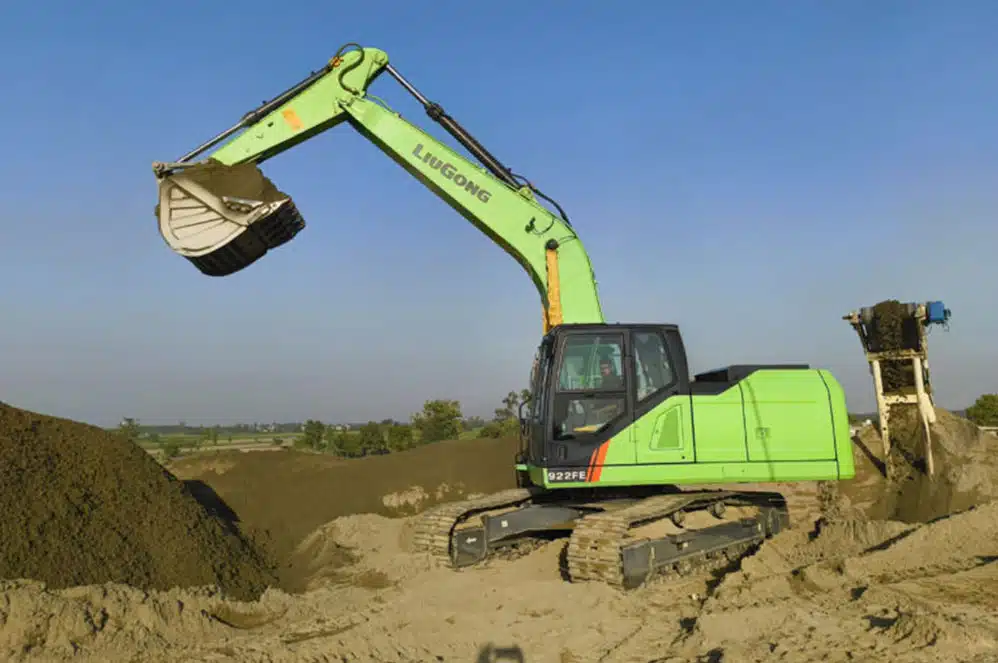
Battery version: 24,100 kg, pack carried on the machine.

Cable version: 22,000 kg, fed from the site supply.
Same motor, same hydraulics, same undercarriage, same digging reach. The 2,100 kg difference between them is the battery and its mounting, which is the clearest measure available of what carrying your own energy costs.
Long unbroken shifts are hard. A machine that must dig for ten or twelve hours without a gap is asking the battery to do something a tank of diesel does easily. Cable-fed machines answer this completely, which is why they dominate quarry and mine faces, but only where the machine stays put.
Remote and moving work. A road job that advances a few kilometres a week, a canal, a rural site with weak or intermittent supply: these are poor fits. Diesel travels with the work.
It costs more to buy, and resale is not yet established. Electric machines are listed at higher prices than their diesel equivalents, and there is no settled second-hand market to tell you what one will be worth in five years. A diesel machine’s resale value can be estimated from years of trade; an electric machine’s is a guess today. Treat that uncertainty as a real cost.
Service reach. A diesel engine can be worked on in most district towns. A high-voltage traction system and its battery management cannot.
What changes and what stays the same
The useful way to read an electric machine is to separate the parts that genuinely differ from the parts that are identical to the diesel version. The second list is longer than most buyers expect.
Electric against diesel, item by item, with the source for each line
| Item | Diesel machine | Electric machine | Source for this line |
|---|---|---|---|
| Prime mover | Diesel engine, must be revved to make torque | Electric motor, full torque from rest; 1,500 Nm at 1,650 rpm against the diesel sibling’s 590 Nm at 1,400 rpm in the 215 class | DesiMachines catalogue spec sheets, SANY SY215EP and SY215C |
| Energy on board | Fuel tank, 340 L on the 215-class SANY and 420 L on the LiuGong 922Ea | Battery pack, or no storage at all on a cable machine; LiuGong lists 423 kWh of LFP on the 922FE Battery | DesiMachines catalogue; LiuGong India 922FE Battery page |
| Engine oil | 22.75 L on the 215-class SANY, 20 L on the LiuGong 922Ea | None listed | DesiMachines catalogue spec sheets |
| Hydraulic system | 230 L on the 215-class SANY; flow 2 x 220 L/min at 34.3 MPa | 270 L on the electric SY215EP; identical flow of 2 x 220 L/min at 34.3 MPa | DesiMachines catalogue spec sheets |
| Coolant | 25.2 L on the 215-class SANY | 29 L on the electric SY215EP; motors and power electronics are water-cooled too | DesiMachines catalogue spec sheets |
| Operating weight | 22,000 kg for the cable-fed 922FE | 24,100 kg for the battery 922FE, otherwise the same machine | DesiMachines catalogue spec sheets |
| Ground bearing pressure | 47 kPa, diesel 215-class SANY at 21,800 kg | 47.3 kPa, electric SY215EP at 21,900 kg | DesiMachines catalogue spec sheets |
| Working range | Limited only by where fuel can be carried | Battery: limited by charge and charger access. Cable: up to 50 m from the supply point, on a 35 m or 45 m reel | LiuGong India 922FE Cable page |
| Servicing the powertrain | Engine work possible in most district towns | Needs a trained high-voltage technician; Volvo CE claims “30% less maintenance” overall on its own electric machines | Volvo CE India EC500 Electric page (maker’s claim) |
| Undercarriage, boom, arm, bucket, cab | Unchanged. The 922FE pair share the same 600 mm track shoes, 49 shoes a side, 9,530 mm digging reach and 6,250 mm digging depth | DesiMachines catalogue spec sheets | |
Catalogue figures are each machine’s own listed specification, read from its spec sheet. Maker claims are labelled as claims and attributed to the maker that published them. The date in the page header shows when this page was reviewed.
Is an electric machine cheaper, faster and lower maintenance?
These are the three claims every salesman makes, and each one is partly true. Here is which part.
Cheaper to run: generally true, but it turns on two prices you already know. An electric machine turns units of electricity into work more efficiently than a diesel machine turns litres of fuel into work, and electricity on an industrial tariff is usually cheaper per unit of work. The size of the gap, though, is set entirely by your tariff and your diesel rate, and both move with the state, the season and whether you are on a grid connection or a generator. Running the machine off a diesel generator removes most of the saving, because you are burning diesel anyway with a conversion loss on top. So measure it rather than assuming it: take your own tariff per unit, your own diesel rate and the machine’s rated power, and work it through on the running-cost page instead of accepting a brochure figure.
Faster: usually no. This is where the torque figure misleads. The motor is rated far above the diesel engine it replaces, but the digging is done by the hydraulics, and on the SANY pair the hydraulic system is identical: 2 x 220 L/min of flow at 34.3 MPa on both machines. Same pumps, same pressure, same cylinders means the same cycle, because what fills a cylinder is oil flow, not motor torque. What the motor gives is instant response and no lag while an engine picks up, which an operator feels as smoothness rather than as output. If anyone quotes a higher hourly output for an electric machine, ask which hydraulic figure changed.
Lower maintenance: true for the engine, not for the machine. The engine’s whole service list goes away, which is a genuine saving in money and in downtime. What does not go away is everything that actually breaks on an excavator: hoses, cylinders, pins and bushes, track chains, rollers, idlers, final drives and the hydraulic oil itself. On the pair above, the electric machine carries more hydraulic oil and more coolant than the diesel, not less. Added to the list is a battery pack that degrades with use and a high-voltage system that needs someone qualified to touch it. Fewer things to service is right. No things to service is wrong.
Does your duty cycle suit an electric machine?
Duty cycle means how hard the machine works, for how long, and with what gaps. It decides the answer more than any specification does, and you can test it on jobs you have already done.
Three numbers settle it, and you can get all three from your own records and your operator.
Three measurements that decide whether electric fits
Read the three together. Work that stops often, stands still a lot, stays in one place and parks somewhere with power overnight is close to ideal: urban basements, material handling in a yard, a fixed crushing or batching point, a tunnel heading, night work in a built-up area. Work that runs long unbroken shifts, moves every few days, or sits far from a sanctioned connection is not, however good the machine is. A cable-fed machine inverts the test, because the charging window stops mattering and the only question is whether the machine stays within reach of its supply point.
Ask one more thing before deciding: who else could use the charger. A connection sized for one machine and used for two hours a night is expensive per hour of charging; the same connection also feeding forklifts and a site office is not.
Do tracks and tyres wear differently on an electric machine?
Weight is what wears an undercarriage, so the question is really whether the electric version is heavier, and that depends on where its energy is carried rather than on it being electric.
On a battery machine the answer is yes, and the 922FE pair measures it. Both versions run the same undercarriage: 600 mm track shoes, 49 shoes a side, the same rollers and the same track gauge. The battery version puts 2,100 kg more onto that same track area, and more weight on the same contact patch means higher ground pressure, more load through pins and bushes, and faster wear per hour worked. It also means more trouble on soft ground and a heavier load on the trailer.
On a cable machine the answer is closer to no. The electric SY215EP, at 21,900 kg, has a listed ground bearing pressure of 47.3 kPa, and the diesel machine of the same class, at 21,800 kg, is listed at 47 kPa. There is no meaningful difference, because nothing heavy is being carried about. The lesson generalises: ask what the pack weighs, not whether the machine is electric.
Tyred machines are a separate question, and a thinner one, because every electric machine listed on DesiMachines today is either a tracked excavator or a stationary concrete pump, so there is no tyred pair here to measure. The principle still holds: a battery sits on the axles, axle loads rise, and tyre load ratings and inflation pressures have to match the machine’s real laden weight rather than the diesel model’s. Ask the maker for the axle loads of the electric variant specifically and check them against the tyre’s load index before buying. Where electric wheeled machines stand is covered in the electric wheel loader guide and, for haulage, the electric dumper and tipper guide.
What should you check before buying an electric machine?
Four checks matter more than the brochure, and three of them are about what happens after the sale.
The battery warranty, in writing and in both units. Ask for the term in years and in working hours, because whichever runs out first ends the cover. Ask what counts as a failure as against normal degradation, and what percentage of original capacity is guaranteed at the end of the term; a pack that still works but holds two-thirds of its charge is a commercial problem, not a breakdown. Ask who pays for labour and transport on a replacement, and what a pack costs outside warranty. Get it on the order, not in conversation.
The charger and the site supply, priced as one item. The charger is part of the purchase, and so is the connection that feeds it. Find out the charger’s power draw, whether your sanctioned load can carry it alongside everything else on site, and what an enhancement would cost and take. Confirm whether the machine charges from a three-phase industrial supply or needs a dedicated unit, and who commissions it.
Service support in your own district. Ask where the nearest technician trained on that traction system is based, what the response time is, and whether a spare pack or motor is held in the country or has to be imported. A machine down for six weeks waiting for a part has lost more than the fuel it saved.
Operator and electrical training. The operating is not very different; the safety is. Someone on site has to know how to isolate a high-voltage system before a panel is opened, what to do about a damaged pack, and how to handle a battery fire, which is not put out the way a diesel fire is. Ask what training comes with the machine and insist on it for the operator and the mechanic, not just the supervisor.
If the purchase is being financed, work the charger, the connection and the uncertain resale value into the arithmetic from the start; the equipment finance pages cover how the terms are structured.
Where to look next
This page carries no prices and no model-by-model list, because both change and this one is meant to stay accurate. Three pages are kept current for those: electric vs diesel excavator cost for the running-cost arithmetic in rupees, what electric construction equipment is really on sale in India for what has reached the market as against what has only been shown, and the most advanced electric excavators for the machines themselves.
To compare what is listed, start at the electric excavators listing, or at the full excavator range for the diesel machines these are judged against. The 922FE Battery against 922FE Cable comparison puts the two power forms of one machine side by side, which is the clearest way to see what the battery costs in weight. Larger mains-fed machines include the SANY SY375EP at 37,800 kg and the Liebherr R 998 SME-E. The rest of this pillar sits under the electric machine guides.
Prices, specifications and features are indicative, vary by variant, location and date, and should always be confirmed with the official OEM or authorised dealer before any purchase decision. DesiMachines is not liable for decisions taken on the basis of information that may have changed after publication.