
 Excavator
294 models
 Backhoe Loader
51 models
 Crane
68 models
 Concrete Mixer
79 models
 Wheel Loader
54 models
 Compactor / Roller
45 models
 Motor Grader
42 models

 Concrete Pump
66 models
 Skid Steer Loader
11 models


If you own a backhoe loader, a self-loading concrete mixer or a Hydra crane and want work on a power line, the job that needs your machine is the tower foundation, not the steel tower. Transmission line construction equipment is mostly digging and concreting machinery at the footings, then gin poles and power winches to put the tower up, and specialist pulling and tensioning gear to string the wire.
This guide follows a line from the first pit to the last earth connection. The erection rules come from IS 802 (Part 6):2022, the Indian Standard for erecting lattice transmission towers, and the foundation rules from IS 4091:1979. Machine figures are read from our own product data in October 2026.
What equipment is used in transmission line construction?
Each stage of a line has its own machine set. The table lists them in the order they happen on site, and the last column shows where a general construction machine fits in.
Table 1: Transmission line stages and the machines each one uses
| Stage | What happens | Machines used | Work for a general machine? |
|---|---|---|---|
| Access and clearing | A track to each tower spot, the footing area levelled | Backhoe loader, small dozer | Yes |
| Foundation digging | Four pits per tower, one under each leg | Backhoe loader, mini or small excavator; drilling and blasting in hard rock | Yes, the main job |
| Concreting | Stubs set in the pits, then the footing cast | Self-loading concrete mixer, small mixer, needle vibrator | Yes |
| Backfilling | Pits refilled and the spot levelled | Backhoe loader | Yes |
| Tower erection | Steel members lifted and bolted, section by section | Gin pole or derrick with a power winch; a crane where the site allows | Partly: a Hydra unloads steel and lifts low panels |
| Stringing | Conductor and earth wire pulled out and tensioned | Pulling and tensioning machines, roller pulleys | No |
| Earthing | Earth pipes or a buried wire at each tower | Backhoe loader for the trench | Yes |
| Substation civil work | Equipment footings, cable trenches, yard levelling | Excavator, backhoe loader, concrete mixers, roller | Yes |
Look down the right-hand column. Six of the eight stages need ordinary site machines, and most of that work sits at the tower spots, which are spread along the whole route. Each spot is a small job, often in a farm field with no road to it. A machine that can drive itself from spot to spot earns well here.
Which machines dig transmission tower foundations?
A self-supporting lattice tower stands on four corner legs, and each leg gets its own footing, so every tower spot means four pits. How big and how deep each pit is comes from the line’s foundation drawings, which are designed for the soil found at that spot.
The backhoe loader is the usual digger. Across the 47 backhoe loaders with a clean figure in our data, maximum digging depth runs from 3.02 m to 5.36 m, with a median of 4.7 m. The JCB 3DX reaches 4.77 m and the JCB 4DX 5.36 m. A mini or small excavator is the other choice. It digs from one spot and swings a full circle, which helps on a tight footing area.
The soil changes the job more than the machine does. IS 4091 sorts footings by the load they must hold and the ground they sit in:
- In black cotton soil, which swells when wet and shrinks when dry, a normal shallow footing is not suitable. The code points instead to bored under-reamed piles carried down to 3.5 m in deep layers of such soil. An under-reamed pile is a bored concrete pile with one or more bulbs widened near its foot. That needs a boring rig, not a bucket.
- A footing with an undercut, where the bottom of the pit is widened under firm, undisturbed soil, develops two to three times the uplift resistance of the same footing without one. Uplift is the pull that tries to lift a tower leg out of the ground when wind loads the wires.
- Soft rock can be dug with pick axe and shovel. Hard rock needs special methods such as blasting, and digging, drilling and blasting must follow the safety codes IS 3764 and IS 4081.
If foundation work is what you plan to bid for, compare live backhoe loader models and prices and shortlist by digging depth first.
How many tower foundations are there in one kilometre of line?
Fewer than most people expect, and the count depends on the voltage. IS 5613 (Part 2/Sec 1):1985, the design code for overhead lines from 11 kV to 220 kV, gives the span lengths that may be adopted. The span is the distance between two towers. Dividing 1,000 m by the span gives towers per kilometre. Multiplying by four legs gives the pits.
Table 2: Towers and foundation pits per kilometre, single circuit lines
| Line voltage | Span range (IS 5613) | Towers per km | Foundation pits per km |
|---|---|---|---|
| 66 kV | 204 to 305 m | 3.3 to 4.9 | 13.1 to 19.6 |
| 110 kV | 305 to 335 m | 3.0 to 3.3 | 11.9 to 13.1 |
| 132 kV | 305 to 365 m | 2.7 to 3.3 | 11.0 to 13.1 |
| 220 kV | 320 to 380 m | 2.6 to 3.1 | 10.5 to 12.5 |
Take a 50 km line at 132 kV. At 365 m spans that is about 137 towers, and at 305 m about 164, so somewhere between 548 and 656 pits. Real routes add angle towers where the line turns, and the tower schedule in the tender is the true number. What the arithmetic shows is the shape of the work: hundreds of small pits, three or so to every kilometre of farmland. Double circuit lines use the same or slightly longer spans in the code (240 to 320 m at 66 kV, 305 to 380 m at 132 kV), so the count barely moves.
How is concrete placed at a tower footing?
Each footing gets a stub first. A stub is the bottom length of the tower leg, a steel angle set in the pit and cast into the concrete, and the tower leg bolts to it later. Setting the stubs is the most exacting part of this stage. IS 802 Part 6 allows only 5 mm of error on the centre-to-centre distance between pedestals, 50 mm on the back-to-back or diagonal distance, and 10 mm of difference in the level of the pedestal tops. A foundation outside those limits is corrected or cast again.
The pour itself is small and far from any batching plant. That is where a self-loading concrete mixer fits: it loads its own sand, aggregate and cement with its bucket, mixes the batch, drives to the pit and discharges. The 38 self-loading concrete mixers we list carry drums of 2.0 to 5.4 m³, and the AJAX ARGO 4500 carries 4.5 m³. A transit mixer needs a plant and a road it can drive on. The self-loading mixer vs transit mixer comparison sets out when each one suits.
Then comes the wait. Tower erection should normally start only after the foundation concrete has cured for 14 days. If quick-setting admixtures are used, the gap can be shortened under a field quality plan agreed between the contractor and the owner. Before erection the pits are backfilled and the spot levelled. In planning terms, the erection gang works at least 14 days behind the foundation gang at every spot.
Can a Hydra crane erect a transmission tower?
It can help with the bottom of one. IS 802 Part 6 names four erection methods: built-up (piece by piece), section, ground assembly, and crane or helicopter. The built-up method is the one the code calls commonly used. The four corner legs go up first and are held by temporary guy ropes, the bracings follow, and the work climbs section by section using a derrick or gin pole. A gin pole is a tall pole lashed to a tower leg and held by guy ropes, with a pulley at its top. A power winch on the ground pulls each member up over it.
The code is direct about the lifting machine. Power winches shall be used to lift tower members, tractors and other vehicles should be avoided, and any crane used must be of the right size and capacity.
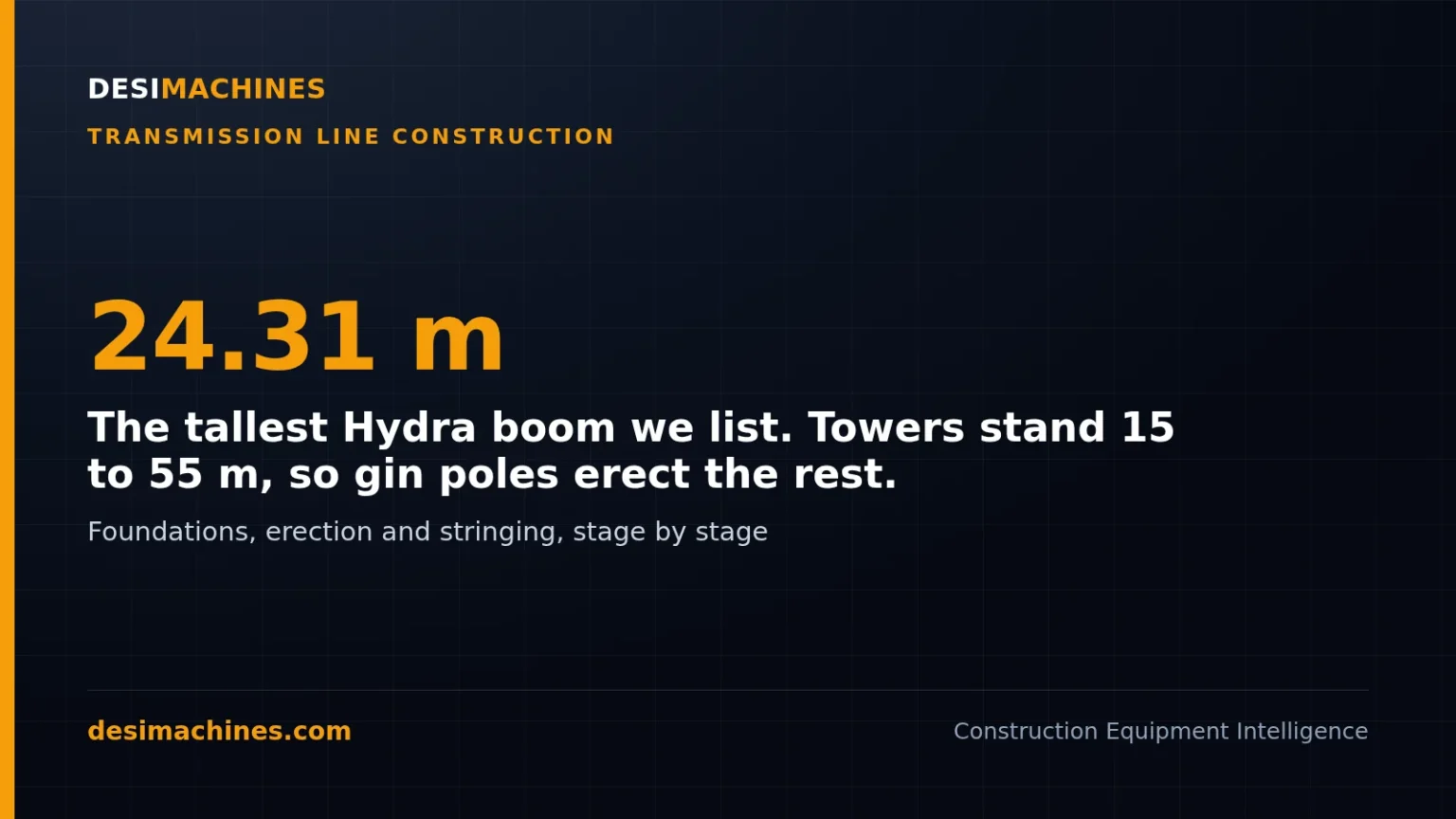
Now set a Hydra against a tower. Transmission towers typically stand 15 to 55 m tall. Across the 57 Hydra (pick-and-carry) cranes whose boom height is stated cleanly in our data, maximum boom height runs from 9.0 m to 24.31 m, with a median of 19.2 m. The tallest is the Indo Power 30FNX at 24.31 m.
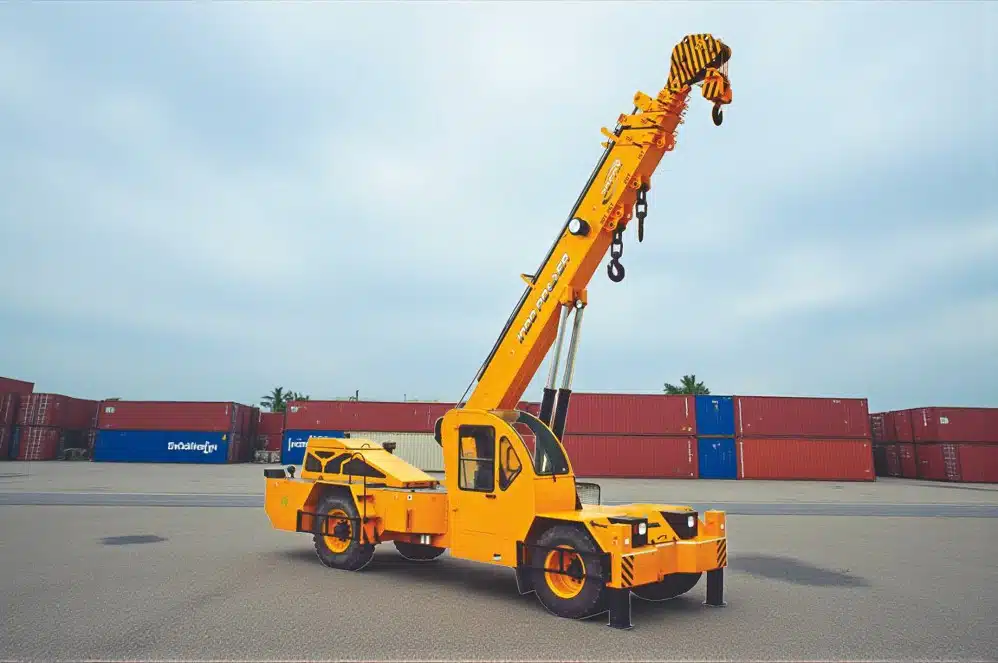
Figure 1: Hydra boom height against typical transmission tower height
Boom height is the tip of the fully raised boom. The hook hangs below it, and the load a Hydra can hold with the boom fully extended is a small share of its rated capacity. So on a tower job the Hydra works at ground level and on the lower body:
- unloading tower steel at the stores yard, which IS 802 Part 6 says should preferably be done with a crane to avoid demurrage, the charge for keeping a truck waiting;
- lifting a ground-assembled bracing or one face of the first section into place;
- moving bundles of members from the stack to the tower spot.
Above that, the gin pole takes over, and the rigging rules are strict. Gin pole guys must be steel wire rope of at least 16 mm, the pole must not lean more than 20 degrees from vertical, one anchor holds one guy only, and a tree is never an anchor. The guide to Hydra crane boom height explains how height, radius and load trade off, and the Escorts Hydra 14 is one of the Hydras buyers ask about most.
How is the conductor strung on the towers?
Stringing means pulling the conductor, the bare wire that carries the power, out along the towers and tensioning it. IS 5613 explains why it is done one section at a time. Spans on a real route are never equal, so one constant tension is applied at the tensioning position and kept the same through the whole section. That tension is worked out from the ruling span, an equivalent span for the section, and the sag of each span follows from it. Sag is how far the wire droops at the middle of a span.
The conductor is handled through roller pulleys at the suspension towers, and IS 802 Part 6 calls for the same pulleys if a cross-arm ever has to be replaced after stringing. The pulling and tensioning machines are specialist stringing gear, and none of the machines we list does this job. For the owner of a general machine, this is where work on the line ends.
What earthing does each tower need?
Every tower is earthed, either with pipe earthing or with counterpoise earthing, chosen by the soil and how well it conducts. Counterpoise is a bare wire buried in a trench that runs out from the tower legs. The contractor measures the tower footing resistance in the dry season, before the earthing is connected to the leg, and IS 802 Part 6 sets the limit at 10 ohms. Above that, more earthing is added until the reading comes down. For a backhoe owner, this is one more short trench at each tower.
What civil work does a substation need?
A substation is the yard where transformers change the voltage between high transmission levels and lower distribution levels. Its civil work is closer to a building site than to a line: footings for transformers and switchgear, cable trenches, roads inside the yard and a levelled, compacted yard. IS 4091 gives heavy electrical equipment mounted on footings a class of its own, with heavy downward load, and suits it to footings with an enlarged base or groups of under-reamed piles.
The machine list is familiar: excavators and backhoe loaders for footings and trenches, self-loading or transit mixers for the concrete, and a soil compactor for the yard. The power plant and transmission construction equipment page tracks the models, live tenders and news for power projects.
Who builds transmission lines, and where are the tenders?
Lines are built by EPC contractors and their subcontractors. The list of who leads the work changes from year to year, so it lives on the blog: see the EPC companies in India. Live tenders for line, substation and civil packages appear on DesiMachines Opportunities.
If you are sizing a road fleet as well, the guide to machinery required for road construction works through it phase by phase.
Where the numbers on this page come from
Erection methods, foundation checks, rigging limits and the 10 ohm earthing limit are from IS 802 (Part 6):2022 (clauses 3.3.1, 3.4.1, 3.6.1, 3.7 and 3.10). Footing classes, black cotton soil piles and the undercut rule are from IS 4091:1979 (clauses 5.1.3.1, 5.1.7 and Table 1), and span ranges and the ruling span from IS 5613 (Part 2/Sec 1):1985 (clauses 6.4.1 and 6.4.2), each read in full for this page. The 15 to 55 m tower height is from the Wikipedia article on transmission towers. Towers and pits per kilometre are our own arithmetic, with the method shown above.
Digging depths, boom heights and drum sizes are read from our own product data in October 2026, only where a machine’s figure is stated cleanly; machines whose two spec records disagree are left out. To plan a foundation package, compare live backhoe loader models and prices, and the heavy equipment guide indexes the rest of this section.
Prices, specifications and features are indicative, vary by variant, location and date, and should always be confirmed with the official OEM or authorised dealer before any purchase decision. DesiMachines is not liable for decisions taken on the basis of information that may have changed after publication.