
 Excavator
294 models
Excavator
294 models  Backhoe Loader
51 models
Backhoe Loader
51 models  Crane
68 models
Crane
68 models  Concrete Mixer
79 models
Concrete Mixer
79 models  Wheel Loader
54 models
Wheel Loader
54 models  Compactor / Roller
45 models
Compactor / Roller
45 models  Motor Grader
42 models
Motor Grader
42 models  Concrete Pump
66 models
Concrete Pump
66 models  Skid Steer Loader
11 models
Skid Steer Loader
11 models  Telehandler
13 models
Telehandler
13 models  Dozer
Dozer 


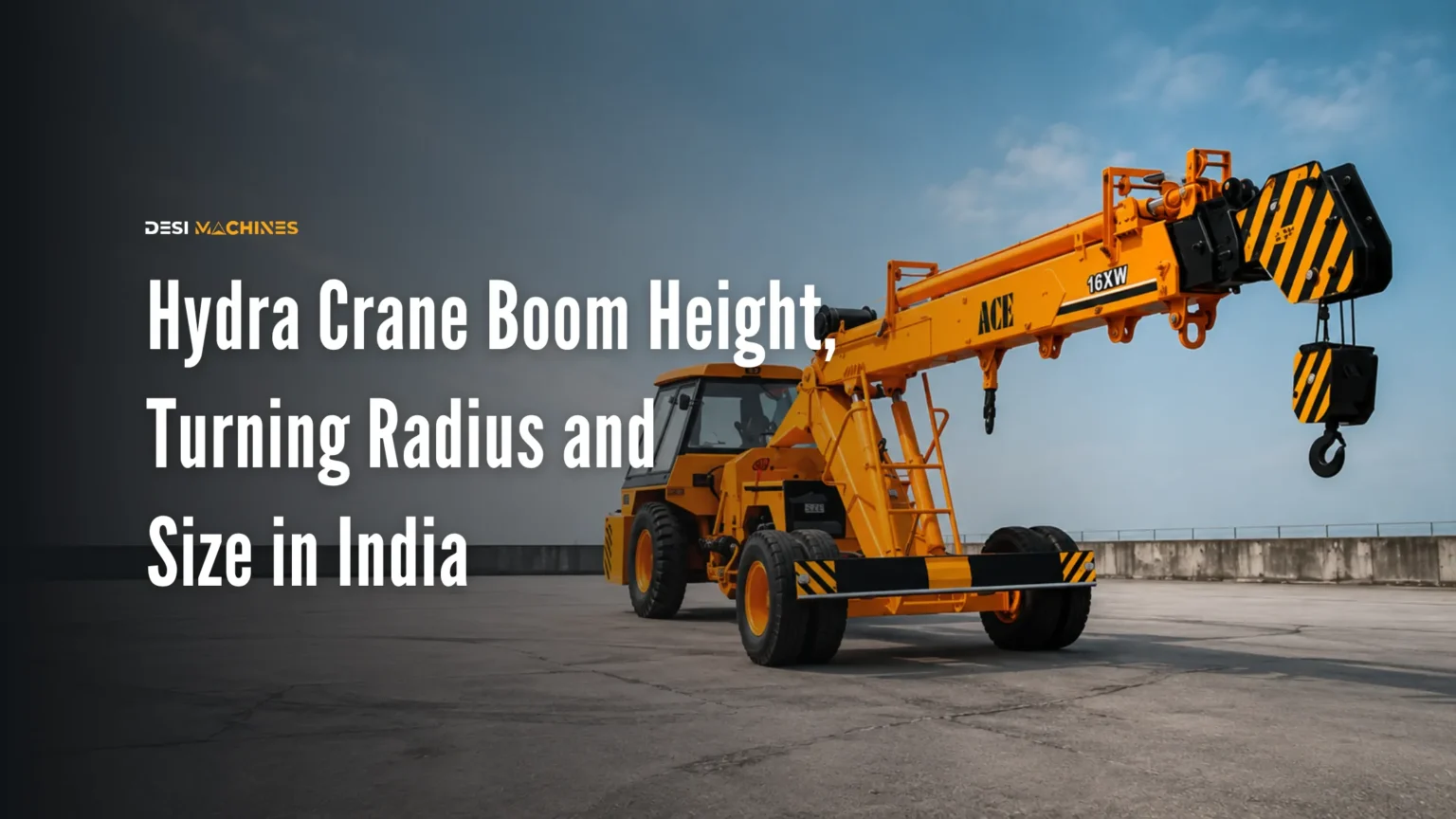
The boom height of a Hydra crane is the maximum height its telescopic boom reaches when fully extended and raised, measured from the ground. Across the 67 pick and carry cranes listed on DesiMachines, that figure runs from 9.0 m (29.5 ft) on the smallest machines to 24.31 m (79.8 ft) on the largest, as per the current Aug 2026 specifications. Boom is the long arm that does the lifting; telescopic means it slides out in sections like the tubes of a folding umbrella.
The number most buyers get wrong is not the boom height itself. It is the assumption that a bigger crane reaches higher. It does not. A 15 tonne machine on this list reaches 21.0 m while a 25 tonne machine reaches 10.53 m, and if you order by tonnage alone you can end up with a heavier crane that cannot get your load over the wall.
This guide covers the three numbers that decide whether a Hydra will actually work on your site: how high the boom goes, how much room the machine needs to turn, and how wide and tall it is when it arrives at your gate.
What is the boom height of a Hydra crane?
Boom height is the manufacturer’s stated maximum height of the boom tip with the boom fully extended and raised to its steepest working angle. Every one of the 67 pick and carry cranes listed publishes this figure, which makes it one of the few specifications you can compare across every brand without gaps.
| Lifting capacity class | Machines listed | Boom height range | In feet |
|---|---|---|---|
| 9–12 Tonne | 5 | 9.0 – 12.84 m | 29.5 – 42.1 ft |
| 13–15 Tonne | 26 | 12.8 – 21.3 m | 42.0 – 69.9 ft |
| 16–20 Tonne | 18 | 17.7 – 22.0 m | 58.1 – 72.2 ft |
| 21–25 Tonne | 10 | 10.5 – 23.1 m | 34.5 – 75.8 ft |
| 27–35 Tonne | 4 | 11.1 – 24.31 m | 36.4 – 79.8 ft |
Figures taken from the published specifications of 63 machines that state a lifting capacity; four Escorts variants do not publish one and are left out of the class table.
Read the ranges rather than the class names. The 21–25 tonne row spans 10.5 m to 23.1 m, a difference of nearly 13 metres inside a single tonnage class. That spread is the whole reason this page exists, and it is covered in the next section.
The shortest booms on the list belong to the ACE Rhino 110C and the ACE Rhino 90C, both at 9.0 m (29.5 ft). The tallest is the Indo Power 30FNX at 24.31 m (79.8 ft). Between those two sits every Hydra and Farana pick and carry crane you are likely to be offered in India.
Does a bigger Hydra crane always have a taller boom?
No. Lifting capacity and boom height are two separate design choices, and on this catalogue they often move in opposite directions. Capacity tells you how much weight the crane can pick up. Boom height tells you how high it can put that weight. A machine can be built strong and short, or lighter and tall.
| Machine | Lifting capacity | Boom height | In feet |
|---|---|---|---|
| ACE HXP 150 | 15 Tonnes | 21.0 m | 68.9 ft |
| Indo Power 25T Mining Master | 25 Tonnes | 10.53 m | 34.5 ft |
| ACE FX 300 | 30 Tonnes | 11.1 m | 36.4 ft |
| ACE 25XW | 25 Tonnes | 23.1 m | 75.8 ft |
| ACE F350 | 35 Tonnes | 22.6 m | 74.1 ft |
The 15 tonne ACE HXP 150 out-reaches the 30 tonne ACE FX 300 by nearly 10 metres. The Indo Power 25T Mining Master does exactly what its name says: heavy, repetitive lifts at low height in a mine or a yard. It carries a two-part boom and stops at 10.53 m. The ACE FX 300 is a three-part boom on a 30 tonne chassis.
The pattern that does hold at the bottom of the range: all five two-part booms on this list stop between 9.0 m and 12.8 m. If a spec sheet says two-part or two-section boom, you already know the machine is short, whatever it lifts. Above two parts the count stops predicting height reliably. There are three-part booms reaching 23.1 m and four-part booms that stop at 15.1 m, so read the stated boom height rather than counting sections. The Hydra crane parts guide explains how the boom sections and the winch work together.
The practical rule: pick your boom height from the job, then check that the machines tall enough for it also lift your load. Doing it the other way round is how contractors end up hiring twice.
How high does a Hydra crane reach in feet?
Indian site conversations happen in feet, while spec sheets are written in metres. These are the common boom heights on this catalogue converted across, so you can check a quotation without doing the arithmetic on site.
| Boom height (metres) | Boom height (feet) | Roughly equivalent to |
|---|---|---|
| 9.0 m | 29.5 ft | A two-storey building |
| 12.8 m | 42.0 ft | Three to four storeys |
| 15.5 m | 50.9 ft | Four to five storeys |
| 18.2 m | 59.7 ft | Five to six storeys |
| 21.0 m | 68.9 ft | Six to seven storeys |
| 24.31 m | 79.8 ft | Seven to eight storeys |
Storey equivalents assume roughly 3 m (10 ft) per floor, which is the usual figure for Indian residential construction. Treat them as a sense of scale for planning, not as a measurement.
One conversion worth memorising: 1 metre is about 3.28 feet, so a 20 m boom is a little over 65 ft. Dealers quote in both, and the two numbers describe the same crane.
Boom height is not hook height: what you actually get
Boom height is measured to the boom tip. Your load hangs below that, and the gap between the two is bigger than most first-time buyers expect.
Three things eat into it. The hook block (the pulley assembly the rope runs through) hangs below the boom tip and takes up height on its own. Your slings or chains add their length between the hook and the load. And the load itself has a height that has to clear whatever you are lifting it over.
So a crane with a 21 m (68.9 ft) boom does not place a load at 21 m. Work backwards from the boom tip: subtract the hook block, subtract the sling length, subtract the height of the load, and what remains is the height you can actually deliver to. On a tall lift with long slings this can easily come to several metres.
The second thing that changes with boom height is capacity. A pick and carry crane lifts far less at full extension than it does with the boom short and steep, and the exact figures are set out in the machine’s load chart. Reading that chart is a separate skill and a necessary one. The crane load chart guide walks through how to read one before you commit to a lift.
Together these two points are the honest summary of boom height: it tells you the maximum the machine can reach, not what it can do at that reach.
What is the turning radius of a Hydra crane?
The minimum turning radius is the tightest circle the crane can steer around, measured from the centre of that circle to the machine. All 67 pick and carry cranes listed publish this figure, and it runs from 5,500 mm (5.5 m / 18.0 ft) to 10,000 mm (10.0 m / 32.8 ft).
The single most common figure on this catalogue is 6,500 mm (6.5 m / 21.3 ft), shared by 18 of the 67 machines. If you are planning around a typical mid-size Hydra and do not yet know the model, that is the sensible number to assume until the dealer confirms it.
| Lifting capacity class | Minimum turning radius | Space needed for a full turn |
|---|---|---|
| 9–12 Tonne | 5,500 – 6,500 mm | about 11.0 – 13.0 m (36 – 43 ft) |
| 13–15 Tonne | 6,500 – 8,500 mm | about 13.0 – 17.0 m (43 – 56 ft) |
| 16–20 Tonne | 6,500 – 8,500 mm | about 13.0 – 17.0 m (43 – 56 ft) |
| 21–25 Tonne | 6,500 – 8,500 mm | about 13.0 – 17.0 m (43 – 56 ft) |
| 27–35 Tonne | 8,200 – 10,000 mm | about 16.4 – 20.0 m (54 – 66 ft) |
The right-hand column is the turning radius doubled, because a full circle needs a diameter, not a radius. This is the arithmetic most site planning gets wrong. A crane with a 6.5 m turning radius needs roughly 13 m (43 ft) of clear width to swing right around, and that is before you allow anything for the boom overhang or for a man to stand clear.
Pick and carry cranes turn tightly for their size because the chassis bends in the middle instead of steering only the front wheels. That bend is called articulation, and on this catalogue it ranges from 35° to 55°, with 40° the most common figure across 32 machines. More articulation means a tighter turn, which is why the two ACE Rhino machines that articulate 55° also hold the smallest turning radius on the list at 5,500 mm.
How wide and how tall is a Hydra crane?
Reach decides whether the crane can do the job. Width and height decide whether it can get to the job at all: through the gate, under the cable, down the approach road.
The third access number is the machine’s own weight, which decides bridges, culverts and soft ground; those figures are in the guide to Hydra crane weight by tonnage class.
| Dimension | Range on this catalogue | In feet | Machines publishing it |
|---|---|---|---|
| Overall width | 2,400 – 2,950 mm | 7.9 – 9.7 ft | 54 of 67 |
| Overall height | 2,700 – 3,450 mm | 8.9 – 11.3 ft | 34 of 67 |
| Operating weight | 7,750 – 27,450 kg | 7.75 – 27.45 tonnes | 67 of 67 |
Width is the one to check first, because it is the one that stops a machine at the gate. The narrowest cranes listed are 2,400 mm (7.9 ft) across, and a standard site gate of 10 ft leaves very little room either side once you allow for the driver’s line of sight. The widest are 2,950 mm (9.7 ft), which will not pass a 10 ft gate in practice.
Overall height matters for what the machine has to travel under: low-tension cables, an entry canopy, a rail underbridge. Only 34 of the 67 machines publish a figure, so ask the dealer directly for the rest rather than assuming.
Operating weight is published for all 67, and it decides two things: whether your approach road and any slab or culvert on it can carry the machine, and what it will cost to transport. The lightest machine listed is 7,750 kg (7.75 tonnes) and the heaviest 27,450 kg (27.45 tonnes), a difference big enough to change which trailer is sent and whether a soft approach needs matting.
If you are weighing a Hydra against a different machine type for the same lift, the telehandler versus crane comparison covers where each one has the advantage. Browse live pick and carry crane models and prices to see the full specifications for any machine named on this page.
How do you check reach and access before you hire or buy?
Do this before the crane is booked, not on the morning it arrives. It takes about twenty minutes on site and it is the difference between a lift that happens and a wasted day’s hire.
- Measure the lift height you actually need, from the ground to where the load has to land, then add the height of the load, the slings and the hook block. That total is the boom height to shortlist against, not the landing height on its own.
- Measure the gate and the approach. Narrowest point of the gate, lowest cable or canopy on the route, and the tightest bend the machine has to get around. Compare these against overall width and overall height, not against the tonnage.
- Pace out the working area. If the crane has to turn on site, you need roughly twice the turning radius in clear width — about 13 m (43 ft) for a typical mid-size machine.
- Check the ground. Operating weight against soft ground, a culvert, a septic tank or a basement slab is a real risk on Indian sites, and it is easier to check than to repair.
- Ask for the load chart for the exact model, and check capacity at the radius you will actually work at. Capacity at maximum boom extension is a fraction of the headline tonnage.
- Confirm every figure against the specific model, not the model family. Variants within one series differ, and four machines on this catalogue do not publish a capacity figure at all.
Buying rather than hiring changes the calculation, because you are choosing for every job you will take over several years, not one lift. The crane buying and rental guide covers that decision, and the used Hydra crane buying guide covers what to inspect on a second-hand machine, where boom wear and steering play matter more than the printed specification.
Whatever you choose, the operator and the lift plan matter more than the machine. The crane safety and operator training guide sets out the rules that apply on Indian sites.
To check which crane suits your lift, enter the heaviest load and the height, and the finder lists cranes that reach it.
Read next
Start with the pick and carry cranes guide if you are still deciding between a Hydra and a Farana, then move to the crane load chart guide to turn a boom height into a real lifting capacity. The complete crane guide covers the wider family, and you can compare live crane models and prices across every brand we list.
Size is one half of the spec sheet; the hydra crane fuel and oil capacities guide covers the other half — how much diesel, hydraulic oil and engine oil each model holds.
Specifications quoted on this page are taken from our listings at the time of writing (Aug 2026) and cover the 67 pick and carry cranes listed. Prices, specifications and features are indicative, vary by variant, location and date, and should always be confirmed with the official OEM or authorised dealer before any purchase decision. DesiMachines is not liable for decisions taken on the basis of information that may have changed after publication.