
 Excavator
294 models
 Backhoe Loader
51 models
 Crane
68 models
 Concrete Mixer
79 models
 Wheel Loader
54 models
 Compactor / Roller
45 models
 Motor Grader
42 models

 Concrete Pump
66 models
 Skid Steer Loader
11 models


Longwall mining takes coal out of an underground seam one long slice at a time. A cutting machine runs back and forth along a straight wall of coal a few hundred metres long, a chain conveyor at its feet carries the coal away, and a line of hydraulic steel roof supports holds the roof up over the crew and then steps forward after every cut.
Behind the supports, nothing is left standing. The roof is allowed to fall into the empty space, called the goaf, and that is the whole difference from the method most Indian coal mines use, bord and pillar, where blocks of coal are left in place to hold the roof.
This guide explains how a longwall face works, the machines on it, how it compares with bord and pillar, and what India’s coal mine regulations say about both. The mining rules quoted are from the Coal Mines Regulations, 2017. There are no prices on this page, because the method does not change and equipment contracts do.
How does a longwall face work?
A longwall face works on a rectangle of coal called a panel. Before cutting starts, two tunnels are driven along the long sides of the panel, from the main roads of the mine out to the far end. These are the gate roads. The one carrying the coal conveyor and the fresh air is the main gate (also called the headgate). The one on the other side is the tailgate. At the far end, a cross tunnel joins the two, and that cross tunnel becomes the face.
All the face machines are set up along that cross tunnel. Then the work goes like this, over and over:
- The shearer, a cutting machine with a spinning drum at each end, travels along the face and cuts a slice off the coal wall. That slice is called a web.
- The cut coal falls onto the armoured face conveyor, a steel chain conveyor that runs the full length of the face, and is carried to the main gate.
- Behind the shearer, the conveyor is pushed forward towards the fresh coal wall, a section at a time, so it snakes along the face.
- The powered roof supports (also called shields or chocks) then lower slightly, pull themselves forward one by one into the newly opened space, and press back up against the roof.
- The roof behind the supports, no longer held up, breaks and falls. That caved space is the goaf.
At the main gate, the coal drops from the face conveyor onto a stage loader with a crusher that breaks big lumps, and from there onto the belt conveyors that run out of the mine. The face keeps moving through the panel this way until the panel is finished, and then the whole set of machines is moved to the next panel.
Fresh air normally comes in along the main gate, sweeps across the face and leaves along the tailgate, carrying dust and mine gases such as methane with it. Wikipedia’s article on longwall mining calls this U-type ventilation.
Figure 1. What you would see walking across a longwall face, from the coal to the goaf
1. Solid coal
The wall of coal still to be cut. The face moves into it.
2. Shearer
Runs along the face on the conveyor and cuts one web of coal.
3. Face conveyor
Steel chain conveyor that takes the cut coal to the main gate.
4. Roof supports
Hydraulic shields. The crew works under their steel canopies.
5. Goaf
Empty space behind the supports where the roof is allowed to fall.
After each cut, items 3 and 4 step forward towards item 1, and item 5 grows by the same amount. The main gate and the tailgate run along the two ends of this strip.
What machines are used in longwall mining?
The face is not one machine but a set of machines that only work together. The table lists them in the order the coal travels.
| Machine | What it does | What to know about it |
|---|---|---|
| Shearer (power loader) | Cuts the coal from the face with two rotating drums fitted with picks | Rides on the face conveyor. Its drums sit on arms that move up and down to follow the seam. The two Indian orders described below came with shearers of up to 750 kW and 2,245 kW installed power |
| Powered roof supports (shields, chocks) | Hold up the roof over the face and the crew, then move forward after each cut | Set side by side along the whole face, each about 1.75 m wide, so a face carries well over a hundred of them |
| Armoured face conveyor (AFC) | Carries cut coal along the face to the main gate | A heavy steel scraper-chain conveyor. The shearer travels on it, and it is pushed towards the coal behind the shearer |
| Stage loader with crusher | Takes coal from the face conveyor, breaks big lumps and loads the gate belt | Sits at the main gate end of the face |
| Gate belt conveyor | Carries coal out along the main gate towards the shaft or incline | Its length changes as the face moves through the panel |
| Power pack and electrics | Pumps the hydraulic fluid for the supports and feeds power to the face | Kept in the main gate and moved along with the face; the Singareni order below included a monorail for it |
To give a sense of scale, one longwall bought by Singareni Collieries came with 154 hydraulic roof supports along 260 metres of face conveyor, according to Coal Age’s report of the order. A complete longwall supplied to Bharat Coking Coal, a Coal India subsidiary, had 149 roof supports, a face conveyor, a beam stage loader with an integrated crusher and a shearer, World Coal reported. The shearer in that set is built, in its maker’s own figures, for seams from 1.80 to 4.50 m thick.
None of these face machines is sold on DesiMachines. They are built to order for one mine and one seam, which is part of why so few Indian mines run a longwall.
What is the difference between retreat and advancing longwall?
There are two ways to lay out the gate roads, and they decide where the face starts.
In retreat longwall, both gate roads are driven all the way to the far end of the panel first. The face is set up at the far end and works its way back towards the main roads, so the face retreats. The gate roads behind the face are no longer needed and are allowed to cave with the goaf. The benefit is that the gate roads are driven through solid coal before any caving starts, so the ground is known before the face reaches it.
In advancing longwall, the face starts near the main roads and moves outwards. The gate roads are built as the face advances, right beside the goaf, and they have to be kept open behind the face for the life of the panel. That takes a lot of support and repair work.
Wikipedia’s account of the method notes that the advancing layout may be used in thinner seams.
What is bord and pillar mining?
Bord and pillar mining (also called room and pillar) cuts the seam into a grid of tunnels and leaves square or rectangular blocks of coal, the pillars, standing between them to carry the roof. The tunnels are called galleries, or bords.
It is worked in two stages. First comes development: the galleries are driven and the pillars are formed. Later comes depillaring: the pillars themselves are mined out, partly or fully, and the roof is allowed to cave behind, or the space is filled with sand (stowing).
India’s Coal Mines Regulations, 2017 set the shape of this grid. Under regulation 111, a gallery may not be more than 3 metres high or 4.8 metres wide anywhere without the Regional Inspector’s written permission, and pillars should normally be rectangular. The same regulation sets a minimum distance between the centres of two neighbouring pillars, which grows with depth, because deeper pillars carry more rock above them.
| Depth of seam from surface | Galleries up to 3.0 m wide | Up to 3.6 m wide | Up to 4.2 m wide | Up to 4.8 m wide |
|---|---|---|---|---|
| Not over 60 m | 12.0 m | 15.0 m | 18.0 m | 19.5 m |
| 60 to 90 m | 13.5 m | 16.5 m | 19.5 m | 21.0 m |
| 90 to 150 m | 16.5 m | 19.5 m | 22.5 m | 25.5 m |
| 150 to 240 m | 22.5 m | 25.5 m | 30.5 m | 34.5 m |
| 240 to 360 m | 28.5 m | 34.5 m | 39.5 m | 45.0 m |
| Over 360 m | 39.0 m | 42.0 m | 45.0 m | 48.0 m |
The table gives the minimum distance between pillar centres, from regulation 111(4) of the Coal Mines Regulations, 2017.
That table says a lot about how much coal stays behind. Take square pillars with 4.8 m galleries. At 100 m depth, centres are at least 25.5 m apart, so each pillar is at least 20.7 m on a side, and only about a third of the coal (34%) comes out during development. Under 60 m of cover the figure is about 43%. Below 360 m it falls to about 19%, because the pillars have to be so big. These percentages are our own arithmetic from the table, for square pillars at the minimum spacing; the rest of the coal can only come out later through depillaring, which needs its own permission under regulation 112.
The machines in a mechanised bord and pillar mine are smaller and more mobile than a longwall: continuous miners that cut the galleries, roof bolting machines, and loaders and haulers such as side discharge loaders, load haul dumpers and shuttle cars. The regulations name all of these machines in their rules on roof canopies, cabs and methane monitors (regulations 126 and 214).
Longwall vs bord and pillar: which is better?
Neither is better everywhere. Longwall wins on output and on how much of the panel it takes out; bord and pillar wins on flexibility and on how little money it needs to start.
| Question | Longwall | Bord and pillar |
|---|---|---|
| What holds up the roof? | Hydraulic shields at the face; the roof behind is left to cave | Pillars of coal left standing, plus roof bolts and props in the galleries |
| How much coal comes out? | Nearly all of the panel between the gate roads | A part during development; more only if the pillars are later extracted |
| How the coal moves | Continuously, on conveyors from face to surface | In batches, by loaders, haulers or shuttle cars to a belt |
| Machines needed | One large, matched set built for the seam | Several smaller machines that can be moved between districts |
| Ground it suits | Flat, even seams with long, uninterrupted panels | Seams broken by faults, irregular shapes, smaller blocks |
| Surface above | Subsides as the goaf caves; settlement is planned for | Can be kept from subsiding if pillars are left in place |
| Permission under CMR 2017 | Needs the Chief Inspector’s written permission (regulation 113) | The standard system; depillaring needs the Regional Inspector’s permission (regulation 112) |
The most important practical point is the last but one. A longwall leaves nothing under the surface to hold it up, so the land above sinks as the face passes. Where there is a village, a road or a railway line above the coal, a mine may have to leave pillars in place, and that pushes it towards bord and pillar. Regulation 119 of the Coal Mines Regulations, 2017 already bars any working, or any pillar extraction, within 45 metres of a railway, a public road, a building or other permanent structure not owned by the mine, unless the Chief Inspector gives written permission.
Is longwall mining used in India?
Yes, but in far fewer mines than bord and pillar, which remains the common method in Indian underground coal. The regulations themselves show which system is the default: regulation 113 says that no development or extraction by any system other than bord and pillar may start without the previous written permission of the Chief Inspector of Mines, and the application has to show the manner and extent of the work on an up-to-date plan.
Longwall faces in India have been run by the coal companies’ underground mines, among them Singareni Collieries and Coal India subsidiaries such as Bharat Coking Coal. For how the coal sector is organised, see the guide to mining companies in India.
Three things keep the number low. A longwall is a large, single investment that only pays back on long, regular panels, and it needs the Chief Inspector’s permission before work starts. Bord and pillar can work smaller or broken blocks of coal with machines that move from one district to the next. And most Indian coal is mined from the surface, which is cheaper still where the seam is shallow enough, as the guide to types of mines in India explains.
What do India’s mining rules say about a longwall face?
Several parts of the Coal Mines Regulations, 2017 speak to longwall work directly. In plain words:
- Permission first. Regulation 113: a method other than bord and pillar needs the Chief Inspector’s written permission before any development starts.
- Supports move up quickly. Regulation 124(18): powered supports must be advanced as soon as practicable after a web of coal is taken, so that the unsupported roof is kept to a minimum. A defective support must be attended to quickly, and where a support cannot hold the roof, enough conventional supports must be set instead.
- A plan for moving the supports. Regulation 125(3) and (4): every mine using powered supports needs a plan for installing them and a plan for withdrawing and transporting them, reviewed and approved by the Regional Inspector before it is used.
- Enough air across the face. Regulation 160: at the maximum span of a longwall face the air must move at no less than 60 metres per minute in a first or second degree gassy seam, and 75 metres per minute in a third degree seam.
- Gas monitors on the machines. Regulation 214: methane monitors must be fitted on longwall face equipment, continuous miners and other machines that cut or load coal, and face machines must have dust controls such as water sprays.
These figures come from the 2017 regulations, made under the Mines Act, 1952. Mine safety law in India is moving under the Occupational Safety, Health and Working Conditions Code, 2020, so always check the current DGMS rules before planning any underground work. Water handling underground has its own rules too; the guide to mine dewatering covers how mines keep workings dry, and the guide to dust suppression in mines covers sprays and dust control.
Where do surface machines fit in an underground coal mine?
Everything at the face is special underground equipment, but once the coal reaches the surface the work looks like any coal yard. The belt drops coal onto a stockpile. Dozers push it up and spread it, and wheel loaders load it into trucks or railway wagons.
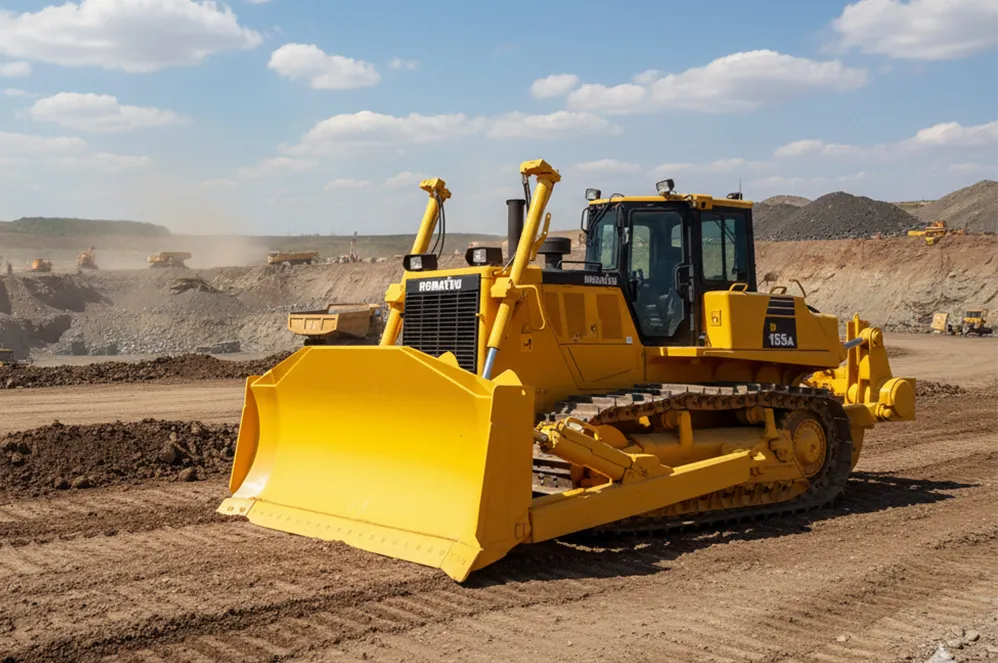
That is the part of an underground mine where machines sold in India’s open market do the work. Mining dozers such as the Komatsu D155A-6 and the BEML BD155 work stockpiles, and large wheel loaders such as the Volvo L150H load out. Compare the full range of dozers and wheel loaders, and talk to a dealer about the duty you need.
Where the same seam comes close enough to the surface, the coal is dug opencast instead, and the guide to overburden removal in opencast mining explains that side. Where an opencast pit reaches its final wall, highwall mining can take some of the coal behind it without going underground. The guide to mining equipment sets out which machine does which job across all of these, and the rest of the series sits on the mining guide hub.
Sources: Coal Mines Regulations, 2017 (DGMS), regulations 111, 112, 113, 119, 124, 125, 126, 160 and 214; Wikipedia, Longwall mining; Wikipedia, Room and pillar mining; Coal Age, “Bucyrus Sells First High Performance Longwall to India”, 18 February 2010; World Coal, “Caterpillar to supply complete longwall system to Coal India subsidiary”, 11 October 2017.
Prices, specifications and features are indicative, vary by variant, location and date, and should always be confirmed with the official OEM or authorised dealer before any purchase decision. DesiMachines is not liable for decisions taken on the basis of information that may have changed after publication. Mining method descriptions in this guide are general; any real mine layout, support design or extraction plan must be worked out for its own seam by qualified mining engineers and approved under the rules in force.
Machines, tenders and news for this industry: Mining · Quarry
