
 Excavator
294 models
 Backhoe Loader
51 models
 Crane
68 models
 Concrete Mixer
79 models
 Wheel Loader
54 models
 Compactor / Roller
45 models
 Motor Grader
42 models

 Concrete Pump
66 models
 Skid Steer Loader
11 models


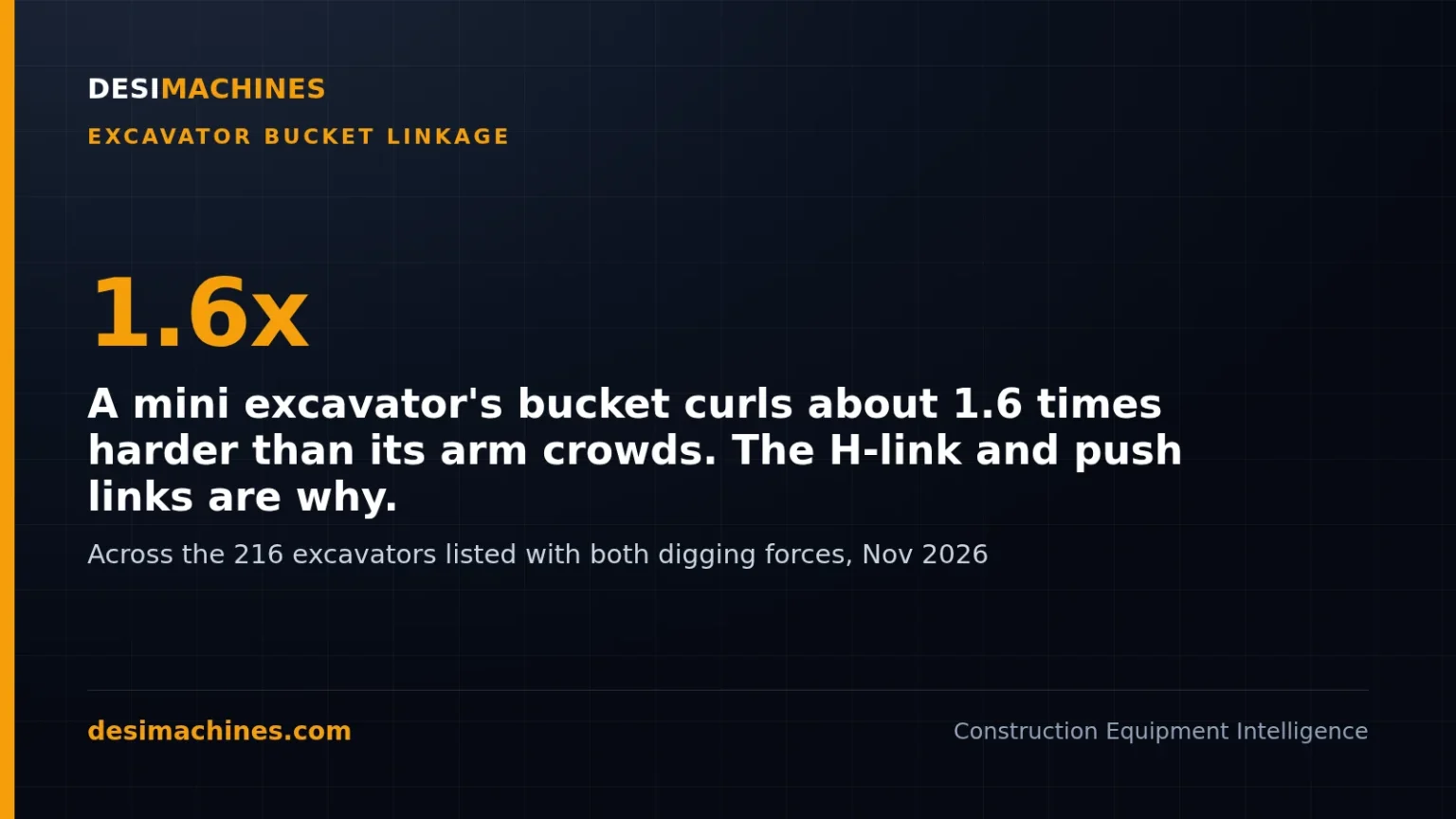
On the mini excavators we list, the bucket curls about 1.6 times harder than the arm crowds. The part that makes that happen is the excavator bucket linkage: the H-link and the pair of push links, called dog bones on site, sitting between the arm tip, the bucket cylinder and the bucket.
It is a small assembly. Two plates, two short links, a handful of pins and their bushes. It carries everything the bucket cylinder can produce, it decides how far the bucket can roll back, and it is the reason a bucket off a 20-tonne machine will not drop straight onto a 14-tonne one.
This guide covers what each link does, why the bucket pulls harder than the arm and by how much across the size classes, what has to match before a bucket from another machine goes on, and how a tired linkage tells you about itself. It carries no prices, because a link, a pin or an H-link is quoted against your exact machine. If one of those is what brought you here, the construction equipment spare parts page is where to raise the request with your machine details.
What is the bucket linkage on an excavator?
The bucket linkage is the short chain of parts that converts the straight push of the bucket cylinder into the rolling movement of the bucket. Four pieces do the work: the arm, the H-link, the push links and the bucket itself. Count the joints between them and there are four, which makes this a four-bar linkage, the arrangement an engineer would recognise as the simplest closed-chain movable linkage: four bodies connected in a loop by four joints, with one link fixed, one driven and one floating between them.
Here the arm is the fixed link. The H-link is the driven one, because the cylinder rod pushes on it. The push links float between the H-link and the bucket, and the bucket swings on its pin at the arm tip.
Figure 1: The four links and five pins of an excavator bucket linkage
- A, the pin holding the H-link to the arm. The H-link rocks about it.
- B, the pin joining the bucket cylinder rod to the top of the H-link.
- C, the pin joining the lower end of the H-link to the push links.
- D, the pin joining the push links to the rear lug of the bucket.
- E, the bucket pin at the arm tip, which is the hinge the bucket turns on.
Pins A, C, D and E are the four joints of the linkage. B belongs to the cylinder. On most machines the H-link is a pair of parallel plates with the cylinder rod between them, which is where the name comes from, and the push links are two separate bars, one on each side of the bucket. The excavator parts and components guide shows where this sits in the rest of the front end.
What does the H-link do, and what do the push links do?
The H-link is a lever. The cylinder rod pushes its top end, it rocks about its pin on the arm, and its bottom end swings forward through a shorter distance than the rod travelled. Shorter distance at the same job means more force, and that is the whole trick. The push links then carry that force in a straight pull to the back of the bucket, well away from the bucket’s own hinge pin, so the bucket turns.
Two separate links are used instead of one long one for a plain reason. The cylinder can only push along its own centre line, while the bucket swings through an arc of well over a hundred degrees. A single rigid connection would bind. Splitting the job between a rocking H-link and a floating push link lets the cylinder stay straight while the bucket sweeps all the way from flat to fully rolled back.
This also explains why the two push links are usually the slimmest part of the whole front end. They are loaded along their length, in tension or compression, which steel handles very efficiently. The H-link is the bulky one because it is loaded sideways, as a bent lever.
How does the linkage multiply the cylinder’s force?
Through lever lengths, twice over. The bucket cylinder pushes the top of the H-link, and the H-link rocks about its pin on the arm. The distance from that pin up to the cylinder pin is longer than the distance down to the push-link pin, so the lower end travels less and pushes harder. The push links then deliver that force to the bucket’s rear lug, which sits well back from the bucket’s hinge pin, and the gap between those two gives a second lever.
This is why a spec sheet publishes two digging forces instead of one. The Bureau of Indian Standards asks for both on the selection data sheet for a hoe excavator: IS 12669 (Part 1) : 2023 calls for the “digging forces (maximum radial force at tooth) with bucket cylinder and with arm cylinder for different arm/boom combinations”. The first of those is what this linkage delivers. The excavator digging force guide holds the figures by size class and which number matters for which work; what is worth noticing here is the shape of them.
On a small machine the linkage does most of the digging. The 1,980 kg SANY SY20U is rated at 15.3 kN from the bucket against 9.2 kN from the arm, and through the mini class the bucket figure runs around 1.6 times the arm figure. The advantage narrows steadily with size. A 12,800 kg JCB 130 gives 84.4 kN and 56.8 kN, and by the 20-tonne class the two have nearly met, with the 20,300 kg Tata Hitachi EX 210 Infra Super+ Series listing 120 kN and 115 kN.
The reason is that the arm grows faster than the linkage does. A big machine carries a long heavy arm on a large cylinder with a long lever of its own, so arm force climbs quickly and on a handful of machines passes bucket force altogether. The 45,000 kg Komatsu PC450LC-7 is one of them, at 287 kN from the bucket against 327 kN from the arm.
Note the words the standard uses: maximum radial force at tooth. It is a peak, not a constant. The leverage through a four-bar linkage changes as the links move, so the bucket is at its strongest over one part of its sweep and weaker at the ends of it. Any operator who has felt the bucket stall near the end of a curl and then bite again after easing the arm has felt exactly that. It is also why an over-wide bucket tends to run out of force at one point in the curl while digging perfectly well either side of it.
Will a bucket from another machine fit?
Only if the linkage interface matches, and that is four separate measurements. No Indian Standard sets them: the BIS standards covering excavator buckets deal with volumetric rating, which is how capacity is calculated and not how a bucket mounts. Makers are therefore free to choose their own pin sizes and lug spacings. Attachment makers do publish indicative charts of pin diameter by weight class, and the pin and bush kit guide carries those alongside the makes sold in India, but they are a starting point rather than an authority. The binding dimensions are the ones in the operator manual for your machine.
Four things have to agree before a bucket goes on.
- Pin diameter, at both the bucket pin and the push-link pin. These are rarely the same size as each other.
- Pin centres, the distance between the bucket’s hinge bore and its rear lug bore. Get this wrong and the bucket will hang on one pin but the second will never line up.
- Lug gap and width, the clear space between the bucket’s two mounting ears, which has to take the arm tip at one pin and the push links at the other.
- Bucket weight and capacity for the class, because the linkage and the machine’s stability were sized for a particular bucket.
That last one is the item people skip. A bucket that bolts up perfectly can still be the wrong bucket, because capacity is matched to the machine and not to the pins. The excavator bucket capacity ranges by size class set the sensible envelope, and the excavator bucket types guide covers choosing a profile for the material.
| Size class (catalogue) | Excavators listed | How the linkage interface behaves in this class |
|---|---|---|
| Mini (0–6 Ton) | 49 | The smallest pins and the narrowest lug gaps of any class. A bucket from one class up will usually not pass over the arm tip at all, so mistakes are obvious early. |
| Small (6–15 Ton) | 46 | Pin sizes and lug widths step up more than once inside the class. A bucket built for a 7-tonne machine and one built for a 14-tonne machine rarely interchange. |
| Medium (15–25 Ton) | 76 | The most crowded class on the market and the riskiest for swaps, because buckets from different makes look interchangeable on sight and generally are not. |
| Large (25–50 Ton) | 46 | Thicker H-link plates and larger bushes. Bucket weight now matters for lift and stability as much as the fit of the pins does. |
| Extra-large (>50 Ton) | 51 | Mining-duty linkages, normally matched to one bucket family by the maker and not swapped in the field. |
This is a general guide based on machine size class. Always confirm the fit with your machine’s operator manual or the manufacturer before buying or fitting. Machine counts are the excavators listed in each catalogue class as of November 2026.
What a replacement set holds, and how worn pins and bushes are measured and pressed out, sits in that same pin and bush guide rather than being repeated here.
What are the signs of a worn bucket linkage?
Play, and then noise. A linkage wears at its four pins and their bushes, and because the bucket sits at the end of the chain, every bit of wear in front of it shows up multiplied at the teeth.
The quickest field check costs nothing. Rest the bucket flat on firm ground, with the engine off and the controls locked, and push the bucket sideways by hand at one corner. A tight linkage barely moves. A worn one rocks, and you will often hear the pins knock as it does.
- Side-to-side wobble at the bucket, worst when the bucket is rolled fully back.
- A knock or clunk each time curl is reversed, which is the slack in the pins being taken up.
- Grease that will not stay in a joint, and a pin that runs dry and bright between services.
- Bent push links, almost always from prying sideways with the bucket rather than from digging.
- Cracks in the H-link around a pin boss, or a weld starting to open there. Stop work and have that inspected before the next load.
- Teeth wearing unevenly across the bucket, which can mean the bucket is sitting skewed on slack pins.
Worn pins and bushes are a cheap repair caught early and an expensive one caught late, because a loose pin wears the bore it sits in. Once the bore in an H-link or a bucket lug has gone oval, the fix moves from replacing a pin to machining or rebuilding the part. Keeping to the greasing interval in the manual is most of the job, and the greasing points, grades and intervals guide sets out where the front-end joints sit in a daily round.
What is an H-link made of, and what moves its price?
An H-link is a steel part built to be loaded sideways, so it is either a weldment of thick plate or a forging, with machined bores at each pin position and a bush pressed into each bore. The bushes are the sacrificial parts: they are meant to wear instead of the bores, which is why replacing them on time is what keeps the link itself alive. Push links are simpler, being a bar with a bushed bore at each end.
The price of any of these is quoted against the machine rather than listed, and several things move it. Machine class and pin size matter most, since the part scales with the machine. Beyond that: whether the link is forged or fabricated, how many bores need machining, whether bushes and pins are supplied with it, and whether you are replacing one push link or a matched pair. For a cracked H-link there is also a choice between a new part and a repair, and that depends on where the crack sits.
What none of this changes is the order of work. Measure the pins and bores first, decide what is actually worn, and quote against that. A set of pins and bushes fitted into an oval bore will be loose again within weeks.
The parts and running costs guides collect the rest of the front-end service items, and how excavator components work puts the linkage back in the context of the boom, arm and hydraulics. If you are sizing a machine rather than mending one, the 15 to 25 ton excavators and the full range of excavators listed in India are the place to compare digging forces side by side and connect with a dealer near you.
Sources: Bureau of Indian Standards, IS 12669 (Part 1) : 2023, Bulk Handling Equipment, Hydraulic Excavator, Data Sheet for Selection, Part 1 Hoe, clause 4; Wikipedia, Four-bar linkage. Machine figures are from the listed technical specifications at the time of writing. Pin sizes, torques and service intervals for your own machine must be taken from its operator manual. Specifications and features are indicative, vary by variant, location and date, and should always be confirmed with the official OEM or authorised dealer before any purchase decision. DesiMachines is not liable for decisions taken on the basis of information that may have changed after publication.
Get a bucket linkage parts price from a dealer near you
Tell us your machine and what you need, and we will ask the nearest dealer to reach out to you with a price.