
 Excavator
294 models
Excavator
294 models  Backhoe Loader
51 models
Backhoe Loader
51 models  Crane
68 models
Crane
68 models  Concrete Mixer
79 models
Concrete Mixer
79 models  Wheel Loader
54 models
Wheel Loader
54 models  Compactor / Roller
45 models
Compactor / Roller
45 models  Motor Grader
42 models
Motor Grader
42 models  Concrete Pump
66 models
Concrete Pump
66 models  Skid Steer Loader
11 models
Skid Steer Loader
11 models  Telehandler
13 models
Telehandler
13 models  Dozer
Dozer 


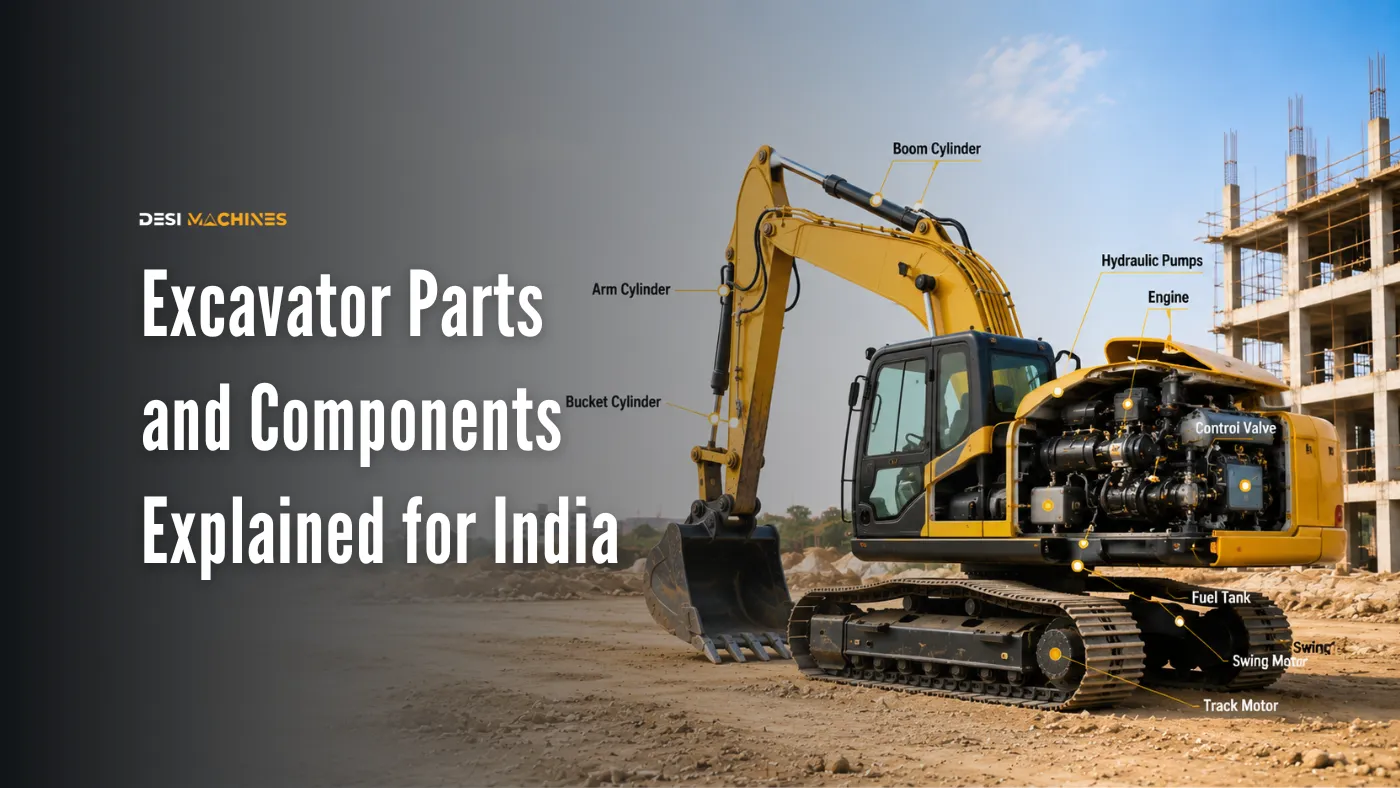
Every specification below is taken from our listings at the time of writing, drawn from the 294 excavators currently listed for India.
What are the main parts of an excavator?
Watch a machine work and you can see the split. The tracks stay on the ground. Everything above them turns as one body. Out in front, three linked pieces reach out and fold back. Nothing else moves on its own.
That is the whole layout:
- Undercarriage — the tracks, rollers, idlers, sprockets and travel motors. It takes the weight and moves the machine.
- Upper structure, also called the house or the revolving frame: engine, hydraulic pumps, cab, fuel and hydraulic tanks, swing motor and counterweight. It sits on a large bearing and turns through a full circle.
- Front, or working equipment: boom, arm (many operators call it the dipper or stick) and bucket, with the cylinders that move them.
- Hydraulic system: pumps, control valve, cylinders, motors, hoses and the oil itself. It carries the engine’s power to every moving part.
The one part that joins the top half to the bottom half is the slew ring, a large toothed bearing that lets the upper structure rotate over the tracks. Oil crosses that joint through a swivel joint in the middle, which is what lets the house turn without twisting a single hose.
Parts naming is the same across the family, so if you have read the backhoe loader parts guide or the guide to Hydra and Farana crane parts, much of this will already be familiar.
What are the parts of the excavator front?
The front is three steel pieces and four or five cylinders. The boom is the big curved section bolted to the house at one end. The arm hangs off the boom’s far end. The bucket hangs off the arm, connected through a pair of links that make it curl further than the cylinder alone could manage.
Each joint has its own cylinder, and the length of each steel piece sets the machine’s reach. On the excavators listed for India, boom length runs from 1,810 mm on a 1.8-tonne SANY SY20U up to 6,000 mm on a 25-tonne Volvo EC250D. Arm length runs from 950 mm to 3,000 mm across the same span. A longer arm reaches further and digs deeper; it also digs with less force, which is the trade every long-reach machine makes.
Table: excavator front-end parts by size class — as per current August 2026 specifications
| Part | Mini (0–6 T) | Small (6–15 T) | Medium (15–25 T) |
|---|---|---|---|
| Boom length | 1,810–3,000 mm | 2,900–4,700 mm | 5,650–6,000 mm |
| Arm length | 950–1,600 mm | 1,620–3,000 mm | 2,200–3,000 mm |
| Bucket capacity | 0.04–0.22 m³ | 0.09–1.0 m³ | 0.17–1.85 m³ |
| Bucket digging force | 15.2–45 kN | 47–110.7 kN | 107.9–188.8 kN |
| Operating weight | 1,800–5,780 kg | 7,050–14,700 kg | 19,760–25,500 kg |
Digging force is quoted in kN, or kilonewtons, a unit of force. As a rough feel, 10 kN is about the weight of one tonne pressing down. So a medium machine’s bucket tears into ground with the force of roughly 12 to 19 tonnes concentrated at the teeth.
The bucket teeth are separate parts, pinned onto an adapter welded to the bucket lip, and they are meant to be replaced. That is the point of them: teeth wear away instead of the bucket. Bucket shape changes with the job, and the guide to excavator bucket types covers rock, general purpose, ditching and grading buckets in detail.
What is in an excavator undercarriage?
The undercarriage is the part that costs the most to neglect. Working from the outside in, it holds the track chain and the track shoes bolted to it, the sprocket at the back that drives the chain, the idler at the front that guides it, the bottom rollers that carry the machine’s weight along the chain, the top rollers that hold the slack run above, and the travel motor and final drive at each sprocket.
Numbers make it concrete. On a 20-tonne machine such as the Tata Hitachi EX 210 Infra Super+, each side runs 49 track shoes, 7 bottom rollers, 2 top rollers and a 600 mm shoe width, with a ground bearing pressure of 46 kPa, which is the pressure the machine puts on soft ground.
Across the listed machines, track shoe width runs from 230 mm on the smallest minis to 610 mm on a 22-tonne class machine, and the bottom roller count climbs with size: three or four on minis, seven on most 20-tonne machines, and eight or nine on the largest. Track tension is adjusted by grease on every machine that lists the method — a grease cylinder behind the idler pushes it forward to take up slack.
Nothing on an excavator wears faster, and nothing is easier to wear out early. The dedicated guide to the excavator undercarriage, its wear and maintenance goes through track sag measurement, what shortens component life on Indian sites, and when a chain is finished.
What is inside the upper structure?
The upper structure is a welded steel frame carrying everything that is not the tracks or the front. At the back sits the counterweight, a solid block of cast iron that balances the load out in front. Remove it and the machine would tip forward with a full bucket, which is why its clearance from the ground, 1,050 mm on that 20-tonne Tata Hitachi, appears on the spec sheet.
Ahead of the counterweight sits the engine with its radiator and air filter, then the hydraulic pumps driven directly off the engine’s flywheel, the main control valve, and the fuel and hydraulic tanks. The cab sits to the left of the boom on almost every machine.
The whole assembly turns on the slew ring, driven by a swing motor through a reduction gearbox. Swing speed on the listed machines runs from 8.3 to 13.8 rpm, which is between four and seven seconds for a full turn. The tailswing radius tells you how far the back of the house sweeps out when it turns: 2,910 mm on that same 20-tonne machine, which is why zero-tailswing minis exist for work between walls.
Tank sizes give a useful sense of scale. Fuel tanks run from 17 litres on the smallest mini to 580 litres on a large 25-tonne machine. Exact oil volumes per machine are listed in the guide to engine oil and hydraulic oil capacity of excavators in India.
What does the hydraulic system contain?
An excavator is a hydraulic machine with a diesel engine attached. The engine turns pumps; the pumps do everything else.
Most machines listed here use two variable displacement axial piston pumps plus a small gear pump for the pilot circuit. Variable displacement means each pump moves only as much oil as the operator is asking for, which saves fuel when the levers are half open. The pilot pump does no digging at all — it carries the low-pressure oil that makes the joysticks work.
From there the oil splits into circuits, each at its own pressure. On the 20-tonne example the implement circuit runs at 27.9 MPa, the swing circuit at 26.9 MPa, the travel circuit at 34.3 MPa and the pilot circuit at just 3.9 MPa. Across the range, implement pressure runs from 14.7 MPa on the smallest minis to 37.3 MPa on a 22-tonne machine. MPa means megapascal; one MPa is about 10 bar, so 27.9 MPa is roughly 279 bar.
Replacing a hose on any of these circuits means matching the hose’s pressure rating to the circuit it sits on rather than to the machine. The sizing, pressure ratings and fittings are set out in the guide to excavator hydraulic hose sizes and fittings.
Two other numbers matter and are often confused. The hydraulic tank holds 8.3 to 277 litres depending on size; the hydraulic system figure is larger, 220 litres against a 129-litre tank on the Tata Hitachi, because it counts the oil sitting in the hoses, cylinders and motors as well. Order oil for a full change against the system figure, not the tank figure. How far the system figure runs above the tank figure across the whole class, and why that gap decides how a machine copes with a hot afternoon, is covered in excavator hydraulic oil temperature.
The rest is plumbing you can see: hoses, steel lines, the swivel joint at the centre of the slew ring, filters and coolers. Hydraulic system maintenance covers oil grades, filter intervals and the contamination that finishes pumps early.
Which excavator parts wear out first in India?
Wear follows dust, water and hours, and Indian sites supply plenty of the first two. In rough order of how quickly you will meet them:
- Bucket teeth and adapters. Weeks on rock, months on soil. Designed to go, cheap to replace, and expensive to ignore. A worn tooth lets the adapter wear, and the adapter is welded on.
- Filters. Air, fuel, engine oil and hydraulic filters, all on fixed hour intervals. Fine dust shortens every one of them.
- Undercarriage. Chain, shoes, rollers, idler and sprocket, worn as a set. Abrasive soil, running on hard rock and slack track tension all speed it up.
- Hoses and seals. Rubber ages, and a hose rubbing on a frame edge will fail long before its time.
- Bushes and pins at the boom, arm and bucket joints, which is where greasing intervals earn their keep — see greasing points, grades and intervals.
For the parts that sit inside the engine or the hydraulics, fit only parts that meet the maker’s specification. The spare parts guide explains what to check before you fit one.
Looking for a machine? Browse the current range of excavator models and specifications and get a quote from a dealer near you.
How do you check these parts before buying a machine?
Walk the machine in the order the parts are grouped, and take an hour over it.
Start with the undercarriage, because it is the most expensive thing on a used excavator and the hardest to hide. Look at shoe wear, roller leaks and the amount of track sag. Then the front: check the pins and bushes at each joint for play by rocking the bucket, and look at the cylinder rods for scoring and weeping.
In the house, look for oil where oil should not be, particularly under the pumps and around the swivel joint. Start the machine cold and listen. Then work it: swing full circle both ways, curl and dump the bucket, track forward and back, and watch whether anything drifts down under its own weight when the levers are centred.
Finally read the sheet against the machine in front of you. The guide to reading an excavator spec sheet explains which numbers matter, and excavator engine power by size class shows what the engine should be for that weight. For a full inspection routine on a second-hand machine, the hour-by-hour service schedule tells you what should already have been done at the hours on the meter.
A note on the figures in this guide
Every number above is read off the specifications of machines currently listed on DesiMachines, and the ranges cover the mini, small and medium classes an Indian buyer usually chooses between. Mining-class machines of 50 tonnes and upward run to much larger figures and are left out on purpose, because quoting them alongside a 20-tonne machine makes both ranges useless.
Specifications also differ by variant. Boom and arm lengths in particular are build options on many models, so the sheet for the exact machine you are buying is what counts. Where a figure is not listed for a model, it is left out rather than estimated.
Excavator parts, in short
Four groups, and every part belongs to one. The undercarriage carries and moves the machine and wears fastest. The upper structure holds the engine, cab and counterweight and turns on the slew ring. The front reaches and digs, with boom, arm and bucket sized to the class. The hydraulic system carries the power to all of it through pumps, valves, cylinders and motors.
Knowing which group a part belongs to is enough to hold a sensible conversation with a mechanic or a seller, and enough to know which noise is worth stopping the machine for. The same layout, with different names for the front, applies to the other machines on your yard: see the road roller parts guide and the wider parts and running costs guides for the rest of the family. If you are still choosing a size, start with the mini excavator guide and the full range of mini excavators.
The consumable side of those systems is covered separately: the guide to excavator filters explains what the air, fuel, hydraulic and oil filters each protect and what a blocked one costs.
The same part groups on a wheeled machine work differently, and the comparison is covered in the guide to wheel loader parts and components.
When one of those cylinders stops holding its load and the boom sinks with the levers centred, the fault is a seal or a valve rather than the pump: see our guide to excavator boom drift.
The same part-by-part treatment for tracked dozers is in our guide to bulldozer parts and components, where the undercarriage carries the whole machine rather than just the tracks.
Pin sizes by machine class and the signs that a joint needs new pins and bushes are set out in a separate guide.
On mini machines the rubber track carries its own three-number size code rather than a steel chain part number, and mini excavator rubber track size sets out the width, link count and tensioning method for the whole 0-6 tonne class.
Prices, specifications and features are indicative, vary by variant, location and date, and should always be confirmed with the official OEM or authorised dealer before any purchase decision. DesiMachines is not liable for decisions taken on the basis of information that may have changed after publication.