
 Excavator
294 models
Excavator
294 models  Backhoe Loader
51 models
Backhoe Loader
51 models  Crane
68 models
Crane
68 models  Concrete Mixer
79 models
Concrete Mixer
79 models  Wheel Loader
54 models
Wheel Loader
54 models  Compactor / Roller
45 models
Compactor / Roller
45 models  Motor Grader
42 models
Motor Grader
42 models  Concrete Pump
66 models
Concrete Pump
66 models  Skid Steer Loader
11 models
Skid Steer Loader
11 models  Telehandler
13 models
Telehandler
13 models  Dozer
Dozer 


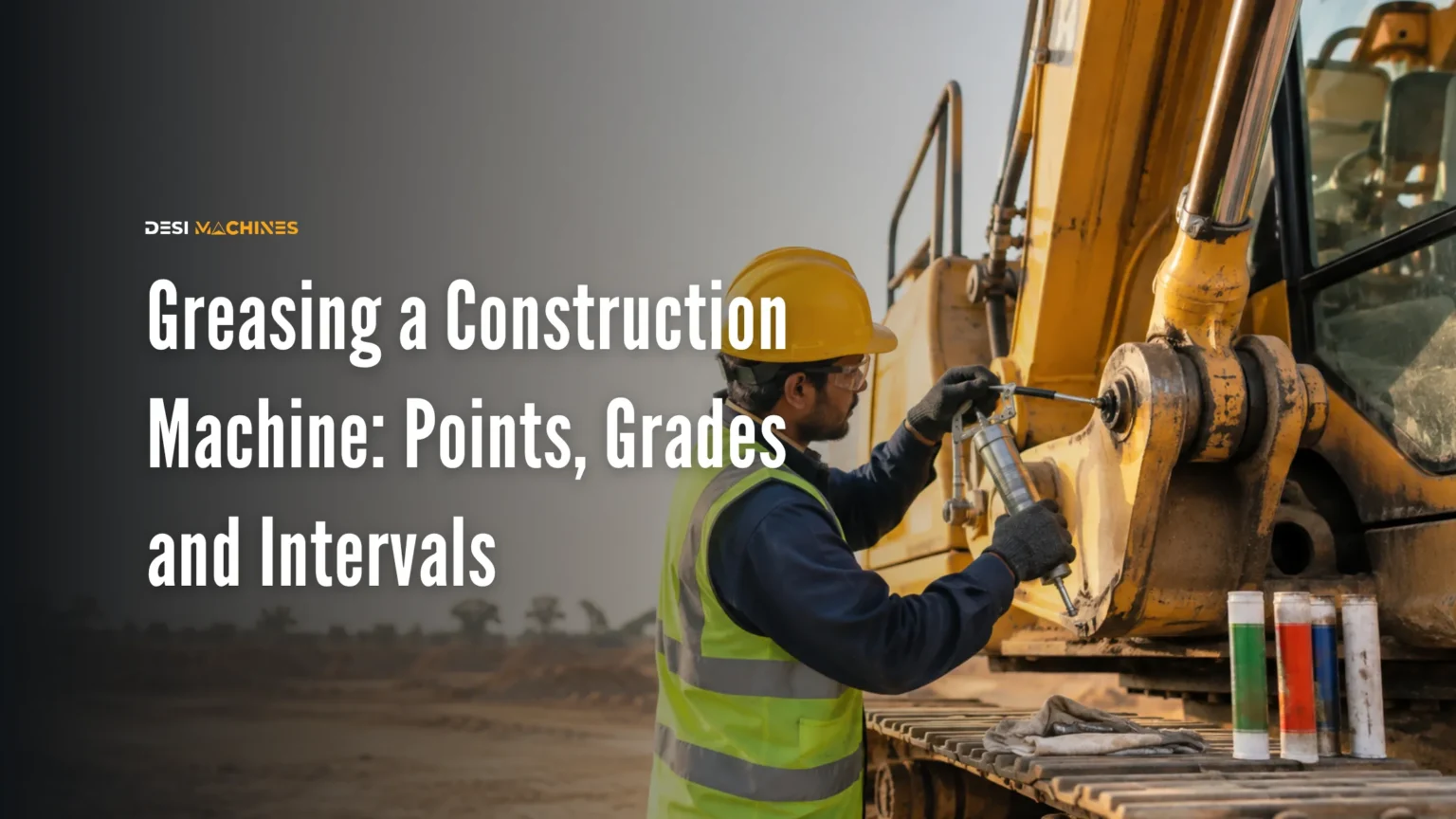
Lubrication on a construction machine means pushing fresh grease into every pin, bush and bearing that carries load, and keeping clean oil in the engine, hydraulics and gearbox. Grease does two jobs at once: it puts a slippery film between two steel parts that rub, and it fills the gap so mud and water cannot get in. On an Indian site the second job matters as much as the first.
This guide covers the grease side of construction equipment lubrication in detail, because that is the part an owner controls every single day. It explains where the grease points are on each type of machine, how often to use the grease gun, what grade to ask for, and how to grease a pin properly. The oil side, which runs on hour-based intervals, is covered in the equipment service schedule.
Why is greasing the cheapest repair you will ever do?
Because a grease gun costs less than a single pin and bush, and a missed greasing schedule is what kills pins and bushes. Every joint on a machine is a steel pin turning inside a steel sleeve, called a bush. Between them sits a thin film of grease. When that film goes, steel rubs steel, both parts wear oval instead of round, and the joint develops play — a knocking movement you can see and hear.
Play is not just noise. On an excavator, a worn bucket pin means the bucket wanders, the operator over-corrects, and the cylinder takes side loads it was never designed for. On a backhoe, a worn king post means the whole backhoe end sits crooked. On a pick and carry crane, play at the articulation joint makes the machine wander on the road. Every one of those repairs costs many times what the grease would have cost, and it takes the machine off work.
The other reason is water. Indian sites run in dust for eight months and water for four. Grease packed into a joint physically blocks both. A joint that has been left dry for one monsoon can seize solid, and then the pin has to be cut out.
Where are the grease points on a construction machine?
The grease points are wherever two parts move against each other under load: every pin joint, the slew bearing, the axle and drive-shaft joints, and the cylinder ends. They are marked by a grease nipple, a small metal button with a ball inside it that lets grease in and stops it coming back out. Wipe it clean before the gun goes on, because whatever dirt is sitting on that nipple gets pushed straight inside.
| Machine | Grease points that matter most | Easy to miss |
|---|---|---|
| Excavator | Boom, arm and bucket pins; bucket linkage; cylinder rod and base ends; slew bearing and slew pinion | The slew bearing gear teeth, and the pins at the back of the boom |
| Backhoe loader | King post, backhoe boom and dipper pins, loader arm and bucket pins, stabiliser (leg) pivots and feet | Stabiliser feet, and the drive-shaft universal joints under the machine |
| Wheel loader | Articulation joint pins, lift-arm and bucket pins, cylinder ends, drive-shaft joints | The upper and lower articulation pins, which carry the whole front weight |
| Pick and carry crane (Hydra) | Boom pivot, derricking cylinder ends, articulation joint, king pin, hook block sheaves | Boom wear pads and the sheave pins at the boom tip |
| Road roller | Articulation joint, drum bearings where fitted, steering cylinder ends, scraper mountings | The articulation joint, because it sits low and gets washed by every water spray |
Two of those deserve a word. The slew bearing on an excavator is the big ring the upper body turns on; it takes grease in its race and, separately, on its gear teeth, and it is the single most expensive lubrication point on the machine — the excavator slewing ring guide explains what replacement involves. The king post on a backhoe is the vertical pivot the whole backhoe end swings on, and it is named in the backhoe loader parts guide as a known failure point. For the crane joints, see Hydra and Farana crane parts; for the roller, road roller parts.
How often should you grease a construction machine?
Grease the working joints every shift on a hard-working machine, and at least once every ten working hours on a lighter one. This is not the same as the oil service, which runs on the hour meter at 250, 500 and 1,000 hours. Greasing is a daily habit, and the interval shortens as conditions get worse.
| Condition | How often | Why |
|---|---|---|
| Normal dry site, single shift | Every 8 to 10 working hours | Standard interval for pins and bushes under load |
| Hard digging, rock, high cycles | Every shift, sometimes twice | More cycles means the film is worked out faster |
| Water, canal work, wet ground | Daily, without exception | Water washes grease out and rusts the pin behind it |
| Heavy dust | Daily, and wipe every nipple first | Dust turns grease into grinding paste |
| Machine standing idle for weeks | Grease before parking, and again before restart | Fresh grease keeps water out of a joint that is not moving |
| Slew bearing | Follow the maker’s interval, usually longer than the pins | Large volume, sealed race; over-greasing pushes the seal out |
The rule that catches people out is the one about standing machines. An owner parks a machine for the monsoon, does nothing to it, and finds three seized joints in October. Grease it before it stands, turn it over and work the cylinders briefly every couple of weeks, and grease it again before it goes back to work.
What grade of grease should you use?
Use the grade printed in your machine’s operator manual. That sentence is the whole answer, and it is worth more than any general advice, because the maker sets the grade against the loads and seals in that specific joint. What follows is only so that you understand what the dealer is handing you.
- Consistency is how stiff the grease is, and it is written as an NLGI number. A softer grease pumps easily in cold conditions; a stiffer one stays put under load and heat. Most construction machines in Indian conditions run a general-purpose grade in the middle of that scale.
- EP on the tin means extreme pressure. These greases carry additives that hold a film when a joint is under very high load, which is exactly what a pin joint on a boom is.
- Moly grease contains molybdenum disulphide, a solid that plates onto the steel and keeps a slippery layer even when the joint is under shock loads. Makers usually specify it for particular high-load pins, and not for bearings that spin.
- Thickener type matters when you mix. Two greases that look identical can be built on different thickeners, and mixing them can turn the mixture soft and let it run out of the joint. If you switch brand or type, purge the joint until only new grease comes out.
One practical warning. Grease is a common place for fake product on the Indian market, because a tin is easy to copy and the damage takes months to show. Buy from a dealer, check the seal, and be careful of a price that is far below the market. The same care applies to filters and other consumables, and the spare parts guide explains what to check before you fit one.
How do you grease a pin properly?
Position the machine so the joint is unloaded, clean the nipple, pump until fresh grease appears at the joint edge, then wipe the excess away. That is the whole method, and every part of it has a reason.
- Take the load off the joint. Rest the bucket on the ground and lower the loader arm. Grease cannot enter a pin that is being squeezed by the weight of the machine.
- Wipe the nipple. Ten seconds with a rag stops you injecting the grit that is sitting on it.
- Pump until you see fresh grease at the edge of the joint. That is the signal that the old, dirty grease has been pushed out and the cavity is full. Counting strokes is a poor substitute; joints vary.
- Wipe the excess off. Grease left hanging on the outside collects dust and turns into a grinding paste at the seal lip.
- If nothing goes in, stop and find out why. A blocked nipple is a cheap part and a five-minute job. Forcing it with a bigger gun splits the nipple or drives the ball in.
- Do not over-grease a sealed bearing. On a slew bearing or a wheel hub, too much pressure pushes the seal out of its seat, and then the joint is open to water for good.
A word on the operator. Greasing is usually his job, and on most sites it is the first thing that gets skipped when work is running late. Give him a grease gun that works, keep a tin on the machine rather than in the office, and check the joints yourself once a week. Machines that are greased daily and machines that are greased when someone remembers are two different machines by year three.
What are the warning signs of a machine that has not been greased?
Look for play, listen for knocking, and look at the joints themselves. All three are visible in a few minutes and none of them need tools.
| Sign | What it means |
|---|---|
| Knocking when the boom changes direction | Play in a pin and bush; the pin has worn oval |
| A squeal or groan when the machine slews or articulates | The bearing or joint is running dry |
| Dry, dusty joints with no grease showing at the edges | Nobody has greased it recently, whatever the log says |
| Rusty water weeping from a joint | Water has got in and is working on the pin |
| Bright metal polish on a pin end | Steel-on-steel contact; the film is gone |
| The bucket or attachment sits crooked | Bushes worn far enough to have changed the geometry |
These are also the first checks worth making on any second-hand machine, because greasing habits tell you how the whole machine was treated. The full routine is in the used equipment inspection checklist. A seller who has greased every joint before the viewing is easy to spot, and so is one who has not greased it in a year.
What about engine, hydraulic and gear oils?
Oils are the other half of lubrication, and they work on hour-based intervals rather than daily habit. The engine oil takes heat and combustion soot; the hydraulic oil carries power as well as lubricating; the gearbox and axle oils run at high load and low speed. Each has its own interval, its own filter, and its own grade.
Three separate pages carry that detail: the hour-by-hour service schedule for what happens at 250, 500 and 1,000 hours, engine and hydraulic oil capacities for how much your machine actually holds, and hydraulic system maintenance for keeping that oil clean. On choosing the oil itself, our blog covers engine oil for construction equipment.
Buying a machine and want to know what it will cost to keep? Browse the current range of excavators and backhoe loaders, and ask the dealer for the lubrication chart before you sign. Every maker publishes one, and it is the sheet that should live in the cabin.
Read next
Part-by-part guides to the machines these grease points sit on: backhoe loader parts, road roller parts and Hydra and Farana crane parts.
The stabiliser leg pivots and pad feet on a backhoe loader are covered in more detail in the guide to backhoe stabilizer legs.
What the different grease guns and grease buckets cost is set out in a separate price guide.
Once a joint has worn past what grease can save, the pin and bush guide explains what to replace and what it costs.
Grease grades, intervals and lubrication points vary by machine, maker and working conditions; the operator manual for your machine is the authority on all three. Prices, specifications and features are indicative, vary by variant, location and date, and should always be confirmed with the official OEM or authorised dealer before any purchase decision. DesiMachines is not liable for decisions taken on the basis of information that may have changed after publication.