Excavator
294 models
 Backhoe Loader
51 models
 Crane
68 models
 Concrete Mixer
79 models
 Wheel Loader
54 models
 Compactor / Roller
45 models
 Motor Grader
42 models

 Concrete Pump
66 models
 Skid Steer Loader
11 models


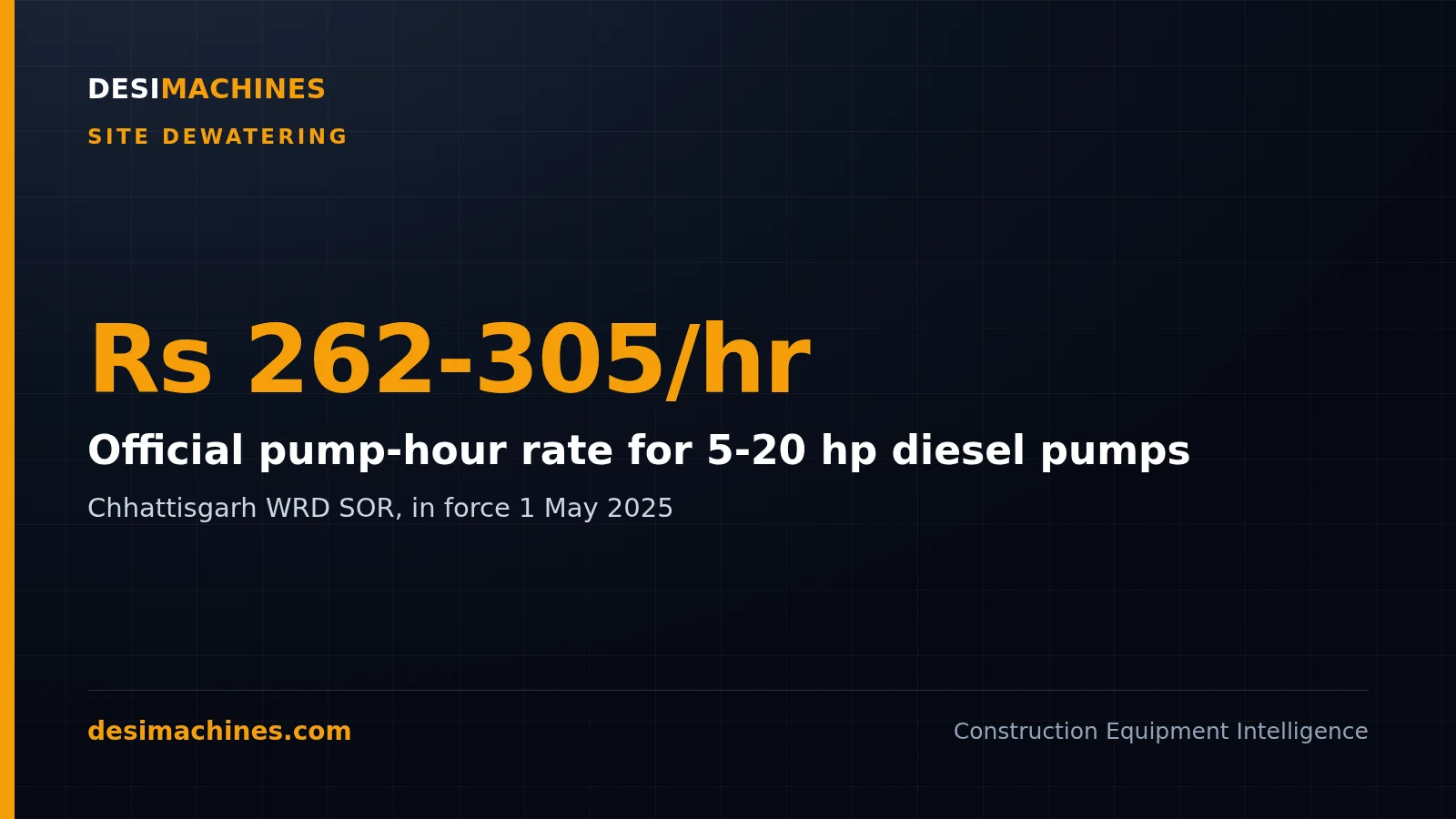
On Indian government work, the dewatering rate comes from the state schedule of rates: Chhattisgarh’s Water Resources Department pays Rs 262 to 305 per pump-hour for 5 to 20 hp diesel pumps (from 1 May 2025), Haryana and Puducherry pay Rs 75 and Rs 239.61 per kilolitre pumped, and CPWD-style schedules add 20 per cent of the earthwork rate per metre depth below the water table. Chhattisgarh’s 2026 building schedule pays Rs 124 per cubic metre of standing water, once. A pump on private hire is priced per day or per month, and no official rate card exists for it, so build that one from pump, diesel, operator and hose costs.
The pit was dry at six in the evening. By morning, water stood a metre deep over the footing level, the excavator was parked on the edge, and the steel fixers were waiting. Someone has to pump it out, and the first question on site is always the same: who pays for the pump, and at what rate?
The answer depends on how your work order describes the water. Get that right and dewatering is a paid item. Get it wrong and it is a cost you carry inside your excavation rate.
How is the dewatering rate charged in India?
Four bases are in use, and a single site can mix them:
- Per pump-hour, by pump size or horsepower, diesel or electric.
- Per kilolitre or per cubic metre of water removed.
- As a percentage extra on the earthwork, concrete or masonry rate, per metre depth below the water level.
- Per day or per month for a hired pump, usually as a lump sum on private jobs.
The first three come from government schedules of rates: estimating rates used to frame tenders, not market quotes, and all before GST.
Dewatering rate per hour and per kilolitre in state schedules
| Schedule and item | What it pays for | Rate |
|---|---|---|
| Chhattisgarh WRD SOR (from 1 May 2025), 3.59.2 | Dewatering the working area, 5 to 10 hp diesel pump | Rs 262 per hour |
| Chhattisgarh WRD SOR, 3.59.3 | Same, 10 to 20 hp diesel pump | Rs 305 per hour |
| Chhattisgarh WRD SOR, 3.59.1 | Same, measured by electric energy used | Rs 40 per kWh |
| Tamil Nadu SOR 2025-26 (from 22 Jul 2025), H-0095 | Hire of dewatering pump with engine | Rs 2,313.30 per day |
| Puducherry PSR 2024-25 (from 14 Aug 2024), 0011 | Hire of pump set, 4,000 litres an hour | Rs 900 per day |
| Haryana HSR 2021, 30.1 | Pumping out water from springs, seepage or broken mains | Rs 75 per kilolitre |
| Puducherry PSR 2024-25, 14.23 | Same description | Rs 239.61 per kilolitre |
| Chhattisgarh Building SOR (10 Jun 2026), 1.10 | Pumping out spring or seepage water during excavation, paid once | Rs 124 per cum |
The hourly item in the Chhattisgarh Water Resources Department schedule of rates is the closest thing to an official dewatering rate per hour. One 5 to 10 hp pump running round the clock comes to Rs 6,288 a day, or Rs 1,88,640 over 30 days. Tamil Nadu’s figure is a hire charge, and unlike its grader and generator lines it does not say fuel is included.
Chhattisgarh’s building schedule measures differently. Item 1.10 (printed as 1.1, between 1.9 and 1.11) takes the volume from the water level to the pit bottom, payable one time for the whole excavation, however often the pit refills.
Dewatering rate as per DSR: the percentage method
CPWD’s method for earthwork is a percentage. Its 2014 analysis of rates (item 2.24) adds 20 per cent of the item rate per metre depth for work “in or under water and/or liquid mud, including pumping out water as required”, and 25 per cent in foul positions. Haryana (HSR 2021, item 4.30) and Puducherry (PSR, item 2.24) use the same figures. Depth runs from the subsoil water level to the centre of gravity of the quantity below it. We could not obtain CPWD’s 2023 schedule on 5 Nov 2026, so check the current DSR item.
For concrete, Haryana’s HSR 2026 keeps item 6.64 at Rs 403 per cum per metre depth as the extra for laying concrete under water, including pumping. The plain concrete bed itself is a separate line, covered in our guide to the PCC rate per cubic meter.
The dewatering rate analysis behind such an extra is short. CPWD’s 2014 analysis for concrete under water takes 14 cum at 0.3 m depth, 3 pump-hours for a 4,000 litre-an-hour pump at Rs 600 a day, and four beldars at Rs 329 a day, then adds 1 per cent for water and 15 per cent for profit and overheads: Rs 426.16 per cum per metre depth at 2014 rates. Repeat the steps with today’s rates.
Tamil Nadu caps it for open wells: 10 per cent of excavation cost, or actuals if less, with anything higher needing the Superintending Engineer’s approval.
Dewatering pump rate on hire: what goes into it
Private hire is quoted per day or per month, and we found no published market rate card. Compare quotes on these heads:
- The pump itself, by size, head and whether it handles slurry.
- Diesel. Delhi’s retail price was Rs 95.20 a litre on 4 Nov 2026 (PPAC). Every litre an hour your pump burns adds Rs 2,284.80 to a 24-hour day, or Rs 68,544 over 30 days. Read the consumption from your own log.
- The operator. Haryana’s HSR 2021 prices a pump operator at Rs 364 a day; your state’s minimum wage is the legal floor.
- Hoses, discharge line to a legal outlet, mobilisation and a backup pump.
Ask in writing whether diesel and the operator are inside the day rate. That one line is where most pump-hire disputes start.
Worked example: one pit, three ways to pay
A footing pit 20 m by 15 m has water standing 1.2 m above its bottom. The pump runs 10 hours a day for 20 days, 200 hours in all, and a 4,000 litre-an-hour pump moves about 800 kilolitres in that time.
| Basis | Working | Amount |
|---|---|---|
| Per cum, once (CG Building SOR 1.10) | 20 x 15 x 1.2 = 360 cum x Rs 124 | Rs 44,640 |
| Per pump-hour (CG WRD 3.59.2) | 200 hours x Rs 262 | Rs 52,400 |
| Per kilolitre (HSR 2021 30.1) | 800 kL x Rs 75 | Rs 60,000 |
Our arithmetic, before GST. The one-time volume basis pays least on a pit that keeps refilling, because later seepage earns nothing. On a high water table, push for a per-hour or per-kilolitre item with a daily signed logbook.
Wellpoint and deep-well dewatering
Basements in sandy ground often need wellpoints: a ring of small tubes jetted around the pit and joined to a vacuum pump, lowering the water before digging. None of the schedules we checked has a wellpoint item. Specialist firms quote against a design, so ask for installation, daily running and removal as separate lines. Bored piles below water are costed differently, as set out under piling rate per meter, and pumping out a mine is another job again, covered in mine dewatering.
When is dewatering paid as an extra?
The schedules draw a clear line between rain and groundwater. Haryana’s brickwork item 7.70 pays for pumping water from springs, subsoil seepage or broken mains, but not “rain water collected in the trenches or foundations”. Its canal-lining notes leave rain water to the contractor and spring or subsoil pumping to the department. Puducherry’s note adds that the 20 per cent extra covers only pumping “envisaged at the time of tendering”, not water treated as contractor’s risk.
So record the subsoil water level before you start, or the department can argue all the water was rain. Pumping groundwater also needs a CGWA or state NOC with a metered discharge, explained in groundwater NOC for construction. The pit itself is priced per cubic metre on the method in excavation rate per cubic meter, and an excavator standing beside a stopped pump earns nothing for either side.
What to fix in the work order before the pump starts
- The water level, recorded jointly with the engineer, with date and depth.
- The payment basis: per pump-hour, per kilolitre, per cum once, or percentage per metre depth.
- Pump size and fuel, and whether diesel and the operator sit inside the rate.
- A daily pump logbook with hour-meter readings, signed by both sides.
- Standby and idle days when the pump runs but work cannot proceed.
- A copy of the groundwater NOC and who reads the flow meter.
Foundation and basement jobs with dewatering lines come up regularly in live tenders and project opportunities, so read the subsoil water clause before you bid.
Schedules of rates, diesel prices and groundwater rules change. Confirm the current item and rate with the department’s latest schedule, your contract and the groundwater authority before you quote or start pumping.