
 Excavator
294 models
 Backhoe Loader
51 models
 Crane
68 models
 Concrete Mixer
79 models
 Wheel Loader
54 models
 Compactor / Roller
45 models
 Motor Grader
42 models

 Concrete Pump
66 models
 Skid Steer Loader
11 models


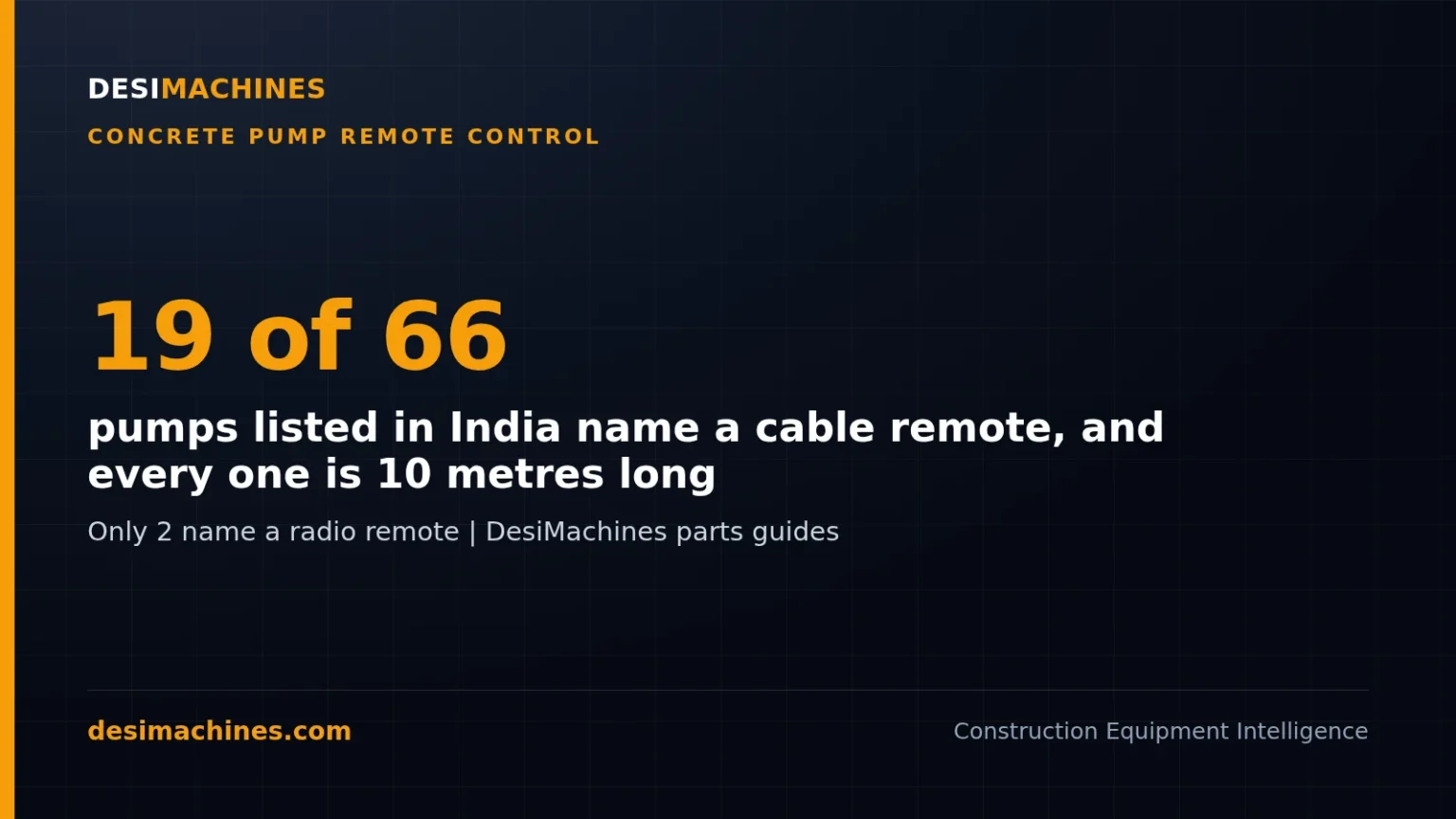
Nineteen of the 66 concrete pumps listed in India name a cable remote in their own specification, and every single one of those nineteen is 10 metres long. Two name a radio remote instead, and both give a working range of up to 100 metres. That gap tells you most of what you need to know: on a stationary or trailer pump the normal fitment here is a short trailing lead, while the wireless remote most people picture hanging off an operator’s chest belongs mainly to the truck-mounted boom pump.
A remote control on a concrete pump is simply a second set of controls on a lead or a radio link, so the man who can see the concrete arriving is the man working the pump. That is the point of it. The pump sits where the transit mixer can reach it; the pour happens somewhere else. This guide covers which type is fitted on which machines, what sits inside the system, what each control does, why a remote stops working, and what a dealer needs from you to match one.
What kind of remote does a concrete pump in India come with?
Most often a cable remote with a 10 metre lead, about 33 feet. We read the published specification of all 66 concrete pumps listed on DesiMachines, from six makers, and counted what each one says about its remote. The table below is that count, not an estimate.
| Make (as listed) | Pumps listed | Cable remote named | Radio remote named | Remote named, type not stated | Nothing stated about a remote | Manual or mechanical override named |
|---|---|---|---|---|---|---|
| Schwing Stetter | 26 | 15 (10 m cable) | 0 | 0 | 11 | 0 |
| Aquarius | 15 | 0 | 0 | 9 | 6 | 10 |
| Putzmeister | 10 | 0 | 0 | 2 | 8 | 0 |
| Venus | 8 | 0 | 0 | 1 | 7 | 8 |
| AJAX | 5 | 4 (10 m cable) | 0 | 1 | 0 | 0 |
| CONMAT | 2 | 0 | 2 (up to 100 m) | 0 | 0 | 2 |
| All makes | 66 | 19 | 2 | 13 | 32 | 20 |
This is a general guide based on machine size class. Always confirm the fit with your machine’s operator manual or the manufacturer before buying or fitting.
Two things in that table are worth sitting with. The first is that 10 metres appears on two makers who share nothing else: the Schwing Stetter SP 1800 D and its siblings, where the feature text calls the 10 metre cable remote standard equipment, and the AJAX ASP 3009 family, where four of the five models call a 10 metre remote optional rather than standard. Standard on one make, an extra on the other, identical length on both. If you are weighing those two machines against each other, the ASP 3009 and SP 1800 D comparison puts the rest of the specification side by side.
The second is that 32 of the 66 say nothing about a remote at all. That is not proof there is none. Specification sheets here list engine power, output and pressure far more consistently than they list controls, so silence means you ask rather than assume. The concrete pumps guide explains what the rest of a pump’s specification is telling you.
Only one of the six makers in our listings publishes a radio remote: the CONMAT SCP 5000 and its larger sibling, both stating a working range of up to 100 metres, roughly 330 feet. Every pump listed on DesiMachines is a stationary or trailer pump, which is why the count leans so far towards cable. Radio is the normal fitment on truck-mounted boom pumps, and those are a different machine; the concrete pump truck guide covers the boom and its hydraulics.
Cable remote or radio remote: what is the difference?
A cable remote is the same box of controls, plugged in. The lead carries the signals, so there is no battery to charge, no pairing to go wrong, and nothing to lose off the back of a bike. Its range is the length of the cable and nothing more. On a 10 metre lead you can walk round the hopper, stand clear of the mixer reversing in, and watch the line leave the pump, which on a trailer pump feeding a ground-floor slab is usually enough.
A radio remote replaces the lead with a transmitter you carry and a receiver bolted on the machine. You get the freedom the cable denies: a hundred metres of it on the CONMAT machines, or line of sight to a slab three floors up. You pay for it with a battery that has to be charged, a pairing that has to match, and an aerial and receiver that can be damaged.
Neither is better in the abstract. The honest test is where you have to stand to see the concrete land. If that spot is within a few steps of the pump, a cable remote is less to go wrong. If the pour is up a building, round a corner, or at the far end of a long delivery line, the cable stops being a control and starts being a tether. Six of the Aquarius machines listed, including the Aquarius 1407 D HR, are sold on exactly that argument, their feature text describing remote operation in terms of a clear view of the job and the freedom to choose where to stand.
What are the parts of a concrete pump remote control system?
Six items, and a dealer will ask you about most of them. The transmitter is the part in your hands, built either as a belly box worn on a belt or as a smaller handheld unit. The receiver is a sealed box on the machine wired into its control system, and it is the half people forget exists. A battery and charger belong to a radio system only, usually two packs so one charges while one works. The cable and its connectors are the equivalent on a wired system. A belt or strap carries the weight off your hands, and a cover keeps cement slurry out of the switches. Scanreco, which builds radio remotes for machine makers, lists its range in exactly these groups, belly-pack and hand-held transmitters, receivers, and batteries, chargers and carrying accessories, on its industrial remote control products page.
How a remote command reaches the pump
Reading the diagram: the transmitter never moves concrete. It asks the receiver, the receiver asks the pump’s own control system, and that system opens the hydraulic valves. Break the chain anywhere, at the stop button, at a cut cable, or by walking out of radio range, and the pump stops. The wiring kit and harness guide covers the machine-side wiring the receiver sits on, and the batteries guide covers charging and storage habits that apply to a transmitter pack as much as to a machine battery.
What does each control on the remote actually do?
On a stationary or trailer pump, the remote carries the pour and nothing else. Expect a start and stop for pumping, a forward and reverse selector, a way to raise or lower the output, the agitator in the hopper, engine or motor speed on some machines, a horn, and an emergency stop. That is a short list because a stationary pump has no boom to place. On a truck-mounted boom pump the same handset also swings and folds the boom sections, which is why those remotes are bigger and carry proportional levers.
Reverse deserves its own line, because it is the control that saves a pour. Running the pump backwards pulls concrete back from the line and drops the pressure, which is the first move when a line starts to block and the first move before opening a coupling. The concrete pump line blockage guide sets out the rest of that drill.
Output is the other control worth understanding before you touch it. Raising output raises the stroke rate, and a higher stroke rate against a long or tall line raises pressure on every joint in it. Starting slow, letting the line prime, then building up is standard practice, not caution. What the machine can actually sustain is a specification matter, covered in the output and pressure guide. Controls may be simple on-off switches or proportional levers, where how far you push decides how much happens; proportional levers give smoother starts on long lines and are the reason an operator who has used one dislikes going back.
Why does a concrete pump remote stop working?
Almost always for one of six reasons, and the first two cost nothing to check. Start with the emergency stop: once pressed it latches, and until it is twisted back out the pump will refuse every command while the remote looks perfectly alive. Then the battery on a radio unit, which is the single commonest dead-remote call there is, and a pack left on charge in a hot site office all summer will not hold what it used to.
Third, the cable and its connectors on a wired remote. The lead gets run over, dragged through aggregate and left coiled in standing water, and the plug fills with cement dust that stops a few pins while others still make contact, so the remote half works. Half working is the signature of a connector, not a transmitter. Fourth, pairing: a radio transmitter and receiver are matched to each other, so a swapped unit from another machine on the yard, however identical it looks, will do nothing until the dealer pairs it.
Fifth, water and cement in the switches. A remote that has been washed down with a jet rather than wiped, or left out through a monsoon night, gets a switch that sticks or a function that fires on its own. Sixth, the receiver or its supply, which is where you stop and call for help; a blown fuse on the receiver’s feed gives exactly the same symptom as a failed transmitter, and telling them apart means testing on the machine. Here one habit matters more than the whole list: a pump that stops the moment the radio link drops is working correctly. That stop is designed in. A pump that kept pumping after losing contact with the man watching the pipe would be the dangerous machine.
Can the pump keep working if the remote fails?
Often yes, for long enough to clear the line. Twenty of the 66 pumps listed publish a manual or mechanical override in their own feature text, and the pattern is clear: all 8 Venus machines, 10 of the 15 Aquarius machines, and both CONMAT machines describe one, while Schwing Stetter and Putzmeister publish no override wording at all. The Venus VCP 1470 HR describes manual override controls for operation during an electrical or power failure, and the Putzmeister BSA 1406 E eSmart instead publishes an emergency stop switch that shuts the whole machine down.
Read that for what it is. An override is there so a pour can be finished and a line emptied before the concrete sets in it, which is the expensive failure. It is not a way to run a shift, and using it means standing at the machine instead of at the pipe, which is the arrangement the remote exists to avoid. None of the 66 listed pumps publishes a description of its on-machine control panel, so what your particular pump falls back to is a question for the dealer and the operator manual, not something to discover with concrete in the line.
What should you check before ordering a remote?
Match it to the control system, not to the pump’s badge. Ask seven things before you call. Is the system radio or cable, since they are not interchangeable without the matching receiver. Is a receiver already fitted on the machine, or does the job include one. What cable length and which connector, if it is wired. How many functions, and are any of them proportional rather than simple on-off. Will the supplier pair a radio unit to your receiver, because an unpaired transmitter is a paperweight. What does the pump’s control system use, electronic as on the CONMAT machines with their i-Pump system, or hydraulic sensing as on the AJAX ASP 7011. And what comes in the box, since a strap, a cover and a second battery are often separate items.
Those same seven answers are what move the cost, in roughly that order. Radio sits above cable. More proportional functions sit above fewer. A system needing a new receiver and a dealer pairing visit sits above a straight replacement handset. A complete set with a spare battery and charger sits above a bare transmitter. What any of it comes to depends on your machine and your dealer, so get the quote against the model, variant and serial number rather than against a name. The concrete pump parts guide covers the pumping unit, hopper and delivery line, where the wear items and the real running cost of a pump live.
Still choosing the machine itself? Browse the full range of concrete pumps and ask the dealer to confirm, in writing, whether the remote is standard or optional on the exact variant you are quoted. The wider parts and running costs guides cover the rest of the machine.
Machine counts and all remote, override and control descriptions in this guide are taken from the published specifications of the 66 concrete pumps listed on DesiMachines at the time of writing; the transmitter, receiver and accessory groupings are as published by Scanreco. Specifications and features are indicative, vary by variant, location and date, and should always be confirmed with the official OEM or authorised dealer before any purchase decision. DesiMachines is not liable for decisions taken on the basis of information that may have changed after publication.
Get a concrete pump remote control price from a dealer near you
Tell us your machine and what you need, and we will ask the nearest dealer to reach out to you with a price.