
 Excavator
294 models
Excavator
294 models  Backhoe Loader
51 models
Backhoe Loader
51 models  Crane
68 models
Crane
68 models  Concrete Mixer
79 models
Concrete Mixer
79 models  Wheel Loader
54 models
Wheel Loader
54 models  Compactor / Roller
45 models
Compactor / Roller
45 models  Motor Grader
42 models
Motor Grader
42 models  Dozer
41 models
Dozer
41 models  Concrete Pump
66 models
Concrete Pump
66 models  Skid Steer Loader
11 models
Skid Steer Loader
11 models  Telehandler
13 models
Telehandler
13 models 


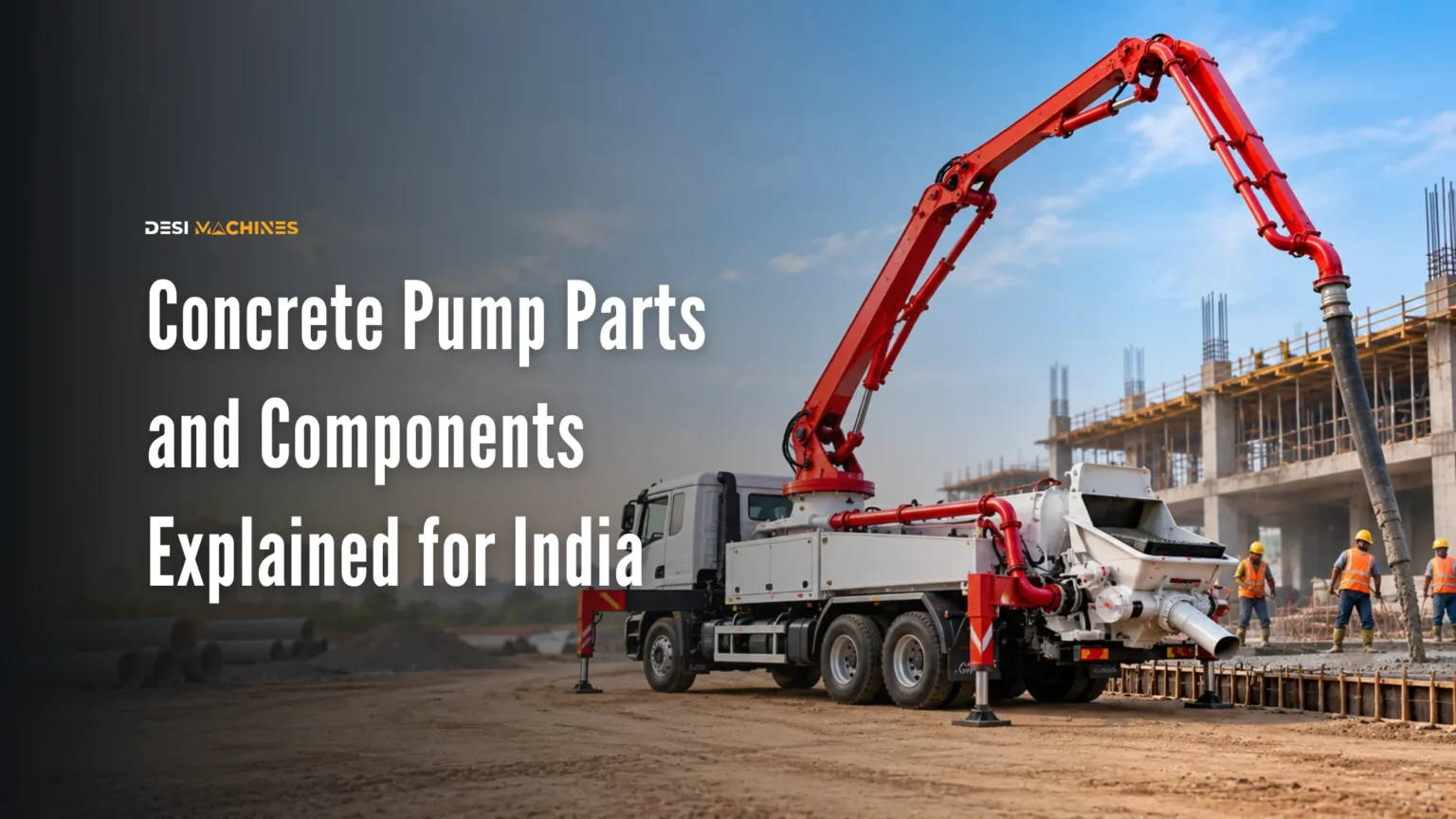
Concrete pump parts fall into four groups. A concrete pump is a machine that pushes wet concrete through a steel pipe under pressure, and everything on it belongs to one of four groups: the hopper that holds the concrete, the pumping unit that pushes it, the power pack (engine or electric motor plus hydraulics) that drives the pumping unit, and the delivery line of pipes and bends that carries the concrete to the pour. Learn those four groups and the machine becomes readable, because a fault in one group is a different repair and a different bill from a fault in another.
This guide names every part, says what it does, and gives the sizes published for the 66 stationary concrete pumps listed for India at the time of writing, across six brands: AJAX, Aquarius, CONMAT, Putzmeister, Schwing Stetter and Venus.
What are the main parts of a concrete pump?
Every concrete pump is built from the same four groups. The pipe work changes, the size changes, the badge changes. The layout does not.
- Hopper group: the open steel tray the mixer discharges into, the agitator (remixer) shaft that keeps the concrete moving inside it, the grille on top, and the outlet into the pumping unit.
- Pumping unit: two delivery cylinders, a piston (ram) inside each one, the water box behind them, and the switching valve, usually an S-valve, that decides which cylinder is filling and which is pushing.
- Power pack: a diesel engine or an electric motor, the hydraulic pumps it turns, the oil tank, the hoses, the cooler and the control panel.
- Delivery line: the pipes, bends, reducers, clamps and the flexible end hose that carry the concrete from the machine to where it is being placed.
The dividing line worth remembering is between the concrete side and the oil side. Concrete is abrasive, so everything it touches is a wear item that will need replacing. Hydraulic parts fail instead from dirt, heat and bad seals. Almost every running-cost decision comes down to which side of that line a part sits on.
Parts naming carries across machine families, so if you have read the transit mixer parts guide or the guide to excavator parts, the hydraulic and engine sections here will feel familiar.
What is inside the pumping unit?
The pumping unit is where a concrete pump does its actual work, and it holds only a handful of parts. Two steel tubes called delivery cylinders sit side by side. Inside each one a piston, a plunger on the end of a rod and also called a ram, slides forward and back. One piston draws concrete in from the hopper while the other pushes its load into the pipe, then they swap, so the concrete leaves the machine in a steady flow rather than in gulps.
Between the cylinders and the pipe sits the switching valve. On most machines this is an S-valve, a thick S-shaped steel tube that swings from one cylinder mouth to the other every stroke; some designs use a rock valve instead, and the job is identical. Where the valve meets the cylinders sit two consumable parts every pump owner learns the names of: the wear plate, a hardened steel plate the valve rubs against, and the wear ring, a hardened collar on the valve mouth. Both are meant to be replaced, and they are what stops the costly castings behind them from wearing.
Behind the delivery cylinders is the water box, an open tank of water the piston rods pass through. It keeps the rods cool and washes away concrete that leaks past a piston seal. Milky water in that box is a piston cup on its way out.
Two cylinder figures are published for every machine listed, and together they tell you how much concrete each stroke moves. Delivery cylinder diameter is how wide the tube is: 200 mm on 48 of the 66 machines, 180 mm on 15 and 150 mm on 3. Delivery cylinder stroke is how far the piston travels: 700 mm to 2,100 mm, with 1,400 mm the most common at 31 machines, then 1,000 mm on 12 and 1,200 mm on 7. A wider, longer cylinder moves more per stroke, which is why the big machines carry both.
The other pumping-unit number is strokes per minute, published by all 66. On 52 of them it is given as two figures, a rod-side and a piston-side rating, because the same machine can be run for speed or for pressure. On the rod side the listed machines run 15 to 36 strokes per minute. Why one machine carries two ratings is explained in the guide to concrete pump output and pressure.
Table 1: Pumping-unit and hopper figures across the 66 stationary concrete pumps listed for India
| Part | What it does | Range published | How many machines publish it |
|---|---|---|---|
| Delivery cylinder diameter | Width of the tube the concrete is pushed through | 150, 180 or 200 mm | 66 of 66 |
| Delivery cylinder stroke | Distance the piston travels each push | 700 mm to 2,100 mm | 66 of 66 |
| Strokes per minute | How often the two pistons swap over | 15 to 36 per minute (rod side) | 66 of 66 |
| Hopper capacity | Concrete held between mixer loads | 400 L to 625 L | 65 of 66 |
| Engine or motor power | Drives the hydraulic pumps | 46 HP (34.6 kW) to 590 HP (440 kW) | 66 of 66 |
| Hydraulic system pressure | Oil pressure behind the pistons | 280 to 350 bar | 5 of 66 |
| Machine weight | What you have to transport and crane | 2,800 kg to 10,000 kg | 43 of 66 |
What does the hopper do, and how big is it?
The hopper is the open steel tray at the back that a transit mixer or a site mixer discharges into. Concrete arrives in loads and leaves in a steady stream, so the hopper is the buffer between the two. Run it near empty and the pump sucks air, which stalls the flow and forces the crew to prime the line again.
Inside the hopper an agitator, also called a remixer, turns slowly on a shaft, keeping the mix moving so the stones do not settle out and the concrete keeps feeding into the cylinder mouths. Above it sits a grille, a steel grid that stops oversized stones, wire and site rubbish reaching the valve. Lifting that grille to clear a blockage is one of the most common jobs on a pumping site, and one of the most dangerous: stop the agitator first.
Hopper capacity is published on 65 of the 66 machines listed. 600 litres is the standard, carried by 49 of them. Below that, 7 machines carry 400 litres and 5 carry 500 litres; above it, 2 carry 625 litres, one carries 601 litres and one carries 450 litres. One machine, the Putzmeister BSA 1408 HD, does not publish the figure. The full range is 400 to 625 litres, which is narrow: hopper size is not where these machines differ.
A 600-litre hopper is roughly one-tenth of a standard transit mixer load, so the pump waits on the next truck rather than the other way round. The smaller machines covered in the guide to the mini concrete pump sit at the 400 to 600 litre end.
What drives a concrete pump, a diesel engine or an electric motor?
Both, and the choice changes the parts list. Of the 66 machines listed, 51 are driven by a diesel engine and 13 by an electric motor; two do not state which. The engine or motor never touches the concrete. Its only job is to turn the hydraulic pumps, which send oil to the cylinders behind the pistons and to the ram that swings the S-valve.
Power runs from 46 HP (34.6 kW) on the Aquarius 703 D to 590 HP (440 kW) on the Schwing Stetter SP 8800, both figures as published on those machines. That is a thirteen-fold spread, far wider than the spread in cylinder or hopper size, because pushing concrete up a high-rise takes very different power from filling a raft foundation at ground level.
A diesel machine brings its own parts list: fuel filter, air filter, oil filter, radiator, alternator, starter and battery. An electric machine has a motor, a starter panel, cables and a supply arranged on site, and is quieter and cheaper to run where a connection exists. The electric versions are often the same pump with a different power pack: the Schwing Stetter SP 8800 and SP 8800 Electric carry the same 2,000 mm cylinder stroke and 600 litre hopper.
The oil side has its own parts: the hydraulic tank, its filters, the cooler, the high-pressure hoses and the control valve block. Only 5 of the 66 machines publish a hydraulic system pressure, all of them AJAX units, and those sit between 280 and 350 bar. Too few state it for you to shop on, but it shows what the hoses and seals hold back. Keeping that oil clean is the cheapest thing an owner does, and the guide to hydraulic system maintenance covers how.
Comparing power packs and sizes before you buy? Look at live concrete pump models and specifications and talk to a dealer about what your pours actually need.
What are the parts of the delivery line?
The delivery line is everything between the pump outlet and the concrete, and on a stationary machine your crew lays it by hand. It is built from a few standard parts, all of which wear:
- Straight pipes, in plain or hardened steel. Hardened pipe costs more and lasts far longer on abrasive mixes.
- Bends. Every bend adds friction and wears faster than straight pipe, because the concrete scrubs the outside of the curve.
- Reducers, which step the pipe down in diameter. A reducer raises pressure and wear, so it goes as close to the machine as the job allows.
- Clamps and gaskets, which join the sections. A leaking joint is usually the rubber gasket, not the pipe.
- End hose, the flexible rubber length the crew holds to place the concrete.
- Cleaning kit: sponge ball, catcher and the water connection used to wash the line out after every pour.
The line is not an accessory. Friction inside it is a large part of why a machine never delivers its theoretical output on site, set out in the guide to output and pressure. Long lines, many bends and worn pipe all cost concrete per hour.
Every concrete pump listed for India here is a stationary pump, pumping through a line laid on the ground. A boom pump carries a folding steel boom and outriggers on a truck and needs no pipe laying; those are explained in the guide to the concrete pump truck, and the two types are compared in the guide to concrete pumps in India.
Which concrete pump parts wear out first in India?
The wear order on a pump is unusually predictable, because the abrasive concrete follows one path through the machine and everything on that path wears in sequence.
Table 2: The usual wear order on a concrete pump, and what each warning sign means
| Part | Warning sign | What ignoring it leads to |
|---|---|---|
| Wear plate and wear ring | Concrete slurry leaking at the valve, falling pressure, a knocking change in sound | The valve and the cylinder mouths themselves wear, a far larger bill than the two sacrificial parts |
| Piston cups (ram seals) | Milky or grey water in the water box, output dropping off | Concrete gets past the piston into the water box and on into the hydraulics |
| S-valve body | Wear visible on the inside of the S bend, slower switching | Valve replacement, and lost output every hour until it is done |
| Delivery pipes and bends | Thin wall on a bend, weeping at a joint, ringing sound when tapped | A burst under pressure, the worst safety event on a pumping site |
| Clamp gaskets | Grout weeping at joints during a pour | Loss of pressure, a slippery working platform, an eventual blow-out |
| Agitator shaft seals | Oil or grout showing at the hopper end bearing | Bearing failure, and a hopper that has to come apart to fix it |
| Hydraulic hoses and oil | Weeping at crimps, chafed covers, dark or hot oil | A burst hose mid-pour, and dirt through the whole oil circuit |
Two things move a pump up or down that list faster than anything else. The first is the mix: a harsh, low-slump mix with sharp aggregate wears a wear plate in a fraction of the time a well-graded pumpable mix does. The second is washing out. Concrete left to set inside a cylinder, valve or pipe overnight is the most expensive avoidable mistake on Indian pumping sites. Wash out after every pour.
Greasing matters more here than on most machines, because the agitator shaft and valve bearings sit in wet concrete all day. The guide to greasing points, grades and intervals covers how often and with what, and the hour-by-hour service schedule covers what else falls due.
How do you check concrete pump parts before buying a machine?
On a used machine the parts tell you more than the hour meter does, because every wear item sits on one path. Start at the hopper. Look for cracked or patched steel, a bent grille and play in the agitator shaft. Then look into the cylinder mouths with the machine stopped and isolated: scoring, a worn lip on the wear plate, or a visible gap all point to parts due for replacement. Open the water box. Clear water is good news; grey slurry means the piston cups are already leaking.
Next, the S-valve. Ask for it to be swung slowly and watch it seat. A valve that hesitates, or seats with a visible gap, is worn or short of hydraulic pressure. On the oil side, look for weeping at hose crimps, oil stains under the tank, and a cooler packed with cement dust. Tap the pipes included in the deal along their length, because a thin pipe rings differently from a sound one. Then ask for the wash-out routine in plain words, and which parts have been replaced and when. The spare parts guide explains what to check before you fit a part.
Ready to compare machines rather than parts? Browse concrete pumps listed for India and connect with a dealer near you.
A note on the figures in this guide
Every number above comes from the specification sheets of the 66 stationary concrete pumps listed for India at the time of writing, not from a brochure. Where only some machines publish a figure, the count is stated so you can judge it yourself.
One figure was deliberately left out. The Putzmeister BSA 1407 HD eSmart publishes its strokes per minute with the rod and piston ratings the opposite way round from every other machine listed, and the opposite way round from its own output and pressure figures on the same sheet. The 15 to 36 strokes per minute band above therefore excludes it, and the discrepancy has been raised for correction. Where a specification disagrees with a machine’s own other figures, we leave it out rather than guess which side is right.
Two more limits. Part prices are not covered here, because spare parts are not listed as products and any figure would be invented. And naming varies between makers: a wear ring on one machine is a cutting ring on another, a piston is a ram, and in each case it is the same part doing the same job.
More in the same series: road roller parts, backhoe loader parts and the full parts and running costs guide.
The commercial side of a second-hand purchase sits outside this parts list. The used concrete pump buying guide covers how many hours is too many on a pump, the papers a seller must produce, and what a used machine should cost against the new price ladder.
Clearing the hopper grille is one job; clearing a plug further down the delivery line is another. The causes, the safe order for opening a coupling and the mix and pipe rules that prevent it are set out in concrete pump blockage: why lines choke and how to clear them.
Prices, specifications and features are indicative, vary by variant, location and date, and should always be confirmed with the official OEM or authorised dealer before any purchase decision. DesiMachines is not liable for decisions taken on the basis of information that may have changed after publication.