
 Excavator
316 models
 Backhoe Loader
54 models
 Crane
68 models
 Concrete Mixer
79 models
 Wheel Loader
54 models
 Compactor / Roller
45 models
 Motor Grader
42 models

 Concrete Pump
66 models
 Skid Steer Loader
11 models


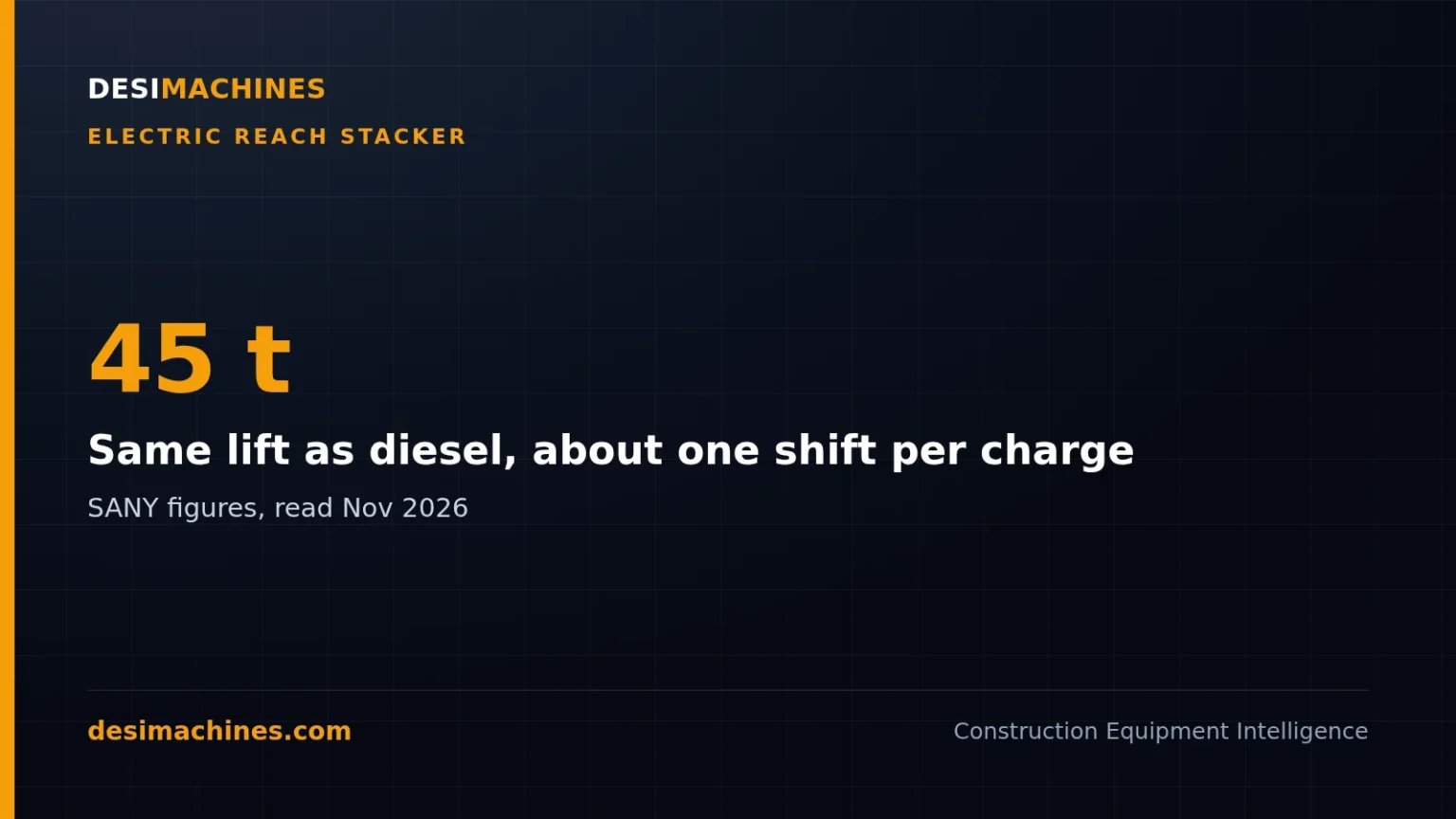
SANY’s battery reach stacker lifts the same 45-tonne container to the same 15.1 m and the same fifth tier as its diesel twin, so lifting is not what decides between them. An electric reach stacker runs on a lithium battery and electric motors in place of a diesel engine and gearbox, and what changes is how long it runs between charges, how steep a ramp it can climb loaded, and how much power your yard must supply.
That makes it a yard decision. A stacker working one shift a day is easy to electrify. One that must run three shifts back to back, with no break long enough to charge, needs a plan.
This guide is for anyone running a container yard at a port, an ICD (inland container depot), a CFS (container freight station) or an empty depot. DesiMachines does not list reach stackers, so machines are named only to explain the work, from the makers’ own published sheets. Where the reach stacker sits among the quay cranes, yard cranes and tractors around it is covered in the guide to container handling equipment.
How does an electric reach stacker work?
It splits the work between separate electric motors, all fed from one battery. Where a diesel stacker has one engine driving both the wheels and the hydraulic pump, the battery machine feeds a travel motor for the wheels and separate motors for the pumps.
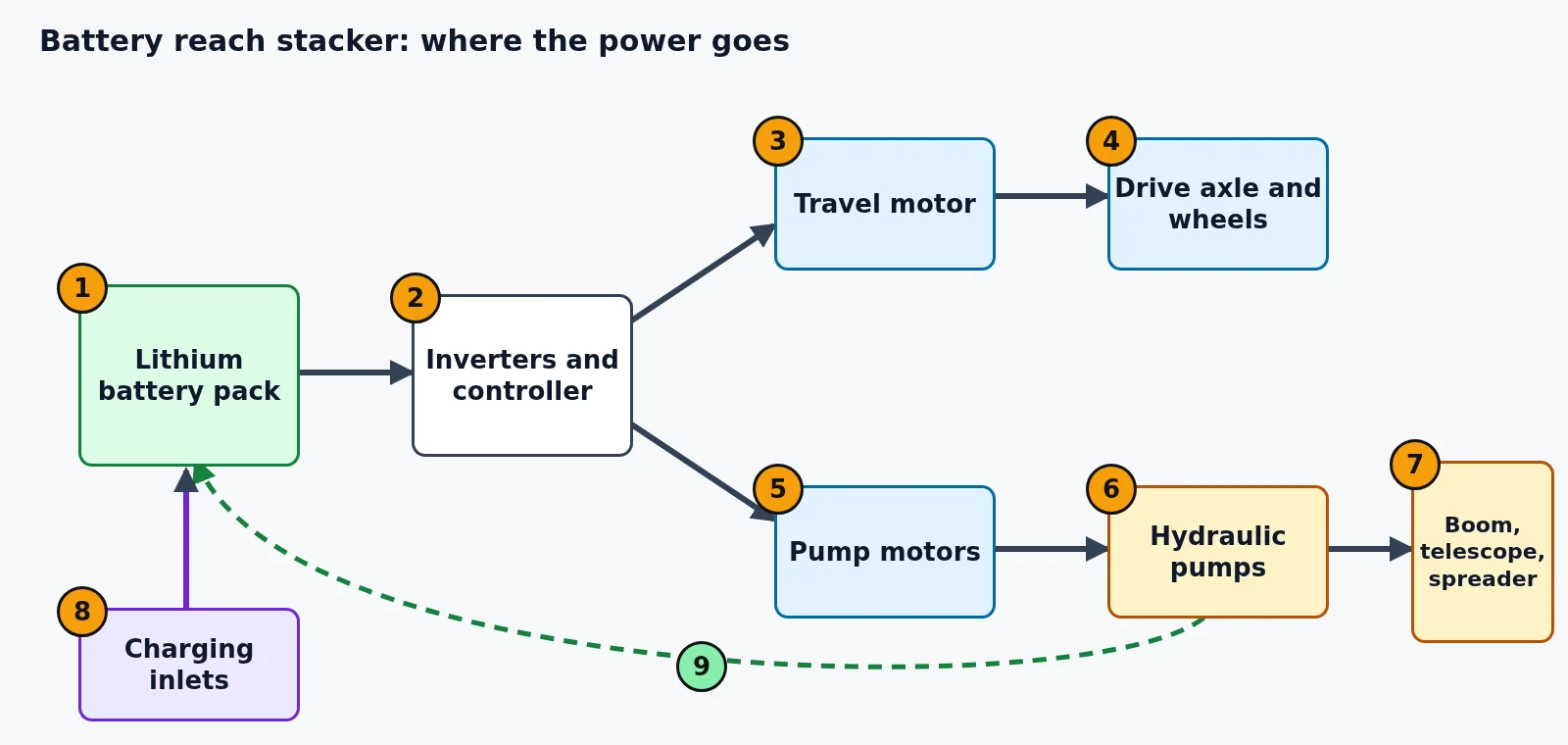
SANY’s reach stacker brochure lists the parts for its SRSC45E3. The battery is a lithium iron phosphate pack at 618 V, offered in three sizes: 422, 507 and 528 kWh. The travel motor is a permanent magnet synchronous motor (PMSM) rated at 171 kW, with a peak of 310 kW. SANY India’s page adds that separate motors drive the boom stretch, hoist, spreader and travel.
When a heavy box comes down, part of the energy of its fall is recovered and returned to the battery. SANY calls this potential energy recovery and claims up to 4 kWh an hour on the SRSC45E3.
The boom, the spreader that locks onto the box’s four corner fittings and the counterweight are as on a diesel machine. For the parts every battery machine shares, read how electric construction machines work.
Electric vs diesel reach stacker: what changes on the same machine?
Lifting stays the same; travel and climbing get slower. SANY publishes both versions of its 45-tonne stacker in one brochure, which makes this a clean comparison:
| SANY 45-tonne reach stacker (maker’s brochure) | SRSC45E3 (battery) | SRSC45V (diesel) |
|---|---|---|
| Rated load | 45 tonnes | 45 tonnes |
| Stacking height | 5 tiers, 15,100 mm | 5 tiers, 15,100 mm |
| Lifting speed (empty / full) | 420 / 250 mm/s | 420 / 250 mm/s |
| Lowering speed (empty / full) | 360 / 300 mm/s | 360 / 300 mm/s |
| Travel speed (empty / full) | 20 / 14 km/h | 25 / 21 km/h |
| Gradeability, steepest slope (empty / full) | 21% / 14% | 39% / 32% |
| Hydraulic working pressure | 350 bar | 260 bar |
| Overall weight | 73 tonnes | 71 tonnes |
| Power | 422, 507 or 528 kWh LFP battery; PMSM motor 171 kW rated, 310 kW peak | Volvo TAD1151VE engine, 265 kW at 2,100 rpm, EU Stage III |
| Turning radius | 8,000 mm | 8,000 mm |
| Aisle width for a 40-foot box | 13,600 mm | 13,600 mm |
Read the gradeability row twice. It is the steepest slope the machine can climb: 14% means a rise of 14 m over 100 m. Laden, the battery stacker is rated for 14% against 32% for the diesel. A flat yard never notices; a yard with a ramp to a rail siding or a weighbridge must measure it before buying.
The 2-tonne difference in weight is small next to a 71-tonne machine, and SANY’s newer SRSC45E6 weighs 67 tonnes, less than the diesel. SANY’s sheets put the SRSC45E3 and SRSC45V on the same 18.00-25 tyres, so the extra weight sits on the same footprint; check it against your pavement’s rating as you would for any heavier machine.
Like the diesel, the battery machine is rated row by row. SANY rates both at 45 tonnes in the first row, 31 tonnes when reaching into the second and 15 tonnes into the third, because the farther the boom reaches, the less it can hold. Why capacity drops with reach is explained in forklift capacity and load centre, and the second-row reach that lets a yard keep its blocks four boxes deep is noted in Wikipedia’s reach stacker entry.
How long does an electric reach stacker run on one charge?
About one shift. SANY’s brochure gives 6 to 7 hours for the 422 kWh pack and 8 to 9 hours for the 507 kWh pack on the SRSC45E3. Charging from 20% to 80% takes 90 minutes on the smaller pack and 110 minutes on the larger ones.
Those are the maker’s figures; long laden runs and ramps cut them. SANY’s own pages do not all agree, so get the figure for your exact pack in writing:
| SANY machine | Battery | Charging time | Running time | Where it is published |
|---|---|---|---|---|
| SRSC45E3 reach stacker, 422 kWh | LFP, 618 V | 90 min (20% to 80%) | 6 to 7 h | Reach stacker brochure |
| SRSC45E3 reach stacker, 507 kWh | LFP, 618 V | 110 min (20% to 80%) | 8 to 9 h | Reach stacker brochure |
| SRSC45E3 reach stacker | Printed as “CATL (407/522 kW)” | 1.5 h fast charge | 8 to 10 h | SANY India product page |
| SRSC45E3A battery-swap reach stacker | 282 kWh LFP | 10 min battery swap | 5 h per battery | Reach stacker brochure |
| SRSC45E2 range-extended reach stacker | Printed as “CATL (141kW)”, plus a 92 kW diesel range extender | 1 h fast charge | 3 h on battery | SANY India product page |
| SDCE90K7 empty container handler, 9 tonnes | 331.7 kWh | 1 h fast charge | 10 h | SANY India product page |
The India page prints the battery in kW, a unit of power; battery size is stored energy, in kWh. When a quotation shows kW, ask for the kWh figure.
Can one battery reach stacker cover a 24-hour yard?
Not on its own, if the yard runs three back-to-back shifts with no long breaks. The arithmetic is simple. A 507 kWh machine runs 8 to 9 hours and then needs close to 2 hours on a charger to go from 20% to 80%. Three 8-hour shifts leave no 2-hour gap.
Yards close the gap in four ways:
- Charge in the breaks. Each meal break and shift change adds some charge. This opportunity charging works best where the breaks are fixed and the charger sits where the stacker parks.
- Run one more machine than the work needs. With four stackers for three machines’ work, one is always on the charger. It costs a machine but keeps every shift covered.
- Swap the battery. SANY’s SRSC45E3A takes a fresh 282 kWh pack in 10 minutes and runs 5 hours on each, so it needs a swap station and spare packs. How swapping works for trucks is explained in the guide to battery swapping.
- Carry a small engine as backup. SANY’s SRSC45E2 has a smaller battery and a 92 kW diesel range extender, a generator that charges the battery when the machine cannot reach a charger. SANY India says this lets it work 20 hours a day. It still burns diesel, so it is a hybrid, and hybrid construction machines are explained separately.
A yard that works one or two shifts avoids the problem: the stacker charges overnight and starts each morning full.
How much power does a yard need to charge an electric reach stacker?
Plan on roughly 170 kW for each machine charging at full rate. That figure comes from SANY’s own numbers: 60% of a 507 kWh pack is about 304 kWh, put in over 110 minutes, which averages about 166 kW into the battery. The 422 kWh pack works out the same, about 169 kW. The charger draws more than that from the supply, because some power is lost as heat.
So the supply grows quickly with the fleet. Four stackers charging together at a shift change need roughly 680 kW at the batteries. Compare that with the spare capacity on your yard’s electricity connection before you order; if it falls short, a bigger connection or a dedicated transformer comes first. Running the chargers off a diesel generator set defeats the purpose of buying electric.
SANY’s SRSC45E5 lists support for the CCS1, CCS2 and GB/T charging plugs, and its machines carry two charging inlets so two charger guns can feed one machine at once. Ask which plug your machine will have, and buy chargers to match. How to work out site power, chargers and charging time step by step is in the guide to charging an electric machine on site.
Which container yards suit an electric reach stacker?
The best fit is a flat yard with a steady work pattern, short travel between stack and truck, and a supply that can carry the chargers. That can be an ICD, a CFS or a port terminal that plans charging around its shifts.
| Yard condition | Fits electric well | Think twice |
|---|---|---|
| Shift pattern | One or two shifts, or fixed breaks every day | Three back-to-back shifts with no spare machine |
| Ground | Flat paved yard | Laden climbs steeper than the machine’s rating (14% on the SRSC45E3) |
| Travel | Short runs between stack, truck and rail wagon | Long laden runs across a large yard, where 14 km/h laden adds up |
| Power | High-tension supply with spare transformer capacity | Weak grid, frequent cuts, or a generator as the only supply |
| Work type | Lots of lifting and lowering, which recovers energy | Mostly travel, which recovers little |
How electric machines compare across tunnel, indoor, port and mine work in general is set out in which jobs suit an electric machine. Indian ports that have already started buying electric yard machines are tracked in our blog on electric fleets working in mines, ports and cities.
What is an electric empty container handler?
It is the battery version of the mast machine that stacks empty boxes only. Empty boxes are light, so it needs far less capacity than a reach stacker and stacks higher. SANY’s SDCE90K7 lifts 9 tonnes to 18.75 m on a 331.7 kWh battery, charges in about an hour and runs 10 hours, all from SANY India’s page. Its diesel twin, the SDCY90K7H2, has the same 9 tonnes and 18.75 m with a Cummins QSB 6.7 engine.
Empty handling can be the easiest place to start: light loads, one depot, and overnight charging if the depot works one or two shifts. SANY’s SDCE90K7 page says the routine service on the battery machine is a coolant top-up for the motor cooling system, against the engine and transmission service of a diesel handler.
An electric pallet stacker is a different, small warehouse machine for pallets; see electric pallet trucks and stackers.
Electric reach stacker pros and cons
| For a container yard | Pros | Cons |
|---|---|---|
| Lifting | Same 45-tonne rating, row ratings and 15.1 m stacking height as the diesel twin | None on SANY’s figures |
| Travel and ramps | Same turning radius and aisle widths, so the yard layout does not change | Slower laden travel (14 vs 21 km/h) and a lower laden climbing limit (14% vs 32%) |
| Running energy | Pays for electricity, not diesel; recovers energy when lowering | Needs chargers, a transformer and planned charging time |
| Service | No engine or transmission to service, as SANY points out on its battery machines | High-voltage system needs trained technicians the dealer must have nearby |
| Site | No exhaust at the machine; cab noise under 70 dB on SANY’s SRSC45E6 | Battery heat in an Indian summer has to be managed; SANY publishes a cold-weather limit, not a hot one |
| Fire risk | No hot engine or fuel lines; SANY lists automatic fire extinguishing on its stackers and high-voltage fault alarms on its electric empty handler | A lithium battery fire is a different kind of fire, and the yard’s fire plan must cover it |
| Money | Energy and service cost per hour can be lower, and the more hours the machine works, the more that counts | Price on request, so compare the quotation with the diesel twin’s; the battery ages, and resale of used battery stackers in India is untested |
Whether the savings pay depends on your hours, tariff and diesel price; work it out line by line with the cost of owning an electric machine.
What should a yard check before buying an electric reach stacker?
Get each answer in the quotation, in writing:
- The battery size in kWh, not kW, and how much of it the machine actually uses.
- The running time on your work: give the dealer your shift pattern, travel distances and ramp slopes.
- The charging time from 20% to 80%, and the charger power that time assumes.
- The charging plug type (CCS2, GB/T or other), the number of inlets, and who supplies and installs the chargers.
- Your yard’s spare transformer capacity, measured by an electrician, against roughly 170 kW for each machine charging at once.
- The laden gradeability against the steepest ramp in your yard.
- The row-by-row load chart, and whether it matches the diesel model you run today.
- The highest air temperature at which the battery is rated to work and charge, since makers often publish only the cold limit.
- The battery warranty in years and charge cycles, and the capacity it promises at the end of it.
- The nearest technician trained on the high-voltage system, and how fast spare motors, inverters and battery modules arrive.
- Stability testing for container work: IS 15515:2004 sets extra stability tests for variable-reach trucks, the family reach stackers belong to, handling containers 6 m long and above.
The same list for any battery machine, from warranty to resale, is in the electric machine buying checklist. How reach stackers compare with forklifts and other lifting trucks is in the guide to types of forklift, and which electric yard and port machines are actually on sale in India today is tracked in our blog on electric construction equipment in India.
Which electric machines can you buy here today?
Battery or cable is a choice on excavators too. The LiuGong 922FE Battery and the LiuGong 922FE Cable are the same excavator powered two ways, and the SANY SY215EP is SANY’s own electric excavator. Compare the whole range of electric excavators and the electric-motor stationary concrete pumps.
For placing pallets, bags and steel on rough ground, browse telehandlers. Port machines, tenders and news are gathered on the port equipment page. A lender can explain construction equipment finance for a fleet, and the rest of the series sits in the electric construction machines guide.
Sources: SANY’s reach stacker brochure (SRSC45E3, SRSC45E3A, SRSC45E5, SRSC45E6 and SRSC45V series technical and configuration tables, and the series load diagram, read November 2026); SANY India’s port machinery pages for the SRSC45E3, SRSC45E2, SRSC45V, SDCE90K7 and SDCY90K7H2 (battery, charging, running time and range extender, read November 2026); Wikipedia’s reach stacker entry (second-row access); IS 15515:2004 (stability tests for variable-reach trucks handling containers). Charging power per machine is our own arithmetic from SANY’s charging times. Excavator figures are from their DesiMachines product listings.
Prices, specifications and features are indicative, vary by variant, location and date, and should always be confirmed with the official OEM or authorised dealer before any purchase decision. DesiMachines is not liable for decisions taken on the basis of information that may have changed after publication.