
 Excavator
294 models
 Backhoe Loader
51 models
 Crane
68 models
 Concrete Mixer
79 models
 Wheel Loader
54 models
 Compactor / Roller
45 models
 Motor Grader
42 models
 Dozer
41 models
 Concrete Pump
66 models
 Skid Steer Loader
11 models
 Telehandler
13 models


Swapping the battery puts an electric truck or tipper back to work in about six or seven minutes, while the same truck on a fast charger waits 40 minutes to an hour. Battery swapping means the truck drives into a station, a machine lifts out the nearly empty battery pack and puts in a charged one, and the empty pack is charged on the station’s rack while the truck goes back to hauling.
This guide is for fleet owners, transporters and site managers who run trucks hard, across two or three shifts, and want to know whether swapping fits their work. None of these trucks is listed for sale on DesiMachines yet, so every figure below comes from a maker’s or station operator’s own published page, or from the International Council on Clean Transportation (ICCT), named where it is used. For how an electric tipper itself works, read the guide to electric dumpers and tippers. For plugging a machine in on site, read the guide to charging an electric machine.
How does a battery swap station work?
A swap station is a bay with a lifting machine above it and a rack of spare battery packs beside it. The truck does the driving. The station does the lifting and the charging.
On heavy trucks the pack sits in one block behind the driver’s cab. The ICCT team that visited Chinese truck swap stations in 2023 found trucks arriving with 20 to 30 per cent charge left. A robotic arm reached down from above, lifted out the depleted pack, which weighs about 3 tonnes (3,000 kg), and set it on the rack. It then picked a charged pack off the rack and lowered it into the truck, and the truck drove away.
Figure 1. One battery swap, step by step
Steps 1 to 3 are the only time the truck stands still. Step 4 happens while the truck is already hauling its next load. Pack weight and the 20-30% arrival charge are from the ICCT’s 2023 station visits; swap and charge times are the ranges published by the ICCT, Montra Electric and Energy In Motion, shown in the table below.
The rack is what makes it work. The stations the ICCT visited held seven packs, each charged on a DC fast charger in about 40 minutes. By the time seven trucks had swapped, the first pack taken out was full again and ready for the eighth truck. That gives a simple rule of thumb: divide the pack charging time by the number of packs in stock, and you get the shortest gap between trucks the station can keep up with. Forty minutes over seven packs is one truck about every six minutes.
Swapping is older than it sounds. It is already common on electric forklifts, which the electric forklift guide covers. And between 1910 and 1924 an American power company ran an exchangeable battery service for electric trucks, according to the history of battery swapping.
How long does a truck battery swap take compared with charging?
All three sources below put a heavy-truck swap in single-digit minutes. Plug-in charging of the same size of pack takes 40 minutes to an hour on a fast charger, and several hours on a slow one.
Swap time against plug-in charging time, as each source publishes it
| Source | What it covers | Battery | Swap time | Plug-in charging time |
|---|---|---|---|---|
| ICCT blog, August 2023 | Swap-capable electric trucks in China (ports, mines, city haulage) | 141 kWh or 282 kWh | 3 to 6 minutes | About 40 minutes on DC fast charging, several hours on regular charging |
| Montra Electric, Rhino 5538 EV product page | 4×2 and 6×4 electric tractor-trailers, 55-tonne gross combination weight | 282 kWh LFP (lithium iron phosphate), swappable pack optional | Under 6 minutes (the page’s FAQ says 7) | 20% to 100% in about 60 minutes on DC fast charging |
| Energy In Motion press release, 29 September 2026 | Heavy-truck swap-cum-charge station at Rewari, Haryana, on NH-48 | 350 kWh (the operator’s own trucks) | Typically 7 minutes | 55 to 60 minutes on a conventional charger |
Sources: ICCT, “China is propelling its electric truck market by embracing battery swapping” (9 August 2023); Montra Electric Rhino product page and FAQ; Energy In Motion Ltd press release on the Rewari station (29 September 2026). Read in October 2026.
Here is what those minutes mean over a working day. Take a truck that needs two top-ups in 24 hours. On a conventional charger that is two waits of 55 to 60 minutes, so 110 to 120 minutes parked. With swapping it is two stops of about 7 minutes, so about 14 minutes. The truck gains roughly 1.6 to 1.8 hours of hauling every day, before you count the drive to the station, which is the same either way. Energy In Motion’s own estimate, in the same press release, is that swapping plus its larger 350 kWh pack adds about 10 per cent more return trips a month on a corridor. Treat that as the operator’s claim and test it against your own route.
Which trucks and jobs suit battery swapping?
Swapping pays where a truck works long hours on a fixed route and passes the same station again and again. The ICCT found China’s swap-capable trucks working mainly short-haul jobs at ports, mining sites and in city haulage, with a typical one-way trip under 100 km. It also photographed a swap station in Hainan province used by electric concrete mixer trucks, the same kind of transit mixer that delivers ready-mix concrete to Indian sites.
Swap or plug in? A quick guide by type of work
| Type of work | Better fit | Why |
|---|---|---|
| Port or plant shuttle, two or three shifts | Swapping | The truck is rarely idle, so an hour of charging is an hour of lost trips. The station sits on the loop. |
| Mine pit or quarry to crusher, fixed haul road | Swapping, if the lease can host a station | Short, repeated trips and round-the-clock work. A station needs a high-tension power supply, which a mine lease may already have. |
| Cement, clinker or steel between two fixed plants | Swapping, if a station sits on the route | A known corridor lets the operator place stations where every truck passes. |
| One shift a day, parked overnight at a depot | Plug-in charging | The truck already stands still for 10 or more hours. A slow overnight charge costs no trips. |
| Road or building project that moves every few months | Neither, for now | A station is unlikely to be built for a temporary site, and a large charger is hard to move. Diesel still suits this work. |
The pattern is the same one that decides plug-in charging on site: the station is a fixed asset, and your trucks have to come to it. The tipper guide explains why payload and range figures need care on loaded ramps, and those cautions apply to a swap-capable truck too.
Who owns the battery when you swap?
Usually the station operator does, and you pay to use it. This is called battery-as-a-service. You buy the truck without its pack, and pay the operator for the energy through a subscription or per use. Energy In Motion describes its offer in these terms on its website: battery ownership separated from the vehicle to lower the purchase cost, on a subscription.
The idea is also old. In the 1910s American service, the truck owner bought the truck without a battery and paid a per-mile charge plus a monthly service fee.
What it changes for you is real. The price you pay up front falls, because you are not buying the pack (the electric truck price guide explains what drives that price). But you never own a particular pack. The one in your truck today will be in someone else’s truck tomorrow, so its health, its warranty and its eventual replacement are the operator’s problem, written into your contract. And you pay that fee for as long as you run the truck, with every top-up tied to that operator’s stations.
Before you sign, read the contract the way you would read a loan. If you are comparing the cost of buying a truck outright against a lower price plus a battery fee, the equipment finance options are a useful place to start the comparison.
What does a swap station need from the site and the grid?
A lot of power, and a lot of spare batteries. Energy In Motion’s press release gives each of its NH-48 stations a connected load of 2.5 MW, and says the Rewari station can serve more than 150 vehicles a day. For comparison, the largest supply the charging guide lists for a single electric excavator is a 300 kVA transformer, a small fraction of that.
The spare packs are the other half of the bill. Station owners told the ICCT in 2023 that about half of a station’s building cost is the stock of batteries sitting on the rack, and the other half is the equipment, cables and transformers. A rack of charged packs earns nothing until trucks come to use them. That is why stations appear first where a large fleet runs a fixed loop: a port, a cement corridor, a big mine. A single small fleet can rarely justify one of its own.
Two practical needs follow. The bay must take your truck with its body or trailer attached, so check the clearance and turning space for your exact vehicle. And the station keeps its own charging time, so its pack stock has to cover your busiest hour, not your average one.
What do you gain from swapping, and what do you give up?
Battery swapping for trucks, two sides
| What you gain | What you give up |
|---|---|
| A top-up in about 3 to 7 minutes instead of 40 to 60, so more trips per shift | You can only swap where a compatible station exists, and today that is a few corridors and terminals |
| A lower purchase price when the battery is leased separately | A battery fee for the life of the truck, tied to one operator |
| Battery health and replacement become the operator’s job | No choice over which pack you get on a given day |
| No high-power charger to build at your own yard | The truck still carries a pack of about 3 tonnes, which counts against payload |
| Easier shift planning, because a top-up takes minutes | A queue at the station when many trucks arrive together at shift change |
The last row deserves attention. Using the rule of thumb from earlier, a station that charges each pack in 40 minutes and holds seven can serve about one truck every six minutes for as long as you like. Send fifteen trucks at once at the end of a shift and the last few will wait for packs to finish charging. Spread your fleet’s arrivals across the hour and the wait disappears.
Why is battery swapping still hard to run in India?
The biggest problem is that packs are not standard. The ICCT names it as the first hurdle even in China: packs from different makers differ in shape, size and the way they connect to the truck, so a driver can only swap at stations built for that pack. Energy In Motion’s October 2026 press release says its hubs swap batteries of its own vehicles “and other compatible makes”, which is the same limit stated from the operator’s side. Before you buy, ask which stations will accept your truck’s pack. Do not assume any swap station will.
The network is also young and placed along a few routes. By September 2026, Energy In Motion’s press releases list heavy-truck swap-cum-charge stations at Palwal, Kotputli and Rewari on the Delhi-Mumbai NH-48 corridor and at the Jawaharlal Nehru Port at Nhava Sheva, with nearly 150 of its trucks working inside the port. Those are the operator’s own dated figures. Check the current station list for your route, because a network like this changes month to month.
Wear is the third issue. A pack that is lifted out and locked in several times a day puts its connectors and latches through far more cycles than a fixed battery ever sees. Wikipedia’s account of an early swap-taxi scheme in Hangzhou records a 2011 fire that investigators traced to a battery and its connecting parts worn out by repeated loading and unloading. That was a small car scheme, not a heavy-truck station, but the lesson carries over: ask who inspects the connectors, and how often.
Finally, a swap-capable truck should still be able to plug in. If a station is down or your route changes, a truck that can only swap is parked. Energy In Motion says its hubs also fast-charge any vehicle with the BIS-standard CCS-2 DC charging socket, and Montra lists DC fast charging on the Rhino alongside the swap option. Make sure the truck you order has both.
What should a fleet owner check before choosing a swap-capable truck?
Take this list to the dealer and to the station operator, and get the answers in writing.
- Is the swappable pack standard or an option on this model? Montra lists it as optional on the Rhino 5538 EV, so make sure the truck you order is the swap version. If you need a tipper, ask whether the tipper model is offered with the swappable pack too.
- Which stations accept this pack, and how far is the nearest one from your loading point and your unloading point?
- How many charged packs does the station hold at the hour your fleet arrives, and is there a slot booking system?
- How is the battery billed: per swap, per kWh, per km or by monthly subscription? What is the minimum commitment?
- Who pays when a pack wears out, and what charge level does the operator promise you will receive?
- Does the truck also carry a CCS-2 DC fast-charging socket for days when no swap is possible?
- What payload is left once the pack and your body are fitted? The pack weight comes off what you can carry.
- Who services the truck, who services the pack, and how fast can each reach your route?
If those answers do not add up for your work, plug-in charging or a diesel truck may still be the safer choice for now. The list of electric tipper and dumper makers in India is a good place to see who builds what.
Which electric machines can you buy in India today?
Swap-capable trucks are not listed on DesiMachines yet, but the machines that load them are. On a mine or quarry where electric trucks run, the excavator at the face can be electric too. The SANY SY215EP, the Volvo EC500 Electric and the LiuGong 922FE Battery are all listed, and the full set is in the electric excavator range. For the running-cost sums on an electric excavator against diesel, read electric vs diesel excavator running cost. Every electric machine type covered so far is in the guide to electric construction machines.
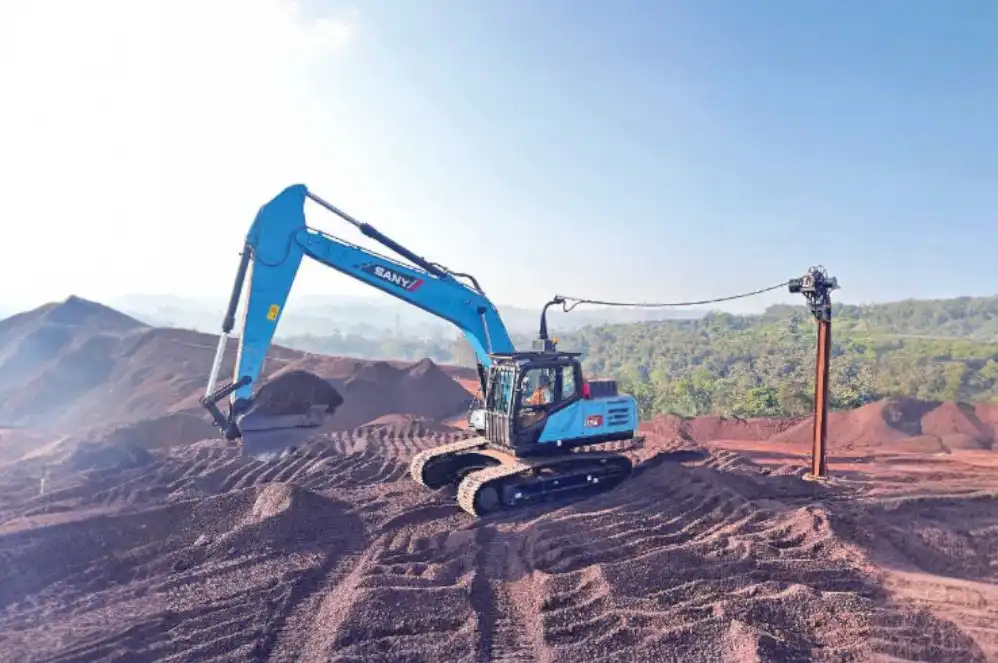
To price an electric machine for your site, compare the electric excavator models and prices and send an enquiry. Tell the dealer your shift pattern and the power supply you have, because those two answers decide whether battery, cable or diesel suits you.
Swap and charging figures are quoted from the ICCT blog of 9 August 2023, the Montra Electric Rhino product page, and Energy In Motion Ltd press releases dated 27 July, 3 September, 29 September and 14 October 2026, read in October 2026. None of the trucks named here is listed for sale on DesiMachines. Prices, specifications and features are indicative, vary by variant, location and date, and should always be confirmed with the official OEM or authorised dealer before any purchase decision. DesiMachines is not liable for decisions taken on the basis of information that may have changed after publication.