
 Excavator
316 models
 Backhoe Loader
54 models
 Crane
68 models
 Concrete Mixer
79 models
 Wheel Loader
54 models
 Compactor / Roller
45 models
 Motor Grader
42 models

 Concrete Pump
66 models
 Skid Steer Loader
11 models


Hot mix plants sold in India are rated from 3 to 10 tonnes an hour for a towed mini plant to 260 tonnes an hour and more for a highway batch plant, and the rating is what the plant makes with dry, correctly graded stone. On a wet morning, with a long haul and a short tipper fleet, the same plant sends out less, so the number to plan with is the one your site can actually take.
Capacity is written as TPH, tonnes per hour of finished hot mix leaving the plant. This guide explains what that figure means, the sizes plants come in, how a batch plant’s figure is built up, why real output falls below the plate, what a model name like DM 60 tells you, and how to work out the size your own road job needs. Figures come from the Indian Standard for small plants (IS 5890), the IRC and MoRTH road specifications, and the makers’ own spec pages. No prices are quoted here.
What does hot mix plant capacity (TPH) mean?
TPH is the weight of finished mix, stone plus bitumen plus filler, that a plant can turn out in one hour of steady running. A 120 TPH plant run flat out for an hour fills about seven tippers carrying 16 tonnes each.
The figure always has conditions behind it. IS 5890:2004, the Bureau of Indian Standards rule for light-duty mobile hot mix plants, says capacity shall be stated as output at 6 percent and 2 percent moisture in the stone, and it gives two classes: 3 to 5 tonnes an hour, and 6 to 10 tonnes an hour. In both classes the wet-stone figure is only 60 percent of the dry-stone figure. The same standard also says a plant’s rated capacity settles only after 50 hours of running, so a new plant should be judged after that, not on its first day.
Large plants are not covered by IS 5890, and their makers set their own basis for the rating. That is why the first question to ask about any TPH figure is: at what moisture, and with what stone?
What capacities do hot mix plants come in?
There are three working families. A batch plant weighs every ingredient and mixes it one load at a time in a paddle mixer (also called a pugmill). A drum mix plant dries the stone and mixes in the bitumen in one long rotating drum, in a steady stream. A mobile mini plant is a small towed unit for patch work and small roads. The ranges below are what Indian makers list on their own sites.
| Plant type | Listed capacity | Where the figure comes from |
|---|---|---|
| Light-duty mobile plant | 3 to 5 or 6 to 10 t/h (wet stone to dry stone) | IS 5890:2004 clause 3.1 |
| Towed bitumen mixer | 6 to 10 t/h | Speedcrafts SBM-10, built generally to IS 5890 |
| Mobile drum mix plant | 20 to 30 t/h | Atlas Industries MDM 25 |
| Stationary drum mix plant | 15 to 150 t/h | Speedcrafts DM 20 to DM 150; Atlas 40 to 120 t/h, larger made to order |
| Batch mix plant | 80 to 260 t/h | Speedcrafts BM 80 to BM 200; Atlas 80, 120, 160, 200 and 260 t/h |
| Wheel-mounted continuous plant | 100 to 200 t/h | CIBER iNOVA 2000, carried on two semi-trailers |
Ammann’s India pages put its batch plants at 80 to 440 t/h and its Alpine continuous plants at up to 600 t/h. Who makes which plant in India, maker by maker, is set out in the list of hot mix plant manufacturers in India.
The Indian Roads Congress specification for bituminous macadam, IRC:27-2009, says a plant “shall be of suitable capacity preferably of batch mix type”, and lists what every plant must have: at least four cold feed bins, a drier with a burner, thermometers, a metered bitumen supply, a filler system and dust control. MoRTH’s road specification, clause 501.3, points to that list and asks for a plant “of adequate capacity”. Neither sets a tonnes-per-hour figure. The contract and the job set that.
How is a batch plant’s capacity worked out?
A batch plant’s hourly figure is simple multiplication: batch size × batches per hour. The mixer holds a fixed weight, and each batch goes through the same steps: weigh the hot stone, filler and bitumen, mix dry, mix wet, open the gate, close it.
The small towed plants show this most clearly. The Speedcrafts SBM-10 has a 300 kg batching chute and a 350 kg pugmill and is rated 6 to 10 t/h. At about a third of a tonne a batch, 10 tonnes an hour means roughly 30 batches, one every two minutes. At 6 tonnes an hour it is about one batch every three minutes.
Anything that lengthens the cycle cuts the TPH. Stone mastic asphalt (SMA) is the clearest case: MoRTH clause 515.4.3 says that when fibre is added in a batch plant, dry mixing must be 5 to 10 seconds longer and wet mixing at least 5 seconds longer. Take a plant that normally finishes a 2-tonne batch every 45 seconds, which is 80 batches and 160 tonnes an hour. Add 10 to 15 seconds and it makes 60 to 65 batches, about 120 to 130 tonnes an hour. Same plant, same burner, up to a quarter less mix.
Figure 1: Where a hot mix plant’s hourly output is decided
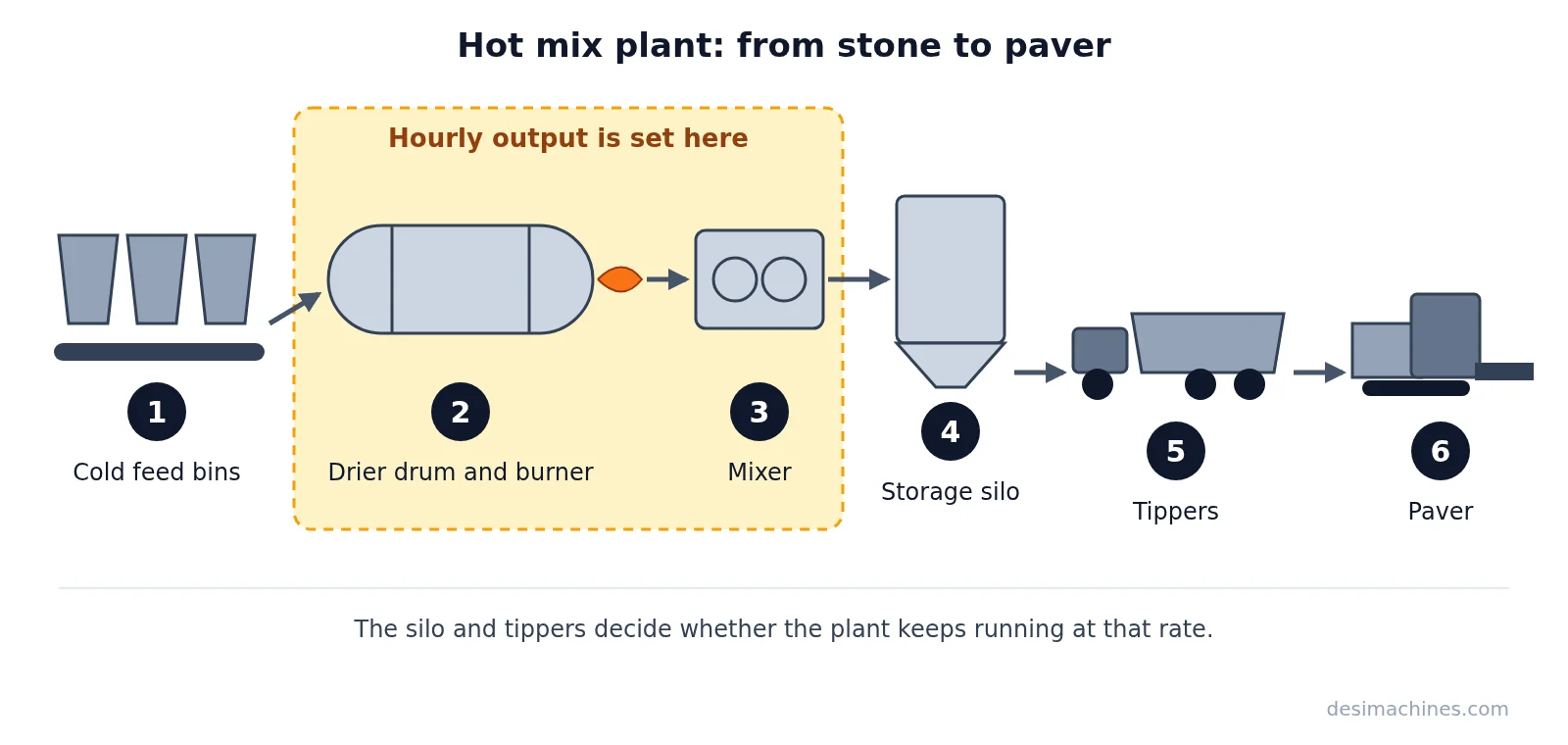
What each numbered stage in Figure 1 does to capacity:
- Cold feed bins. They meter the stone sizes onto a belt. If one bin runs short, the whole plant slows.
- Drier drum and burner. They dry and heat the stone, and every percent of water has to be boiled off before the stone is hot enough. On a drum plant this is the hourly limit. IS 5890 also requires a small plant’s mixer to keep up with the drier’s maximum output, so there too the drier sets the pace.
- Mixer. In a batch plant, batch size and cycle time set the output. In a drum plant, mixing happens in the same drum, so the drier’s rate is the plant’s rate.
- Storage silo. It holds finished mix so the plant keeps running while no tipper is waiting. It adds no tonnes.
- Tippers. Too few trucks and the plant stops to wait for them.
- Paver. It lays what arrives. MoRTH wants it fed so it never stops.
Why does a plant make less than its rated TPH?
Wet stone is the main reason. The burner has to drive the water out of the aggregate before it can heat it, and that takes fuel and time. IS 5890 is strict about how a drier is rated: stone wholly passing a 20 mm sieve with half of it retained on 2.36 mm, dried to no more than 0.5 percent moisture and heated to at least 180°C. Stone straight from a rain-soaked stockpile is far from that test, which is why the standard’s own wet-stone figures are only 60 percent of the dry ones.
Other things pull the real figure down:
- Too many fines (dust) or the wrong stone sizes in the bins. The plant then has to waste material or slow down to stay inside the job mix grading.
- A hotter mix. Stiffer bitumen grades need the stone hotter, which costs burner time. The mixing temperatures for each grade are in the guide to bitumen grades and temperatures.
- Recycled asphalt (RAP), the milled-off old road fed back into new mix. Every plant has a design ceiling on it: Ammann quotes up to 60 percent on its Alpine continuous plants and up to 100 percent only with its RAH100 recycling system. Ask the maker what TPH the plant holds at the RAP share you plan. Where RAP comes from is explained in the guide to cold milling.
- Stops. A plant waits for tippers, for a lab check, for a burner restart. Every minute of waiting is output lost for good.
For drum plants, IRC:27 asks for a way to measure aggregate moisture so the bitumen and filler can be corrected for it. That meter is also the plant operator’s best guide to how fast the plant can run that day.
What does a model name like DM 50 or DM 60 tell you?
Very little on its own. “DM” stands for drum mix, and the number is the maker’s own label, not a standard size. Two Indian makers show the problem:
| Model name | Speedcrafts rating | Atlas Industries rating |
|---|---|---|
| DM 60 | 45 to 60 TPH | 90 to 120 TPH |
Speedcrafts names its drum plants after the top of each band (DM 20 for 15 to 20 TPH, up to DM 150 for 120 to 150 TPH). Atlas lists a DM 60 installed in Rajasthan at 90 to 120 TPH. A buyer comparing a “DM 60” from one maker with a “DM 60” from another could be comparing a plant with twice the output of the other. Read the TPH figure and its moisture basis on that maker’s sheet, never the badge.
How do you work out the plant capacity your road job needs?
Start from the road, not the plant. Work out how many tonnes of mix one day’s paving needs, divide by the hours you can really lay, and then allow for the plant’s stops. Here is the sum for one kilometre a day of dense bituminous macadam (DBM), the thicker bituminous layer laid under the wearing course. MoRTH Table 500-10 sets DBM Grading 2 at 50 to 75 mm thick with at least 4.5 percent bitumen.
| Step | Working | Result |
|---|---|---|
| Compacted volume | 5.5 m wide × 0.05 m thick × 1,000 m | 275 cubic metres |
| Weight of mix | 275 × about 2.3 tonnes per cubic metre | About 630 tonnes |
| Laying hours in the day | Say 8 hours of daylight paving | About 80 tonnes an hour delivered |
| Allow for plant stops | If the plant really runs 45 minutes in each hour: 80 ÷ 0.75 | About 105 to 110 tonnes an hour |
| Bitumen for the day | 630 tonnes × 4.5 percent minimum | About 28 tonnes |
So this job wants a plant that can make about 110 tonnes an hour at the moisture your stone will have, not at the dry-stone figure. The 2.3 tonnes per cubic metre is a working figure: the real density of your job mix comes from the lab’s mix design, explained in the guide to the Marshall stability test. Where DBM and the wearing course sit in the road is shown in the guide to road construction layers.
Two checks finish the sum. First, the contract: some state schedules of rates name a minimum plant type and size for certain layers, so read it before you size by arithmetic alone. Second, the paver: at 80 tonnes an hour the paver crawls, which is how it should be. How fast a paver moves for a given plant output is worked through in the guide to the asphalt paver.
How many tippers and how much bitumen storage does a plant need?
A plant only makes its TPH if the trucks keep coming. MoRTH clause 501.4 asks for clean, insulated and covered trucks, and clause 501.5.3 asks that delivery be regulated so the paver can work without stopping. That makes the tipper count part of the plant’s capacity.
| Step | Working | Result |
|---|---|---|
| Loads per hour | 80 tonnes ÷ say 16 tonnes of mix per tipper | 5 loads an hour |
| One round trip | Load 5 min + 15 km to site 30 min + wait and tip into the paver 10 min + return 25 min | About 70 minutes |
| Tippers on the road | 5 loads × 70 ÷ 60 | About 6, plus 1 spare |
Use your own tipper’s legal load, which depends on its axles and its registration; the guide to tipper capacity shows how to work it out. A longer haul or slower roads add tippers, not plant capacity.
Bitumen storage is a limit too. At 80 tonnes an hour and 4.5 percent bitumen the plant uses about 3.6 tonnes of bitumen every hour. Speedcrafts supplies its drum plants with a 15 or 20 tonne bitumen tank, and Atlas fits a 12 tonne tank with its MDM 25 mobile plant. A 20 tonne tank lasts about five and a half hours at that rate, so a full day’s DBM needs a second tank or a refill planned in.
Does a hot mix storage silo increase capacity?
No. A silo stores finished mix; it does not make more of it. What it does is stop the plant from idling. When the next tipper is late, the plant keeps running into the silo, and when three tippers arrive together, the silo loads them fast. Over a day, that keeps the plant near its real hourly figure instead of stopping and starting.
Atlas lists insulated hot mix silos of 5, 10, 15, 20 and 25 tonnes, and up to 50 tonnes, as optional items on its drum plants, and says mix can be held in them for some time. Small plants have only a loading hopper: the Atlas MDM 25’s holds half a tonne, and the CIBER iNOVA 2000 has a 2 cubic metre loading silo. Mix cools and stiffens in storage, so a silo covers short gaps, not a broken-down paver.
What should you check before trusting a capacity figure?
Before you buy or hire a plant, or rely on a supplier’s plant to feed your paver, ask these questions:
- At what stone moisture is the TPH stated? A figure with no moisture basis cannot be compared with another.
- For a batch plant, what is the mixer’s batch size and the normal cycle time? Multiply them and see if the answer matches the plate.
- How many hours has the plant run since it was set up? IS 5890 judges a small plant’s rating only after 50 hours.
- Does the plant meet the IRC:27 list: four or more cold bins, a moisture meter on drum plants, thermometers and a metered bitumen feed?
- What does the contract ask for? Some schedules name a minimum plant type and size for certain layers.
- How big are the bitumen tanks and the silo, and how many tippers will serve the plant?
For small patch work and village roads where even a 6 t/h mixer is too much, a bitumen boiler and hand laying may be the right tool. For a plant’s running economics, siting rules and licences, see the guide to the hot mix plant business. A concrete batching plant is a different machine with its own way of stating output in cubic metres an hour, covered in the guide to types of batching plant.
Behind every plant comes a rolling crew. Compare tandem roller models and specs or browse the full range of road rollers and compactors and talk to a verified dealer. More on how Indian roads are built is in the road construction guide.
Sources
Capacity classes, the moisture basis of the rating, the drier test conditions and the 50-hour settling rule are from IS 5890:2004, Mobile hot mix asphalt plants, light duty, requirements, clauses 3.1 and 10.2 (IS 5890:2004). The essential features of hot mix plants, including the moisture meter for drum plants, are from IRC:27-2009, Specifications for bituminous macadam, Annex A (IRC:27-2009). Plant capacity, transport, delivery to the paver, SMA mixing times and the DBM grading table are from the MoRTH Specifications for Road and Bridge Works, fifth revision, clauses 501.3, 501.4, 501.5.3, 515.4.3 and Table 500-10. Maker figures are from the Speedcrafts, Atlas Industries, CIBER (Wirtgen Group India) and Ammann websites. All were read on 14 November 2026.
Prices, specifications and features are indicative, vary by variant, location and date, and should always be confirmed with the official OEM or authorised dealer before any purchase decision. DesiMachines is not liable for decisions taken on the basis of information that may have changed after publication.
Machines, tenders and news for this industry: Road Construction