
 Excavator
294 models
 Backhoe Loader
51 models
 Crane
68 models
 Concrete Mixer
79 models
 Wheel Loader
54 models
 Compactor / Roller
45 models
 Motor Grader
42 models

 Concrete Pump
66 models
 Skid Steer Loader
11 models


Tipper capacity has two parts, and a full load is whichever one runs out first: the weight the truck may legally carry, which is the laden weight on its registration certificate minus its unladen weight, and the space in its body, measured in cubic metres (m³) or cubic feet (cft). For sand, soil and stone the weight runs out first on most box bodies, so a tipper filled to the brim is usually overloaded.
This guide shows where each number comes from: the axle limits in the government notification that cap a 6, 10 or 12-wheeler, the body volumes printed on maker spec sheets, and the material weights that turn cubic metres, cft and brass into tonnes. Every conversion is worked out in tables, so you can read off a load for your own truck. No prices are quoted here.
What does tipper capacity mean?
Tipper capacity means two different numbers, and Indian sites mix them up all the time.
The first is weight. Every registered truck carries a laden weight, also called gross vehicle weight or GVW: the most the truck may weigh with its body, driver, fuel and load all on board. It also carries an unladen weight: the truck and body empty. Both are printed on the registration certificate (RC). The certificate format in the Central Motor Vehicles Rules, Form 23A, has a box for each. The difference between them is the payload: the weight of material you may legally put in the body.
The second is volume. The body is a steel box, and its size is quoted in cubic metres on the maker’s spec sheet. Sand and aggregate suppliers in many states quote in cft or in brass instead, so the same load gets three names.
A tipper is full when it reaches either limit. Volume tells you how much fits. Weight tells you how much is allowed. The rest of this guide is about turning one into the other.
Off-highway dumpers work differently. They never take a number plate, so their capacity is the payload the maker rates them for, in tonnes, and the haul road is the limit, not the RTO. How rigid and articulated dumpers differ from road tippers is covered in the guide to the types of tipper truck and dumper.
How many tonnes can a 6, 10 and 12-wheeler tipper carry?
The legal ceiling comes from the axles. The Ministry of Road Transport and Highways set the maximum safe weight for each kind of axle in notification S.O. 3467(E) of 16 July 2018, issued under section 58 of the Motor Vehicles Act. A truck’s GVW may not be more than its axle limits added together.
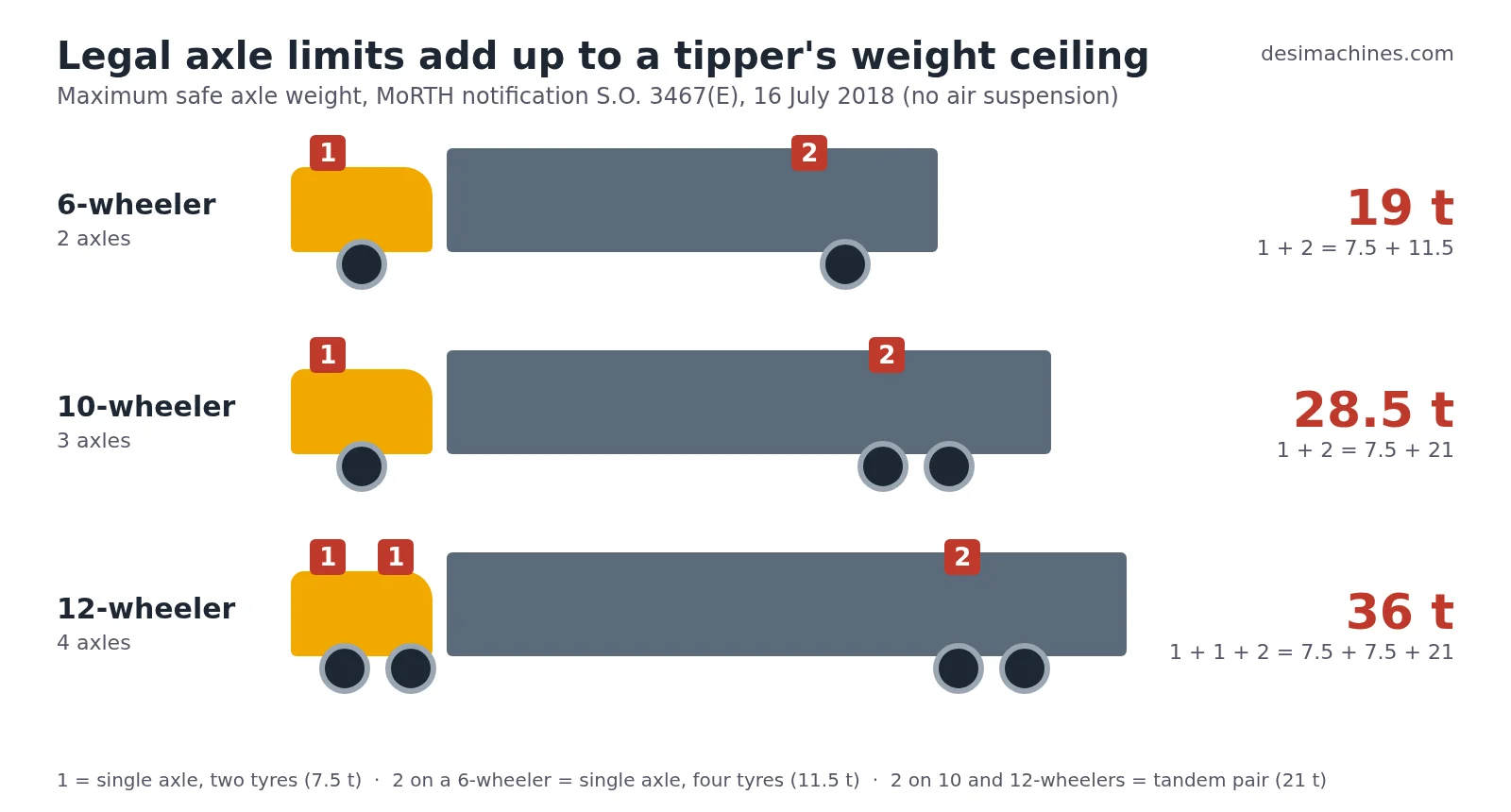
Figure 1. How the axle limits add up. A single steering axle on two tyres is allowed 7.5 tonnes. A single rear axle on four tyres is allowed 11.5 tonnes. A tandem pair, two rear axles less than 1.8 metres apart, is allowed 21 tonnes. Add the axles on the truck and you have its ceiling.
| Tipper | Axles on the road | Legal ceiling from the axle limits | Example GVW on a maker’s sheet |
|---|---|---|---|
| 6-wheeler | 1 steering axle (7.5 t) + 1 rear axle on four tyres (11.5 t) | 19 tonnes (19,000 kg) | BharatBenz 1926C: 18,500 kg |
| 10-wheeler | 1 steering axle (7.5 t) + rear tandem pair (21 t) | 28.5 tonnes (28,500 kg) | BharatBenz 2828C HX: 28,000 kg |
| 12-wheeler | 2 steering axles (7.5 t each) + rear tandem pair (21 t) | 36 tonnes (36,000 kg) | BharatBenz 3532C HX: 35,000 kg |
Axle limits from S.O. 3467(E); GVW figures from BharatBenz spec pages, read 7 November 2026.
Notice that the maker’s figure sits a little under the legal ceiling on each truck. The number that binds you is the one on your RC, because that is what the truck was approved and registered at. The ceiling only tells you the most any 10-wheeler on leaf springs can be rated at under these limits.
Three details in the same notification matter for tippers:
- A truck with air suspension (pneumatic suspension) is allowed one extra tonne on each of its rear four-tyre and tandem axles. Most construction tippers run leaf springs or a bogie, so check before you count on it.
- No rigid truck may weigh more than 49 tonnes, however many axles it has.
- A tolerance of up to five per cent on GVW is allowed when compliance is checked under section 113 of the Motor Vehicles Act. Treat it as room for scale and loading error, not as spare payload.
Covering the load is a separate rule from weight; the change coming for tippers and dumpers is in the news item on the tipper and dumper load cover rule.
How much does a tipper body hold in cubic metres, cft and brass?
Body volume is the easy half. One cubic metre is 35.31 cft, because a metre is 3.281 feet and you cube it. One brass is a trade unit of 100 cft, which works out to 2.83 cubic metres. Many sand, aggregate and murrum suppliers sell by the brass.
| Tipper and body | Cubic metres | Cubic feet (cft) | Brass |
|---|---|---|---|
| 6-wheeler, BharatBenz 1926C, box body | 10.5 m³ | 371 cft | 3.7 |
| 10-wheeler mining tipper, BharatBenz 2832CM, scoop (rock) body | 16 m³ | 565 cft | 5.7 |
| 10-wheeler, BharatBenz 2828C HX, box body | 18 m³ | 636 cft | 6.4 |
| 12-wheeler, BharatBenz 3532C HX, box body | 23 m³ | 812 cft | 8.1 |
Body volumes as printed on the BharatBenz spec pages; cft and brass are our conversion.
Bodies are built to order, so the same chassis can carry a bigger or smaller box. Read the volume off your own body builder’s drawing, or measure it: inside length times inside width times side height gives the level-full volume in cubic metres.
How do you convert cubic metres, cft or brass into tonnes?
Multiply the volume by the weight of one cubic metre of the material, which engineers call its density or unit weight. The Indian Standard on dead loads, IS 875 (Part 1), lists these weights; the figures below are taken from the guide to the unit weight of building materials, which sets out the full table.
| Material (IS 875 Part 1) | Weight of 1 m³ | Weight of 1 brass (100 cft) | Cft in 1 tonne |
|---|---|---|---|
| Sand, dry and clean | 1,540 to 1,600 kg | 4.4 to 4.5 tonnes | 22 to 23 cft |
| Sand, wet | 1,760 to 2,000 kg | 5.0 to 5.7 tonnes | 18 to 20 cft |
| Earth, dry | 1,410 to 1,840 kg | 4.0 to 5.2 tonnes | 19 to 25 cft |
| Earth, moist | 1,600 to 2,000 kg | 4.5 to 5.7 tonnes | 18 to 22 cft |
| Gravel, loose | 1,600 kg | 4.5 tonnes | 22 cft |
| Broken stone (aggregate), dry | 1,600 to 1,870 kg | 4.5 to 5.3 tonnes | 19 to 22 cft |
Brass and cft columns are our arithmetic from the IS 875 figures.
Water is the swing factor. In the IS 875 figures, wet sand weighs around a fifth more than dry sand, so a load that was legal in May can be over the limit in July. Take the wet figure whenever the stockpile is damp.
Dug earth also grows. Earthwork in India is measured in the ground before it is dug, the bank measure in IS 1200 (Part 1), but the tipper carries it loose, and loose soil takes more space than the hole it came from. So a pit measured at 10 m³ fills more than 10 m³ of body, while its weight stays the same.
Loading a tipper fleet? Compare the range of excavators and backhoe loader models that do the filling, and talk to a verified dealer.
Why does a full tipper body weigh more than the truck may carry?
Because the body is sized for lighter loads than sand, soil and stone. Fill the body level with these materials and the load alone comes close to the whole GVW, before the truck’s own weight is counted.
| Material | Full 10.5 m³ body (6-wheeler, GVW 18.5 t) | Full 18 m³ body (10-wheeler, GVW 28 t) | Full 23 m³ body (12-wheeler, GVW 35 t) |
|---|---|---|---|
| Sand, dry | 16.2 to 16.8 t | 27.7 to 28.8 t | 35.4 to 36.8 t |
| Sand, wet | 18.5 to 21.0 t | 31.7 to 36.0 t | 40.5 to 46.0 t |
| Earth, dry | 14.8 to 19.3 t | 25.4 to 33.1 t | 32.4 to 42.3 t |
| Broken stone, dry | 16.8 to 19.6 t | 28.8 to 33.7 t | 36.8 to 43.0 t |
Load only, our arithmetic: body volume times IS 875 weight. The truck’s unladen weight comes on top.
Take the 10-wheeler. Eighteen cubic metres of dry sand weighs 27.7 to 28.8 tonnes, which is the entire 28-tonne GVW spent on sand alone. Add a truck that weighs several tonnes empty and the load is far past the RC figure. A legal load of sand on that truck fills only part of the box.
This is why mining tippers carry smaller rock bodies on the same chassis: the BharatBenz 2832CM takes 16 m³ against 18 m³ on the construction 2828C HX, both at 28 tonnes GVW. Box or rock body, and how plate grade changes the weight of the body itself, are explained in the post on the Hardox tipper body.
How do you work out the right load for your own tipper?
Five steps, and the first two need only your RC:
- Read the laden weight and the unladen weight off the registration certificate.
- Subtract. The answer is your legal payload in kilograms.
- Divide the payload by the weight of one cubic metre of the material from the table above. The answer is the most cubic metres you may carry.
- Multiply by 35.31 for cft, or divide the cft by 100 for brass, if your supplier sells that way.
- Weigh the first load on a public weighbridge and correct your mark on the body side. Repeat after heavy rain.
If the body is changed, the unladen weight changes too, so weigh the empty truck again. A heavier body takes its extra steel out of the payload.
For planning, the table below turns a payload into volume for the common materials. Find the row nearest your own RC payload.
| Payload on your RC | Dry sand | Wet sand | Broken stone, dry |
|---|---|---|---|
| 10 tonnes | 6.2 to 6.5 m³ (221 to 229 cft) | 5.0 to 5.7 m³ (177 to 201 cft) | 5.3 to 6.2 m³ (189 to 221 cft) |
| 15 tonnes | 9.4 to 9.7 m³ (331 to 344 cft) | 7.5 to 8.5 m³ (265 to 301 cft) | 8.0 to 9.4 m³ (283 to 331 cft) |
| 20 tonnes | 12.5 to 13.0 m³ (441 to 459 cft) | 10.0 to 11.4 m³ (353 to 401 cft) | 10.7 to 12.5 m³ (378 to 441 cft) |
| 25 tonnes | 15.6 to 16.2 m³ (552 to 573 cft) | 12.5 to 14.2 m³ (441 to 502 cft) | 13.4 to 15.6 m³ (472 to 552 cft) |
Our arithmetic from the IS 875 weights. The higher volume in each cell goes with the lighter end of the material’s weight range.
Rates for soil and sand by the cft or the brass change every season, so they are kept out of this guide. Current sand rates by the brass and by the load sit in the post on river sand price.
What happens when a tipper carries more than its capacity?
The truck pays first. Tyres run hotter and wear faster, springs and the rear bogie take loads they were not built for, and the brakes have more weight to stop on every downhill. How load shortens tyre life is worked through in the post on tipper tyre life.
The road pays too, which is why axle limits exist at all. And the owner carries the legal risk: section 113 of the Motor Vehicles Act bars driving a vehicle heavier than the weight on its registration certificate, and the five per cent tolerance is the only margin the notification gives.
The cheap fix starts at the loading point. A loader operator who knows the truck’s legal volume stops one bucket short. Count the bucket loads that make a legal load once on the weighbridge, then paint that count where the operator can see it. A JCB 3DX front shovel or a 20-tonne excavator such as the Tata Hitachi EX 210 Infra fills a tipper in a known number of passes. How many tippers one excavator keeps busy is explained in the guide to the shovel dumper combination.
Electric tippers follow the same weight rules; how their payload works is covered in the guide to the electric dumper and tipper. For more on tippers and dumpers, start from the tipper and dumper guides.
Choosing the machines that will load your tippers? Browse the wheel loaders, excavators and backhoe loaders side by side and talk to a verified dealer.
Sources
Axle limits, the 49-tonne cap, the air suspension allowance and the five per cent tolerance are from the Ministry of Road Transport and Highways notification S.O. 3467(E), dated 16 July 2018, published in the Gazette of India, Extraordinary, Part II, Section 3(ii). The laden weight and unladen weight boxes on the registration certificate are from Form 23A of the Central Motor Vehicles Rules on parivahan.gov.in. Tipper GVW and body volumes are from the BharatBenz tipper spec pages for the 1926C, 2828C HX, 2832CM and 3532C HX. Material weights are from IS 875 (Part 1):1987, Code of practice for design loads, dead loads, as tabled in the unit weight guide linked above; the bank measure of earthwork is from IS 1200 (Part 1). All were read on 7 November 2026. The cft, brass and full-body figures are our own arithmetic from those sources.
Prices, specifications and features are indicative, vary by variant, location and date, and should always be confirmed with the official OEM or authorised dealer before any purchase decision. DesiMachines is not liable for decisions taken on the basis of information that may have changed after publication.