
 Excavator
316 models
 Backhoe Loader
54 models
 Crane
68 models
 Concrete Mixer
79 models
 Wheel Loader
54 models
 Compactor / Roller
45 models
 Motor Grader
42 models

 Concrete Pump
66 models
 Skid Steer Loader
11 models


Silica fume goes into concrete at about 5 to 10 percent of the cement, and that small dose of an extremely fine grey powder makes the concrete denser, stronger and much harder for water and salt to get through. It is the dust caught from the furnaces that make silicon and ferro-silicon, sold as microsilica, and in India it is bought against IS 15388:2003.
The catch is that it changes how the concrete behaves on site. The mix turns sticky, it needs a superplasticizer to flow, it bleeds almost no water, and it has to be weighed, mixed and cured with more care than ordinary concrete. This guide covers what the material is, what the standard asks of it, how much to add, what it does, where it earns its cost, and how it compares with GGBS and fly ash.
Key points
- IS 456 says silica fume is usually used at 5 to 10 percent of the cement content of a mix. On one 50 kg bag of cement that is 2.5 to 5 kg.
- IS 15388 asks for at least 85 percent silicon dioxide, loss on ignition of 4 percent at most, and a 7-day mortar strength of at least 85 percent of the control.
- Concrete with mineral admixtures must be kept wet for at least 10 days under IS 456, and MoRTH asks for at least 14 days of moist curing on high performance concrete.
- Undensified silica fume weighs only 150 to 350 kg per cubic metre, so it must be batched by weight, never by bucket or by bag count.
What is silica fume, and where does it come from?
Silica fume is a by-product. Factories that make silicon metal and ferro-silicon alloy heat quartz with carbon in electric arc furnaces at over 2,000°C. Some of the silica turns into a gas, silicon monoxide, which meets the air above the furnace, oxidises back to silicon dioxide and condenses into tiny glassy spheres that rise with the furnace smoke. The filters catch them, and that collected dust is silica fume. IS 15388 gives its other two trade names, condensed silica fume and microsilica, so all three words on a quotation mean the same material.
The particles are what make it special. IS 15388 puts their average diameter at 0.10 to 0.15 micron, and a micron is a thousandth of a millimetre. That is roughly 100 times smaller than an average cement grain. Because they are glass and not crystal, they react chemically inside concrete, which is what the word pozzolanic means: the powder has no binding power of its own, but it combines with the lime released by setting cement to form more of the glue that holds concrete together.
Do not confuse it with fumed silica, a different and more expensive product made by burning silicon tetrachloride in a hydrogen-oxygen flame. It is not what a concrete specification means.
The standard describes three forms you can buy:
- Natural state, straight from the collection filter, weighing 150 to 350 kg per cubic metre.
- Densified, where the particles are made to clump together so the powder weighs above 500 kg per cubic metre and is easier to transport and handle.
- Slurry, a liquid suspension in water, typically half silica fume by mass, which holds about 700 kg of silica fume per cubic metre.
Which IS code covers silica fume, and what does it ask for?
IS 15388:2003, Silica Fume Specification, published by the Bureau of Indian Standards in August 2003. It covers silica fume for use in concrete and other mixes made with hydraulic cement. Amendment No. 1 of April 2017 added a method for measuring available alkalis. IS 456, the concrete code, was amended in September 2005 to point to it, so its clause 5.2.1.2 now reads that silica fume conforming to IS 15388 may replace part of the cement “provided uniform blending with the cement is ensured”.
Table 1: What IS 15388 asks of silica fume
| Requirement | Limit | Where in IS 15388 |
|---|---|---|
| Silicon dioxide (SiO₂) | 85.0 percent by mass, minimum | Table 1 |
| Moisture content | 3.0 percent by mass, maximum | Table 1 |
| Loss on ignition | 4.0 percent by mass, maximum | Table 1 |
| Alkalis as Na₂O (only where the aggregate is reactive) | 1.5 percent, maximum | Table 1, Notes 2 and 3; method in Amendment 1 |
| Specific surface (BET gas method) | 15 m²/g, minimum | Table 2 |
| Retained on the 45 micron sieve | 10 percent, maximum | Table 2 |
| Variation of the 45 micron residue from the average | 5 percent, maximum | Table 2 |
| Compressive strength at 7 days, as percent of control | 85.0 percent, minimum | Table 2 |
Fineness is tested one of two ways: the gas-adsorption surface area, or the two sieve tests together. A surface of 15 m²/g is 15,000 m² per kilogram, against the 320 m²/kg minimum IS 16714 sets for GGBS, ground granulated blast furnace slag. That gap explains most of how silica fume behaves.
Sampling follows the fly ash method of IS 6491: two samples from the first 100 tonnes of a lot, then one for every further 100 tonnes, each at least 1 kg. Moisture, loss on ignition and the sieve residue are tested on every 100 tonnes; the rest on composite samples covering up to 400 tonnes.
The paperwork is lighter than many buyers assume. Clause 10 asks the supplier for a test certificate only “if requested by the purchaser”, so ask for it in the order. Clause 11 requires every bag or consignment to show the source, the net mass, the batch number and the month and year of packing. The BIS Standard Mark is optional under clause 11.2, so the batch certificate matters more than a logo. The full text is in the BIS specification for silica fume, IS 15388.
How much silica fume should you add to concrete?
Usually 5 to 10 percent, but check what the percentage is a share of. Three Indian documents give a band, and they measure it on slightly different bases.
Table 2: Silica fume dosage in Indian codes
| Document | Dosage | Measured as a share of | Applies to |
|---|---|---|---|
| IS 456:2000, note to clause 5.2.1.2 | 5 to 10 percent, “usually” | The cement content of the mix | Plain and reinforced concrete generally |
| IS 10262:2019, Table 9 | 5 to 10 percent, recommended | Total cementitious material | High strength mixes |
| MoRTH Specifications, 5th revision, clause 602.2.4 | 3 to 10 percent | Cement | Pavement quality concrete for rigid roads |
On site the arithmetic is simple. A 50 kg bag of cement takes 2.5 kg of silica fume at 5 percent and 5 kg at 10 percent. IS 10262, the Indian code for designing concrete mixes, works a full example for M70 concrete: out of 535 kg of total binder per cubic metre, it takes 80.25 kg of fly ash (15 percent), 26.75 kg of silica fume (5 percent) and 428 kg of OPC 53 grade cement.
More is not better past the band. Slump loss grows with the silica fume content, so a bigger dose needs more superplasticizer just to place the concrete. Trial mixes, not a rule of thumb, settle the final figure inside the band.
One detail matters for anyone checking a mix design. Note 1 under IS 456 Table 5 lets fly ash and GGBS be counted towards the minimum cement content and the water-cement ratio, within the limits of their blended-cement standards. It names those two and not silica fume. IS 10262 and MoRTH both write high strength mixes in terms of the water-cementitious materials ratio (w/cm): water divided by cement plus every mineral admixture. Ask the designer which ratio a mix sheet shows before you compare two quotations.
What does silica fume do to concrete strength, permeability and workability?
It works in two ways at once. The particles are small enough to pack into the spaces between cement grains, and around the stones, where ordinary paste is weakest. Then, as the cement sets, the silica reacts with the lime it releases and turns it into more binder. The concrete ends up with fewer and finer pores.
That one change explains most of the effects:
- Strength goes up: compressive strength, bond to the steel and resistance to wear. IS 10262 says silica fume is generally advantageous for M50 and above, and for concrete that needs higher abrasion resistance. The standards also expect it to start fast: IS 15388 asks a silica fume mortar to reach 85 percent of the control at 7 days, while IS 16714 asks a half-slag mortar for 60 percent. Cube tests on the actual mix still decide.
- Permeability drops. With fewer connected pores, water, chlorides and sulphates move through the concrete far more slowly, which protects the steel inside from rusting. That is why coastal work, bridges over salt water and foundations in salty ground use it.
- Workability is the cost. The huge surface area soaks up water, so the slump drops and keeps dropping with time, more so as the dose rises. The mix becomes very cohesive and barely bleeds. That is why silica fume concrete almost always carries a superplasticizer, the high-range water reducer explained in our guide to concrete admixture types and dosage. The IS 10262 example uses a polycarboxylate ether based superplasticizer at 0.5 percent of the binder.
Silica fume is a mineral admixture, and a superplasticizer is a chemical admixture. A high strength mix needs both, and neither replaces the other.
The water figures are low. IS 10262 Table 8 recommends a w/cm of 0.33 for a 70 N/mm² target with 20 mm aggregate, falling to 0.24 at 100 N/mm². For high performance concrete, MoRTH clause 1715.2 says the ratio should generally not exceed 0.33 and must never exceed 0.40. With that little water, the mix only flows because of the superplasticizer.
Where is silica fume used in India?
Where ordinary concrete is not strong or tight enough, and the extra cost and care pay back. The Indian codes point to four places.
High strength concrete. IS 10262 lists silica fume with fly ash, GGBS and metakaolin as the usual cementitious materials for high strength mixes, and its worked example is an M70 mix placed by pump at 120 mm slump. A mix that rich and sticky goes on a pump sized for it; current machines are listed under concrete pump models and prices.
High performance concrete on roads and bridges. MoRTH clause 1715 calls for high performance concrete where a structure needs high strength, high early strength, high workability, low permeability and high durability in severe service conditions, and says silica fume conforming to IS 15388 “shall be used”. Cement plus mineral admixtures must be at least 380 kg per cubic metre, with the Portland cement alone at no more than 450 kg.
Foundations in aggressive ground. For piles, MoRTH Section 1100 allows fly ash, silica fume and GGBS to improve resistance to chlorides and sulphates from the surrounding soil or water.
Concrete road slabs. MoRTH clause 602.2.4 allows silica fume at 3 to 10 percent of the cement in pavement quality concrete, the top layer of a rigid road. The full list of materials such a road uses is in our guide to road construction materials and their tests.
For a house slab, a plinth or a small culvert, plain OPC or PPC concrete designed and cured properly is usually the better spend.
How is silica fume batched and mixed?
By weight, with a separate weigher, and with patience at the mixer. IS 4926, the Indian standard for ready-mixed concrete, sets the rules most plants follow:
- Clause 9.1.1.2 asks for separate storage for silica fume, fly ash, GGBS and other mineral admixtures, just as for cement. How big those silos need to be is covered in our guide to cement silo capacity for batching plants.
- Clause 9.1.3 says cement and mineral admixtures are measured by mass, in a hopper separate from those used for other materials, to within 2 percent of the quantity.
- Annex G requires the delivery ticket to name the generic type of any mineral admixture in the load, so the ticket should say silica fume if the mix contains it.
Weighing is not optional because the powder is so light. Cement weighs about 1,440 kg per cubic metre in bulk, the figure IS 875 gives and our guide to the unit weight of building materials uses. A 5 kg dose of undensified silica fume, at 150 to 350 kg per cubic metre, fills 14 to 33 litres, close to the space taken by a whole 50 kg bag of cement. Measured in pans or buckets, it will always be wrong.
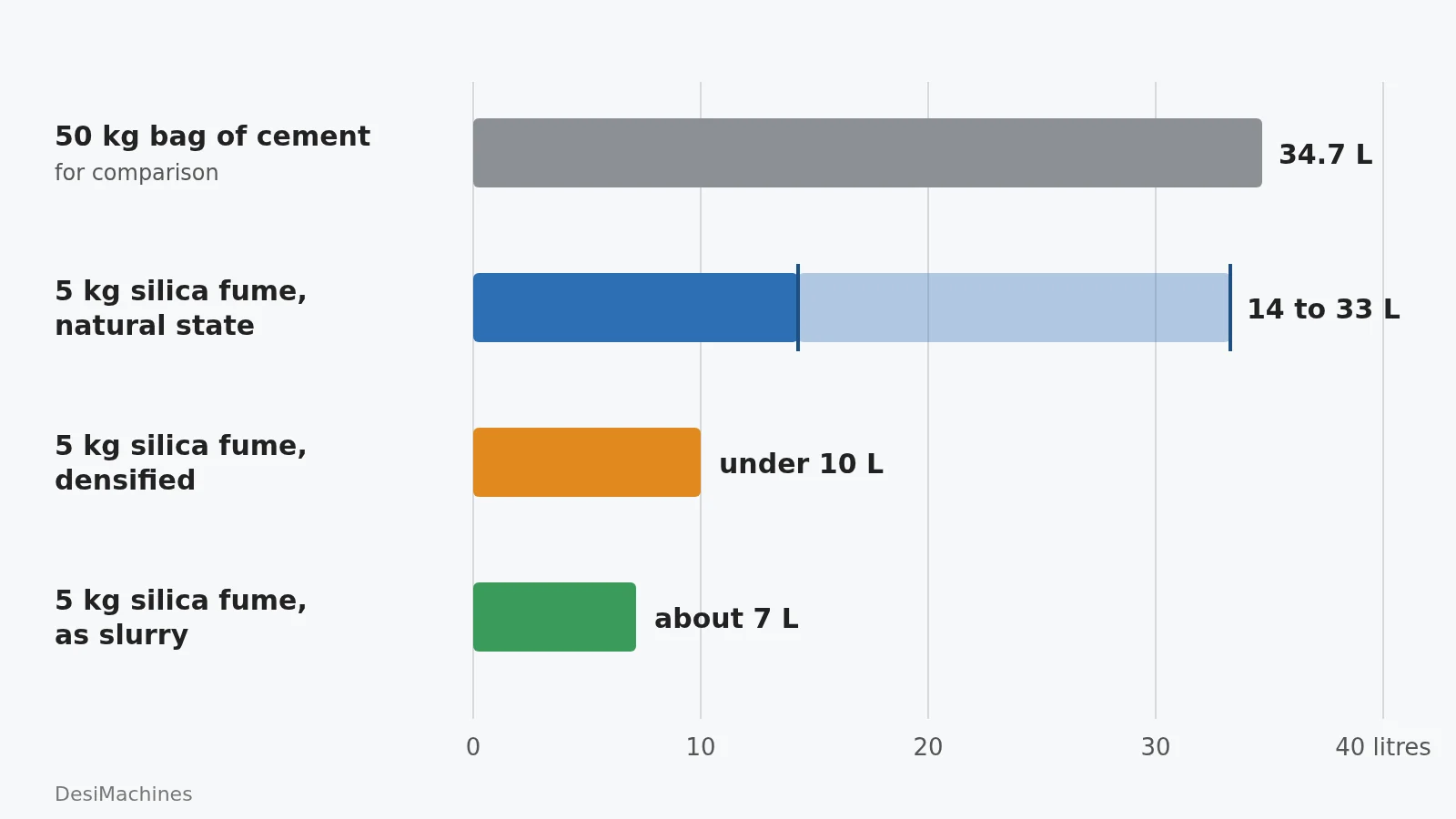
Mixing can take longer too. Silica fume is usually supplied densified, as small granules, and these may need extended mixing to spread evenly through the concrete, so fix the mixing time in the trial mixes. Slurry avoids both the dust and the granules, but its water has to be counted as part of the mixing water.
On a site without a batching plant, a self-loading mixer is the usual machine, and the question to ask is how it weighs a charge. The Fiori DBS 4300 lists computerised batching with printed certificates, and the AJAX ARGO 4500 a pressure transducer with load cell. Their loading buckets hold 560 and 600 litres, sized for aggregate and cement, so a few kilograms of silica fume are better pre-weighed into bags or a container for each batch and added in the same order every time. Compare self-loading concrete mixer models and prices and ask the dealer what each machine records per batch.
If the job takes ready-mixed concrete instead, the questions shift to the plant, set out in our comparison of RMC and site-mixed concrete.
How should silica fume concrete be cured?
Early and for longer. IS 456 clause 13.5.1 requires exposed concrete to be kept wet for at least 10 days where mineral admixtures are used, against 7 days for plain OPC, and recommends extending that to 14 days.
MoRTH clause 1715.8 explains why silica fume concrete is less forgiving than other concrete. It is so cohesive that there is little or no bleed water rising to the surface to replace what evaporates. In sun or wind the surface can dry and crack while the concrete is still soft; these are called plastic shrinkage cracks. So MoRTH asks for initial curing to start soon after the initial set, with moist covers, opaque plastic sheets or a curing compound, then moist curing from the final set for at least 14 days.
Where water cannot be kept on a surface, the spray-on choice and its coverage are in our guide to curing compound types and coverage. Stop curing at day 7, as many crews do from habit, and the surface, where the protection matters most, misses the curing it needs.
Silica fume vs GGBS vs fly ash: which one should you use?
Each does a different job, and a good mix often uses two. GGBS and fly ash replace a large share of the cement; silica fume replaces a small share to make the concrete stronger and tighter.
Table 3: Silica fume, GGBS and fly ash compared
| Silica fume | GGBS | Fly ash | |
|---|---|---|---|
| Where it comes from | Silicon and ferro-silicon furnaces | Blast furnaces making iron | Coal-fired power stations |
| Indian standard | IS 15388:2003 | IS 16714:2018 | IS 3812 (Part 1) |
| Fineness | 15 m²/g (15,000 m²/kg) minimum | 320 m²/kg minimum | Graded by category in IS 3812 |
| Dosage for high strength mixes, IS 10262 Table 9 | 5 to 10 percent | 25 to 50 percent | 15 to 30 percent |
| MoRTH limits for high performance concrete, clause 1715.2 | Must conform to IS 15388 | 50 to 70 percent | 20 to 35 percent |
| Early strength test in its standard | Mortar at 85 percent of control at 7 days | Half-slag mortar at 60 percent at 7 days, 75 percent at 28 days | Set in IS 3812 (Part 1) |
| Main reason to use it | High strength, low permeability, abrasion | Durability in sulphate and coastal ground, low heat in thick pours | Part-replacing cement in everyday concrete; Portland pozzolana cement (PPC) is made with it |
The IS 10262 example is the clearest proof that they combine: 15 percent fly ash for workability and economy, 5 percent silica fume for strength and density, in the same M70 mix. Where a structure faces sulphates or sea water, IS 456 credits slag with better resistance once it is more than half the binder, as our GGBS guide explains.
Is silica fume dust harmful to handle?
It should be handled with care. IS 15388 clause 12 notes the fears raised over the powder because of its fineness and high silica content, and records that X-ray diffraction tests show it is amorphous, which should make it less dangerous than crystalline silica. It still advises all necessary precautions in handling, and asks that the same information travel on the shipping invoice for bulk loads.
In practice that means dust masks and eye protection for anyone opening bags or loading the mixer, and keeping the powder out of the wind. Where the volume justifies it, the slurry form reduces the dust problem, in the standard’s words, “virtually to zero”.
The clauses above come from the BIS code of practice for plain and reinforced concrete, IS 456, and the silica fume specification linked earlier, with dosage and mix figures from IS 10262:2019, batching rules from IS 4926:2003 and road and bridge rules from the MoRTH Specifications for Road and Bridge Works, 5th revision. More guides on cement, concrete and other materials sit on the building materials guide hub, and the machines that mix and place concrete are listed under concrete mixer models and prices.
Prices, specifications and features are indicative, vary by variant, location and date, and should always be confirmed with the official OEM or authorised dealer before any purchase decision. Dosages, test limits and code clauses should be confirmed against the current edition of the Indian Standard and with your engineer before work starts. DesiMachines is not liable for decisions taken on the basis of information that may have changed after publication.
Machines, tenders and news for this industry: Building Construction