
 Excavator
294 models
 Backhoe Loader
51 models
 Crane
68 models
 Concrete Mixer
79 models
 Wheel Loader
54 models
 Compactor / Roller
45 models
 Motor Grader
42 models
 Dozer
41 models
 Concrete Pump
66 models
 Skid Steer Loader
11 models
 Telehandler
13 models



Cement weighs 1,440 kg per cubic metre, dry sand 1,540 to 1,600 kg, plain concrete 2,240 to 2,400 kg and steel 7,850 kg. Those are the unit weights IS 875 (Part 1), the Indian code for dead loads on buildings, gives for the materials that go into almost every house, shed and road in the country.
Engineers use these numbers to work out how heavy a slab or wall is before they size the beams under it. Site supervisors use the same numbers for something simpler: turning cubic metres into tonnes, so they know what a truck, a loader bucket or a mixer is really carrying. This guide puts the IS 875 figures in one place, in both kg/m³ and kN/m³, and shows how to use them.
What is unit weight, and is it the same as density?
Unit weight is the weight of one cubic metre of a material, written in kilonewtons per cubic metre (kN/m³). Density is the mass of that same cubic metre, written in kilograms per cubic metre (kg/m³). One is a force and the other is a mass, but on Indian sites, in tender documents and in exam papers both are loosely called “unit weight”. IS 875 (Part 1) prints the two columns side by side, so you can read either.
Converting between them takes one step:
kN/m³ = kg/m³ × 9.81 ÷ 1,000
Take prestressed concrete at 2,400 kg/m³. Multiply by 9.81 and divide by 1,000, and you get 23.5 kN/m³, which is exactly the figure in the code. To go the other way, divide by 9.81 and multiply by 1,000. A handy rule of thumb is that 1 kN is about 102 kg.
You will also meet specific gravity. It is the density of a material divided by the density of water (1,000 kg/m³). Steel at 7,850 kg/m³ therefore has a specific gravity of 7.85, and cement at 1,440 kg/m³ in bulk works out to 1.44. That last number is the cement as it sits in a heap or bag, air gaps included. The cement grains themselves are far heavier, which is why a mix design uses a different figure for them.
What is the unit weight of building materials as per IS 875?
IS 875 (Part 1):1987 lists building materials in alphabetical order in its Table 1, from acoustic materials to wood-wool slabs, and puts stored materials such as metals in Appendix A. The two tables below pull out the ones that matter on an ordinary Indian building or road job. The first covers concrete and the materials that make it; the second covers masonry, steel, stone, soil and water.
Table 1: Unit weight of cement, sand, aggregate, mortar and concrete (IS 875 Part 1, Table 1)
| Material | Unit weight (kN/m³) | Density (kg/m³) |
|---|---|---|
| Cement, ordinary | 14.10 | 1,440 |
| Cement, rapid-hardening | 12.55 | 1,280 |
| Sand, dry and clean | 15.10 to 15.70 | 1,540 to 1,600 |
| Sand, river | 18.05 | 1,840 |
| Sand, wet | 17.25 to 19.60 | 1,760 to 2,000 |
| Broken stone (coarse aggregate), dry and well shaken | 15.70 to 18.35 | 1,600 to 1,870 |
| Broken stone, fully wet | 18.85 to 21.95 | 1,920 to 2,240 |
| Cement mortar | 20.40 | 2,080 |
| Cement plaster | 20.40 | 2,080 |
| Lime mortar | 15.70 to 18.05 | 1,600 to 1,840 |
| Plain concrete, sand with gravel or crushed stone | 22.00 to 23.50 | 2,240 to 2,400 |
| Reinforced concrete, 1 percent steel | 22.75 to 24.20 | 2,310 to 2,470 |
| Reinforced concrete, 2 percent steel | 23.25 to 24.80 | 2,370 to 2,530 |
| Reinforced concrete, 5 percent steel | 24.80 to 26.50 | 2,530 to 2,700 |
| Prestressed concrete | 23.50 | 2,400 |
| Aerated concrete | 7.45 | 760 |
Table 2: Unit weight of masonry, steel, stone, soil and water (IS 875 Part 1, Table 1 and Appendix A)
| Material | Unit weight (kN/m³) | Density (kg/m³) |
|---|---|---|
| Common burnt clay bricks | 15.70 to 18.85 | 1,600 to 1,920 |
| Brick masonry, common burnt clay bricks | 18.85 | 1,920 |
| Brick masonry, engineering bricks | 23.55 | 2,400 |
| Stone masonry, granite rubble | 23.55 | 2,400 |
| Stone masonry, dry rubble | 20.40 | 2,080 |
| Granite (solid stone) | 25.90 to 27.45 | 2,640 to 2,800 |
| Basalt (solid stone) | 27.95 to 29.05 | 2,850 to 2,960 |
| Steel, cast | 77.00 | 7,850 |
| Steel, wrought mild | 76.80 | 7,830 |
| Earth, dry | 13.85 to 18.05 | 1,410 to 1,840 |
| Earth, moist | 15.70 to 19.60 | 1,600 to 2,000 |
| Gravel, loose | 15.70 | 1,600 |
| Gravel, rammed | 18.85 to 21.20 | 1,920 to 2,160 |
| Water, fresh | 9.81 | 1,000 |
| Water, salt | 10.05 | 1,025 |
| Teak (at 12 percent moisture) | 6.28 | 640 |
Notice the gap between a brick and a brick wall. A wall of common bricks is listed at 1,920 kg/m³, the top of the range for the bricks alone, because the mortar joints are heavier than many bricks.
Three materials have their own guides with more detail. AAC blocks, the aerated concrete most Indian builders now buy, come in five density classes and most plants make the 551 to 650 kg/m³ class; the classes are explained in the guide to AAC block sizes, weight and density. The weight of a single red brick is worked out in fly ash bricks vs red bricks. And the volume of one 50 kg bag, which comes straight from the 1,440 kg/m³ figure, is in the guide to cement bag weight and volume.
Why do sand and aggregate have a range instead of one number?
Because the same sand can weigh very different amounts depending on how wet it is and how tightly it is packed. Cement and steel come out of a factory with a fixed make-up. Sand and stone come out of a river bed or a crusher, and every heap is a little different.
Water is the bigger effect. Dry sand has air in the gaps between the grains. Wet the sand and water fills those gaps, so the same cubic metre gets heavier. IS 875 lists dry fine sand at 1,600 kg/m³ and the same fine sand fully saturated at 2,080 kg/m³. That is nearly half a tonne of extra weight in every cubic metre, and all of it is water.
Packing is the second effect. IS 2386 (Part 3), the Indian test method for aggregate density, measures bulk density two ways. For the loose weight, the aggregate is poured into a measure from a scoop held no more than 5 cm above it. For the rodded or compacted weight, the measure is filled in three layers and each layer gets 25 blows of a tamping rod. The compacted figure always comes out higher, because tamping pushes the grains closer together.
The same standard adds a warning worth remembering. Its bulk density test is meant for comparing one aggregate with another in a laboratory, and the code says it is not generally suitable as the basis for mix design conversion factors. So when a supplier quotes a bulk density, ask whether it is loose or compacted, and dry or damp.
What is bulking of sand, and how do you allow for it?
Bulking is the swelling of damp sand. A thin film of water around each grain pushes the grains apart, so damp sand piled loosely in a box takes up more room than the same sand would if it were dry. If you keep adding water until the sand is flooded, the swelling disappears again and the sand settles back to its dry volume.
This matters only when sand is measured by volume: in boxes, head pans or a mixer’s loading bucket. Ten boxes of damp sand hold less actual sand than ten boxes of dry sand, so a mix measured that way ends up short of sand. IS 2386 (Part 3), clause 4, gives a simple field check:
- Fill a container about two-thirds full of the site sand, loosely. Level the top and push a steel rule down to the bottom to read the depth. Call it h.
- Tip the sand out without losing any. Half-fill the container with water, put the sand back in two halves and rod each half with a 6 mm steel rod until it settles.
- Level the top of this flooded sand and read the new depth. Call it h′.
- Percentage bulking = (h ÷ h′ − 1) × 100.
Say the loose damp sand stood 24 cm deep and the flooded sand 20 cm. The bulking is (24 ÷ 20 − 1) × 100 = 20 percent. Where the mix calls for one box of dry sand, you add 1.2 boxes of this damp sand. The code itself calls the correction “a rough approximation”, because measuring by volume is rough to begin with. Weighing the sand avoids the problem altogether.
The water that damp sand carries also changes the mix. The guide to the water cement ratio explains how to cut the added water to allow for it, and how to calculate building materials shows where the dry volume factor fits into a cement, sand and aggregate estimate.
What unit weight of concrete and RCC is used in design?
For ordinary design work, IS 456:2000, the Indian code for plain and reinforced concrete, keeps it simple. Clause 19.2.1 says dead loads may be worked out from the IS 875 (Part 1) unit weights, and that unless a more exact calculation is needed, plain concrete may be taken as 24 kN/m³ and reinforced concrete as 25 kN/m³, both made with sand and gravel or crushed stone.
Those round figures sit inside the IS 875 ranges in Table 1. Reinforced concrete gets heavier as the steel share rises, from 2,310 to 2,470 kg/m³ at 1 percent steel up to 2,530 to 2,700 kg/m³ at 5 percent, because steel is more than three times as dense as concrete. Most slabs and beams carry well under 2 percent steel, which is why 25 kN/m³ works for them.
Here is how the numbers turn into a load, for a 150 mm thick roof slab:
- Self-weight = 0.15 m × 25 kN/m³ = 3.75 kN per square metre, or about 382 kg on every square metre of slab.
- A 230 mm wall of common bricks, 3 m high, adds 0.23 × 3 × 18.85 = about 13 kN for every metre of its length.
- 12 mm of cement plaster on both faces of that wall adds 2 × 0.012 × 3 × 20.40 = about 1.5 kN per metre.
These are the dead loads a structural engineer adds up before sizing beams, columns and footings. They are shown here so you can follow the sum, not to replace the design for your building.
What is the unit weight of steel, and where does D²/162 come from?
Steel weighs 7,850 kg per cubic metre. IS 875 lists cast steel at 7,850 kg/m³ (77.00 kN/m³) and wrought mild steel a shade lighter at 7,830 kg/m³. IS 1786:2008, the Indian standard for TMT and other deformed reinforcement bars, fixes the density for bar weights at 0.00785 kg per square millimetre of cross-section per metre of length, which is the same 7,850 kg/m³.
You will often see steel quoted as 78.5 kN/m³. That figure uses 10 instead of 9.81 for gravity. The exact conversion is 7,850 × 9.81 ÷ 1,000 = 77.0 kN/m³, which is what IS 875 prints.
The bar weight formula follows from that density. A round bar of diameter D mm has an area of 3.1416 × D² ÷ 4 square millimetres. Multiply by 0.00785 and you get D² × 0.006165 kg per metre, which is the same as D² ÷ 162.2. Site engineers round it to D² ÷ 162.
Table 3: Weight of reinforcement bars per metre (IS 1786:2008 Table 1 and the D²/162 formula)
| Bar size (mm) | Area (mm²) | IS 1786 nominal mass (kg/m) | D² ÷ 162 (kg/m) | One 12 m bar (kg) |
|---|---|---|---|---|
| 8 | 50.3 | 0.395 | 0.395 | 4.74 |
| 10 | 78.6 | 0.617 | 0.617 | 7.40 |
| 12 | 113.1 | 0.888 | 0.889 | 10.66 |
| 16 | 201.2 | 1.58 | 1.580 | 18.96 |
| 20 | 314.3 | 2.47 | 2.469 | 29.64 |
| 25 | 491.1 | 3.85 | 3.858 | 46.20 |
| 32 | 804.6 | 6.31 | 6.321 | 75.72 |
The 12 m column uses the IS 1786 nominal mass. The formula and the standard agree within 0.001 kg per metre for 8 to 16 mm bars, and differ by less than a quarter of a percent on 25 and 32 mm bars. Real bars are allowed a small tolerance either side of the nominal mass, which is one reason a bundle never weighs exactly what the sum says. How these weights go into a full steel list is shown in the bar bending schedule guide, and the bar grades themselves in the guide to TMT bars.
How do you convert cubic metres of material into tonnes?
Multiply the volume by the density and divide by 1,000:
Tonnes = cubic metres × kg/m³ ÷ 1,000
A few everyday cases show why this matters on site. One cubic metre of loose cement is 1,440 kg, which is 28.8 bags of 50 kg.
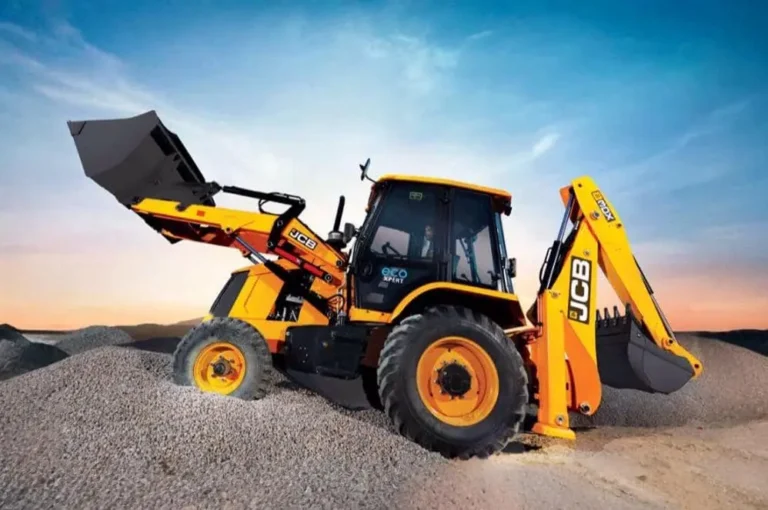
Now a loader bucket. The JCB 3DX backhoe loader has a 1.0 m³ standard front shovel. Full of dry sand, that is 1.54 to 1.60 tonnes. Full of wet sand, it is 1.76 to 2.00 tonnes, so the same scoop can be nearly half a tonne heavier after rain. Dry, well-shaken broken stone lands in between at 1.60 to 1.87 tonnes.
A mixer’s loading bucket works the same way. The AJAX ARGO 4500 self-loading concrete mixer has a 600-litre loading bucket. Filled with dry sand, it lifts about 0.92 to 0.96 tonnes; filled with dry broken stone, about 0.96 to 1.12 tonnes. Wet material in the same bucket is heavier again, which is one more reason to weigh a batch rather than count buckets.
Truck bodies are sold by the cubic metre, but road limits are set in tonnes. A 10 m³ body filled with dry sand carries 15.4 to 16 tonnes. Load the same body with wet sand and it carries 17.6 to 20 tonnes, so a body that is legal when loaded dry can be overweight with wet sand.
Choosing a loader or mixer with the material weight in mind is easier when you can see the bucket sizes side by side. Compare backhoe loader models and prices before your next purchase.
For soil on a road or building platform, the density that matters is the one after compaction, measured in place. That test is covered in the guide to the field density test.
Which unit weight should you use?
For a structural calculation, use what the design code tells you. That means 25 kN/m³ for reinforced concrete and 24 kN/m³ for plain concrete under IS 456, and the IS 875 (Part 1) table for everything else, unless your engineer has measured the actual material. For ordering and transport, use the range rather than a single figure, and take the wet end of it in the monsoon. For mixing by volume, test the sand for bulking every morning, or better, weigh it.
If you are batching concrete on site regularly, a mixer that weighs its own batch takes most of this guesswork away. Compare concrete mixer models and prices and talk to a dealer. More material topics are collected in the building materials guides.
The unit weights on this page are from IS 875 (Part 1):1987, Code of Practice for Design Loads, Part 1: Dead Loads, Unit Weights of Building Materials and Stored Materials, Table 1 and Appendix A, read from the scanned standard in October 2026. The bulk density and bulking methods are from IS 2386 (Part 3):1963, Methods of Test for Aggregates for Concrete, clauses 3 and 4. Bar masses are from IS 1786:2008, Table 1 and clause 3.6, and the design unit weights of concrete from IS 456:2000, clause 19.2.1. Machine bucket sizes are from the JCB 3DX and AJAX ARGO 4500 specification sheets current in October 2026.
Prices, specifications and features are indicative, vary by variant, location and date, and should always be confirmed with the official OEM or authorised dealer before any purchase decision. DesiMachines is not liable for decisions taken on the basis of information that may have changed after publication. Unit weights on this page are as published in IS 875 (Part 1):1987, IS 2386 (Part 3):1963, IS 1786:2008 and IS 456:2000, read in October 2026; loads for a building should be worked out by its structural engineer.
Machines, tenders and news for this industry: Building Construction