
 Excavator
316 models
 Backhoe Loader
54 models
 Crane
68 models
 Concrete Mixer
79 models
 Wheel Loader
65 models
 Compactor / Roller
45 models
 Motor Grader
42 models

 Concrete Pump
66 models
 Skid Steer Loader
11 models


To operate a man lift, you pick the control station with the key switch, pull out both red emergency stops, wait for the start-up checks to finish, and then hold an enable switch or foot pedal down while you move the joystick or switch for each movement. Let go of the enable and the machine stops; that one habit is what every other step on a scissor lift, boom lift or mast lift is built around.
This guide walks through those steps in the order an operator does them on site: the controls, starting up, raising and lowering, driving, working a boom, reading the warning lights, getting down when something fails, and parking at the end of the day. It is written from the operator’s manuals JCB publishes for machines in its Indian access range, the S-series electric scissor lifts and the AJ48D diesel articulating boom, with the Haulotte Star 10 as the example of the small mast lift many Indian buyers call a “man lifter”. The daily walk-around check, harness rules and ground checks are not repeated here; they are set out in aerial work platform safety, and the types of man lift are explained in aerial work platform types and how to choose.
A manual is no substitute for training. Read the one that came with your machine, because control layouts change from maker to maker and even between models of one maker.
What controls does a man lift have?
Every man lift has two control stations: a platform controller in the basket, which the operator uses for all normal work, and a ground controller at the base, which is there so a person on the ground can bring the platform down. Both stations have their own red emergency stop.
JCB’s manuals carry the same warning for the scissor and the boom: do not run the machine from the base controls while people are in the platform, except in an emergency. The base is for testing and for rescue. On the S-series scissor lifts, the base controls can only raise and lower the platform; on the AJ48D boom they work every boom movement. Neither base can drive or steer.
Figure 1. A scissor lift platform controller, simplified
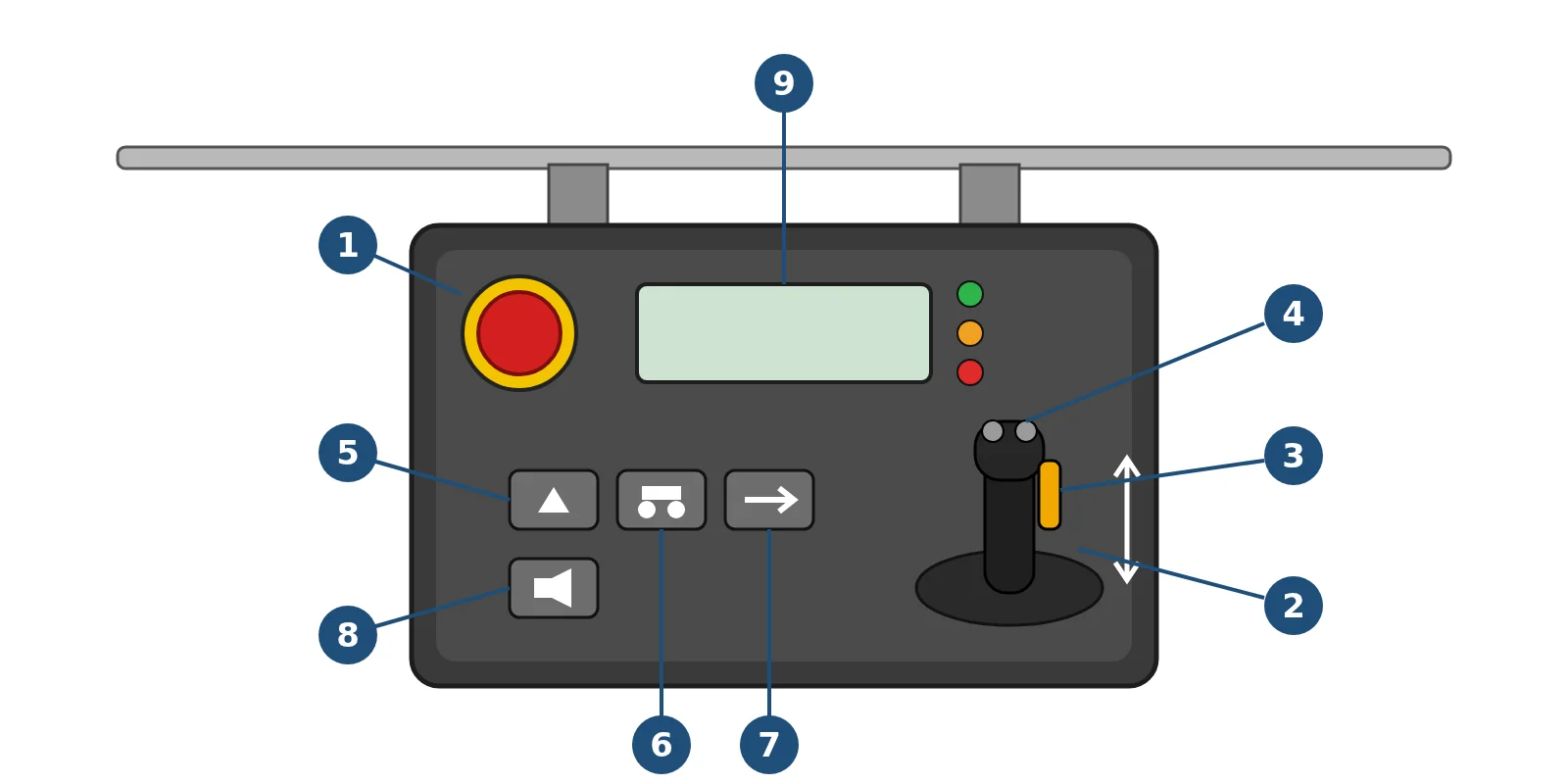
1 = emergency stop, which cuts every function at once. 2 = joystick, pushed forward or pulled back to drive or to lower and raise. 3 = enable trigger on the joystick handle, held down for every movement. 4 = steer left and steer right buttons. 5 = lift mode button. 6 = drive mode button. 7 = drive speed button (fast or slow). 8 = horn. 9 = display with three lights: green for machine ready, amber for a fault code and red for overload. The drawing follows the controller described in JCB’s S-series manual and is not to scale; the layout on your machine may differ.
Table 1: Man lift controls and what each one does
| Control | Where it is | What it does | On a JCB S-series scissor | On a JCB AJ48D boom |
|---|---|---|---|---|
| Key switch | Base | Switches the machine on and chooses ground or platform control | Two positions: chassis or platform | Ignition key at the base panel |
| Emergency stop | Base and platform | Red push button that stops every function at once | Stops lifting; when driving, brakes fully | Either one prevents the engine starting |
| Enable switch | Base and platform | Must be held down for any movement; release it to stop | Trigger on the joystick handle; enable switch at the base | Foot pedal in the basket; enable switch at the base |
| Mode buttons | Platform | Choose what the joystick does | Lift mode or drive mode | Travel joystick, plus boom switches and a lever |
| Speed setting | Platform | Sets travel speed | Fast or slow (shown as a hare and a tortoise) | Speed dial, engine speed button and a high-torque switch |
| Steering | Platform | Turns the steering wheels | Thumb buttons on the joystick | Steering switch, with colour-coded arrows on the chassis |
| Boom switches | Base and platform | Raise, lower, extend, swing and level the boom and basket | Not fitted (goes straight up) | Main boom, articulated boom, telescope, jib, slew, platform level and rotate |
| Emergency lowering | Base | Brings the platform down when the power or controls fail | Emergency lowering lever | Auxiliary power and an emergency override switch |
Source: JCB operator’s manuals for the S1932E to S4550E scissor lifts (issue 10, February 2026) and the AJ48D (issue 4, April 2024).
The enable switch is the control new operators forget. On a JCB scissor it is a trigger on the front of the joystick; on the AJ48D it is a foot pedal on the basket floor, and the boom will not move unless the operator’s foot is on it. JCB adds a time-out: if the pedal is held for 10 seconds with no movement, it switches off and has to be released and pressed again. The S-series controller does something similar, falling back to neutral after 10 seconds with nothing selected.
How do you start a man lift?
Start from the ground, with the platform fully lowered, after the daily check is done. The order JCB gives for its machines is short:
- Make sure the battery isolator is switched on (on battery and hybrid machines).
- Pull out both emergency stop buttons, the one at the base and the one in the platform.
- Turn the key to the control station you want: chassis for a test from the ground, platform for normal work.
- Wait for the start-up checks. On the S-series scissor the green light on the platform controller turns solid when the machine is ready. On a diesel boom like the AJ48D, start the engine with the start button, and do not press the foot pedal or the base enable switch while it starts.
- Read the display. If a fault code shows, do not work around it; JCB’s instruction is to contact the dealer.
Then test before you climb in. Run each movement once from the base controls, then from the platform. JCB’s scissor lift manual asks for exactly that order after any incident, and the daily function check in the AJ48D manual starts at the base too. If one emergency stop does not stop the machine, it does not go up.
How do you raise and lower a scissor lift?
From the platform: turn the key to platform, press the lift mode button, hold the enable trigger and pull the joystick back to raise. Push it forward to lower. Before the first lift, the guardrails must be up and locked; JCB says the platform is never raised with them folded down.
Coming down, most scissor lifts stop on their own a short way above the ground. On the JCB S-series this pause sits between 2.1 m and 3 m depending on the model (2.9 m on the S4046E) and an alarm sounds. It gives the operator a moment to check that nothing, and nobody’s hands or feet, is inside the scissor arms before they close. Let go of the joystick, look down and check the arms are clear, then press again: after a 3-second delay, with the alarm still sounding, the platform lowers the rest of the way.
Expect it to be slow. The JCB S4046E, with an 11.9 m platform height, takes 62 to 67 seconds to rise fully with a full load and 46 to 54 seconds to come down. Above the pause height, two things change by themselves: the pothole guards (bars beside the wheels) drop down, and the top driving speed falls to a crawl.
From the ground, with nobody on the platform, the same machine is raised and lowered with the key at chassis, the enable switch held and the up-down toggle. That is how the machine is tested with the platform empty, and how a person on the ground brings it down in an emergency.
How do you drive a man lift, and how fast can it go when raised?
You drive a man lift from the basket, never from the base. On the S-series, press the drive mode button, check its light is on, hold the trigger and move the joystick slowly: forward to go forward, back to reverse. The steer buttons turn the wheels. JCB sets the machine to the slow tortoise speed by default, and asks the operator to check the speed setting before moving, especially just after lowering the platform.
Direction is the trap on a boom lift. Once the turntable has swung round, pushing “forward” can send the machine the other way from the way you are facing. That is why the AJ48D’s controls and chassis carry colour-coded direction arrows, and why it locks out driving once the turntable is more than 55 degrees off straight ahead until the operator presses a slew acknowledge button. Match the arrow on the controller to the arrow on the chassis before every move.
Every man lift drives far slower when raised. These are the figures in the makers’ own data:
Table 2: Driving speed and slope limits on three man lifts
| Machine | Type | Top speed, platform lowered | Top speed, platform raised | Steepest slope while raised | Steepest climb, lowered | Outdoor use |
|---|---|---|---|---|---|---|
| JCB S4046E | Electric scissor lift, 13.9 m working height | 4.5 km/h (fast), 2.2 km/h (slow) | 0.8 km/h | 3° front to back, 1.5° side to side | 25% | Indoor only |
| JCB AJ48D | Diesel articulating boom, 16.7 m working height | 6.8 km/h | 1.1 km/h | 5° in any direction | 40% | Wind up to 12.5 m/s |
| Haulotte Star 10 | Electric vertical mast lift, 10 m working height | Up to 5 km/h | Drives at its full 8 m platform height | Tilt alarm at 3° | 25% | One person outdoors, two indoors |
Sources: JCB operator’s manuals for the S-series (issue 10, February 2026) and the AJ48D (issue 4, April 2024); Haulotte India’s Star 10 data, read 19 November 2026.
Two rules come straight out of those numbers. First, drive raised only on smooth, firm, level ground with no holes or obstructions, because a rutted site yard can easily lean more than 1.5 degrees from side to side. Second, take any slope with the platform fully down. JCB tells S-series operators to use the slow setting on slopes and to drive up them with the ladder end facing the slope and the driven wheels at the back; on the AJ48D it asks for the high-torque setting. The climbing figure in the table is for a lowered machine (on the S-series, with one person aboard), not a slope you can work on.
How do you work the boom on a boom lift?
Hold the foot pedal down, then move one boom switch or joystick at a time. On the AJ48D the boom movements are: main boom up and down, articulated (jointed) boom up and down, telescope out and in, jib up and down, turntable slew left and right, and the basket’s level and rotate. While any of them runs, an amber beacon flashes and an alarm sounds at the chassis to keep people on the ground clear.
Three habits come from the manual. Set the speed dial before you start, because with the dial at its minimum some functions may not move at all. Expect some movements to refuse to run together: the machine follows whichever one you commanded first and shows a caution light for the other. And give it time: the AJ48D takes 75 to 99 seconds to reach full height with the engine at its higher speed, and 92 to 116 seconds at the lower one. Driving speed also drops as soon as the main or jointed boom rises above its lower limit switch or the telescope comes out.
Bring the basket in to the work slowly for the last metre. The basket can keep moving for a moment after a control is released, and getting pinned between the basket and a beam is one of the main dangers on these machines, covered in detail in the aerial work platform safety guide. How articulating and telescopic booms differ in reach and tail swing is set out in boom lift types.
What do the lights and alarms on a man lift mean?
Each warning is the machine telling the operator to stop. JCB’s manuals and quick guides list these signals:
- Tilt light or alarm: the machine is on a steeper slope than it allows. On the A45E boom it glows steady when the machine is stowed and flashes when it is raised. Lower the platform and move to level ground.
- Overload light: steady means the load is close to the limit, flashing means it is over. Take weight off the platform. On the AJ48D, if the platform is overloaded, JCB says the extra weight must be removed before the platform is lowered.
- Fault light or code: on the S-series, lower the platform fully, switch the key off and on again, and if the code is still there, stop using the machine and call the dealer.
- Caution light: the movement you asked for is not allowed right now, often because another one is running.
- Descent alarm and travel alarm: warnings for people nearby, not faults.
Never cover, tape over or bypass a warning. The tilt and overload systems are what keep a man lift standing.
How do you bring a man lift down if it stops working?
If the operator in the basket can still work the controls, the platform comes down the normal way. If not, a trained person on the ground uses the base controls, and if the power or controls have failed, the emergency lowering system. JCB’s warning applies to both its scissor and its boom: do not use the platform controls to free a basket that is stuck, snagged or caught; use the base controls, and only once nobody is in the platform.
How emergency lowering works depends on the machine:
- On a JCB S-series scissor lift, pull out the emergency lowering lever at the base; let it go to stop.
- On the AJ48D, if the engine fails, the booms are moved on auxiliary power: from the base by holding the base enable switch, or from the basket with the foot pedal down and the auxiliary power button held. If the controls themselves fail, an emergency override at the base (key off, override held, key back on) lets the booms be brought down, and a service engineer has to reset it afterwards.
- The Haulotte Star 10 mast lift lists an emergency hand pump.
Everyone on site who might have to do this should know where these controls are before the platform goes up. The rescue plan itself is covered in aerial work platform safety.
How do you park and shut down a man lift?
Park on firm, level ground out of the way of traffic, lower the platform fully, switch the key off and take it out of the machine so nobody else can use it. On a battery machine, check the charge before you walk away and put it on charge if it needs it, so it starts the next shift full. The parking brakes on the JCB S-series act on the front wheels only, which is one more reason not to leave a man lift standing on a slope.
If the machine is going on a truck to the next job, the platform stays lowered and the boom stowed; the guide to scissor lift vs boom lift compares their weights and what each needs to set up.
Who should be allowed to operate a man lift?
Only a person trained on that type of platform and then shown the exact model: its controls, its warning lights and its emergency lowering. JCB’s manuals ask operators to practise until they know every control and what it does, and note that a national certification scheme may require them to show competency. In India, aerial work platform operators can take a national skill qualification; the course and what operators earn are covered in boom lift operator salary in India.
A person who stays on the ground should also know the base controls and the emergency lowering, because that person is the rescue plan if the operator in the basket is taken ill or the controls fail.
On some Indian sites, “man lift” is used for a pick-and-carry crane such as the ACE NXP 150. A crane is operated from its cab to lift loads, and none of the steps above apply to it; which machine should lift people is settled in man lift vs crane vs telehandler. A telehandler such as the JCB 530-70 or the SANY STH1056A can lift people only with a work platform approved for that machine, as the guide to telehandler attachments explains.
Need to lift material at height as well as people? Compare telehandler models and prices and cranes, and talk to a verified dealer. Hiring a man lift for a short job? How to rent construction equipment covers the agreement and the checks at hand-over, and every guide on these machines is listed under aerial work platforms.
Sources
Control layouts, start-up order, lowering pause, speeds, slope limits, cycle times and emergency procedures are from JCB’s operator’s manuals, read on 19 November 2026: the S1932E to S4550E electric scissor lift manual (9841/9150, issue 10, February 2026) and the AJ48D articulating boom manual (9831/4967, issue 4, April 2024), with the display lights from JCB’s A45E quick reference guide. Star 10 figures are from Haulotte India’s product page, read the same day. Man lifts are not listed on DesiMachines, so no prices are given.
Prices, specifications and features are indicative, vary by variant, location and date, and should always be confirmed with the official OEM or authorised dealer before any purchase decision. DesiMachines is not liable for decisions taken on the basis of information that may have changed after publication.