
 Excavator
316 models
 Backhoe Loader
54 models
 Crane
68 models
 Concrete Mixer
79 models
 Wheel Loader
65 models
 Compactor / Roller
45 models
 Motor Grader
42 models

 Concrete Pump
66 models
 Skid Steer Loader
11 models


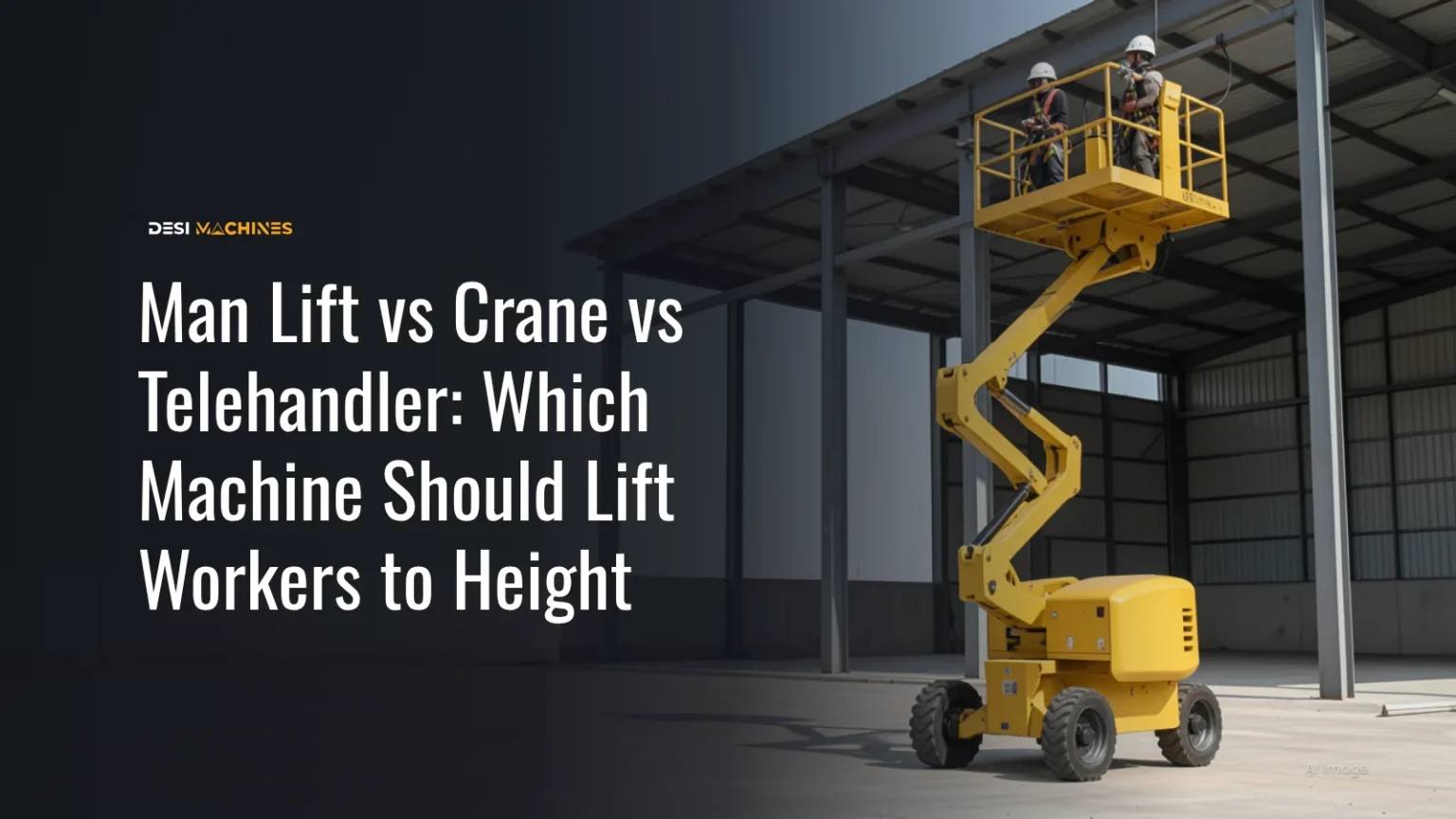
If the job is to put a worker up beside a light, a roof sheet or a signboard, the machine built for it is a man lift, and a crane is the wrong answer for most of those jobs. A crane is built to lift loads; a man lift (an aerial work platform) is built to lift people, and a telehandler sits in between, because with a platform certified for that exact machine it can do both.
The choice gets confused on Indian sites because one word covers three machines. People say “man lift crane” for a pick-and-carry crane, ask for a hydra or farana “with man basket”, and hire a telehandler for loads and then send a worker up on its forks. This guide settles the man lift vs crane question job by job: which machine should carry a person to which job, what the old construction rules said about putting people in a crane basket, and what each machine’s published height figure really measures. What a man lift is, and its six types, are covered in aerial work platform types and how to choose.
What is the difference between a man lift, a crane and a telehandler?
The difference is what each one is designed to hold up: a person, a load, or a load that can be swapped for a person.
A man lift holds people in a railed basket or deck, and the worker in the basket drives it. The controls are in the platform, with a second set at the base so someone on the ground can bring it down. A crane holds a load on a hook, and the operator sits in the cab, often without a clear view of the hook. A telehandler holds a load on forks or a jib, but it is the only one of the three that can swap the forks for a work platform made for it.
The weights show it. Wikipedia’s article on aerial work platforms notes that they are designed to lift a limited weight, usually less than a tonne, which is what separates them from most cranes. A pick-and-carry crane such as the ACE NXP 150 is listed at 15 tonnes, and the ACE AT 30 telehandler at 3,000 kg.
Table 1: Man lift, pick-and-carry crane and telehandler for work at height
| Question | Man lift (aerial work platform) | Pick-and-carry crane (hydra, farana) | Telehandler |
|---|---|---|---|
| Built to lift | People and their hand tools | Loads on a hook | Loads on forks, a bucket or a jib |
| Can it carry a worker? | Yes, that is its only job | Not as normal work; only as a rare, planned exception (see the next section) | Only with a work platform approved for that exact machine, in platform mode |
| Who controls the movement | The worker in the basket, with ground controls as back-up | The crane operator in the cab | The cab, or the basket on platforms built for basket control |
| Reach sideways | None on a scissor lift; several metres on a boom lift | Yes, by luffing and telescoping the boom | Yes, forward only on a fixed-boom machine; all round on a rotating one |
| What else it does on site | Nothing else | Lifts and carries loads around the site | Loads, unloads, places pallets, works as a small crane with a jib |
The table hides one point that matters on the ground. In a man lift the person at height moves the basket themselves and can stop it the instant something is wrong. In a crane basket the person at height depends on hand signals to someone who may not see them clearly.
Can a hydra or farana crane lift workers in a man basket?
Only as a rare exception, and Indian construction rules treated it that way for almost three decades. Rule 77 of the Building and Other Construction Workers Central Rules, 1998 said that no building worker may be raised, lowered or carried by a power-driven lifting appliance except on the driver’s platform in the cage of a crane, on a hoist, or on an approved suspended scaffold.
A crane basket was allowed only where a hoist or suspended scaffold was not reasonably practicable, and even then the rule set four conditions:
- The appliance can be worked from one position only.
- Any winch used meets the rules for winches (rule 59).
- The worker rides in a chair or cage, or in a skip or other receptacle at least three feet (about 0.9 m) deep, soundly built, properly maintained, able to stop the person falling out, and kept clear of loose tools and material.
- The chair, cage or skip is prevented from spinning or tipping in a way that endangers the person inside.
Those 1998 rules were superseded on 8 May 2026, when the central rules under the Occupational Safety, Health and Working Conditions Code were notified as G.S.R. 345(E). The new rules do not reprint a clause on carrying people by lifting appliances. So read rule 77 as the long-standing benchmark for Indian sites, not as the current text of the law, and check what your state’s rules and the principal employer’s safety plan now require.
A pick-and-carry crane makes the spinning and tipping conditions hard to meet. Its whole job is to lift, travel and swing, and a basket hung from a hook turns and sways as the crane moves. That is why the guide to hydra and farana cranes tells operators never to carry people or use the hook as a work platform. If a job truly has no other way up, the basket must be a purpose-built personnel basket, the lift must be planned, and the crane’s maker should confirm in writing that the model may carry one at all. If the maker says no, or does not answer, the basket stays on the ground. The duties around crane testing, examination and the operator are in crane safety rules and training.
A drum, a pallet or a bucket tied to the hook is not a basket under any reading of these rules. Neither is a worker standing on telehandler forks.
When does a telehandler with a work platform make sense?
When the same site needs material lifted and people at height on the same days, and the telehandler is already there for the material.
The telehandler attachments guide sets three conditions: a work platform approved for that exact machine, a telehandler built to run in platform mode, and an operator trained for it. If any one is missing, no one goes up. With the platform fitted, the machine must slow its movements and often locks out some functions, because a person is now the load.
Wikipedia’s telescopic handler article notes that telehandlers fitted with work platforms and driven from the basket are classed as elevated work platforms, not as cranes, under the licensing rules of Victoria in Australia. The machine is judged by what it is carrying. The same article describes the rotating type, fully stabilised with a turntable between the upper and lower frame, as a hybrid between a telehandler and a small crane. That rotating type is the one that reaches highest; the rotating telehandlers in our catalogue range from a 15.8 m to a 34.7 m lifting height.
A fixed-boom telehandler such as the JCB 530-70 or the ACE AT 30 makes sense for a shed, a warehouse or a low-rise building. The platform saves hiring a second machine for short jobs, such as fixing a gutter after the roof sheets have gone up. It is a poor choice when crews work at height all day, because every hour the telehandler carries people is an hour it is not moving material. For that, hire a man lift for the fixers and keep the telehandler on the loads.
Compare telehandler models and prices, and ask the dealer which platform the maker approves for each one before you buy.
How high can each machine put a worker?
Less high than the brochure number suggests, because each machine’s headline figure measures something different.
A man lift is sold on working height, which is about 2 m above the platform floor, to allow for a person’s reach. JCB, for example, gives its A45E boom lift a 15.84 m working height and a 13.84 m platform height, as listed in the scissor lift vs boom lift guide. A telehandler is sold on maximum lifting height, which is measured at the forks with the boom fully raised, not at a platform floor. A pick-and-carry crane is sold on boom height, which is not the height of the hook, as the hydra crane boom height guide explains.
Figure 1. Where each machine’s height figure is measured
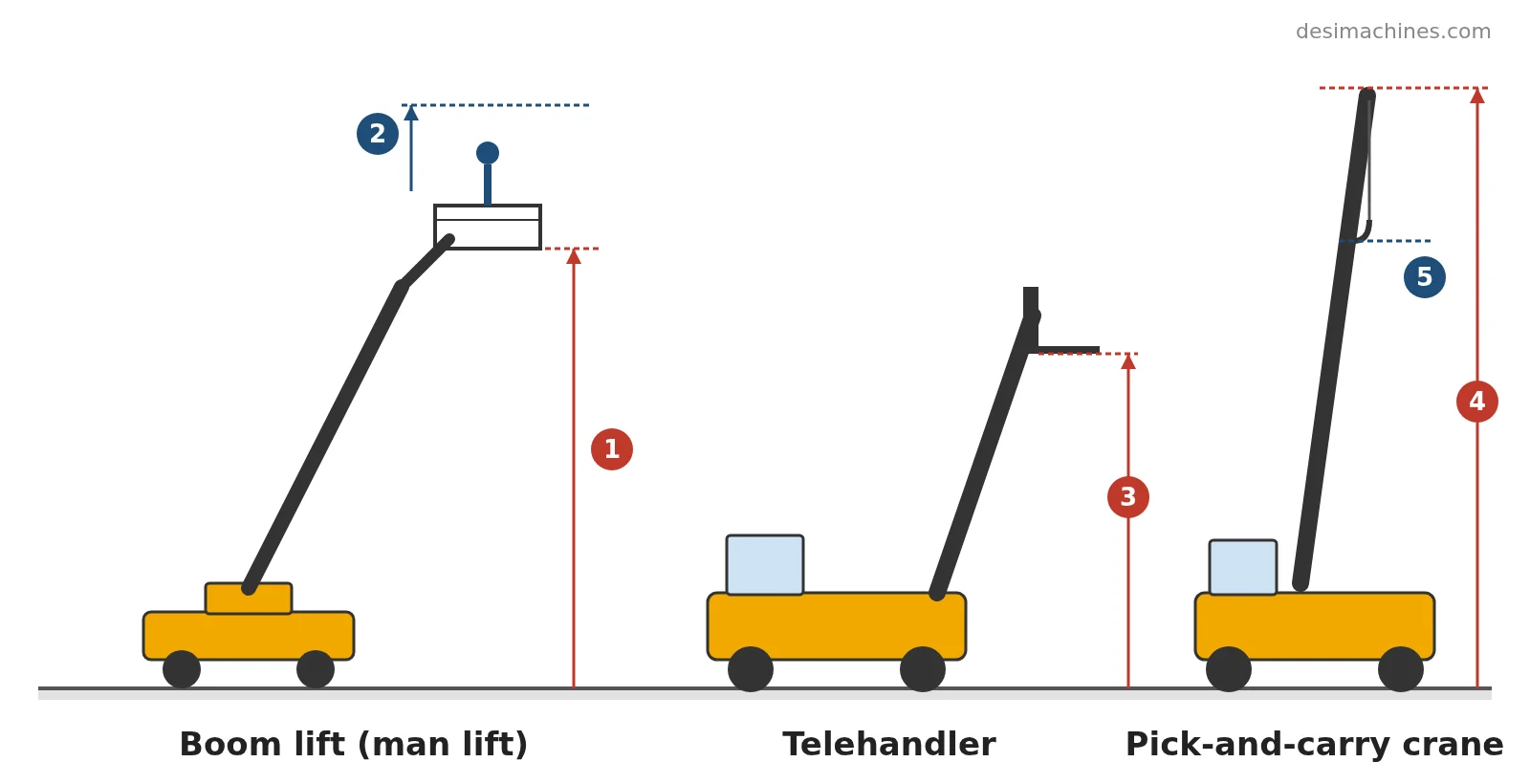
1 = platform height, measured to the floor of the basket. 2 = working height, about 2 m above the platform floor, the figure a man lift is sold on. 3 = a telehandler’s maximum lifting height, measured at the forks. 4 = a pick-and-carry crane’s boom height, measured at the boom tip. 5 = the hook, which hangs below the boom tip. The drawing is not to scale.
Table 2: Published height figures and what each one measures (listed specifications, November 2026)
| Machine | Type | Published figure | What the figure measures |
|---|---|---|---|
| JCB 530-70 | Fixed-boom telehandler | 7.0 m (7,000 mm) | Maximum lifting height at the forks |
| ACE AT 30 | Fixed-boom telehandler | 11.2 m (11,200 mm) | Maximum lifting height at the forks |
| MANITOU MRT-X 1645 | Rotating telehandler | 15.8 m (15,800 mm) | Maximum lifting height |
| MANITOU MRT-X 2570 | Rotating telehandler | 24.8 m (24,800 mm) | Maximum lifting height |
| Escorts Hydra 15 Top-Jack | Pick-and-carry crane | 17.2 m | Boom height, not hook height |
| ACE NXP 150 | Pick-and-carry crane | 21.0 m | Boom height, not hook height |
| Escorts Hydra 1565 | Pick-and-carry crane | 21.5 m | Boom height, not hook height |
Two things follow. First, a telehandler’s fork height is neither its platform floor height nor a working height, so ask the dealer for the platform figure for your exact machine and platform pair. Second, a crane’s boom height is measured with the boom fully extended, and a fully extended boom carries the lowest ratings on its load chart. The height alone says nothing about whether a basket and two people could be held there safely; only the load chart answers that.
For work up to about 15 m, a boom lift or a scissor lift will usually cover the job. Above that, the choice narrows to large boom lifts and rotating telehandlers with approved platforms.
Which machine should you use for each job?
Start from what goes up with the worker, then from what stands between the machine and the work.
Table 3: Work-at-height jobs on Indian sites and the machine that fits
| Job | Machine that fits | Why |
|---|---|---|
| Ceiling lights, ducts or sprinklers in a factory with a finished floor | Electric scissor lift | Goes straight up, carries two or three people with tools, no exhaust indoors |
| Fixing over a parapet, a drain or a pipe rack | Articulating boom lift | Reaches up and over an obstacle the machine cannot drive past |
| Roof sheets, cladding or glass panels on a shed | Telehandler for the panels, man lift for the fixers | The panels are a load; the fixers need a basket they control themselves |
| Steel beams, trusses or precast pieces | Crane for the piece, man lift for the people who bolt it | The crane holds the load steady while the fixers work from their own basket |
| A gutter, a light or a sign after the main lifting is done | Telehandler with an approved platform, if one is on site | A short job that does not justify hiring a second machine |
| A single pole-top sign or street light | Hired boom lift | A day’s hire costs less than the risk of a basket on a hook |
The pattern is simple. Loads go up on a crane or a telehandler. People go up on a machine they control, or, where a telehandler is already on site, on its approved platform. The telehandler vs crane guide compares the two load machines on height, weight and cost. For jobs where a crew stays up for weeks, fixed scaffolding may still beat any machine; the scaffolding safety norms in India set out what it must meet.
Man lifts are usually hired rather than bought for a single project, and how to rent construction equipment covers what to check in the hire paperwork.
What should you check before anyone goes up?
Five questions, asked before the job is booked, settle most of it.
- Is this machine built or approved to carry people? A man lift is. A telehandler is only with its approved platform. A crane needs the maker’s written yes and a planned lift.
- Who will control the basket? On a man lift it should be the worker in it, with a trained person at the base who knows the emergency lowering.
- What is the real height to the work? Use working height for a man lift, platform height for a telehandler platform, and the load chart for a crane, never the brochure figure.
- How much goes up with the worker? Count people, tools and material against the basket’s rated load.
- Is the ground firm and level, and are overhead lines away from the boom’s path?
The full daily check, harness rules, wind and slope limits and rescue plan for platforms are in aerial work platform safety. The controls, and the order to work them in, are explained in how to operate a man lift.
Lifting material at height as well as people? Compare telehandler models and prices or pick-and-carry cranes, and talk to a verified dealer. All platform guides are under aerial work platforms.
Sources
Read on 19 November 2026: Building and Other Construction Workers (Regulation of Employment and Conditions of Service) Central Rules, 1998, rule 77, Carrying of persons by means of lifting appliances; Ministry of Labour and Employment, G.S.R. 345(E), 8 May 2026, the central rules under the Occupational Safety, Health and Working Conditions Code, 2020; Wikipedia’s articles on aerial work platforms and telescopic handlers. Machine heights are the listed specifications of each model as of November 2026; the JCB A45E figures are from JCB India as quoted in the scissor lift vs boom lift guide. Aerial work platforms are not listed on DesiMachines, so no prices are given.
Prices, specifications and features are indicative, vary by variant, location and date, and should always be confirmed with the official OEM or authorised dealer before any purchase decision. DesiMachines is not liable for decisions taken on the basis of information that may have changed after publication.