
 Excavator
316 models
 Backhoe Loader
54 models
 Crane
68 models
 Concrete Mixer
79 models
 Wheel Loader
65 models
 Compactor / Roller
45 models
 Motor Grader
42 models

 Concrete Pump
66 models
 Skid Steer Loader
11 models


Sand for plaster, brickwork and concrete should carry no more than 8 percent silt when it is checked by the site test, and that test needs only a 200 ml measuring cylinder, a pinch of salt and three hours of waiting. The silt content test of sand is that check: you shake a sample of sand in salty water, let it settle, and measure the thin layer of fine mud that sits on top of the sand as a percentage of the sand below it.
The method and the 8 percent limit come from the CPWD Specifications (Vol 1, 2009 edition, Appendix C), the rule book for Central Public Works Department jobs. This guide walks through the test step by step, shows how to read the cylinder and work out the figure with three worked loads, explains how it differs from the laboratory tests in IS 2386, and says what to do when a load fails.
Key points
- The field test fills a 200 ml measuring cylinder with damp sand up to the 100 ml mark, adds salty water up to 150 ml, and leaves it to settle for three hours.
- Silt content is the height of the silt layer divided by the height of the sand below it, times 100. Dividing by the total height makes a failing load look like a pass.
- CPWD rejects sand with more than 8 percent silt by this test, and asks for the test on every 20 cubic metres of sand or part of it.
- A load that fails is washed until it comes within the limit, and then tested again.
What is the silt content test of sand?
The silt content test is a quick site check of how much very fine material is mixed into a load of sand. Silt is soil made of particles far smaller than sand grains, finer than the eye can pick out one by one; with it usually comes some clay and fine dust. Dry, it looks like light brown powder. Wet, it turns into a soft mud that coats the sand grains.
That coating is the problem. The CPWD Specifications list clay and other fine matter among the impurities that harm the hardening, strength, durability or look of mortar, plaster and concrete, and IS 383:2016, the Indian Standard for concrete aggregates, puts limits on clay and fine material for the same reason. Cement paste has to grip the sand grains. Where a film of silt sits between the paste and the grain, the paste is holding on to mud, not to sand.
The field test does not need an oven, a balance or a laboratory. It uses the fact that sand grains are heavy and sink fast in water while silt is light and settles slowly, so after a few hours the two sit in separate layers that you can read off the side of the cylinder.
What do you need for the silt content test?
Everything on this list can be bought from a laboratory supply shop or carried in a site kit box.
Table 1: Apparatus and material for the field silt test (CPWD Specifications 2009, Vol 1, Appendix C)
| Item | What CPWD asks for | Why it matters |
|---|---|---|
| Measuring cylinder | 200 ml, glass or clear plastic, marked in ml | The ml marks are how you read the layers |
| Sand sample | Taken from the load as it is, without drying | CPWD tests the sand as it is delivered, damp |
| Clean water | Enough to bring the level up to 150 ml | Dirty water adds its own silt to the reading |
| Common salt | About one teaspoon to half a litre of water | Helps the finest particles settle instead of hanging in the water |
| Time | Three hours of standing | Silt settles slowly; read too early and the layer is not complete |
Take small scoops from three or four places in the heap, including near the bottom, and mix them before you fill the cylinder. One scoop from the top of the heap tells you only about the top of the heap.
How do you do the silt content test step by step?
The steps below follow Appendix C of the CPWD Specifications. Mix the salt water before you start.
- Dissolve about one teaspoon of salt in half a litre of clean water.
- Put the sand into the 200 ml cylinder, as it comes from the load, until it reaches the 100 ml mark. Do not dry it first.
- Pour in the salt water until the level reaches the 150 ml mark.
- Close the top with your palm or a stopper and shake hard, so that every grain is moving. Give the last few shakes sideways, so the sand settles with a level top.
- Stand the cylinder on a flat surface out of the wind and leave it alone for three hours.
- Read two marks against the scale: the top of the sand and the top of the silt layer sitting on it. The silt layer is the soft, darker or lighter band between the clean sand and the clear water.
- Work out the silt content with the formula in the next section, and compare it with the 8 percent limit.
Read at eye level, with your eye in line with the marks. A reading taken from above or below the mark can be out by a millilitre or two, and on a layer only 5 to 10 ml thick that is a large error.
How do you calculate silt content in sand?
Silt content is the height of the silt layer as a percentage of the height of the sand below it:
Silt content (%) = (height of silt layer ÷ height of sand layer) × 100
Because the cylinder is the same width all the way up, the ml marks stand in for height. If the sand settles to the 86 ml mark and the silt layer reaches the 93 ml mark, the silt layer is 93 − 86 = 7 ml, and the silt content is 7 ÷ 86 × 100 = 8.1 percent. That load fails.
Be careful with the bottom of the fraction. CPWD’s wording is the height of the silt “expressed as a percentage of the height of sand below”. It is easy to divide by the total height of sand plus silt instead, and that small change can flip the verdict. In the example above, 7 ÷ 93 × 100 comes to 7.5 percent, which would pass a load that should have been washed.
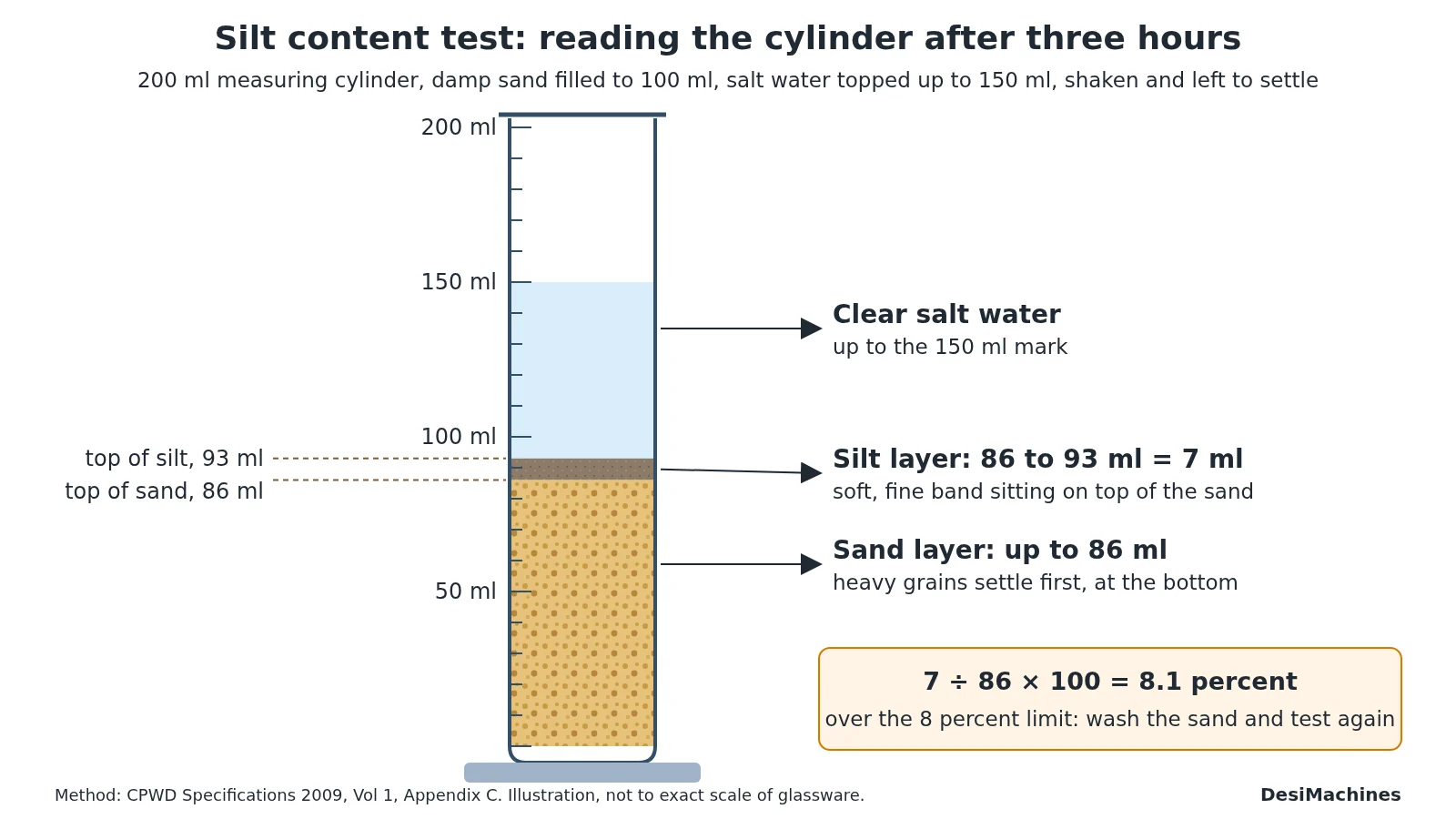
Table 2: Three worked readings checked against the 8 percent limit
| Load | Top of sand (ml mark) | Top of silt (ml mark) | Silt layer (ml) | Silt content | Result |
|---|---|---|---|---|---|
| A | 94 | 98 | 4 | 4 ÷ 94 × 100 = 4.3% | Pass |
| B | 86 | 93 | 7 | 7 ÷ 86 × 100 = 8.1% | Fail: wash and test again (7 ÷ 93 would wrongly read 7.5%) |
| C | 88 | 99 | 11 | 11 ÷ 88 × 100 = 12.5% | Fail: wash or send the load back |
Write each reading in the site register with the date, the truck or trolley number and the supplier, so a pattern of bad loads from one source shows up over a few weeks.
What is the permissible limit of silt content in sand?
On a CPWD-specification job, sand may carry no more than 8 percent silt by the field cylinder test. Other limits in the codes measure a different thing, by mass in a laboratory, so they are set lower and are checked by other methods. Keep them apart when you read a test report.
Table 3: Silt and fines limits that apply to sand on Indian sites
| Where the limit comes from | Sand it applies to | What is measured | Limit |
|---|---|---|---|
| CPWD Specifications 2009, cl 3.1.3.2 and Appendix C | Fine aggregate for mortar and concrete | Silt layer by volume, field cylinder test | 8 percent maximum |
| CPWD Specifications 2009, sand for masonry mortar and plaster | Natural, crushed gravel and crushed stone sand | Clay, fine silt and fine dust by mass, IS 2386 (Part 2) laboratory method | 5 percent maximum |
| IS 2116:1980, sand for masonry mortars | Natural sand, crushed gravel sand and crushed stone sand | Clay, fine silt and fine dust by mass, IS 2386 (Part 2) | 5 percent maximum |
| IS 383:2016, Table 2 | Fine aggregate for concrete | Material finer than the 75 micron sieve, by mass, IS 2386 (Part 1) | Depends on the type of sand |
The IS 383 limit is the one most often argued about, because it is much looser for crushed sand than for river sand. The figures for each type, and why crushed stone sand is allowed more fine powder, are set out in the guide to quarry dust and M-sand.
IS 383 also lets the engineer-in-charge relax some limits after further tests show the sand performs well. So treat 8 percent as the gate check, and the engineer’s written approval as the only way past it.
How is the field test different from the IS 2386 lab test?
The field test reads the volume of a wet, loosely settled layer. The laboratory tests in IS 2386 weigh dried material. A field figure and a lab figure for the same load will not match, and no Indian Standard gives a factor to convert one into the other.
Two parts of IS 2386 deal with fine material. Part 1 (1963) finds the material finer than the 75 micron sieve by washing. The sample is dried in an oven at 110°C and weighed, washed and stirred until the wash water runs clear, poured over a 1.18 mm sieve sitting on a 75 micron sieve, and the washed sand is dried and weighed again. The loss in weight, as a percentage of the first dry weight, is the answer: a 500 g sample that weighs 487 g after washing has lost 13 g, or 2.6 percent. Part 2 (1963) finds clay, fine silt and fine dust, the particles up to about 20 microns, by a sedimentation method with a rotating jar and a pipette.
Table 4: Field cylinder test against the two IS 2386 laboratory tests
| Point | Field cylinder test (CPWD Appendix C) | Finer than 75 micron (IS 2386 Part 1) | Clay, fine silt and dust (IS 2386 Part 2) |
|---|---|---|---|
| Where it is done | At the site gate | Laboratory | Laboratory |
| How it measures | Height of the settled silt layer | Dry weight lost on washing | Weight of fine particles drawn off by pipette |
| Unit | Percent by volume | Percent by mass | Percent by mass |
| Equipment | 200 ml cylinder, salt, water | Oven, balance, 1.18 mm and 75 micron sieves | Glass jar, rotating device, sedimentation pipette, oven, balance |
| Time | About three hours | Several hours: the sample is oven-dried to constant weight before and after washing | Several hours, plus oven drying |
| Limit it is checked against | 8 percent (CPWD) | IS 383 Table 2, by type of sand | 5 percent for mortar and plaster sand (CPWD, IS 2116) |
Use the field test to accept or turn back loads every day. Send a sample to the laboratory when a new source starts supplying, when the field readings sit close to 8 percent, and whenever the contract asks for IS 383 compliance in concrete.
What should you do if the sand fails the silt test?
CPWD’s answer is simple: sand with more silt than allowed is washed as many times as the engineer-in-charge directs, until the silt comes within the limit, and the contractor is paid nothing extra for the washing. In practice there are three choices at the gate.
- Turn the load back before it is tipped, if the supply terms allow it. This is the cheapest choice by far.
- Wash the sand on site: spread it on a sloping platform or screen and play water over it until the run-off is clear, then let it drain and test it again.
- Keep it for work where the specification is looser only if the engineer agrees in writing, and stack it apart so it cannot be mixed up with good sand.
Do not try to hide a silty load by adding more cement. The silt is still in the mix, and the extra cement adds cost without removing it.
Two other gate checks often go with the silt test. CPWD also asks for an organic impurities test on every 20 cubic metres of sand. The IS 2386 (Part 2) version fills a 350 ml clear glass bottle to the 75 ml mark with a 3 percent caustic soda solution, adds sand until the sand reaches 125 ml, tops it up to 200 ml, shakes it and leaves it for 24 hours. Liquid darker than the standard colour means the sand needs further tests. The second is bulking, the swelling of damp sand that throws out volume batching; the guide to the unit weight of building materials covers bulking of sand. Grading is a separate check from silt: the fineness modulus of sand shows how coarse a load is, and a clean sand can still be too fine for the job.
How often should sand be tested for silt on site?
The mandatory tests table in the CPWD Specifications lists the silt content test as a field test on every 20 cubic metres of sand or part of it, or more often if the engineer-in-charge decides. Sand in India is often bought by the brass. One brass is 100 cubic feet, about 2.83 cubic metres, so 20 cubic metres is a little over 7 brass.
On a small house job that may mean only one or two tests in all. Test more often than the minimum when the supplier or the source changes, after heavy rain, and whenever the sand looks or feels different from the last load. Rub a pinch of damp sand between your palms: if it leaves a muddy stain that does not brush off, run the cylinder test before you accept the load.
Clean sand matters most where it is used in quantity. A self-loading mixer such as the Schwing Stetter SLM 4300, AJAX ARGO 4500 or Apollo Carmix 30 FX loads sand with its own bucket straight from the site heap, so whatever silt is in the heap goes into the drum. Check the heap before the first batch, not after the cubes come back weak. Compare self-loading concrete mixers and talk to a dealer about the machine that suits your pour.
Where does silt in sand cause the most trouble?
Plaster is where silt is easiest to see. It is a thin coat on show, and the CPWD Specifications name the appearance of plaster, along with its strength and durability, among the things impurities in sand can spoil. Redoing a wall costs far more than a test. Work out how much sand a plastering job needs with the plaster quantity calculation guide, and test each load that comes in against that order.
In concrete, IS 383 limits clay and fine material because they affect strength and durability. Keep the water in check as well; the water cement ratio guide explains why a few litres more per bag matter, and the cube test of concrete is where a silty sand often shows up weeks later as low strength.
River sand and M-sand both need the test. River sand can carry silt from the bed and banks where it is dug, and M-sand can carry fine stone dust from crushing. For the machines used to dig and load sand, see sand mining equipment in India; for what a load costs by state, see the river sand price post, which is kept up to date.
The field method and the 8 percent limit above are from the CPWD Specifications 2009, Vol 1 (clause 3.1.3.2, Appendix C and the mandatory tests table for mortars), the laboratory methods from IS 2386 (Part 1):1963 and IS 2386 (Part 2):1963, and the fines limits from IS 383:2016 and IS 2116:1980. More guides on sand, cement and concrete sit on the building materials guide hub, and the machines that mix it are listed under concrete mixer models and prices.
Prices, specifications and features are indicative, vary by variant, location and date, and should always be confirmed with the official OEM or authorised dealer before any purchase decision. Test methods, limits and code clauses should be confirmed against the current edition of the CPWD Specifications or Indian Standard named in your contract. DesiMachines is not liable for decisions taken on the basis of information that may have changed after publication.
Machines, tenders and news for this industry: Building Construction