Excavator
316 models
 Backhoe Loader
54 models
 Crane
68 models
 Concrete Mixer
79 models
 Wheel Loader
65 models
 Compactor / Roller
45 models
 Motor Grader
42 models

 Concrete Pump
66 models
 Skid Steer Loader
11 models


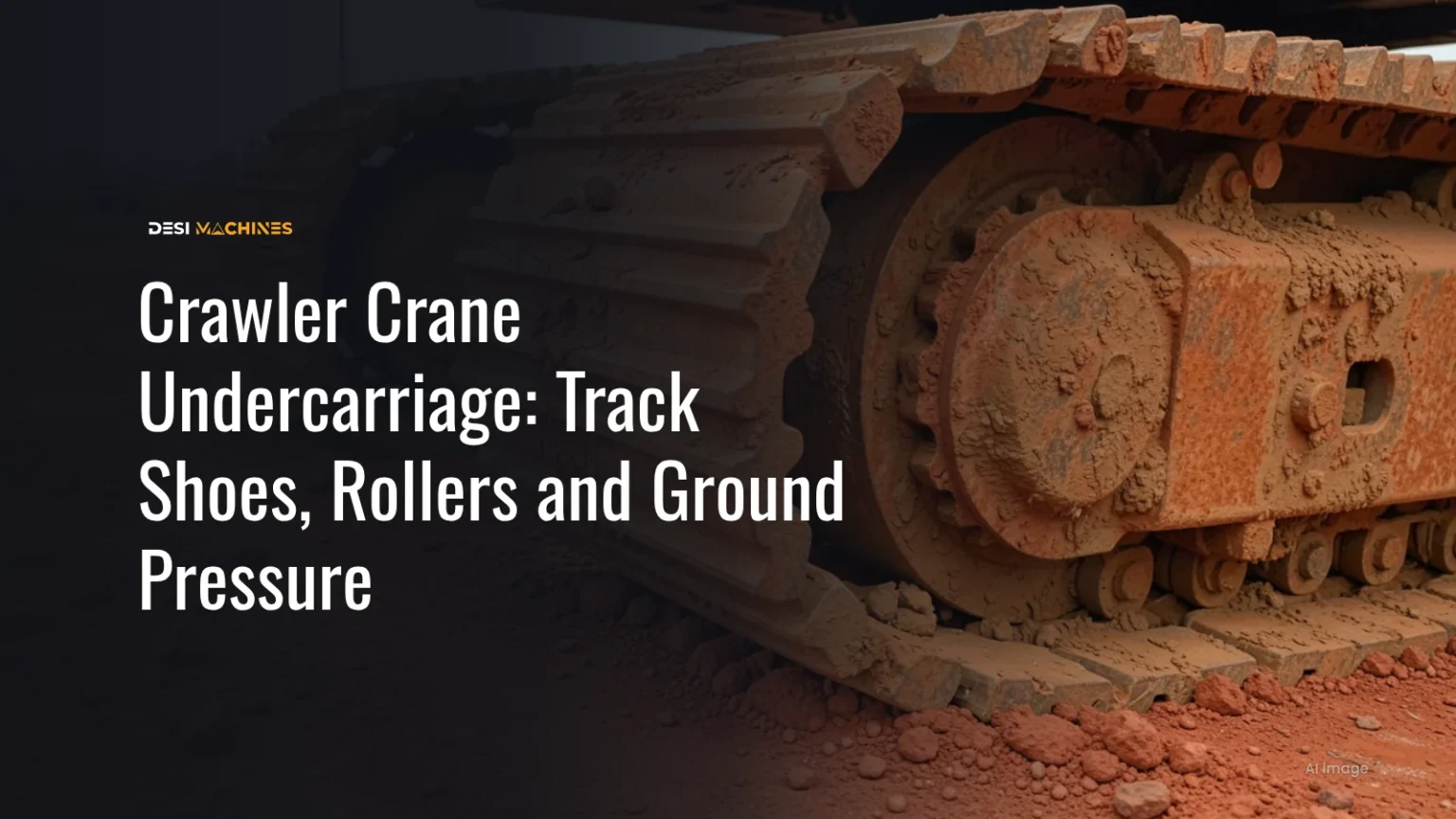
Crawler crane track shoes run from about 700 mm wide on a 50 tonne machine to 1,200 mm (47 in) on a 250 tonne one, and that width, multiplied by the length of track resting on the ground, is what decides whether the soil holds the lift or gives way. Everything that produces those two numbers sits in the crawler crane undercarriage: two track frames, the chains and shoes running around them, the rollers and idlers inside each frame, the drive tumblers that turn them, and the carbody joining the two sides together.
A wheeled crane puts its load through outriggers onto four pads. A crawler crane has no outriggers. It stands and lifts on its tracks, which makes the undercarriage the foundation of every lift the crane makes, and not merely the way it gets between pick points. This guide explains what sits inside a track frame, how shoe width and track length decide ground pressure, why the bigger machines carry track frames that slide in and out, and what wears first. To raise a request for an undercarriage item, go through spare parts.
One thing to be clear about first. Our own crane listings are pick-and-carry, hydra and mobile cranes. Crawler cranes are covered here as knowledge for the people who run, hire or inspect them.
What is in a crawler crane undercarriage?
Each side of the machine is a complete, self-contained track frame, and the two frames bolt or pin onto a central carbody. Inside one frame you will find the same seven part groups.
What each number on the diagram is
- Drive tumbler. The toothed wheel at the driven end. It takes drive from the travel motor and pulls the chain round. Some makers call it the drive sprocket.
- Idler. The plain wheel at the other end. It does not drive anything. It guides the chain round the end of the frame and takes the tensioning force.
- Track rollers. The row of small wheels along the bottom of the frame. These carry the machine’s weight down onto the chain, and they are what transfers the lift into the ground.
- Carrier roller. One or two wheels on top of the frame that hold the upper run of chain so it does not sag onto the frame.
- Track chain and shoes. Links joined by pins and bushings, with a steel shoe (also called a track pad or plate) bolted across each link. The shoes are the only part that touches the ground.
- Track frame. The welded steel beam holding all of the above, with the tensioning cylinder inside the idler end.
- Travel motor and final drive. A hydraulic motor with a gearbox and a parking brake, driving the tumbler.
The parts list reads much like the undercarriage of an excavator or the track frame inside dozer parts, and the wear logic is shared. What differs is the duty. An excavator tracks around all day. A crawler crane may stand in one spot for a week, then creep a hundred metres with a load hanging.
How wide is a crawler crane track shoe?
Shoe width climbs with the lifting class, because a heavier crane needs more area under it to stay within the ground pressure its lifts allow. These figures come from the makers’ own published data sheets, named in the last section.
| Lifting class | Data sheet the figures come from | Shoe width | Shoes per side | Published average ground pressure |
|---|---|---|---|---|
| 60 tonnes | SANY SCC600A-6 brochure (December 2022) | 760 mm (30 in) | 60 | 0.062 MPa, about 0.63 kg/cm² or 6.3 tonnes per square metre |
| 100 tonnes, telescopic boom | SANY SCC1000TB brochure (April 2023) | 850 mm (33 in) | 54 | Not stated on the sheet |
| 180 tonnes | SANY SCC1800 brochure (August 2016) | 1,100 mm (43 in) | 56 | 0.1 MPa, about 1.0 kg/cm² or 10 tonnes per square metre |
| 250 tonnes | Liebherr LR 1250.1 unplugged data sheet (September 2023) | 1,200 mm (47 in) flat track pads | Not stated on the sheet | Calculated live and shown in the cab, not published as one figure |
This is a general guide based on lifting class. Always confirm the shoe width, pad count and pressure figures for your exact machine against its own operator manual or the maker before ordering or planning a lift.
One line in that table matters more than the widths. At the 250 tonne end, Liebherr stops publishing a single ground pressure figure altogether. That is not an omission, and the next sections explain why.
Why do some crawler cranes have extendable track frames?
A crane is most stable when its two tracks are far apart, and most transportable when they are close together. Indian road moves make that conflict sharp, because a load wider than about 3 metres turns an ordinary trailer run into a permit job with escorts and night-only movement.
The makers solve it by letting the track frames slide in and out on the carbody. The SANY SCC1000TB sheet gives both numbers for the same machine: the width over the tracks is 5,250 mm working, and 3,490 mm with the frames pulled in. The same idea appears on the bigger machines as a transport width held to 3 metres, with the track frames taken off altogether and carried as separate loads.
Two rules follow from this, and both matter on site:
- Retracted is for travelling, not for lifting. The load chart is drawn for the working track width. Narrowing the tracks narrows the base the crane tips over, and the chart no longer describes the machine.
- Check the frames are fully out and pinned before the first pick. A frame that is out on one side and short on the other puts the machine on a base that is not symmetrical, and the crane cannot sense that for you.
Smaller telescopic crawler cranes may also carry an outrigger cylinder, used not for lifting but to take the weight off a track frame so it can be unpinned for transport.
How does the undercarriage carry the load of a lift?
Follow the weight down. The load hangs on the rope, which runs over the boom head, and the boom is pinned to the rotating upper structure. The upper structure sits on the slewing ring, a large toothed bearing that lets the machine turn through 360 degrees. Below the slewing ring is the carbody, and the carbody passes everything out sideways into the two track frames, down through the track rollers, into the chains and shoes, and finally into the soil.
Every crane load chart is written on an assumption about that last step. The Liebherr data sheet states it plainly: the stated lifting capacities are valid with the machine standing on firm, horizontal ground. The chart tells you what the steel can carry. It does not tell you what the ground can carry, and the ground is the part nobody has load-tested.
This is also why carbody counterweight exists. Liebherr lists carbody slabs separately from the rear counterweight on the LR 1250.1, and the SANY SCC1000TB carries 3 tonne blocks at the front and rear of the carbody. Weight placed low and central steadies the machine without adding to what the boom swings around.
How is crawler crane ground bearing pressure worked out?
The basic sum is simple. Ground bearing pressure is the weight on the ground divided by the area of track touching it:
- Contact area = 2 × shoe width × the length of track on the ground
- Average pressure = total weight ÷ contact area
Take the published figures for a 100 tonne machine. The SANY SCC1000TB sheet gives a shoe width of 850 mm and a centre distance between the driving and engaged wheels of 5,785 mm, so the track on the ground is roughly 2 × 0.85 m × 5.785 m, which is about 9.8 square metres. Put a machine of around 100 tonnes on that and the average works out near 10 tonnes per square metre, which is 1 kg/cm² or about 0.1 MPa. That lands in the same range as the published averages in the table, which is a useful check that the method is right.
Now the part that catches people out. That average is almost never the pressure that matters. When the crane slews and picks, the weight shifts towards one corner of the base, so the pressure under one end of one track can be several times the average while the other end lifts towards zero. A crawler crane sitting still is a rectangle of even pressure. A crawler crane working is a seesaw.
The makers treat it that way. Liebherr says the actual ground pressure is calculated from the configuration and position of the machine and displayed in the operator’s cabin, with a planning tool that works it out before the crane ever reaches site. SANY offers a real-time ground pressure display that reports the pressure distribution, the effective ground contact length, the average and maximum pressure, the pressure at each key point, and how far the centre of gravity has moved off centre.
So the brochure average is for comparing machines, not for approving a set-up. The number to design against is the peak under the worst corner at the worst slew angle, and the soil then has to be made capable of taking it. On soft or filled ground that means steel or timber mats under the tracks to spread the load, and it means knowing what is buried underneath. A drain, a culvert, an old septic tank or a service trench under one track is a common cause of a crawler crane going over, and no amount of shoe width fixes it. The same area-and-pressure thinking, applied to tracked earthmovers, is set out under excavator ground pressure.
Which undercarriage parts wear first?
Because a crawler crane travels so little compared with an excavator, undercarriage wear is slower, but it is also easier to ignore until it becomes a problem.
| Part | What goes wrong | What you see or hear |
|---|---|---|
| Pins and bushings in the chain | Internal wear stretches the chain, so the pitch no longer matches the tumbler teeth | Chain rides high on the teeth, a knocking sound while travelling, tension needing frequent adjustment |
| Track shoes | Worn or flattened grousers, cracks around the bolt holes, bent plates from travelling over rock | Poor grip on slopes, loose or snapped shoe bolts |
| Track rollers | Flange and tread wear, seal failure letting oil out and grit in | Oil film on the frame, a roller that is dry and hot after travel, uneven chain wear |
| Idler and tumbler | Tooth and flange wear, worn idler guide faces | Chain wandering sideways, teeth visibly hooked |
| Travel motor and final drive | Seal leaks, brake not holding | Machine creeping on a slope, oil at the hub |
| Tensioning arrangement | Grease cylinder that will not hold, or shims that have worked loose | Chain that goes slack again within days of adjustment |
Track tension is the one adjustment that pays for itself. Too slack and the chain slaps, climbs the tumbler and wears the teeth. Too tight and every pin, bushing and roller runs under permanent extra load, so the whole set wears faster. Both SANY sheets describe the same method: a hydraulic jack pushes the guide wheel out and shims are inserted to hold the setting. Liebherr uses a hydraulic chain tensioning device built into the maintenance-free crawler side frame. Use the sag figure from your own manual, because it changes with the size of the undercarriage.
The pin-and-bushing story is the same one that runs through pins and bushes everywhere on a machine, and roller seals depend on greasing and lubrication being done on schedule. Bolting rubber over steel shoes to cross finished surfaces is a separate subject, covered in rubber track pads, and it belongs to the smaller tracked machines rather than to heavy lift cranes.
What should you check on an undercarriage before a lift or a purchase?
Walk the machine before you trust it. The same six checks serve an owner, a hirer and a used buyer.
- Walk both sides. Look along each chain for a shoe sitting differently from its neighbours, loose or missing shoe bolts, and cracks running from the bolt holes.
- Look for oil. A wet roller is a failed seal. Count how many are wet, because one is a repair and six is a rebuild.
- Check the sag the way the manual says, on level ground, not by eye.
- Confirm the track frames are fully extended and pinned, with the pins secured, before any load is picked.
- Look under the machine, not only at it. Know what services are buried below the set-up position, and whether the ground is natural or filled.
- Match the mats to the pressure, using the peak corner figure for the planned lift rather than the brochure average.
On a used machine this is the item most worth an honest inspection. It is heavy, it is expensive to put right, and a seller cannot hide a stretched chain from anyone who knows how the links should sit on the tumbler teeth.
If you are weighing up crane types rather than inspecting one, see our guide to types of cranes, and the devices that keep a crane inside its chart under crane safety devices. To see the cranes we list, visit cranes on DesiMachines.
How does the undercarriage travel between sites?
On all but the smallest machines, the track frames come off and travel as their own loads. The published transport figures show why this is not optional.
- On the Liebherr LR 1250.1, one crawler side frame with 1,200 mm flat track pads weighs 19,658 kg. The basic machine, with the side frames and carbody counterweight removed, is 41,700 kg, and the maximum transport width is 3 metres.
- On the SANY SCC1800, each crawler assembly is 8.63 m long and weighs 20 tonnes, and the basic machine travels at 43.5 tonnes within a 3 metre width.
- On the 60 tonne SANY SCC600A-6, the basic machine travels with its crawler frames still attached at 30.5 tonnes, within 12.1 m by 3 m by 3.35 m.
Both makers build self-assembly systems into the crane for this reason, so the side frames, carbody and counterweights can be removed and refitted by the crane itself instead of hiring a second crane at each end of the move. When you cost a crawler crane onto a site, the undercarriage is usually two of the heaviest items on the transport list.
Where the figures in this guide come from
Every figure on this page was taken from a maker’s own published data sheet, opened and read for this guide rather than quoted from memory: the Liebherr LR 1250.1 unplugged technical data sheet dated September 2023, the SANY SCC1000TB brochure dated April 2023, the SANY SCC600A-6 brochure dated December 2022, and the SANY SCC1800 brochure dated August 2016. The 2016 sheet is the oldest of the four and its figures should be read as being of that date.
Those makers are named because their documents are the source of the numbers, not as a recommendation. Shoe widths, pad counts, track widths and pressure figures vary by model, variant, year and the undercarriage fitted, and makers change them without notice. Always confirm the figures for your own machine against its operator manual, the maker’s current data sheet or your dealer before planning a lift or ordering a part. For the wider set of running and wear items, see the parts and running costs guide.
Prices, specifications and features are indicative, vary by variant, location and date, and should always be confirmed with the official OEM or authorised dealer before any purchase decision. DesiMachines is not liable for decisions taken on the basis of information that may have changed after publication.
Get a crawler crane undercarriage parts price from a dealer near you
Tell us your machine and what you need, and we will ask the nearest dealer to reach out to you with a price.