
 Excavator
294 models
Excavator
294 models  Backhoe Loader
51 models
Backhoe Loader
51 models  Crane
68 models
Crane
68 models  Concrete Mixer
79 models
Concrete Mixer
79 models  Wheel Loader
54 models
Wheel Loader
54 models  Compactor / Roller
45 models
Compactor / Roller
45 models  Motor Grader
42 models
Motor Grader
42 models  Concrete Pump
66 models
Concrete Pump
66 models  Skid Steer Loader
11 models
Skid Steer Loader
11 models  Telehandler
13 models
Telehandler
13 models 


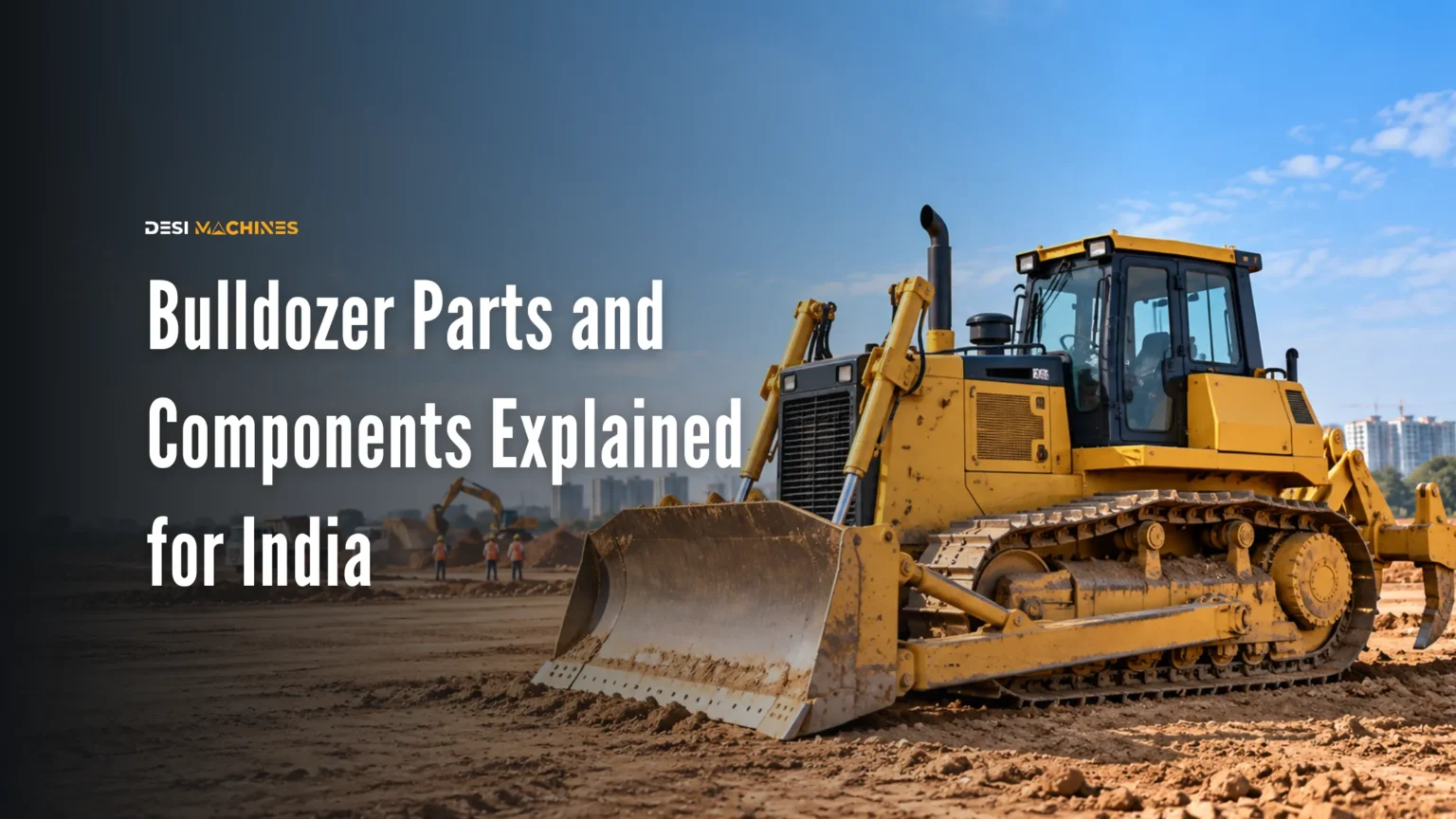
A bulldozer carries between 37 and 45 track shoes on each side, and those shoes, with the chain and rollers under them, are the parts you will buy again and again for as long as you own the machine. Everything else on a dozer falls into four groups: the blade and push arms at the front, the ripper at the back, the engine, transmission and final drives in the middle, and the hydraulic pump, rams and valves that move the blade.
That list is shorter than most first-time buyers expect. A dozer has no swing bearing, no boom, no loader arm. What it has instead is an undercarriage that takes the machine’s entire weight and drags it through the ground it is cutting.
This guide takes each group in turn, using the figures the 41 dozers listed on DesiMachines publish for themselves. Where the catalogue publishes no number, this guide says so rather than filling the gap with a guess.
What are the main parts of a bulldozer?
Of the 41 dozers listed, 37 run on tracks and 4 run on tyres. The tracked machines share one parts list. The four wheel dozers share a different one, and the section further down deals with them separately.
| Part group | What it does | Machines publishing a figure |
|---|---|---|
| Undercarriage | Carries the whole machine and puts engine power on the ground. Track chain, shoes, rollers, idlers, sprockets. | 37 of 37 tracked |
| Blade and push arms | Cuts, carries and spreads soil. The push arms take the load back into the machine. | 37 of 37 tracked |
| Ripper | Breaks hard ground behind the machine before the blade cuts it. | 33 of 37 publish a ripper line |
| Engine | Runs the machine and drives both the transmission and the hydraulic pump. | 41 of 41 |
| Transmission and final drives | Turn engine power into track movement, with the last gear reduction at each sprocket. | 41 of 41 |
| Steering and brakes | Slow one track to turn the machine, and hold it on a slope. | 41 of 41 |
| Hydraulic system | Pump, rams and valves that lift, tilt and angle the blade and work the ripper. | 41 of 41 publish a relief pressure |
Two of those groups decide most of your parts bill. The undercarriage, because every hour of work wears it. And the blade edge, because it is the part actually touching the ground.
What is inside a dozer undercarriage?
The undercarriage is a loop. The sprocket at the back is the driven wheel: it has teeth that engage the track chain and pull it round. The idler at the front is a smooth wheel that guides the chain and takes up slack through a spring. Between them, track rollers under the frame carry the machine’s weight onto the chain, and one or two carrier rollers on top stop the returning chain from sagging.
The track chain is a row of links joined by pins and bushes. Bolted to the links are the track shoes — the steel plates you actually see, each with a raised bar across it called a grouser, which is what bites into soil for grip.
How power travels through a dozer undercarriage
Reading the diagram: 1 — Idler (front): guides the chain and holds its tension through a recoil spring. 2 — Sprocket (rear, marked with its teeth): the driven wheel, turned by the final drive, which pulls the chain round. 3 — Track rollers: carry the machine’s weight down onto the chain; the catalogue calls these bottom rollers and lists 5 to 8 of them per side. 4 — Carrier rollers: hold up the returning top run of chain; almost every machine here lists 2. The dark loop itself is the track chain and shoes.
The numbers below are what the catalogue publishes for each machine, and they show how the undercarriage scales with weight:
| Machine | Operating weight | Shoes each side | Shoe width | Bottom rollers | Ground pressure |
|---|---|---|---|---|---|
| Komatsu D39EX-22 | 9,040 kg (9.0 tonnes) | 39 | 460 mm | 6 | 40.8 kPa |
| BEML BD50 | 12,170 kg (12.2 tonnes) | 38 | 400 mm | 5 | 71.6 kPa |
| Shantui SD16E | 16,890 kg (16.9 tonnes) | 39 | 560 mm | 7 | 74 kPa |
| CASE 1650L | 17,960 kg (18.0 tonnes) | 45 | 559 mm | 8 | 46.1 kPa |
| BEML BD85 | 24,340 kg (24.3 tonnes) | 41 | 560 mm | 7 | 66.1 kPa |
| Komatsu D155A-6 | 41,700 kg (41.7 tonnes) | 41 | 560 mm | 7 | 115.8 kPa |
| Komatsu D475A-5E0 | 108,390 kg (108.4 tonnes) | 41 | 710 mm | 8 | 166 kPa |
Notice what does not change. A 9-tonne machine carries 39 shoes a side and a 108-tonne machine carries 41. The shoe count barely moves; the shoe width and the roller count do. Shoe width runs from 400 mm on the BEML BD50 to 710 mm as standard on the Komatsu D475A-5E0, and grouser height from 50 mm to 105 mm.
Ground pressure explains why two machines of similar weight need different shoes. It is the machine’s weight spread over the area its tracks cover, and a lower figure means the machine floats better on soft ground. The Komatsu D39PX-22 gets down to 31.0 kPa because it runs 635 mm shoes on a 9,480 kg (9.5-tonne) machine. Wider shoes buy flotation and cost you chain life on rock, because the extra leverage works the pins and bushes harder. Ground contact area, where published, runs from 16,700 cm² to 64,240 cm² across the same two extremes.
Caterpillar quotes its ground pressure to ISO 16754, the standard method for measuring it. Worth checking when you compare two brands, because a figure measured a different way is not comparable. Undercarriage wear itself works the same on any tracked machine, and our guide to the excavator undercarriage and its wear parts covers measuring and turning pins and bushes.
What are the parts of a dozer blade?
The blade is a curved steel plate held by two push arms that pivot on the track frames. Rams lift it, and depending on the type, tilt one corner down or swing the whole blade at an angle. Along the bottom edge are two bolt-on wear parts: the cutting edge, a long steel strip, and the end bits at each corner. Both are meant to be replaced, and both are cheaper than letting the blade itself wear.
Blade capacity across the tracked machines listed runs from 1.76 m³ on the BEML BD50 to 34.4 m³ on the Cat D11. Capacity is how much loose soil the blade will carry in front of it, so it decides how much you move per pass.
| Blade type | Machines (of 37 tracked) | What it is and what it suits |
|---|---|---|
| Semi-U (SU) | 17 | A straight blade with short side wings. Carries more soil than a straight blade without losing much cutting force. The most common fitment here. |
| Straight / straight-tilt (S) | 8 | Flat blade, no wings. Best cutting force, least carrying. Used for grading and spreading. |
| Power angle tilt (PAT / VPAT) | 7 | Lifts, tilts and angles from the joystick, so one machine cuts a drain, spreads a layer and pushes to one side without stopping. Common on the smaller machines. |
| Angle (A) | 4 | Set to push soil to one side. Used for road formation and side-casting. |
| Full U | 1 | Deep side wings. Carries the most soil over distance; used for bulk work and coal. |
Most machines also list alternative blades their frame will take. The BEML BD85 publishes straight-tilt, angle, semi-U at 7.5 m³, coal at 10.1 m³ and a rake, on one machine. A coal blade is a big, light blade for material that weighs little per cubic metre; a rake replaces the blade with tines for clearing roots and scrub. The frame and rams are common, so switching blade type later is a parts decision, not a new machine.
If you are still choosing between machine classes rather than blades, our comparison of the motor grader against the bulldozer sets out which one belongs on a finishing job.
What is a ripper, and how many shanks does it have?
A ripper is a frame at the back of the machine carrying one or more steel teeth, called shanks, that are pushed into hard ground and dragged through it. Ground that a blade cannot cut gets broken up first, then pushed.
33 of the 37 tracked machines publish a ripper line, and almost all of them list it as an option rather than standard equipment. Two shapes appear:
- Multi-shank, usually three teeth on a parallelogram frame, for general hard soil and weathered rock. The Shantui SD16E lists a three-shank unit weighing 1,709 kg with 572 mm of penetration.
- Single-shank, one heavy tooth that goes deeper, for the harder material on mining work. The Komatsu D475A-5E0 lists a giant single-shank ripper at 7,360 kg reaching 1,744 mm deep.
Write down the weight of the ripper before you order anything. It runs from about 1,000 kg to 9,720 kg on the machines listed, and it changes ground pressure, trailer loading and where the machine can work. The tips on the shanks are wear parts and are replaced far more often than the shanks.
The two smallest machines show the limit. The catalogue lists a multi-shank ripper for the Komatsu D39EX-22 and none at all for the D39PX-22, which runs wider tracks for soft ground and is not a ripping machine.
What sends power from the engine to the tracks?
This is where dozer parts lists split apart, and it is the single most useful thing to know before you walk up to a parts counter. Three different drive families are listed, and they do not share components.
| Drive type | Machines (of 37 tracked) | Parts it has | Parts it does not have |
|---|---|---|---|
| Powershift with torque converter | 22 | Torque converter, planetary gear packs, transmission oil, wet multi-disc steering clutches, band or disc steering brakes | — |
| Hydrostatic (HST) | 13 | A drive pump and a motor for each track, high-pressure hoses, hydraulic oil doing the work of transmission oil | No torque converter, no steering clutch |
| Direct drive | 2 | A wet main clutch and a mechanical gearbox, hand-operated | No torque converter, no powershift clutch packs |
Ask for a torque converter kit for a CASE 1650L and you will get a blank look, because that machine is hydrostatic and the part does not exist on it. The same applies to the three SEM machines, the five Shantui DH-series machines, the two small Komatsu D39s and the other two CASE dozers. The two direct-drive machines, the BEML BD80 and BD50, are the opposite case: they have a wet main clutch, a part the powershift machines do not carry at all.
On every machine the last stage is the final drive — a gear reduction at each sprocket that turns high-speed shaft rotation into slow, high-force track movement. It runs in its own oil bath, separate from the transmission, and the volume is small: 3.5 litres a side on the Komatsu D39EX-22, up to 82 litres on the LiuGong B230. Small volume, high load, and a leaking final drive seal is one of the faster ways to lose an expensive assembly.
The engine in front of all this is usually bought in, not built by the machine brand. Among the 37 tracked machines: Weichai on 11, Komatsu‘s own on 7, BEML‘s own on 6, Cat‘s own on 5, Cummins on 3 (plus one Chongqing Cummins), FPT Industrial on 3 and Shangchai on 1. Filters, injectors, water pumps and gaskets often come through the engine maker’s network rather than the machine dealer, so write the engine model off the plate before you need it. Komatsu’s Indian range, including the D375A-6 and D85ESS-2, is listed on the Komatsu India product page.
Engine power across the tracked machines runs from 67 kW (90 HP) on the BEML BD50 to 664 kW (890 HP) on the Komatsu D475A-5E0.
What does the hydraulic system contain?
A pump driven off the engine, a control valve, and rams that lift, tilt and angle the blade and raise the ripper. The pump type is what matters for spares. Two families are listed: gear pumps, simpler and cheaper, and variable displacement piston pumps, which deliver only the oil the job needs and so burn less fuel. Komatsu calls its version CLSS, a closed-centre load-sensing system; Caterpillar and CASE list load-sensing hydraulics of their own.
Maximum pump flow runs from 99 litres per minute on the Komatsu D39 machines to 586 litres per minute on the BEML BD475-2. Implement relief pressure — the setting at which the valve dumps oil rather than let pressure keep climbing — runs from 13.73 MPa on the BEML machines to 27.5 MPa on the large Komatsu machines.
One figure is easy to misread. The Shantui DH-series machines publish 43.5 to 45 MPa, and the catalogue itself notes this is the hydrostatic drive-circuit overflow setting, not the implement relief: the pressure in the circuit driving the tracks, not the one lifting the blade. Quoted as a blade figure it would make those machines look three times stronger than the rest.
Hoses, seals and filters are what actually fail here, and they fail on a schedule you can plan for. Our guides to hydraulic system maintenance and the hour-by-hour service schedule cover the intervals.
Looking at machines rather than parts? Compare the full range of dozers listed on DesiMachines, from mini dozers to mining classes, and send an enquiry for a price on the model you are considering.
What parts does a wheel dozer have instead of an undercarriage?
Four of the 41 machines run on tyres, not tracks: the Caterpillar 814K, 824K and 834K and the Komatsu WD600-6R. Everything from the blade forward is familiar. Everything under the machine is different.
A wheel dozer has no track chain, no shoes, no rollers, no idlers and no sprockets. In their place are axles, wheels and tyres, and the machine bends in the middle to steer instead of slowing one track. The Cat 834K lists articulated hydraulic steering, a fixed front axle, a rear trunnion axle that oscillates 13 degrees either way, a 4,550 mm wheelbase and 35/65-R33 tyres. Tyres of that size are a serious line item, and on a wheel dozer they are the wear part the undercarriage would otherwise have been.
What you gain is speed. The 834K lists a maximum forward speed of 38.5 km/h, and every tracked machine in this catalogue sits between 8.0 and 12.7 km/h. A wheel dozer walks itself between working areas on a large site; a tracked one waits for a trailer. What you lose is grip and flotation: rubber on soft ground cannot do what a 710 mm steel shoe does.
Which dozer parts wear out first in Indian conditions?
In rough order of how often they come up:
- Cutting edge and end bits. Bolt-on, cheap against the blade, and the first thing to check. Working on murram and rock finishes an edge far faster than working on soil.
- Track shoes, chain, pins and bushes. The big one. Rock, abrasive sand and long travel on hard surfaces all cut chain life. Running the chain too tight wears pins and bushes much faster than running it correctly.
- Sprocket teeth and idler. They wear along with the chain, which is why an undercarriage is usually replaced as a set rather than piece by piece.
- Ripper tips. Consumable by design on any machine doing hard-ground work.
- Hydraulic hoses and ram seals. Heat, dust and the constant flexing at the blade rams. A slow seep at a ram gland is an early warning, not a nuisance.
- Filters and oils. Air filters on a dusty Indian site, and the final drive oil almost nobody checks until it leaks.
Daily greasing of the pins on the blade, push arms and ripper is the cheapest maintenance on the machine, and the one most often skipped. Our guide to greasing points, grades and intervals lists where the points are and how often they need attention.
Service volumes are worth keeping on paper, because ordering the right quantity of oil matters as much as ordering the right grade:
| Machine | Fuel tank | Engine oil | Coolant | Hydraulic system | Final drive (each side) |
|---|---|---|---|---|---|
| Komatsu D39EX-22 | 195 L | 15 L | 23 L | 60 L | 3.5 L |
| BEML BD50 | 240 L | 24 L | 35 L | 50 L | 12 L |
| Shantui DH13B3 | 270 L | 16 L | 26.5 L | 66 L | 20 L |
| BEML BD85 | 420 L | 32 L | 88 L | 130 L | 36 L |
| Komatsu D155A-6 | 625 L | 37 L | 82 L | 85 L | 31 L |
| BEML BD475-2 | 1,520 L | 76 L | 206 L | 180 L | 75 L |
Whether you fit genuine, OEM-supplied or aftermarket parts is a separate decision, and it is not the same answer for a cutting edge as it is for a hydraulic pump. Our guide to genuine, OEM and aftermarket spare parts works through where each one makes sense.
How do you check these parts before buying a machine?
On a used dozer, the undercarriage is the number that decides whether the machine is cheap or expensive, and it is measurable rather than a matter of opinion.
- Measure the chain, do not eyeball it. Ask for wear readings on pins, bushes, links, rollers, idler and sprocket. A dealer who services dozers has the gauges. A machine at 80% undercarriage wear can cost a large fraction of its own price to put right.
- Look at the sprocket teeth from the side. Symmetrically pointed teeth mean a worn set, and a worn sprocket eats a new chain.
- Check chain tension on level ground. Over-tightening is the most common self-inflicted wear there is.
- Sight along the cutting edge. A wavy edge and rounded end bits are normal. A cracked or repair-welded moldboard is a different conversation.
- Work every blade function cold. Lift, tilt, angle if fitted, and the ripper. Watch for drift with the engine off, and check the ram rods for scoring.
- Match the drive type to the support you can reach. A hydrostatic machine in a district served only by a powershift dealer is a slower repair, every time.
- Write down the engine model, not just the machine model. It is what the filter and injector numbers hang off.
Machine prices vary widely by class. The BEML BD50 is listed at ₹30–40 Lakh, the Shantui SD16E at ₹70–85 Lakh and the Cat D6R2 at ₹1.20–1.45 Crore (all indicative, as of Sep 2026). Where a machine shows no price, it is available on request.
If you need a dozer for one job only, the parts bill stays with the owner rather than you: our guide to taking a dozer on rent in India covers rates, the class to ask for and what to check on the machine that turns up. For a used purchase, the broader used construction equipment checks apply here too.
A note on the figures in this guide
Every number here comes from the specification each machine’s own listing publishes, counted across the 41 dozers available at the time of writing — 37 tracked and 4 wheeled, including the mining classes. Where a figure is not published, this guide says so instead of substituting a typical value. Wear limits, part numbers and torque settings are not catalogue data at all; they come from your machine’s parts manual and your dealer.
The same series covers excavator parts and the other machine families, and the full parts and running-costs guide is the place to start if your machine is not a dozer.
Ready to look at machines? Browse the listed dozer range, or read the class-level bulldozer buying guide if you are still deciding on size.
Prices, specifications and features are indicative, vary by variant, location and date, and should always be confirmed with the official OEM or authorised dealer before any purchase decision. DesiMachines is not liable for decisions taken on the basis of information that may have changed after publication.