
 Excavator
294 models
Excavator
294 models  Backhoe Loader
51 models
Backhoe Loader
51 models  Crane
68 models
Crane
68 models  Concrete Mixer
79 models
Concrete Mixer
79 models  Wheel Loader
54 models
Wheel Loader
54 models  Compactor / Roller
45 models
Compactor / Roller
45 models  Motor Grader
42 models
Motor Grader
42 models  Dozer
41 models
Dozer
41 models  Concrete Pump
66 models
Concrete Pump
66 models  Skid Steer Loader
11 models
Skid Steer Loader
11 models  Telehandler
13 models
Telehandler
13 models 


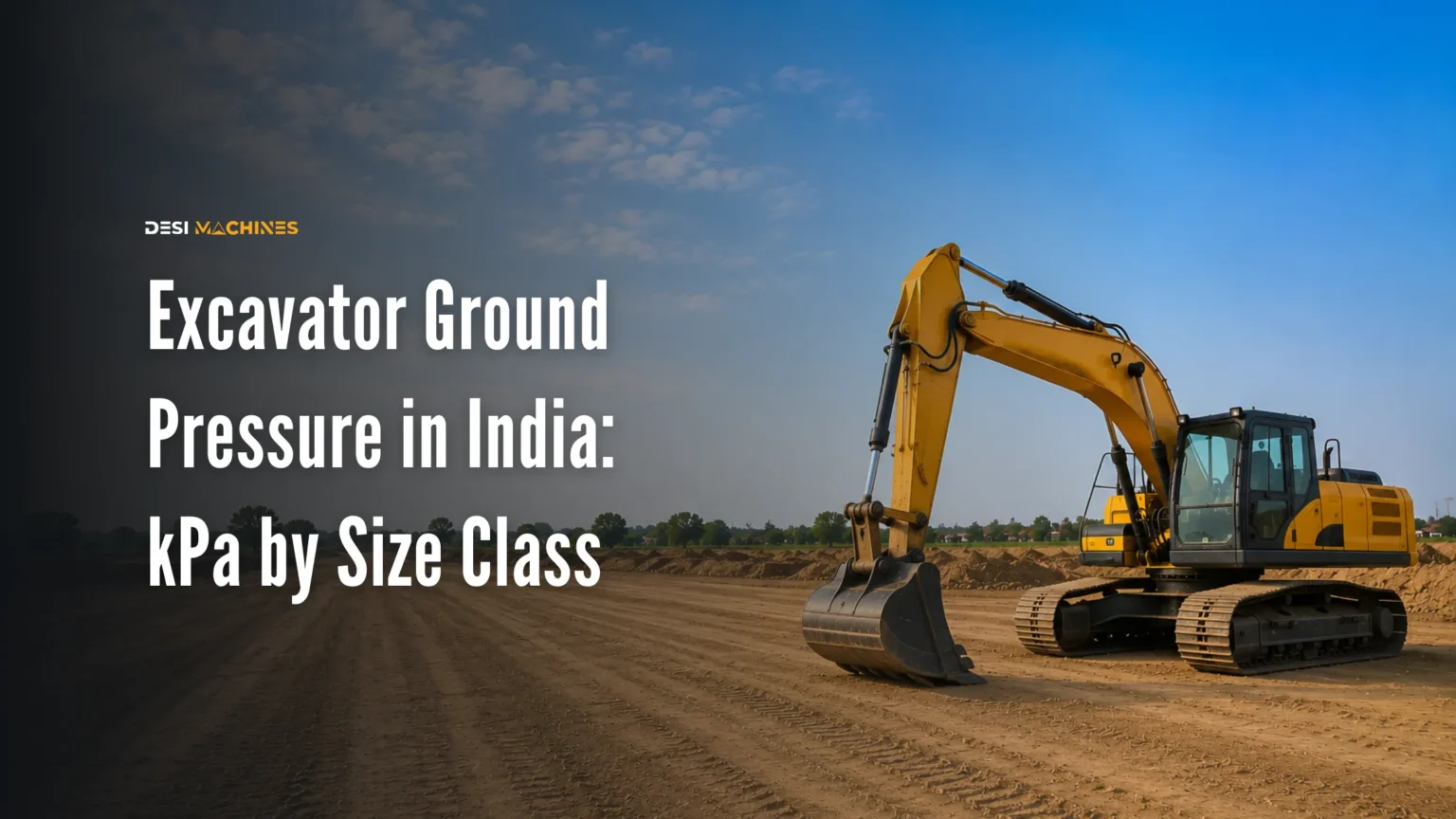
Ground pressure is the weight an excavator puts on every square metre of soil under its tracks, written on the spec sheet as ground bearing pressure in kilopascals (kPa). Across the 294 excavators listed on DesiMachines it runs from about 25 kPa on a mini machine to 265 kPa on a mining machine, and a typical 20 tonne (20,000 kg) machine sits near 47 kPa. It is the number that decides whether your machine works on a wet field or sinks into it, and it depends as much on track shoe width as on weight.
What is ground pressure on an excavator?
Ground pressure is how hard the machine presses down on the soil beneath its tracks. Take the weight of the machine, spread it over the area where the tracks actually touch the ground, and that is the figure. Spec sheets call it ground bearing pressure and print it in kilopascals, shortened to kPa.
A lower number means the machine spreads its weight better and sinks less. A higher number means it concentrates its weight on a smaller patch and digs itself in. The units are worth a moment, because kPa means nothing to most buyers. As a rough handle, 100 kPa is about 1 kg per square centimetre. So a mini excavator at 31 kPa presses down with roughly a third of a kilo on every square centimetre of ground it stands on.
Of the 294 excavators listed, 221 publish a usable ground bearing pressure figure and 289 publish a track shoe width, so this is one of the better covered numbers on an Indian spec sheet. It sits in the undercarriage block, usually a few lines below track shoe width, which is the more detailed guide to reading an excavator spec sheet.
How much ground pressure does an excavator have?
Ground pressure climbs steadily with machine size, but not in a straight line, and the classes overlap more than most buyers expect. Here is the full picture from the catalogue, grouped by the size class each machine is listed under.
| Size class | Machines with a figure | Ground pressure (kPa) | Typical | Operating weight | Usual shoe width |
|---|---|---|---|---|---|
| Mini (0–6 Ton) | 29 | 25.5 – 41.7 | ~31 | 1,980 – 5,780 kg (2.0 – 5.8 Ton) | 300 mm |
| Small (6–15 Ton) | 35 | 28.0 – 50.9 | ~39 | 7,050 – 14,700 kg (7.1 – 14.7 Ton) | 500 mm |
| Medium (15–25 Ton) | 59 | 42.1 – 57.0 | ~47 | 19,760 – 25,500 kg (19.8 – 25.5 Ton) | 600 mm |
| Large (25–50 Ton) | 40 | 50.9 – 93.1 | ~68 | 25,650 – 50,800 kg (25.7 – 50.8 Ton) | 600 mm |
| Extra-Large (>50 Ton) | 45 | 86.5 – 265.8 | ~136 | 49,400 – 825,000 kg (49.4 – 825 Ton) | 600 mm and wider |
| Long Reach | 6 | 37.3 – 51.0 | ~48 | 21,800 – 28,610 kg (21.8 – 28.6 Ton) | 800 mm |
Read down the table and one row breaks the pattern. Long reach machines weigh as much as large machines and press like medium ones. That is deliberate, and it is covered further down.
The size class a machine belongs to is explained in the guide to excavator size classes in India, and the weights themselves in the guide to excavator and backhoe operating weight.
What is the ground pressure of a 20 ton excavator?
A 20 tonne (20,000 kg) excavator in India typically puts about 47 kPa under its tracks, and the whole 15 to 25 tonne class runs from 42.1 to 57.0 kPa. This is the class most Indian contractors buy, so it is worth looking at closely.
Of the 59 machines in the class that publish the figure, 53 run 600 mm track shoes and sit in a tight band of 43.0 to 52.5 kPa. The five machines on narrower 500 mm shoes are scattered much wider, from 42.1 to 57.0 kPa, and the two highest-pressure machines in the entire class are both 500 mm machines. The lightest-pressing machine on standard shoes is the Tata Hitachi EX 215LC Prime at 43.0 kPa, and the heaviest-pressing is the JCB NXT 210LC Fuel Master at 57.0 kPa.
That is a difference of 14 kPa, or about a third, between two machines of roughly the same weight. On a dry quarry floor it changes nothing. On a canal bank in September it decides whether you finish the job or spend the afternoon pulling the machine out.
Compare the full range of 15 to 25 tonne excavators and check the shoe width on the sheet before you shortlist.
What is the ground pressure of a mini excavator?
A mini excavator puts roughly 31 kPa on the ground, with the 29 minis that publish a figure running from 25.5 to 41.7 kPa. Minis are light, so buyers assume they float over anything. The spread says otherwise, because most minis are also fitted with narrow shoes: 19 of the 29 run 300 mm track shoes, the narrowest in the catalogue.
Two machines from the same class make the point better than any explanation. The SANY SY27U weighs 2,680 kg (2.7 Ton) on 300 mm shoes and presses at 25.5 kPa. The JCB 30 PLUS weighs 2,870 kg (2.9 Ton), barely 190 kg more, but runs 250 mm shoes and presses at 39.2 kPa. Seven per cent more weight, fifty per cent more ground pressure.
If your work is on finished plots, farm land or soft fill, that gap matters more than the size of the machine. Browse the range of mini excavators, or read the full mini excavator guide first.
How do you calculate excavator ground pressure?
Divide the machine’s weight by the area of track touching the ground. The track contact area is the track length on ground multiplied by shoe width, doubled for the two tracks. Both numbers are on the spec sheet.
Take the JCB NXT 210LC Fuel Master, a 21,250 kg (21.3 Ton) machine with 3,660 mm of track on the ground and 500 mm shoes:
- Contact area = 2 × 3.66 m × 0.5 m = 3.66 square metres
- Weight per square metre = 21,250 kg ÷ 3.66 = about 5,800 kg on every square metre
- In the sheet’s own units that is 57 kPa, which is exactly what the machine publishes
That middle line is the one to hold on to. Nearly six tonnes sitting on every square metre of soil is a real, physical thing you can picture, and kPa is only the same fact in different clothes.
The arithmetic reproduces the published figure within ten per cent on 132 of the 207 machines that print all four numbers, and matches it almost exactly on many. Where it disagrees, the usual reason is that the maker quoted the pressure on an optional wider shoe than the one printed in the shoe-width line. Use the published figure when you have it and keep the calculation for machines that leave it blank.
Does a heavier excavator always press harder on the ground?
No. A heavier excavator on wide shoes regularly presses less than a lighter one on narrow shoes, and the catalogue is full of examples. This is the single most useful thing to understand about the number.
| Machine | Operating weight | Track shoe width | Ground pressure |
|---|---|---|---|
| Bobcat E50z | 5,019 kg (5.0 Ton) | 300 mm | 41.7 kPa |
| JCB 50Z | 4,946 kg (4.9 Ton) | 400 mm | 29.4 kPa |
| SANY SY80C-9 SALT | 7,620 kg (7.6 Ton) | 600 mm | 28.0 kPa |
| Kobelco SK80 | 7,660 kg (7.7 Ton) | 450 mm | 31.5 kPa |
| Kobelco SK80 on 600 mm shoes | 7,660 kg (7.7 Ton) | 600 mm | 24.4 kPa |
The SANY SY80C-9 SALT weighs 2.6 tonnes more than the Bobcat E50z and presses about a third less on the soil. The Kobelco SK80 on its wider shoe option is the lightest-pressing machine in this table while being the heaviest machine in it.
So weight tells you what the machine can lift, what it costs to move and what trailer you need. It does not tell you where the machine can stand. Those are two different questions and buyers routinely answer the second one with the first.
Do wider track shoes reduce ground pressure?
Yes, and by close to the amount the arithmetic predicts. Five machines in the catalogue publish two ground pressure figures for two track options, which lets you see the effect on one machine instead of guessing across two.
| Machine | Track option | Ground pressure | Change |
|---|---|---|---|
| Kobelco SK80 | 450 mm to 600 mm shoes | 31.5 to 24.4 kPa | down 23% |
| Kobelco SK380XDLC | 600 mm to 800 mm shoes | 70.0 to 53.0 kPa | down 24% |
| JCB 50Z | standard to wide track | 29.4 to 21.5 kPa | down 27% |
| JCB 51R | standard to wide track | 31.3 to 22.5 kPa | down 28% |
| JCB 55Z | standard to wide track | 34.3 to 24.5 kPa | down 29% |
The two Kobelco machines are the clearest, because they publish both widths. In each case the shoe gets a third wider and the pressure falls to about three quarters of what it was, which is what you would expect if pressure simply spreads over the extra width. The three JCB minis publish two pressures against one printed width, so treat the lower figure as the optional wider track and confirm the exact width with the dealer.
Wider shoes are not free. They add weight, they add cost, they wear faster on hard and abrasive ground, and they put more strain on the undercarriage when the machine turns. On rock and quarry floors they are the wrong choice. The full trade-off sits in the guide to the excavator undercarriage.
Which excavator suits soft ground, wet fields and canal banks?
For soft ground the machine you want is one with a low published ground pressure and the widest shoes the job allows, and in India that usually points at either a mini on wide tracks or a long reach machine. Black cotton soil, or kaali mitti, holds water for weeks after the monsoon and will take a machine down to its rollers. Freshly filled soil behaves the same way, and so does the edge of any canal that was cut recently.
The long reach row in the class table is the standout. Four of the six long reach machines that publish a figure run 800 mm shoes, against none of the 59 medium machines. The JCB NXT 245HD LR weighs 23,850 kg (23.9 Ton) and presses at just 37.3 kPa, which is the lowest ground pressure of any machine above 20 tonnes in the catalogue. A standard 21 tonne machine presses harder while weighing less.
That is the whole design intent. These machines are built to stand on a soft bank and reach out over the water rather than drive down to it, which is why they matter for desilting work. The full picture is in the guide to excavators for dredging and canal desilting, and the machines themselves are in the long reach excavator range.
For levelling a finished plot the same logic applies at a smaller size, since a machine that ruts the surface makes work for itself. That is covered in the guide to excavators for land levelling and grading. For well and pond work on soft banks, see the guide to excavators for well digging.
What should you check before buying a machine for soft ground?
Five things settle it, and only the first two are on most buyers’ lists.
- The published ground bearing pressure, and the shoe width it was measured on. A pressure figure without its shoe width is half a number. If the sheet quotes 24 kPa on an 800 mm shoe and the machine arrives on 600 mm shoes, you did not buy 24 kPa.
- Whether wider shoes are available, and what they cost. On the evidence above, going one step wider takes roughly a quarter off the pressure. That is often cheaper than buying a smaller machine.
- Track length on ground. Two machines of the same weight and shoe width can differ here, and a longer track spreads the load further. It is printed in the static dimensions block.
- What the ground is actually like in your worst month, not today. A field that carries a 21 tonne machine in April may not carry it in August.
- Whether the job needs the machine to stand on the soft ground at all. Sometimes reach solves what tracks cannot, and that is a cheaper answer than a specialist undercarriage.
Ground pressure also feeds into what the machine gets done in a day, since a machine that is bogged down is not producing. Output is worked through in the guide to excavator productivity and output per hour, and the volume it moves per pass in the guide to excavator bucket capacity. How deep it can reach is in the guide to excavator digging depth by size. Check the machine’s ground clearance at the same time, since a low belly beaches a machine on soft ground even when the ground pressure figure looks fine; clearances by class are listed in the excavator dimensions guide.
Ground pressure by class: the short version
Ground pressure is machine weight divided by track contact area, printed in kPa in the undercarriage block. Minis run around 31 kPa, a 20 tonne machine around 47 kPa, a 30 to 50 tonne machine around 68 kPa, and mining machines run past 100 kPa. Lower is better on soft ground and wet fields, and worse than useless as a comparison on rock, where weight buys you stability.
The figure is not decided by weight alone. Track shoe width moves it by roughly a quarter in either direction, which is enough for a 7.6 tonne machine to tread more lightly than a 5 tonne one. Check the pressure and the shoe width together, or you are reading half the sheet.
Compare the full range of excavators by size class and shoe width, and talk to our team about which machines suit your ground before you commit.
Specifications quoted here are taken from our listings at the time of writing and are current as per the Aug 2026 spec. Prices, specifications and features are indicative, vary by variant, location and date, and should always be confirmed with the official OEM or authorised dealer before any purchase decision. DesiMachines is not liable for decisions taken on the basis of information that may have changed after publication.