
 Excavator
316 models
 Backhoe Loader
54 models
 Crane
68 models
 Concrete Mixer
79 models
 Wheel Loader
65 models
 Compactor / Roller
45 models
 Motor Grader
42 models

 Concrete Pump
66 models
 Skid Steer Loader
11 models


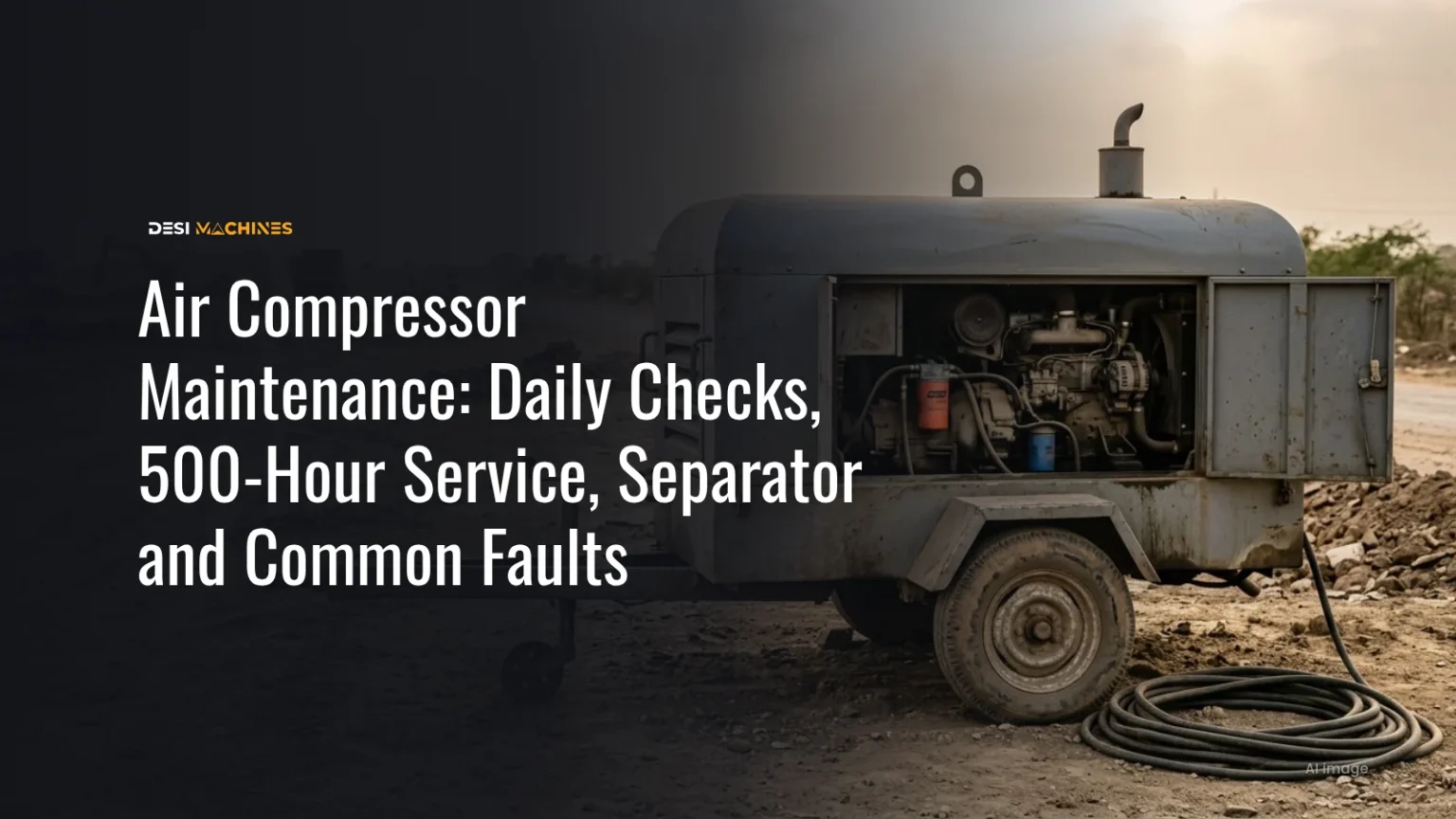
A diesel screw compressor on a construction site needs a short round of checks before every shift and a full oil and filter service every 500 running hours. The oil separator element, the part that strips oil out of the air, comes due at 1,000 to 2,000 hours depending on the maker, and sooner in dust and heat.
This guide lays out that schedule hour by hour from the Indian Standard and two makers’ manuals, explains what each part does, and ends with a fault table you can use when a compressor overheats, runs short of air or starts throwing oil down the hose. It is written for the portable, oil-flooded screw compressor that feeds breakers, rock drills and DTH hammers. If you are still choosing a machine, the guide to the air compressor for construction and quarries comes first.
How often should an air compressor be serviced?
Count service in running hours, not in months, and do whichever comes first if the maker gives both. The Indian Standard for compressor plants, IS 6206:2023, sets out a rotary compressor schedule in clause 17.3.2: daily checks, a first check at 50 hours, then jobs at every 200, 500, 1,000 and 5,000 hours. It also says plainly that the maker’s manual comes first. The makers’ own figures are close to the standard, with one real difference, the separator element.
| Item | IS 6206:2023, cl. 17.3.2 | Doosan Portable Power 7/72 manual (2013) | ELGi portable checklist (2024) |
|---|---|---|---|
| Compressor oil level, leaks, drain water | Daily | Daily | Daily |
| Compressor oil change | Every 500 h | 500 h or 6 months | First at 50 h, then 500 h or 6 months |
| Compressor oil filter | Every 500 h | 500 h or 6 months | First at 50 h, then 500 h or 6 months |
| Air intake filter | Check and clean every 200 h | Replace when the indicator shows red, or at 500 h or 6 months | Check weekly, replace at 500 h or 6 months |
| Oil cooler and radiator fins | Clean cooler fins every 200 h | Clean every month | Clean every 90 days |
| Safety (relief) valve | Check it lifts at its set pressure, every 200 h | Check at 500 h or 6 months | Check every 90 days |
| Oil separator element | Check at 1,000 h, replace if needed | Replace at 1,000 h or 12 months | Replace at 2,000 h or 2 years |
| Automatic shutdown switches | Not listed | Test at 1,000 h or 12 months | Not listed |
| Strip and clean the compressor | Every 5,000 h | Not listed | Inlet and minimum pressure valves checked every 3 years |
A June 2026 maintenance note from Hitachi Global Air Power, published on Sullair’s site, puts the oil and separator change on oil-flooded portable machines at 1,500 hours. So the separator interval runs from 1,000 to 2,000 hours across the makers we read. Follow the plate on your own machine, and if there is no manual with it, ask for one: IS 6430:2023, the Indian Standard for mobile construction compressors, requires an operating and maintenance manual and an illustrated parts list with every unit (clause 20.1).
The engine has its own schedule. IS 6206 leaves the prime mover, the diesel engine or electric motor that drives the compressor, to its own maker’s manual, and the engine side of a portable compressor is serviced much like a site genset. The genset maintenance schedule covers that engine work in detail.
How does oil move through a screw compressor?
A screw compressor floods its rotors with oil. IS 6206 lists what that oil does: it lubricates the bearings and gears, cools the air while it is being compressed, seals the clearances between the rotor lobes and balances the end thrust on the rotors, and then it has to be taken out of the air again before the air reaches your hose. Almost every service item on the machine guards one stage of that loop.
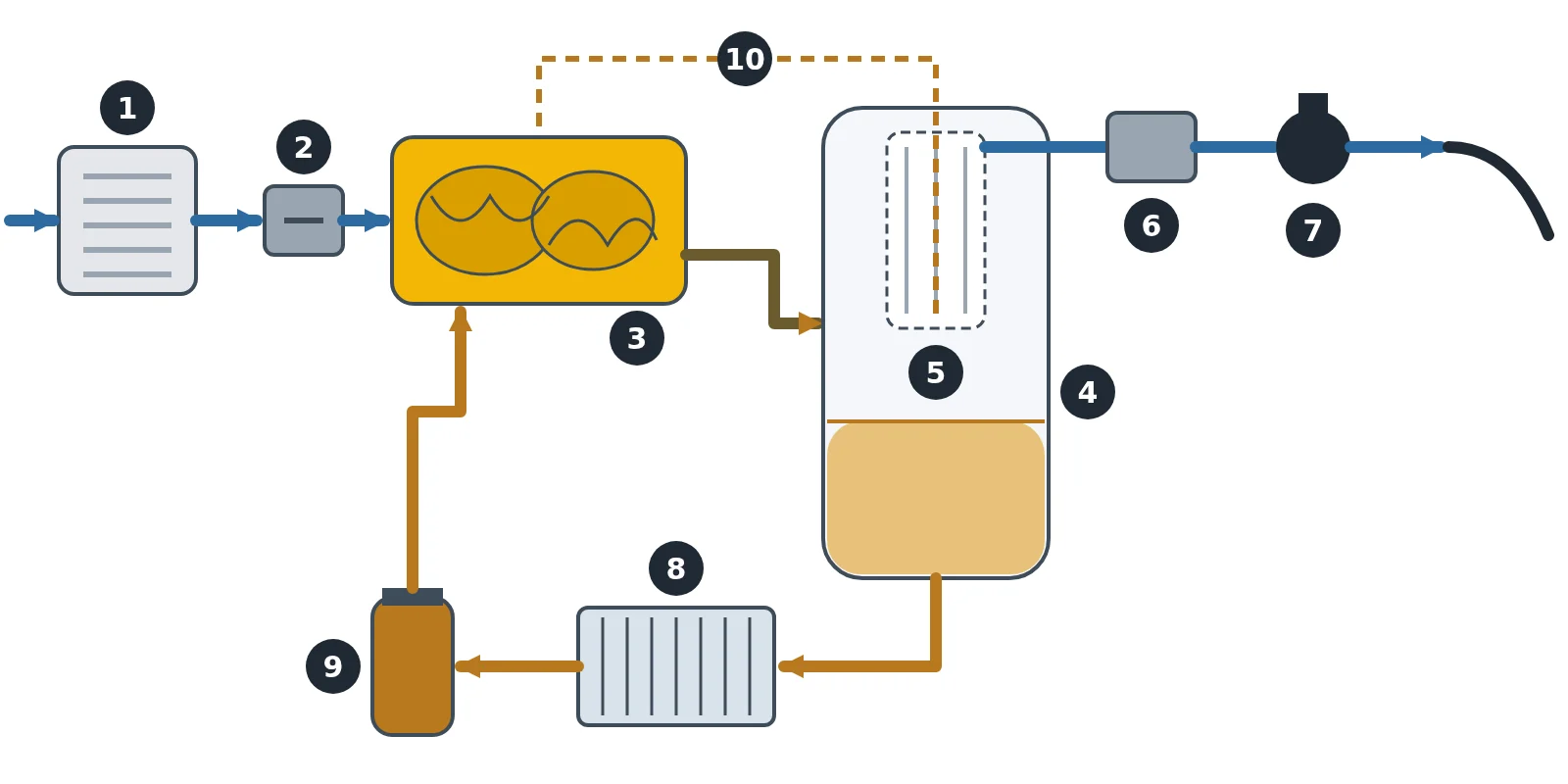
Read the loop and the schedule makes sense. Dust that gets past the intake filter (1) ends up in the oil. Dirty oil blocks the oil filter (9), and a blocked filter is bypassed, so the dirt goes round again. A cooler (8) packed with dust cannot shed heat, so the oil runs hot and breaks down faster. Oil that has broken down loads the separator element (5) early. One skipped air filter can shorten the life of three other parts.
IS 6430 builds some of this into the machine. The compressor oil filter must last at least 100 hours, and the oil has to bypass the filter on its own if the filter clogs, so the airend is never starved (clause 8.1.1). The oil in the compressor and engine must stay under 120 °C at full load (clause 7.4). That bypass protects the rotors for a day; it is not a reason to run a clogged filter for a week.
What should you check on a compressor every day?
Do these with the machine level, stopped and the air pressure fully released. The list combines IS 6206 clause 17.3.2 (a) with the daily column of the Doosan 7/72 manual.
- Compressor oil level on the sight glass or dipstick, and engine oil level.
- Coolant level, with the engine cold.
- Fuel. The Doosan schedule asks for the tank to be filled at the end of each day.
- Drain water from the moisture separator, the fuel filter and the fuel water separator.
- The air filter’s service indicator. Empty the dust bowl, and never let it get more than half full.
- Oil, fuel and coolant leaks under and around the machine.
- Gauges and warning lamps work when the machine starts, and the emergency stop works.
On a quarry or a road job, look at the cooler too. Hitachi Global Air Power’s maintenance note says a dirty or clogged cooler or radiator is the most common reason a portable compressor overheats and shuts down, and suggests inspecting both every 100 hours.
Weekly, the Doosan manual adds the fan and alternator belts, battery connections, the air cleaner’s pre-cleaner and tyre pressure. Monthly, it adds every hose, the automatic shutdown system and the outside of the oil cooler.
Why does the first 50 hours matter?
A new compressor still carries contaminants from manufacture in its oil and air system, and the first service flushes them out. Hitachi Global Air Power calls it break-in maintenance. That is why ELGi’s portable compressor checklist replaces the compressor oil, compressor oil filter, diesel fuel filter, engine oil and engine oil filter after the first 50 hours, and why IS 6206 asks for the sump to be drained and the oil strainer cleaned at 50 hours. After that first change, the normal 500-hour rhythm starts.
The same 50-hour check is the time to run the machine up to working pressure and confirm it delivers what the plate says, and to check for oil leaks and that every joint and fastening is secure, as IS 6206 lists for the same visit.
What is done at the 500-hour service?
The 500-hour service is the main one. On the schedules we read, it covers:
- Drain the compressor oil and refill with the oil the maker names.
- Replace the compressor oil filter.
- Replace the air intake filter element, or earlier if its indicator shows red.
- Check the safety valve and the scavenge line, which the Doosan schedule also puts at 500 hours.
- Replace the engine oil, engine oil filter and fuel filters, as the engine maker asks.
Two rules about the oil matter more than the brand. First, never top up or refill with the wrong kind. ELGi’s checklist says in capitals not to use hydraulic oil in its compressors. The Doosan manual warns that some oil types are incompatible and, when mixed, form varnish and lacquer that can block filters, so a change of type or brand is best made only at a complete drain and refill. Second, look at the old oil filter. The Doosan manual says varnish or lacquer on the element means the compressor oil has broken down and should be changed at once, whatever the hour meter says.
A machine working in severe conditions needs these jobs sooner. The Doosan manual names quarry drilling, well drilling and sandblasting as severe work, and says high heat, heavy dust and high humidity all shorten the life of the oil, the separator and the filters. A borewell rig’s compressor in a Rajasthan summer is exactly that case. IS 6430 expects a mobile compressor to work between 5 °C and 45 °C (clause 6.1), and a site at the top of that range is working the oil hard.
If you are hiring rather than owning, most of this is the hire firm’s job, but the daily checks stay with the site. You can find site machines through machines on rent, and the rental guide explains how hire terms are usually split.
When should the oil separator be changed?
Change the oil separator element when the maker’s hours come up, which is 1,000 hours on the Doosan 7/72 schedule and 2,000 hours on ELGi’s checklist, or earlier if oil starts to come out with the air. IS 6206 asks for it to be checked at every 1,000 hours and replaced if necessary.
The separator element is a fine filter inside the separator tank. Most of the oil falls to the bottom of the tank on its own; the element catches the mist that is left. Once the element is damaged, oil gets through to the hose and the tools, which is the clearest sign it is due.
The Doosan manual adds three details worth knowing before anyone opens the tank:
- The element has a small staple through its gasket that earths it, to stop static building up. Do not remove it, and do not use gasket sealant, which would break that earth.
- Refill with fresh compressor oil after fitting a new element.
- Check the scavenge line, its orifice and check valve, at every service. A blocked scavenge line leaves the oil the element has caught with nowhere to go, and it ends up in the air.
The same manual says the element should not need early replacement as long as the air and oil filters are looked after. That is the strongest reason to keep the cheap filters on time.
What are the common air compressor problems and their causes?
Most faults on a portable screw compressor trace back to heat, dirt or a regulation setting. The table follows the fault-finding pages of the Doosan 7/72 operation and maintenance manual; the causes are listed roughly in the order to check them.
| What you see | Likely causes | What to do |
|---|---|---|
| Compressor overheats or shuts down on high temperature | Low oil level; dirty or blocked oil cooler; wrong grade of oil; hot exhaust air being drawn back in; fan or belt fault; faulty temperature switch | Top up and look for the leak; clean the cooler fins; use the maker’s oil; move the machine so it does not draw in its own hot air; check fan and belts |
| Too little air at the tools | Engine speed too low; blocked air cleaner; air leaking; regulation set wrong | Check the air filter indicator first, then leaks, then the speed and pressure regulation |
| Oil coming out with the air | Blocked scavenge line or orifice; damaged separator element; system pressure too low | Clean the scavenge line and orifice; replace the element; check the minimum pressure valve |
| Safety valve blows | Working pressure set too high; regulator set wrong or faulty; inlet valve set wrong; faulty safety valve | Reset or replace the regulator. A faulty safety valve is replaced, never repaired |
| Oil pushed back into the air filter | Machine stopped the wrong way; faulty inlet valve; faulty discharge check valve | Close the discharge valve and let the machine idle before stopping; check both valves |
| Engine starts, then stops | Low engine oil pressure; a safety shutdown working; fuel starvation or water in the fuel; high compressor oil temperature | Read the warning lamp before restarting; check oil, fuel, water separator and the cooler |
Before blaming the compressor for weak tools, check the hose. On a well laid-out line the drop from compressor to tool should stay under 0.6 to 1.0 bar, and the air compressor cfm calculation guide shows how hose length, bore and couplings add to it. If it is a breaker that is hitting weak, the compressor breaker machine guide goes through the breaker side of the problem.
Never silence a shutdown. Low oil pressure, high temperature and the other trips are there to stop a few minutes of trouble turning into a wrecked airend. The Doosan schedule tests those switches once a year, and IS 6430 lists the gauges a mobile compressor must carry, including a temperature gauge or switch on the compressed air or oil on rotary machines (clause 16.1). If a lamp keeps coming back, find the cause.
How do you keep track of compressor service hours?
Use the hour meter and a written log. Note the hours at every check, every oil and filter change and every fault, with the date and who did it. The log tells you when the next service is due, and when you sell the machine or hand back a hired one, it settles arguments about hours.
Check that the machine has an hour meter before you rely on one. IS 6430 lists the running hour recorder as fitted when the purchaser asks for it (clause 10.2), so an older or basic unit may not carry one. If yours does not, log engine starts and stops by the clock.
Screw and piston compressors are serviced differently. A piston machine has valves, rings and a crankcase to look after rather than a separator, and the screw vs piston compressor guide compares the two service rhythms side by side. A DTH hammer at the end of the hose has its own oil needs, set out in the DTH hammer guide.
For breaking work where a compressor’s upkeep is more trouble than it is worth, a hydraulic breaker on an excavator needs no compressor at all; the rock breaker attachment range shows what is available. Every other page on site compressors is collected in the air compressor guide.
Sources
Read on 18 November 2026: IS 6206:2023, Guide for Selection, Installation and Maintenance of Air Compressor Plants, clauses 17.1 to 17.3.2, from its copy on the Internet Archive, read from the page images; IS 6430:2023, Mobile Air Compressor for Construction Purposes, clauses 6.1, 7.4, 8.1.1, 10.2, 16.1 and 20.1, from the same archive; the Doosan Portable Power 7/72 operation and maintenance manual, September 2013 edition, maintenance schedule and fault-finding pages; ELGi’s portable compressor maintenance checklist, published 2 December 2024; and Hitachi Global Air Power’s note on portable compressor maintenance, published 1 June 2026. Service intervals differ between makers and models, so treat the tables as a guide and follow the manual for your machine.
Prices, specifications and features are indicative, vary by variant, location and date, and should always be confirmed with the official OEM or authorised dealer before any purchase decision. DesiMachines is not liable for decisions taken on the basis of information that may have changed after publication.