
 Excavator
313 models
 Backhoe Loader
51 models
 Crane
68 models
 Concrete Mixer
79 models
 Wheel Loader
54 models
 Compactor / Roller
45 models
 Motor Grader
42 models

 Concrete Pump
66 models
 Skid Steer Loader
11 models


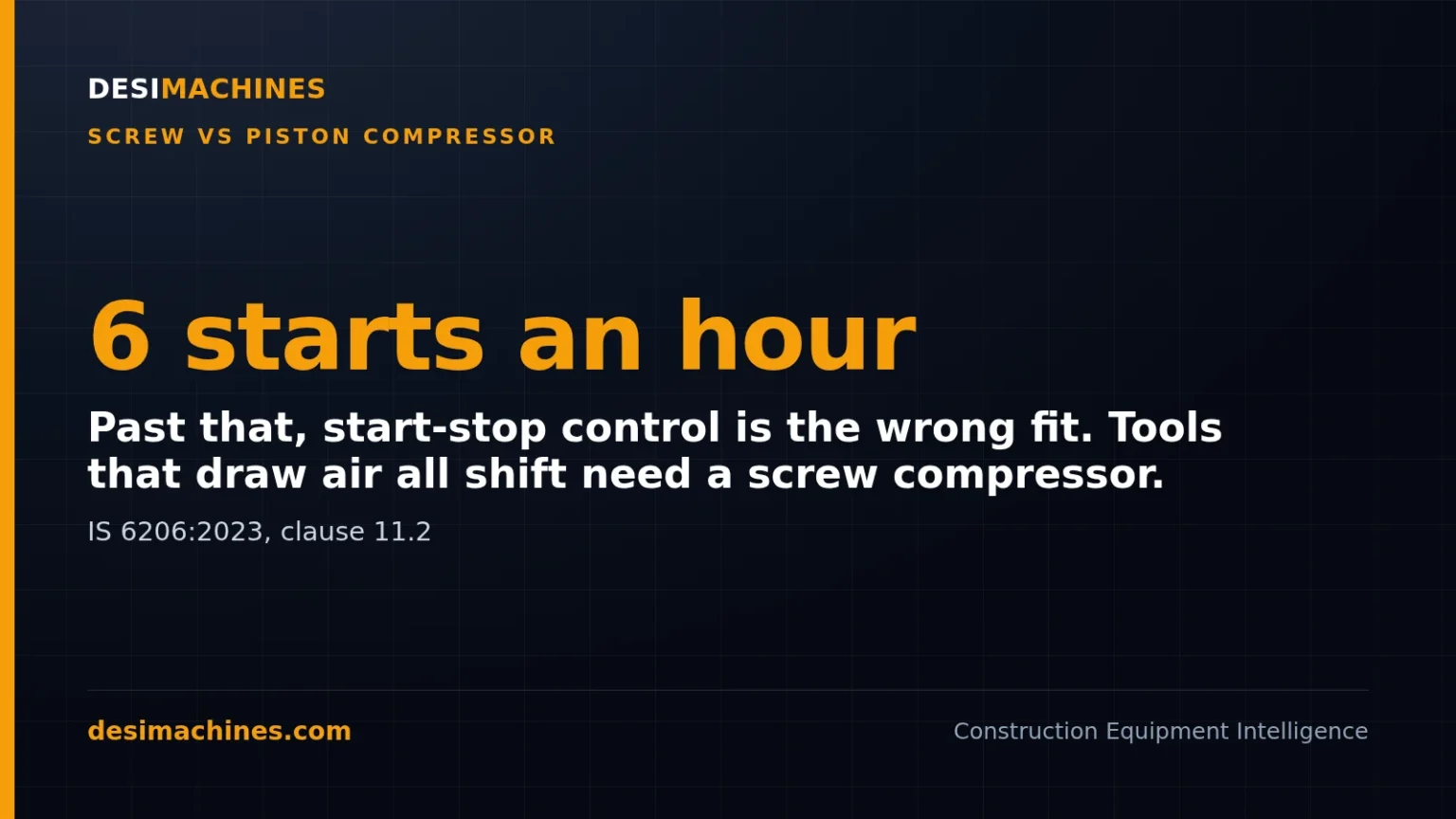
Choosing between a screw and a piston air compressor comes down to one question: how long do your tools draw air without a break? Breakers, rock drills and DTH hammers that run for most of a shift need a screw compressor; a workshop, tyre bay or service van that uses air in short bursts is cheaper to run on a piston compressor with a tank.
The rest of this guide explains why. It sets the two machines side by side on duty cycle, service life, pressure, power and upkeep, using two Indian Standards and the makers’ own pages, and ends with a job-by-job table. If you have not yet worked out how much air your tools need, start with the main guide to the air compressor for construction and quarries, then come back here to pick the type.
What is the difference between a screw and a piston compressor?
A piston compressor squeezes air with a piston moving up and down in a cylinder, one stroke at a time. A screw compressor squeezes it between two meshing rotors that turn without stopping. Both are “positive displacement” machines, which means they trap a fixed pocket of air and make the pocket smaller. The difference is in how often that happens, and it shows up in everything else.
In a piston (also called reciprocating) machine, a crankshaft drives the piston. On the way down the inlet valve opens and air is drawn in; on the way up both valves close and the air is squeezed; once its pressure beats the pressure in the tank, the outlet valve opens and the air is pushed out. Atlas Copco’s Indian page on piston compressors calls the result “a naturally pulsating airflow”. That is why a piston compressor almost always sits on a receiver tank: the tank stores air between strokes and evens out the pulses.
In an oil-flooded screw machine, the kind used on Indian sites, two rotors with spiral lobes turn against each other. The pocket of air between them gets smaller from the intake end to the outlet end, and that shrinking is the compression. Oil is sprayed in to seal the gaps, cool the air and carry the drive from one rotor to the other. A separator tank pulls the oil back out before the air goes to the hose. Wikipedia’s article on the rotary-screw compressor describes the process as “a continuous sweeping motion” with very little pulsing of the flow.
How each machine makes compressed air
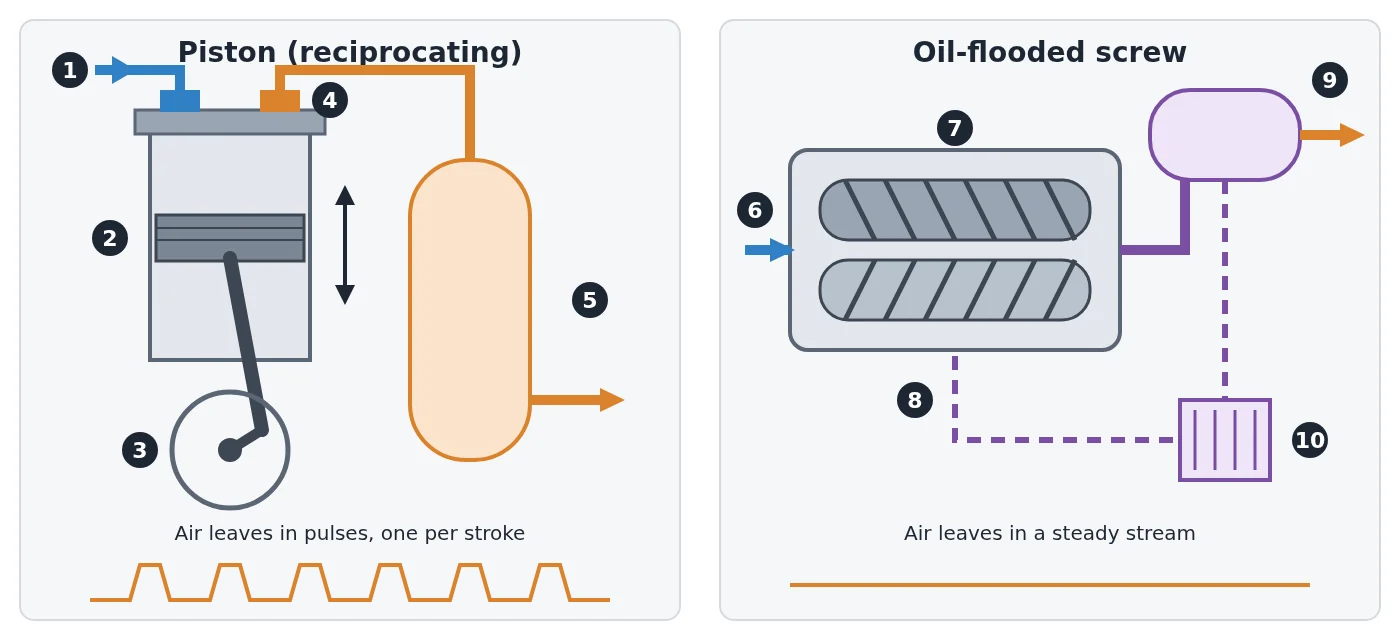
1 Inlet valve: opens as the piston goes down and draws air in. 2 Piston: rises and squeezes the air in the cylinder. 3 Crankshaft: turns the motor or engine’s rotation into the up-and-down stroke. 4 Outlet valve: opens once the cylinder pressure is above the tank’s. 5 Receiver tank: stores air between strokes and smooths the pulses. 6 Air intake. 7 Air end: two screw rotors whose shrinking pocket compresses the air. 8 Oil injection: seals the rotor gaps and cools the air. 9 Separator tank: takes the oil out, and clean air leaves. 10 Oil cooler: cools the oil before it goes back to the air end. Solid lines carry air; dashed lines carry oil.
Screw vs piston compressor at a glance
The table puts the differences that matter on a site in one place. Each row is taken from the sources named under it, not from one maker’s brochure.
| Point | Piston (reciprocating) | Oil-flooded screw |
|---|---|---|
| How air comes out | In pulses, one per stroke; needs a tank to smooth them | A steady stream |
| Built for | Short bursts with rest in between (small air-cooled units); large water-cooled models can run continuously | Long hours of steady demand |
| Noise and shaking | Higher; bigger units need a solid base | Lower; small foundation, rubber mounts |
| Pressure | Up to about 10 bar in one stage; multi-stage machines go far higher (ELGi lists three-stage units to 60 bar) | About 17 bar (250 psi) in one stage and about 41 bar (600 psi) in two |
| Size it suits best | Small outputs, where it leaks less air than a small screw | Medium to large outputs |
| Starting load on the engine or motor | Higher | Low; no clutch needed on engine-driven units |
| Parts that wear | Piston rings, valves, bearings, connecting rod | Few wearing parts; oil, oil filter, separator and air filter are the service items |
| Buying cost | Lower | Higher |
Sources for the table: IS 6206:2023 clause 6.1 (types of compressor); Atlas Copco India’s piston compressor page; Wikipedia’s rotary-screw compressor article for pressure by stage and the small-size leakage point; ELGi India’s reciprocating range page for the 10 bar single-stage and 60 bar three-stage machines.
What does duty cycle mean, and why does it decide the choice?
Duty cycle is the share of each hour a compressor spends actually making air. For example, a tyre bay might run its compressor for ten minutes in an hour. A road crew with two breakers can keep it loaded for fifty.
Atlas Copco’s Indian page is plain about piston machines: they are “designed for intermittent operation and require regular cooling periods to prevent overheating and wear”, and for continuous or round-the-clock air it points to a screw compressor. The reason is heat. Every stroke heats the cylinder, valves and rings, and a small air-cooled unit cools down only while it is stopped. Take away the rest and the parts run hot all shift.
The Indian Standard for selecting compressor plants, IS 6206:2023, gives a practical limit from the control side. A small compressor that switches itself off when the tank is full and back on when pressure drops is on “start-stop” control. Clause 11.2 says that as a general rule this control is not used once the machine would start more than six times an hour. Above that, a compressor runs on and unloads instead, which is how a screw machine handles changing demand.
Two cautions keep this honest. First, not every piston compressor is a small tank unit. IS 6206 clause 6.1.1.2 describes double-acting, water-cooled piston machines as heavy-duty, continuous-duty compressors used in factories, and ELGi rates some of its Indian piston ranges for continuous duty. Read the duty rating on the sheet of the machine you are offered rather than assuming. Second, a screw compressor on a light job is not free either: it keeps running unloaded between demands, and an engine-driven one burns diesel while it does. Matching size to the job, worked through in air compressor cfm calculation, matters as much as the type.
Which lasts longer, a screw or a piston compressor?
On a long-hours job, the screw. On a light, stop-start job, a well-kept piston machine lasts a long time too, and it is easier to rebuild.
Atlas Copco India puts the life of a piston compressor at up to 15 years in light or intermittent work, falling to 5 to 8 years in heavy or continuous use, “particularly if overheating or poor maintenance occurs”. The same page notes that piston machines need servicing more often than screw machines, but that their simple design lets you replace a part rather than the whole unit.
A screw compressor’s life is counted in running hours on its air end rather than in years. None of the maker pages we read publishes a single life figure for it, so ask the seller what the air end is rated for and what the warranty covers, in hours. IS 6206 clause 6.1.2.2 lists the oil-injected screw’s advantages as small size and light weight, “low maintenance cost as there is no wear and tear parts in the machine”, low discharge temperature and low starting torque. In practice that means the service items are oil, filters and the separator element rather than rings and valves.
The service rhythm in IS 6206 clause 17.3 shows the difference in daily work:
| Check | Piston compressor | Rotary (screw or vane) compressor |
|---|---|---|
| Every day | Crankcase oil level, drain the receiver and coolers, test the safety valve by hand | Fuel and oil levels, drain the moisture separator |
| First scheduled job | Clean the valve assembly every 300 running hours | Clean the suction filter and drain the receiver every 200 running hours |
| Deep check | Bearings, valves, springs and cylinder wear at 1,000 hours; strip and replace worn parts at 5,000 hours | Follow the maker’s schedule for oil, filters and separator |
The standard says its schedule is a guide and does not override the maker’s manual, so treat the hours as a starting point.
Which compressor gives higher pressure?
For the pressures used on construction sites, both can do the job, and a screw does it more smoothly. For very high pressure, a multi-stage piston machine.
Breakers, hand-held rock drills and sandblasting work in the low-pressure class, which Wikipedia’s air compressor article puts at up to 10 bar. Atlas Copco India puts piston compressors on construction sites at 7 to 12 bar. Deep borewell and blast-hole drilling needs much more: the largest portable machines sold in India for DTH work run at about 20 to 30 bar, and they are screw machines. Wikipedia gives about 250 psi (17 bar) as the limit of a single-stage screw and about 600 psi (41 bar) for two stages.
Piston machines reach further. ELGi’s Indian range includes three-stage piston compressors to 60 bar, and Wikipedia notes that multi-stage piston compressors commonly produce pressures of thousands of psi. That is factory and gas-filling territory, not site work. How DTH air demand rises with pressure and hammer size is covered in the guide to blast hole drilling.
Is a screw compressor more efficient than a piston compressor?
It depends on how many hours a day it runs. For steady, all-day demand a screw machine usually costs less to run per unit of air. For small, occasional demand, a piston machine that stops between uses can be the cheaper one.
The figure to compare is the one IS 6206 calls specific power consumption: the kilowatt-hours used per cubic metre of free air delivered. The standard notes that power is the largest running cost of a compressed air plant, and that the power bill can equal the plant’s buying price within a fraction of its working life. ELGi’s Indian pages put power at about 70 per cent of a compressor’s lifetime cost. Ask each seller for specific power at your working pressure, so you compare like with like.
For an electric compressor fed from a site genset, starts matter as well. Every start pulls a burst of current from the set, and a piston machine on start-stop control starts many times a day. How motor starting changes the size of genset you need is explained in generator size calculation.
Can a piston compressor be used on a construction site?
Yes, for the right work. IS 6206 clause 6.1.1.2 says single-acting piston compressors are “very well suited” where air demand is infrequent or intermittent, where the machine is left unattended for long periods, and for construction jobs and temporary installations. IS 6430:2023, the Indian Standard for mobile air compressors for construction, covers piston, rotary and screw machines alike up to 20 bar.
So a piston machine earns its place in a site workshop, a plant yard or a store: filling tyres on dumpers and loaders, blowing out filters and radiators, running an impact wrench for an hour. It struggles when a breaker crew holds the trigger for long stretches, or a drill rig needs air without a pause, because that is continuous duty. For those jobs the trolley screw compressor is the norm.
If the job is breaking rock or concrete all day, a hydraulic breaker on a backhoe loader such as the JCB 3DX needs no compressor of either type. Compare rock breaker sizes before you plan a compressor crew for heavy breaking.
Which compressor is right for your job?
Use how long the air is drawn without a break as the first test, then pressure.
| Job | How the air is used | Type to choose |
|---|---|---|
| Road cutting or demolition with one to three breakers | Long stretches on the trigger, all shift | Portable diesel screw |
| Hand-held rock drills in a small quarry | Steady draw while holes are drilled | Portable diesel screw |
| Borewell or blast-hole drilling with a DTH hammer | Continuous, at about 20 to 30 bar | Large high-pressure screw |
| Shotcrete or sandblasting | Continuous while spraying | Screw, sized for the nozzle |
| Site workshop: tyres, blowing, impact wrench | Short bursts with long gaps | Piston on a tank |
| Service van or small garage | A few minutes an hour | Small piston on a tank |
Which drill rigs run off a compressor at all, and which use mud or augers instead, is set out in the guide to the drilling rig machine. Every type of air compressor and how it is sized are gathered in the air compressor guides.
What should you check on the sheet before you choose?
For a mobile compressor, IS 6430:2023 sets out what a buyer can hold either type to. Use it as a checklist:
- Size is stated as free air delivered at a stated working pressure (clause 5), measured to IS 5456 (clause 7.1). A figure with no pressure beside it cannot be compared.
- The machine should give its rated output up to 300 m above sea level; above that, the supplier must state the derating (clause 6.3).
- It should work and be stored between 5 °C and 45 °C, and run at a tilt of 1 in 7 in any direction (clauses 6.1 and 7.6).
- Oil in the compressor and engine should stay under 120 °C at full load (clause 7.4); on a screw machine, the oil filter should last at least 100 hours (clause 8.1.1).
- The fuel tank should run the machine for at least six hours at full load (clause 13.1).
- The exhaust silencer should hold noise to 75 dB at 7 m (clause 10.2.1).
Then ask for the duty rating if it is a piston machine, the air end hours and warranty if it is a screw, and the specific power at your pressure for either.
For one job or one season, hiring is often simpler than buying. You can find site machines through machines on rent, and the rental guide explains how hire terms work. Compressors are not listed on DesiMachines, so this guide names no prices.
Sources
Read on 11 November 2026: IS 6206:2023, Guide for Selection, Installation and Maintenance of Air Compressor Plants (clauses 6.1, 11.2 and 17.3), from its copy on the Internet Archive; IS 6430:2023, Mobile Air Compressor for Construction Purposes, from the same archive; Atlas Copco India’s piston compressor page; ELGi India’s reciprocating air compressor range page; and Wikipedia’s rotary-screw compressor and reciprocating compressor articles.
Prices, specifications and features are indicative, vary by variant, location and date, and should always be confirmed with the official OEM or authorised dealer before any purchase decision. DesiMachines is not liable for decisions taken on the basis of information that may have changed after publication.