
 Excavator
316 models
 Backhoe Loader
54 models
 Crane
68 models
 Concrete Mixer
79 models
 Wheel Loader
54 models
 Compactor / Roller
45 models
 Motor Grader
42 models

 Concrete Pump
66 models
 Skid Steer Loader
11 models


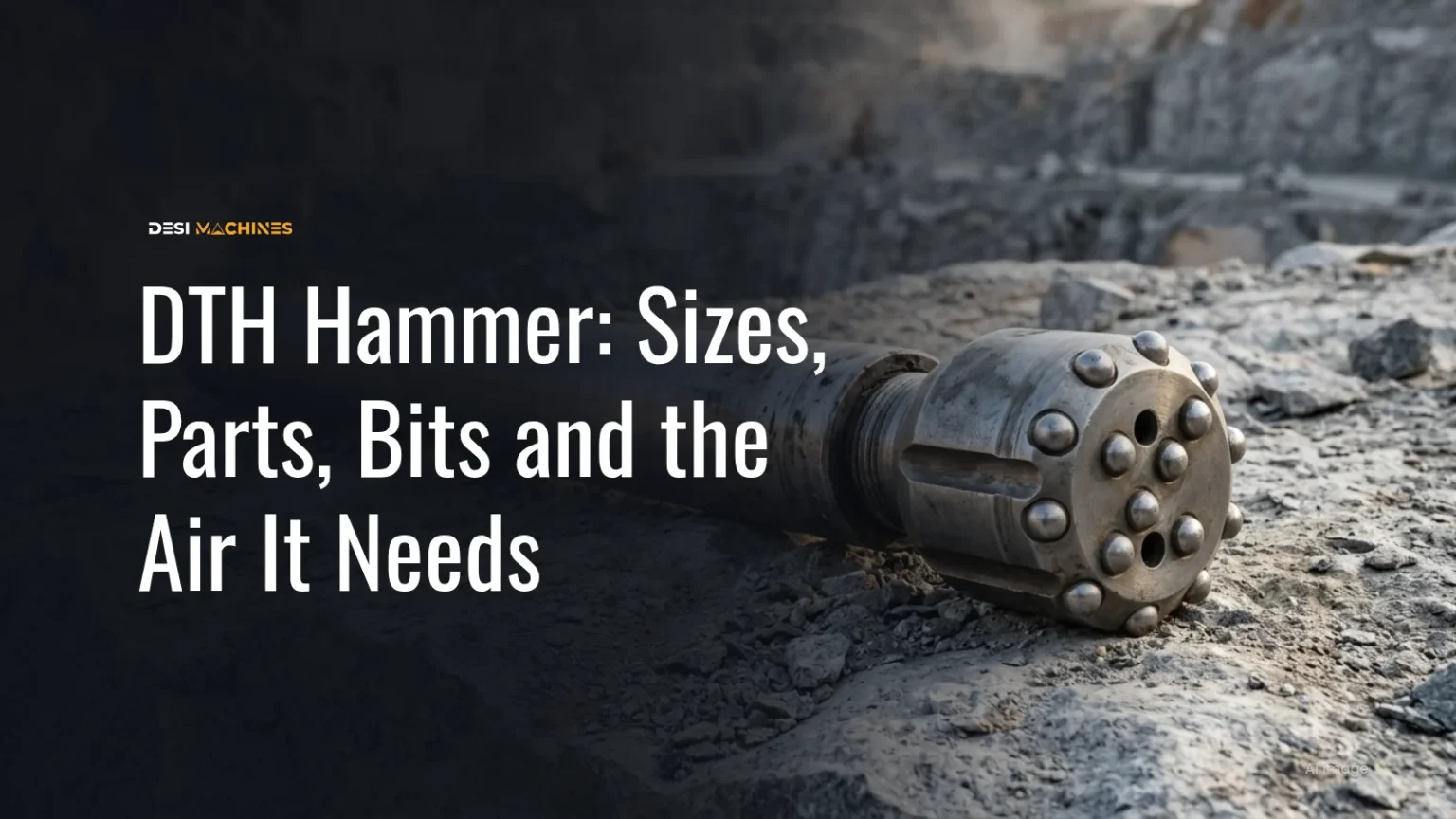
DTH hammers come in size classes from 3 inches to 40 inches, and the class tells you roughly what hole the hammer drills. A 6-inch hammer takes bits of about 152 to 203 mm (6 to 8 inches), which covers a 6½-inch (165 mm) borewell.
The hammer is the part of a down-the-hole rig that actually breaks the rock. It sits at the bottom of the drill string, right behind the bit, and it runs on compressed air. That one fact ties three things together: the hole you need decides the hammer, the hammer decides the bit, and the hammer and the pressure decide the compressor. Buy any one of them on its own and the other two will fight it.
This guide is for a borewell operator, quarry owner or drilling contractor buying or replacing a hammer. How DTH drilling compares with top-hammer and rotary drilling is covered in the guide to blast hole drilling, so it is not repeated here.
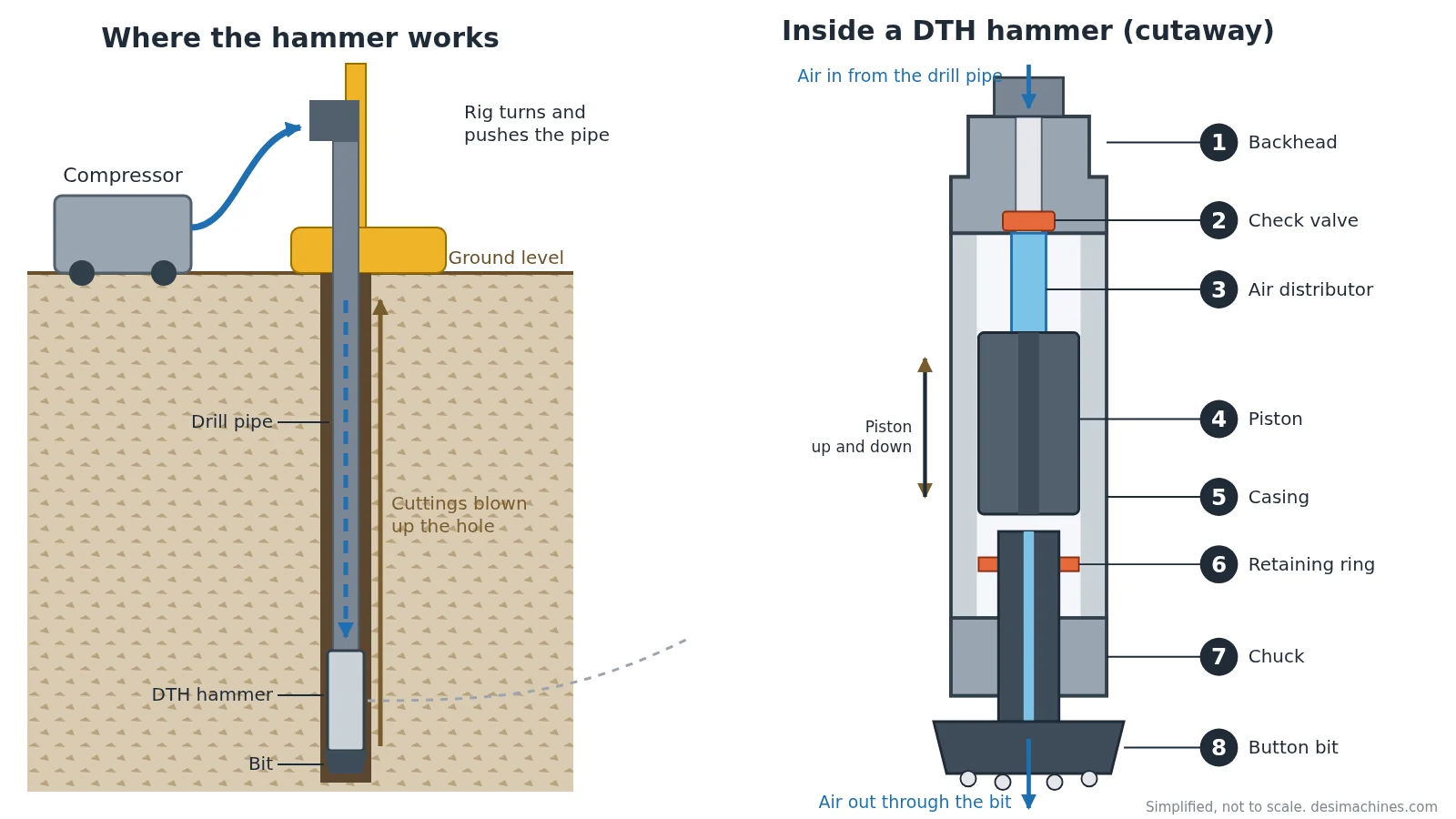
Key to Figure 1
- Backhead (top sub): screws onto the drill pipe and lets air into the hammer.
- Check valve: closes when the air is shut off, so water and cuttings cannot run back up into the hammer.
- Air distributor or feed tube: sends air above and below the piston in turn.
- Piston: the heavy moving part that strikes the bit.
- Casing (wear sleeve): the outer tube that holds everything and guides the bit.
- Bit retaining ring: stops the bit falling out when the hammer is lifted.
- Chuck (driver sub): screws into the casing, turns the bit through its splines.
- Button bit: the steel head studded with tungsten carbide buttons that chips the rock.
What is a DTH hammer?
A DTH hammer is an air-driven hammer that works at the bottom of the hole, screwed onto the end of the drill pipes, with the drill bit fitted directly to its front end. DTH stands for down-the-hole. Wikipedia’s article on the down-the-hole drill calls it, in effect, a jackhammer screwed onto the bottom of a drill string, and says it is thought to have been invented separately by Stenuick Frères in Belgium and Ingersoll Rand in the USA in the mid-1950s.
The rig on the surface does not hammer at all. It turns the pipes slowly, pushes them down with a light force and pumps air into them. The hammer does the breaking.
Because the blow lands right behind the bit, a DTH hammer hits as hard deep in the hole as it does near the top. A top-hammer drill loses a little of every blow at each rod joint on the way down. That is why DTH hammers are used for deep holes in hard rock: borewells for water, blast holes on quarry benches, and rock sockets for piles, where the choice against a rotary rig is set out in DTH piling vs rotary piling.
How does a DTH hammer work?
A DTH hammer works by letting compressed air push a heavy steel piston up and down inside a tube, so that the piston strikes the top of the bit again and again while the rig turns the bit a little between blows.
The air path runs like this:
- The compressor sends air down the hollow drill pipes into the backhead.
- The air pushes open the check valve and reaches the air distributor, a part that sends it alternately into the chamber below the piston (to lift it) and the chamber above it (to drive it down).
- The piston is driven down and strikes the end of the bit. The blow travels through the bit into the carbide buttons, which chip the rock.
- The used air escapes down through holes in the bit and rushes back up the gap between the hammer and the hole wall, carrying the chips (cuttings) to the surface.
- The cycle repeats, and the rig turns the string so each blow lands on fresh rock.
Two small parts matter more than their size suggests. The foot valve is a short tube fitted in the top of many bits. In a 2013 Atlas Copco Secoroc patent describing a typical DTH hammer, this tube slides into the hollow centre of the piston and decides the moment the air that lifts the piston is let out through the bit. Some hammer and bit designs are built without one, and Mincon’s 2026 range lists which of its hammers need a bit with a foot valve and which need a bit without.
The check valve sits in the backhead. An Ingersoll Rand patent for a backhead check valve, filed in 1998, explains why: when the air is shut off, it closes, so water and rock debris in the hole cannot flow back up into the casing and damage the parts.
What are the parts of a DTH hammer?
A DTH hammer has a backhead at the top, a casing in the middle holding the check valve, air distributor and piston, and a chuck at the bottom that holds and turns the bit. A 1995 Ingersoll Rand patent, assigned today to Epiroc Drilling Tools, names them from the top down: backhead, check valve, air distributor, piston inside the casing, then a bit bearing and retainer, the chuck and the bit. Numa, an American hammer maker, says its own hammers have only eight major parts, with a feed tube fixed to the backhead to keep everything in line.
| Part | Where it sits | What it does | What to watch |
|---|---|---|---|
| Backhead (top sub) | Top end, joined to the drill pipe | Takes the air and the turning force from the pipe | Thread condition; torque it with the hammer stationary, not while drilling |
| Check valve | Inside the backhead | Stops water and cuttings flowing back when the air stops | If it fails to close, water and cuttings get in |
| Air distributor or feed tube | Below the check valve | Times the air above and below the piston | Keep dirt out of the pipes, or it ends up here |
| Piston | Inside the casing | Strikes the bit | Measure against the maker’s wear limits at rebuild |
| Casing (wear sleeve) | The outer tube | Holds the parts and guides the bit in the hole | Wear; a worn chuck speeds it up |
| Bit retaining ring | Between casing and chuck | Holds the bit in when the hammer is lifted | Its job is to stop the bit being lost down the hole |
| Chuck (driver sub) | Bottom end | Turns the bit through matching splines | Spline wear; a worn chuck wears out the casing |
| Bit | Fitted in the chuck | Chips the rock with carbide buttons | Flat or broken buttons; sharpen before speed drops |
Piston weight climbs fast with size: Mincon’s 2026 brochure lists 3.9 kg in its lightest 3-inch hammer and 1,500 kg in its 40-inch MP400.
What sizes do DTH hammers come in?
DTH hammers are named by size class in inches, from 3 inches for small holes to 40 inches for very large ones, and each class drills a band of hole sizes slightly bigger than the hammer itself. The hammer body has to be narrower than the hole, so that air and cuttings can rise past it.
The table below is taken from the specification tables in Mincon’s DTH hammers and bits brochure (version dated 23 February 2026) and its size pages, read in November 2026. Mincon is an Irish maker of hammers and bits; other makers use similar classes with small differences.
| Size class | Hammer outside diameter | Hole (bit) size | Thread to the drill pipe | Hammer weight | Bit shank designs listed |
|---|---|---|---|---|---|
| 3-inch | 77 to 85 mm | 85 to 105 mm (3.4 to 4.1 in) | 2 3/8 in API Reg | 21.4 to 25 kg | DHD3.5, MD3.5 |
| 4-inch | 98 to 101.5 mm | 110 to 130 mm (4.3 to 5.1 in) | 2 3/8 in API Reg | 38.5 to 46 kg | DHD340, TD40, MD4, MQ40, MP40, MC43 |
| 5-inch | 115 to 130 mm | 127 to 152 mm (5 to 6 in) | 3 1/2 in API Reg | 55.4 to 74.4 kg | QL50, DHD350, MQ50, MC51 |
| 6 to 7-inch | 140 to 173 mm | 152 to 229 mm (6 to 9 in) | 3 1/2 or 4 1/2 in API Reg | 83.7 to 169.6 kg | DHD360, QL60, MQ60, MC61, MC71 |
| 8 to 9-inch | 181.5 to 219 mm | 203 to 254 mm (8 to 10 in) | 4 1/2 in API Reg | 172.1 to 315 kg | DHD380, QL80, MQ80, MC81, TD90 |
| 10 to 15-inch | 219 to 340 mm | 254 to 457 mm (10 to 18 in) | 6 5/8 or 8 5/8 in API Reg | 295 to 857 kg | SD10, MC100, QL120, SD12, MC120, N125, MC150 |
Above that, Mincon’s 18 to 40-inch hammers weigh from 1,164 kg to about 6 tonnes and drill holes up to 1,524 mm across. Those are foundation and shaft tools, not quarry hammers.
Numa’s figures for its Patriot range land in the same bands: its 4-inch Patriot 40 drills 108 to 133 mm, its 6-inch Patriot 60 drills 152 to 222 mm and its 8-inch Patriot 80 drills 200 to 254 mm. So the class name is a fair guide across makers, but the exact hole range is set by each hammer’s own sheet.
For the Indian buyer, the useful reading is this. PRD Rigs, a borewell rig builder in India, lists its PRD 650 rig for holes of 165 to 254 mm and gives its depth as 250 m at 165 mm (6½ inches), which is a 6-inch class hole. A 115 mm blast hole on a small quarry bench sits in the 4-inch class.
Loading what the holes break is the next job on any bench. Compare mining excavators sized for the face, and talk to a dealer near your quarry.
Which bit sizes go with which DTH hammer?
A DTH bit has to match the hammer in two ways: its shank (the splined back end that slides into the chuck) must be the same design as the hammer’s chuck, and its head must fall inside the hole range for that hammer.
The shank names in the size table, such as DHD340, QL60 or MC61, are those designs. A QL60 bit goes into a hammer built for QL60 shanks; a DHD360 bit does not, even though both are 6-inch class. Mincon’s shank drawings show why: they differ in spline count (8 to 16 splines across its range), length, and whether they carry a foot valve. Its hammers with MQ or MC in the name, for example, only take bits without a foot valve. Before ordering bits, read the shank name off the hammer’s own sheet or ask the supplier to measure the chuck.
Each shank comes with a range of head sizes. Mincon’s brochure says “bit to hammer ratio is important”, and its June 2026 article on hammer life explains the risk: an oversized bit on a smaller hammer strains its internal parts, raises its running temperature, spoils the flushing of cuttings and speeds up wear. Go below the minimum and the hole is barely wider than the hammer body, which leaves little room for the air and cuttings to rise. Stay inside the maker’s minimum and maximum bit size.
The bit face and the buttons are then chosen for the rock. Mincon’s 2026 brochure groups them like this:
| Choice | Type | What the maker says it suits |
|---|---|---|
| Bit face | Convex | Most drilling; especially hard, abrasive rock, with good speed and long life |
| Bit face | Concave | An all-round face for hard and soft rock; steady, straight holes with low vibration |
| Bit face | Flat | Very broken ground, hard rock, and soft rock that tends to over-drill |
| Button shape | Dome | Hard, abrasive rock and deep holes; suits nearly all rock drilling |
| Button shape | Semi-ballistic | Faster than dome, longer life than ballistic; less suited to broken ground |
| Button shape | Ballistic | Less abrasive sedimentary rock where speed matters; not for badly broken ground or very hard rock |
Granite and basalt fall in the hard-rock rows. The ballistic button is for softer, less abrasive layered rock such as many limestones, and Mincon does not recommend it in badly broken or extremely hard rock.
How much air does a DTH hammer need?
A DTH hammer’s air need is set by its size and by the pressure you run it at, and it climbs steeply with both. Read from the air chart for Mincon’s 6-inch MP60-QL, the hammer uses about 275 cfm at 10.3 bar (150 psi), about 575 cfm at 17.2 bar (250 psi) and about 900 cfm at 24.1 bar (350 psi). Cfm means cubic feet of free air per minute; bar is the pressure.
Pressure is the lever. More pressure gives a harder blow and a faster hole, but each step up asks for a bigger compressor. That is why borewell rigs carry such large machines. PRD offers its PRD 650 rig with either a 575 cfm, 16 bar compressor or an 1,100 cfm, 21 bar one, and its bigger Speed Star rig, rated to 363 m and holes of 165 to 305 mm, with 1,100 cfm at 21 bar or 1,200 cfm at 24 bar. The 575 cfm machine is close to what a 6-inch hammer draws at that pressure, with little to spare for depth and water.
Mincon’s charts are drawn at 20 °C and sea level, and its brochure notes that thinner air at altitude increases consumption. Long hoses lose pressure, and in a deep hole the same air must also lift the cuttings, so buy against the rig maker’s figure for hammer, bit and depth together. The full table for 3-inch to 8-inch hammers, with altitude and hose corrections and two worked examples, is in the guide to air compressor cfm calculation. Why rigs run screw compressors rather than piston ones is in screw vs piston compressor.
What oil does a DTH hammer need?
A DTH hammer needs rock drill oil (RDO), a sticky oil made to cling to metal in a stream of compressed air, fed steadily into the air line so it reaches the piston and casing while the hammer runs. Mincon says the oil protects the moving parts inside from friction, heat and wear.
The oil goes in through a lubricator on the rig. Numa describes its own as a positive displacement pump that injects rock drill oil into the air line under pressure, in sizes from a 19-litre tank for 3 to 6-inch hammers to a 170-litre tank for 18-inch hammers and above. As a rough measure of how much is used, Numa compares its paste lubricant with the 45 litres (12 gallons) of rock drill oil it says a hammer would use over 305 to 457 m (1,000 to 1,500 feet) of drilling. That works out to roughly 0.1 to 0.15 litres per metre drilled, a figure to check against your own hammer’s manual.
Mincon’s June 2026 advice on hammer life adds four points:
- Use the rock drill oil the maker recommends. Other oils can cause early internal wear and failure.
- When water is injected into the air for dust control, increase the oil to keep the inside protected.
- Before the first hole with a new hammer, pour rock drill oil into the top and blow air through it for several minutes before drilling.
- Before storing a hammer, put a little oil inside and turn it to coat the wear surfaces.
What makes a DTH hammer wear out early?
Dirt, a mismatched bit, a worn chuck and too much push shorten a DTH hammer’s life more than anything else. Mincon’s June 2026 article calls contamination one of the biggest enemies of a DTH hammer, because dust that gets into the drill string while pipes are added goes straight into the hammer. So keep caps on pipe ends, grease only the pin (male) thread of a joint, and use clean water; water from quarry or mine pumps can be acidic. Change a worn chuck before it wears out the casing.
Pushing harder does not drill faster either. Mincon’s July 2026 article on hammer efficiency says overfeeding or overrotating usually lowers efficiency and raises wear, and advises setting a stable collar (the first few centimetres of the hole) before going to full settings.
What do Indian mine rules say about DTH drilling?
Indian mine rules make the hammer and bit part of dust control: they ask for sharp bits, steady pressure, clean holes and water on the cutting edge, turned on before the air.
The Metalliferous Mines Regulations, 1961, which apply to every mine other than coal and oil mines, so to stone quarries that come under the Mines Act, say in regulation 124(6)(b) that during drilling on the surface or underground, dust shall be reduced “by using bits which are sharp and of proper shape, by keeping suitable pressure on the bits and by keeping the holes clear of the cuttings”. A jet of water must be directed on to the cutting edge, or an equally good device approved by the Chief Inspector used, and “where pneumatic drilling is performed, water shall be turned on before turning on compressed air to the drill”. The Coal Mines Regulations, 2017 carry a similar bit-and-dust rule for coal mines. A replacement for the 1961 regulations under the Occupational Safety, Health and Working Conditions Code, 2020 was published as a draft in 2026, so check which set applies to your lease.
On a quarry, that means a DTH rig needs either a water injection system or a dust collector working from the first hole. How quarries handle dust across drilling, blasting and haul roads is in the guide to dust suppression in mines.
How do you choose a DTH hammer for your rig?
Start from the hole and work back to the compressor, checking each link against the one before it.
- Hole size. Fix the hole diameter the job needs, such as 165 mm for a borewell or 115 mm for a small quarry bench. That picks the hammer class.
- Thread. Check the hammer’s backhead thread matches your drill pipe (2 3/8, 3 1/2, 4 1/2 inch API Reg and so on), or use the right adaptor.
- Shank. Note the hammer’s shank design and buy bits only in that design, inside its minimum and maximum bit size.
- Air. Read the hammer’s air chart at the pressure you plan to run, add for altitude, hose and depth, and compare it with the compressor on your rig.
- Rock. Choose bit face and buttons for the ground, using the table above.
- Oil and water. Make sure the rig’s lubricator and water injection suit the hammer’s size.
The rig families that carry DTH hammers, from borewell trucks to crawler quarry drills, are explained in the guide to the drilling rig machine, and the hole size, depth and straightness of blast holes in blast hole drilling. What a quarry needs around the rig is in the guide to quarry equipment. If you drill borewells for a living, the charges per foot are set out in the blog on borewell rate per feet, and the business side in borewell business profit.
The machines that load and haul what the holes break are listed in the range of excavators, and more drilling guides are in the drill rig guide section.
Sources: hammer sizes, weights, threads, shank data, bit faces and button shapes are from Mincon’s DTH Hammers and Bits brochure (version 23 February 2026) and its 3-inch to 15-inch hammer pages; hammer care points are from Mincon’s articles on extending hammer life (11 June 2026) and optimising hammer efficiency (14 July 2026), all read in November 2026. Patriot hole sizes and lubricator figures are from Numa’s small conventional products and lubrication pages. Rig hole sizes, depths and compressor ratings are from PRD Rigs’ PRD 650 and Speed Star pages. The air cycle and parts are from US patents 5,562,170 (Ingersoll Rand, 1996), 6,170,581 (Ingersoll Rand, 2001) and 8,561,730 (Atlas Copco Secoroc, 2013). Dust rules are from the Metalliferous Mines Regulations, 1961, regulation 124, as published by the Directorate General of Mines Safety. No prices are quoted, because hammers and bits are not listed on DesiMachines.
Prices, specifications and features are indicative, vary by variant, location and date, and should always be confirmed with the official OEM or authorised dealer before any purchase decision. DesiMachines is not liable for decisions taken on the basis of information that may have changed after publication.
Get a down-the-hole hammer price from a dealer near you
Tell us your machine and what you need, and we will ask the nearest dealer to reach out to you with a price.