
 Excavator
294 models
Excavator
294 models  Backhoe Loader
51 models
Backhoe Loader
51 models  Crane
68 models
Crane
68 models  Concrete Mixer
79 models
Concrete Mixer
79 models  Wheel Loader
54 models
Wheel Loader
54 models  Compactor / Roller
45 models
Compactor / Roller
45 models  Motor Grader
42 models
Motor Grader
42 models  Dozer
41 models
Dozer
41 models  Concrete Pump
66 models
Concrete Pump
66 models  Skid Steer Loader
11 models
Skid Steer Loader
11 models  Telehandler
13 models
Telehandler
13 models 


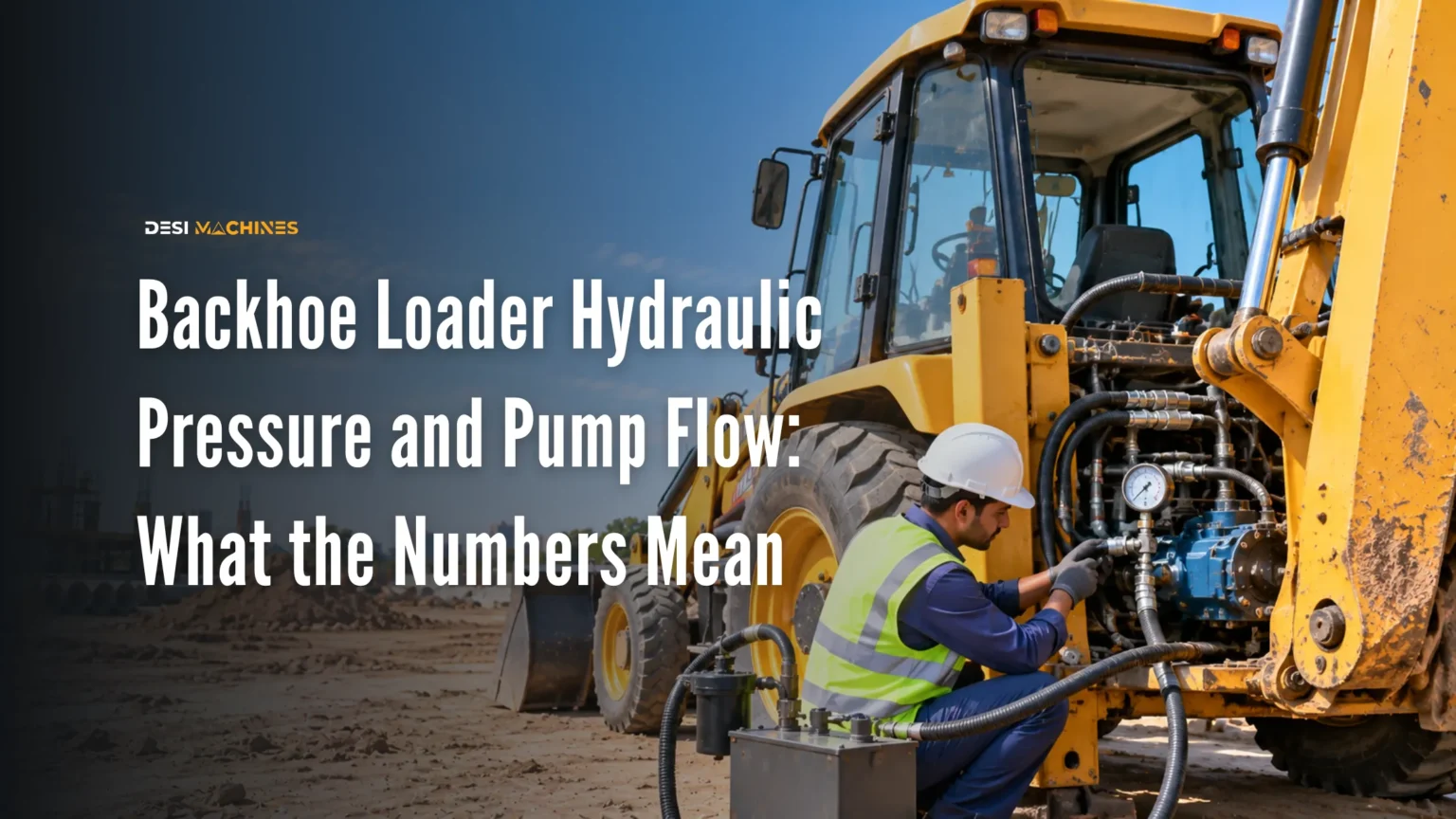
Indian backhoe loaders run their hydraulics between 180 and 270 bar, and their pumps move 70 to 148 litres of oil a minute. Both figures sit on the spec sheet of every machine, and the flow figure tells you more about how a machine will feel on site than its horsepower does. Two 74 HP (55 kW) backhoe loaders on the same price shelf can differ by 35% on oil flow.
The parts of a backhoe loader guide already explains what the system contains and the simple rule that flow is speed and pressure is push. This page does the measuring instead. Every one of the 51 backhoe loaders listed on DesiMachines publishes both numbers, so the class can be described exactly rather than roughly: what backhoe loader hydraulic pressure really ranges across, where the pump flow sits, which machines name a pump type, and what to check when the arms go slow.
How much hydraulic pressure does a backhoe loader run at?
All 51 machines publish a system pressure, and the whole class fits in a band of 90 bar. The lowest is the JCB 2DX at 180 bar (about 184 kgf/cm², the kg/cm² figure most Indian mechanics still read on a gauge). The highest is 270 bar, shared by the JCB 3DX, the 3DX Plus and the 3DX Super.
System pressure is the maximum pressure the pump is allowed to build before a relief valve opens and sends the oil back to tank. It is a setting as much as a capability, and it is what decides how hard the bucket can push against hard ground before the machine simply stalls the function.
| System pressure | Machines (of 51) | Examples |
|---|---|---|
| 180 to 199 bar | 2 | JCB 2DX (180 bar), CASE 770 EX (195 bar) |
| 200 to 224 bar | 11 | BEML BL9H, ACE AX 130, Mahindra Earthmaster SXE (210 bar) |
| 225 to 239 bar | 19 | Escorts Digmax II, Manitou MBL 745 HT (225 bar); Bull HD76 (230 bar) |
| 240 to 254 bar | 15 | CAT 424 (245 bar), JCB 4DX (250 bar), Mahindra SX IV (253 bar) |
| 255 to 270 bar | 4 | Tata Hitachi Shinrai Pro (265 bar), JCB 3DX family (270 bar) |
Forty-four of the 51 sit between 210 and 250 bar, and the median is 230 bar. That narrowness is not a coincidence. Hoses, cylinders, seals and valve blocks for this class of machine are all built to similar duty ratings, so no maker has much room to be different. Pressure is therefore rarely the number that separates two backhoe loaders you are choosing between.
What pump flow does a backhoe loader have?
Flow is where the spread is. The same 51 listings publish a maximum pump flow from 70.4 L/min on the JCB 2DX to 148 L/min on the JCB 4DX and the JCB 3DX Xtra. The median is 118 L/min.
| Maximum pump flow | Machines (of 51) | What sits here |
|---|---|---|
| 70 to 99 L/min | 2 | The small 49 HP class and one economy variant |
| 100 to 119 L/min | 35 | The bulk of the 74 to 76 HP market |
| 120 to 139 L/min | 6 | Higher-output versions of the same machines |
| 140 to 148 L/min | 8 | JCB 4DX and 3DX Xtra, CASE 770 EX Plus and NX Magnum, Bull HD100 |
Why this matters on a working day: oil flow sets the speed of a ram. For a cylinder of a given bore, double the oil and you get double the speed. So a machine listed at 148 L/min can run the same ram about a third faster than one listed at 110 L/min, and across a day of trenching that is the difference you feel, not the pressure rating.
Three listings are left out of the named figures above. The Tata Hitachi Shinrai Power, the BULL CH76 Challenger and the Bull SD76 BS5 Super Smart each store two different flow values in two different places on the catalogue, and a figure that disagrees with itself is not a figure worth quoting. All three sit inside the range rather than at either end, so the 70.4 to 148 L/min span holds. The disagreement has been logged for the data team to settle with the makers.
Does a bigger engine give you faster hydraulics?
No, and the catalogue proves it twice over. The JCB 3DX, rated 49 HP (37 kW), publishes 114 L/min. The ACE AX 130, rated 79.0 HP (59 kW), publishes 102 L/min. The smaller engine drives the faster hydraulics.
| Machine | Gross power | Max pump flow | System pressure |
|---|---|---|---|
| JCB 2DX | 49 HP (36.4 kW) | 70.4 L/min | 180 bar |
| JCB 3DX | 49 HP (37 kW) | 114 L/min | 270 bar |
| BEML BL9H 4×2 | 74 HP (55 kW) | 110 L/min | 210 bar |
| CAT 424 | 74 HP (55 kW) | 132 L/min | 245 bar |
| JCB 4DX | 74 HP (55 kW) | 148 L/min | 250 bar |
| ACE AX 130 | 79.0 HP (59 kW) | 102 L/min | 210 bar |
| Bull HD100 4WD | 100 HP (74.5 kW) | 145 L/min | 230 bar |
Three machines at an identical 74 HP (55 kW) rating publish 110, 132 and 148 L/min. What sets the flow is the pump: how much oil it displaces per turn, and the engine speed it is geared to turn at. The engine only has to supply the power, and the maker decides how to spend it. Engine power still matters for the loader end, for travel and for pushing through a full bucket, which the backhoe loader engine power figures cover.
There is a useful check hidden in these two columns. Hydraulic power in kW is pressure in bar multiplied by flow in L/min, divided by 600. Run it on the JCB 3DX and 270 bar at 114 L/min works out to about 51 kW, from a 37 kW engine. The arithmetic is not wrong and nor is the listing: the two maximums never happen together. Full pressure arrives when a function is stalled against a load and flow has dropped near zero; full flow arrives when the arms are swinging free and pressure is low. Any spec sheet in this class is quoting two separate peaks, not one operating point.
Gear pump or variable pump: what does your machine have?
Thirty-eight of the 51 listings describe the pump or the circuit. Reading them carefully shows they are answering two different questions, and the counts for the two do not add up to the same thing.
What kind of pump it is. Twenty-four listings name a gear pump, one of those offering a piston pump as an option. Six name a piston or axial piston pump. Eight describe the circuit without naming the pump element at all. The remaining thirteen say nothing about the pump.
How the flow is controlled. Ten listings say fixed displacement or fixed flow. Thirteen say variable displacement, variable flow or load sensing. Twenty-eight do not state it either way.
A fixed-displacement pump pushes the same oil every turn whenever the engine runs, and whatever the machine is not using goes over the relief valve and comes back as heat in the tank. A variable-displacement pump can reduce its own stroke when little is being asked of it, which is why makers attach it to fuel economy claims. Load sensing adds a further trick: the circuit reads the pressure a function needs and feeds it that, so a boom holds its speed as the load on it changes. The underlying distinction between fixed and variable displacement pumps is geometric, not electronic, and it predates every control system bolted onto it.
| What the listing says | Machines (of 51) | What it means for you |
|---|---|---|
| Gear pump named | 24 | Simple, cheap to replace, repairable in most district workshops |
| Piston or axial piston pump named | 6 | Higher pressure capability, costlier to rebuild, dealer-level work |
| Fixed displacement or fixed flow stated | 10 | Spare oil becomes heat; tank and cooler condition matter more |
| Variable displacement or load sensing stated | 13 | Pump backs off when idle; the claim attached to it is fuel saving |
| Pump not described at all | 13 | Ask the dealer before you sign, especially on a used machine |
One maker shows why the two questions have to be asked separately. The Escorts Digmax II lists a tandem gear pump with fixed flow. The Digmax II XP lists an axial piston pump, also with fixed flow. The Jungli HT lists an axial piston pump with variable flow. All three publish 225 bar and about 117 L/min. Same numbers, three different pieces of hardware behind them, from one maker.
What the catalogue does not publish is a fuel figure per pump type, so the saving a variable pump is sold on cannot be quantified from the listings. Treat it as a design intention and judge it against real consumption on a machine you have seen working, which is the approach the JCB mileage and fuel consumption figures take.
Why thirteen machines do not state a pump type
Six of the thirteen are the JCB range, and the reason is a quirk worth knowing. In the hydraulics section of its listings, JCB fills the type field with its filtration arrangement rather than its pump: a suction strainer and a return-line filter, the one JCB calls the Filtromatic. Across the 2DX, 3DX, 3DX Plus, 3DX Super, 3DX Xtra and 4DX, that is what the field says.
It is a real piece of information, just not the one the heading promises. JCB chooses to tell you where the oil gets cleaned, which matters, because a backhoe loader in Indian dust kills pumps through contamination far more often than through pressure. The backhoe loader filter kit guide covers what those elements are and when they get changed.
The other seven are five ACE machines and two base-model Manitou variants, which publish nothing in that field. If you are buying one of those thirteen, the pump type is a question for the dealer, and a sensible one: it changes what a rebuild will cost you in year six.
Weak, slow or jerky hydraulics: what to check first
The published pressure and flow are the baseline a fault is measured against, which is the first reason to know them. A gauge reading of 190 bar means nothing until you know the machine is set for 230. Work through the symptom rather than the part.
| What you see | Where it usually sits | The check |
|---|---|---|
| Everything is slow, and it gets worse under load | Pump wear, or a relief valve opening early | Gauge the system at the test port against the listed pressure for that model |
| One function is slow, the rest are normal | That circuit: its spool, cylinder seals or a hose | Swap the function across to a known-good lever and see if the fault follows |
| Fine when cold, slow after an hour | Oil grade, a blocked cooler, or oil breaking down | Check oil condition and level, and the cooler core for packed mud |
| Jerky movement, whining, foam in the tank | Air entering on the suction side | Suction hose clamps, strainer, and the tank level before anything else |
| Boom settles down on its own under load | Cylinder seals or a holding valve | Hold a load and watch the rod, not the gauge |
Two cautions. A pressure test needs the right gauge on the right port and is dealer work on most machines, not a roadside job. And a pump is the last thing to condemn, because it is the costliest part in the circuit and a worn pump and an early-opening relief valve look identical from the operator seat. The same fault-finding order applies across machine classes, and the wheel loader hydraulic problems guide works through it on a bigger machine.
Most hydraulic failures on an Indian site are not design problems at all. They start with dirty oil, a long-overdue filter or a hose rubbing on a bracket, all of which the hydraulic system maintenance schedule exists to catch.
What pressure and flow do not tell you
Both figures are maximums, usually quoted at a stated engine speed, and several listings say so openly: 116 L/min at 2,000 rpm, 118 L/min at 2,200 rpm. Drop the throttle and you drop the flow.
They also say nothing about three things buyers assume they cover. Cycle time depends on cylinder bore and stroke as much as on flow, so two machines at 119 L/min can dig at different speeds, and the backhoe loader productivity figures are the better guide there. Digging force comes from pressure acting on a cylinder area, which is why the published breakout force in kgf, not the bar rating, is what you compare. And the oil the system holds is a separate number again, set out in the backhoe loader oil and fluid capacities reference.
Steering is its own circuit with its own setting, often well below the implement pressure, and the backhoe loader steering system page carries those figures. If you want the whole circuit explained from pump to ram first, start with how a backhoe loader works, then come back to the numbers.
Where the two figures are measured
Oil tank
Pump
Control valve
and relief
Cylinders
Return filter
A
B
A. Pump outlet: maximum pump flow in L/min is the oil leaving here at the stated engine speed. B. Control valve and relief setting: system pressure in bar is the ceiling the relief allows before oil returns to tank. The dashed line is the return path through the filter. Oil cleanliness is decided on that side of the loop, and pump life follows it.
How to use these figures when you buy or service
Within one engine class, compare flow before anything else, because that is where the real difference sits: 110 against 148 L/min at the same 74 HP (55 kW) is a faster machine all day. Read the pressure figure as a check that a machine is not an outlier, not as a ranking, since 44 of 51 are inside one 40-bar band anyway.
Then look at whether the listing names a pump type, and treat silence as a question rather than a flaw. On a used machine, ask for a pressure test against the figure its own model is listed at, and a look in the tank for foam or dark oil. Those two checks cost nothing and tell you more than the hour meter.
If you are shortlisting, the full range of backhoe loaders carries the hydraulics section for each machine, from the 70.4 L/min JCB 2DX up to the 148 L/min JCB 4DX, with the CASE 770 NX Magnum at 143 L/min just below it. For the rest of the machine, the backhoe loader guide covers transmission and the other systems in the same way.
Pressure and flow figures in this guide are taken from the hydraulics section of each machine’s listing on DesiMachines as of October 2026, covering all 51 backhoe loaders listed, with the three self-contradicting flow values named above excluded from individual quotes.
Prices, specifications and features are indicative, vary by variant, location and date, and should always be confirmed with the official OEM or authorised dealer before any purchase decision. DesiMachines is not liable for decisions taken on the basis of information that may have changed after publication.
