
 Excavator
294 models
Excavator
294 models  Backhoe Loader
51 models
Backhoe Loader
51 models  Crane
68 models
Crane
68 models  Concrete Mixer
79 models
Concrete Mixer
79 models  Wheel Loader
54 models
Wheel Loader
54 models  Compactor / Roller
45 models
Compactor / Roller
45 models  Motor Grader
42 models
Motor Grader
42 models  Dozer
41 models
Dozer
41 models  Concrete Pump
66 models
Concrete Pump
66 models  Skid Steer Loader
11 models
Skid Steer Loader
11 models  Telehandler
13 models
Telehandler
13 models 


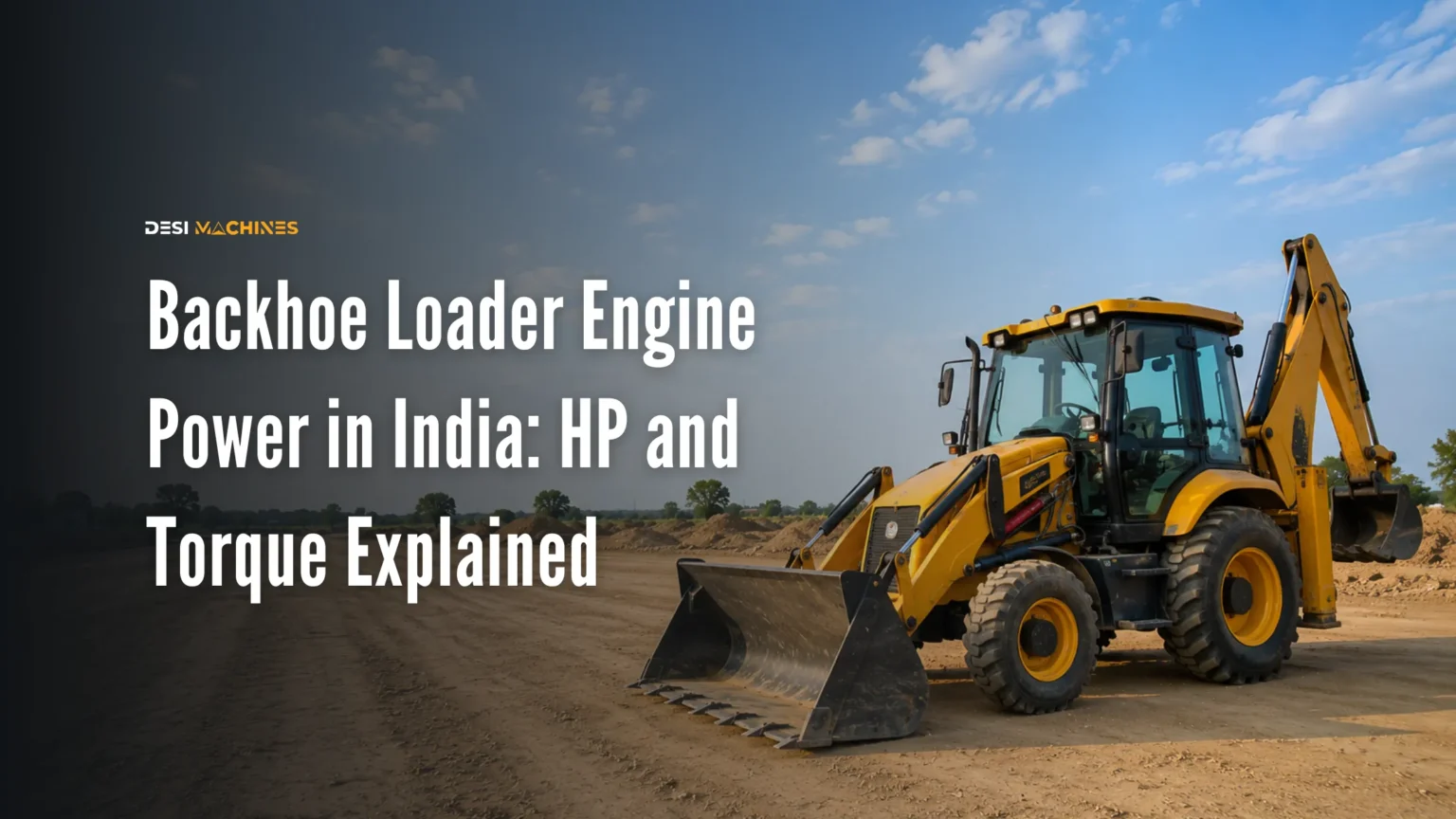
Backhoe loader engine power is the output of the diesel engine that drives both the front shovel and the rear digging arm, measured in horsepower (HP) and kilowatts (kW). Across the backhoe loaders sold in India, published engine power runs from 49 HP (37 kW) to 100 HP (74.5 kW), and engine torque runs from 170 Nm to 440 Nm.
That range hides the part that actually matters. Of the 50 machines that publish a power figure, 37 sit between 73 HP and 79 HP, and 18 of them are rated at exactly 74 HP (55 kW). Horsepower is the first number every dealer says. In this machine class, it is close to the last number that will help you choose.
This page sets out what backhoe loaders in India actually carry, using the published engine specifications of all 51 models listed here, and explains why the torque figure printed beside the HP tells you far more about how the machine will dig.
How much horsepower does a backhoe loader have?
Most backhoe loaders sold in India are rated at 74 HP (55 kW). The full catalogue splits into three clear groups, and almost everything a contractor is shown falls into the middle one.
The 49 to 55 HP group is the economy end: eight machines, built for lighter work and a lower running cost. The 73 to 79 HP group is the standard class and holds 37 of the 50 machines. The 96 to 100 HP group is a small heavy-duty corner with five machines, all of them built for continuous hard digging and loading.
Two terms before the table. HP (horsepower) and kW (kilowatts) measure the same thing, which is engine output. Indian spec sheets print both because the engine maker’s home market may use one or the other. Divide HP by about 1.34 to get kW. Nm (newton metres) is the unit of torque, the twisting force the engine makes, which is explained further down.
Backhoe loader engine power by class
Every machine counted below is currently sold in India. Power and torque are as published on each model’s own specification sheet.
| Class | Models listed | Engine power | Torque | Built for |
|---|---|---|---|---|
| Economy | 8 | 49 to 55 HP (37 to 41 kW) | 170 to 290 Nm | Light trenching, plot work, municipal jobs, farm use |
| Standard | 37 | 73 to 79 HP (55 to 59 kW) | 300 to 440 Nm | General contracting, roads, pipelines, building sites |
| Heavy duty | 5 | 96 to 100 HP (71.5 to 74.5 kW) | 377 to 410 Nm | Hard ground, bigger buckets, long loading shifts |
One model, the Manitou MBL 745 S, publishes no engine figures at all, which is why 51 listed machines produce 50 power ratings. Ask the dealer for the engine sheet on any machine that does not print one.
How much horsepower does a JCB have?
Across India, “JCB” is spoken as the name for the whole machine class, so the question usually means “how much power does a backhoe loader have”. Taken literally, for the JCB machines listed here, the answer is either 49 HP or 74 HP.
The JCB 2DX is rated at 49 HP (36.4 kW) with 203 Nm of torque. The JCB 3DX is rated at 49 HP (37 kW) with 170 Nm. The JCB 3DX Super, the 3DX Xtra, the 3DX Plus and the JCB 4DX are all rated at 74 HP (55 kW) with 440 Nm, the highest torque figure published by any backhoe loader on this list.
So a buyer asking kitna HP hai about a JCB is really asking which variant is standing in the yard. That distinction is worth more than it sounds, and it is the next question.
Is the JCB 3DX 49 HP or 74 HP?
Both, depending on the variant, and this is the single most common point of confusion in the segment. The plain 3DX lists 49 HP. The 3DX Super, 3DX Xtra and 3DX Plus list 74 HP. All four carry the same JCB 430 CRDi Stage 5 engine family; the difference is how that engine is rated in each variant.
The practical effect is that two machines wearing what looks like the same name can differ by 25 HP and by 270 Nm of torque. They are not the same purchase, they do not do the same work, and they are not priced the same. Before you pay any advance, read the variant name and the gross power figure on the quotation and on the machine’s own spec sheet, and check that the two agree.
Ready to compare machines properly? Browse live backhoe loader models, specifications and prices and speak to a dealer near you.
Why are so many backhoe loaders 74 HP?
Because the Indian backhoe loader market has settled on one power rating almost completely. Eighteen of the 50 machines are rated at exactly 74 HP, and 33 of them fall between 73 HP and 75 HP. Whatever sits behind that on the manufacturing side, the consequence for a buyer is simple and awkward: horsepower cannot separate most of the machines you will be shown.
Torque can. Here are the machines rated at exactly 74 HP, with the torque each one publishes.
| Model (all rated 74 HP) | Max torque | At engine speed |
|---|---|---|
| JCB 3DX Super, 3DX Xtra, 3DX Plus, 4DX | 440 Nm | 1,150 rpm |
| CAT 424 | 424 Nm | 1,200 rpm |
| Mahindra Earthmaster SX and VX, BEML BL9H 4×4 | 400 Nm | 1,100 to 1,200 rpm |
| CASE 770 NX, 770 NX Magnum, 851 NX | 375 Nm | 1,400 rpm |
| ACE AX 124, Mahindra SX IV | 345 Nm | 1,200 to 1,500 rpm |
| CASE 770 EX and 770 EX Plus | 340 Nm | 1,400 to 1,500 rpm |
| Bobcat B900 | 336 Nm | 1,400 rpm |
| Mahindra VX IV | 306 Nm | 1,300 to 1,700 rpm |
| BEML BL9H 4×2 | 304 Nm | 1,500 rpm |
Same 74 HP on every row, and torque running from 304 Nm to 440 Nm. That is a difference of about 45 per cent in the number that decides whether the machine keeps digging or stalls in hard ground. A spec comparison that stops at horsepower misses all of it.
What is torque, and why does it matter more than horsepower?
Torque is turning force. Think of loosening a tight bolt with a spanner: the push you apply at the end of the handle is torque. Horsepower is a combination of that force and how fast the engine keeps producing it. An engine can make good horsepower at high revs and still feel weak in the ground, because digging happens at low revs.
On a backhoe loader, the engine drives a hydraulic pump, and the pump drives the loader arms and the digging boom. When the bucket bites into hard murrum or rock, the engine is pushed down towards low revs. Torque is what holds it there and keeps the bucket moving. Too little, and the engine bogs, the operator has to reposition, and the cycle takes longer.
The engine speed in the table matters as much as the number itself. The JCB engines make their 440 Nm at 1,150 rpm, low in the working range, so the pull arrives exactly where the machine works. The BEML BL9H 4×2 makes its 304 Nm at 1,500 rpm, higher up. Lower is generally better for digging, because the machine pulls without being revved.
One honest caution. Torque is not the whole picture either. Hydraulic pump flow, machine weight and bucket breakout force all decide what a backhoe can actually dig, and a heavy machine with modest torque can out-dig a light one with a big number. The figures that measure digging directly are set out in the guide to backhoe loader bucket capacity, dig depth and breakout force.
Does a bigger engine mean more power?
No, and the catalogue proves it twice over. Displacement is engine size, the total volume of the cylinders, printed in litres. Of the machines that publish it, displacement runs from 2.8 L to 4.76 L.
The CASE 770 NX makes 74 HP from a 2.8 L engine. The BEML BL9H 4×2 makes the same 74 HP from a 4.76 L engine, about 70 per cent larger. A turbocharger is the usual reason: it forces more air into a smaller engine so it produces the output of a bigger one.
Neither approach is automatically better, and owners genuinely disagree. A larger engine at the same rating is working less hard, which some fleet owners believe pays back in engine life. A smaller turbocharged engine is usually lighter on diesel. What decides it for you is hours per day and how hard the ground is, not the litre figure on the brochure. Which engine brand sits under which machine is covered in the guide to engine brands in construction equipment.
Which emission norm engine will you get?
Most, but not all, of the backhoe loaders listed carry a current-norm engine. Twenty-four of the 50 listings describe a CEV Stage V or BS-V engine, ten describe CEV Stage IV or BS-IV, and eleven still describe a BS-III, Euro III or older engine. A few listings do not state a norm at all.
The norm matters for three practical reasons. A newer-norm engine burns cleaner and usually brings electronic controls such as common-rail injection and exhaust after-treatment, which means better fuel control but also a workshop bill that a mechanic in a small town may not be equipped for. Older-norm machines are cheaper to buy and simpler to repair. And a machine bought on an older norm can be harder to sell on later.
Emission norm is also the specification most likely to be out of date in a published listing anywhere, because manufacturers update engines mid-range without changing the model name. Confirm the norm in writing with the dealer before you commit. What the norms mean is set out in full in the guide to BS and CEV emission norms for construction equipment.
Does more horsepower mean more diesel?
Usually yes, but far less than buyers expect, because a diesel engine burns fuel according to the work it is doing rather than its rating. A 74 HP machine idling at the side of a road and a 55 HP machine digging hard all morning will not consume in the order their badges suggest.
Operating habit, hydraulic load and idling time move the fuel bill more than 20 HP of rating does. What a backhoe loader really uses per hour, and how to measure it on your own machine instead of trusting a brochure, is set out in the guide to backhoe loader mileage and fuel consumption. The ownership side of the same question, covering how engine choice follows through to running cost and resale, is worked through in the diesel engine in your machine.
How much engine power do you actually need?
Start from the work, not the badge.
49 to 55 HP suits light and occasional work: shallow trenching in soft soil, plot levelling, small municipal jobs, farm use, and sites where the machine works a few hours a day. It costs less to buy and less to run. The CASE 770 NXe and the Mahindra SX Smart 50 sit here.
73 to 79 HP is the default, and for good reason. It handles general contracting, road work, pipeline trenching and building sites, and because it is what almost everyone buys, dealers stock the parts, mechanics know the machines and the second-hand market is deep. Buy outside this band only if you have a specific reason.
96 to 100 HP is for hard ground, larger buckets and long continuous shifts. The Bull Grandia is one of the five machines here. The trade-off is a smaller choice of models, fewer dealers, and a thinner resale market when you want to move the machine on.
One more thing worth saying plainly: for most Indian buyers, the drive choice matters more than 10 HP either way. A 74 HP machine that cannot climb out of a wet trench is not helped by its rating. That decision is worked through in 2WD vs 4WD backhoe loader, and the physical fit of the machine to your site is in backhoe loader dimensions and site access.
Backhoe loader engine power: the short version
Engine power across backhoe loaders in India runs from 49 HP (37 kW) to 100 HP (74.5 kW), and torque from 170 Nm to 440 Nm. Thirty-seven of the 50 machines that publish a rating sit between 73 HP and 79 HP, and 18 are rated at exactly 74 HP.
Because so many machines share one rating, horsepower is a weak way to compare them. At the same 74 HP, published torque ranges from 304 Nm to 440 Nm, and the engine speed at which that torque arrives varies too. Read the torque figure and the rpm beside it, check the variant name against the power on the quotation, confirm the emission norm with the dealer, and judge fuel by measuring rather than by rating.
Where to read next
If you are new to these machines, what a backhoe loader is and how it works explains the machine from the start, and what a TLB is clears up the naming. The components these engines drive are listed in backhoe loader parts and components, and the service intervals for them are in the backhoe loader maintenance schedule.
The force that actually reaches the bucket edge is published separately from engine power, and it separates machines far more sharply — see backhoe loader breakout force.
For the same numbers on other machine families, see excavator engine power by size class and wheel loader engine power and torque. Everything written on this machine family sits in the backhoe loader guide. What that power gives you on the road is a separate figure: backhoe loader speed and gears sets out the 28 to 41 km/hr top-gear range and what each of the four forward gears is for.
Compare live backhoe loader models, specifications and prices, look specifically at 2WD machines or 4WD machines, and if you are working out the monthly outgo, equipment finance options set out what the lenders active in this segment offer.
Before you buy
Prices, specifications and features are indicative, vary by variant, location and date, and should always be confirmed with the official OEM or authorised dealer before any purchase decision. DesiMachines is not liable for decisions taken on the basis of information that may have changed after publication. Figures on this page are taken from our listings at the time of writing.

