
 Excavator
294 models
Excavator
294 models  Backhoe Loader
51 models
Backhoe Loader
51 models  Crane
68 models
Crane
68 models  Concrete Mixer
79 models
Concrete Mixer
79 models  Wheel Loader
54 models
Wheel Loader
54 models  Compactor / Roller
45 models
Compactor / Roller
45 models  Motor Grader
42 models
Motor Grader
42 models  Dozer
41 models
Dozer
41 models  Concrete Pump
66 models
Concrete Pump
66 models  Skid Steer Loader
11 models
Skid Steer Loader
11 models  Telehandler
13 models
Telehandler
13 models 


What is backhoe loader productivity?
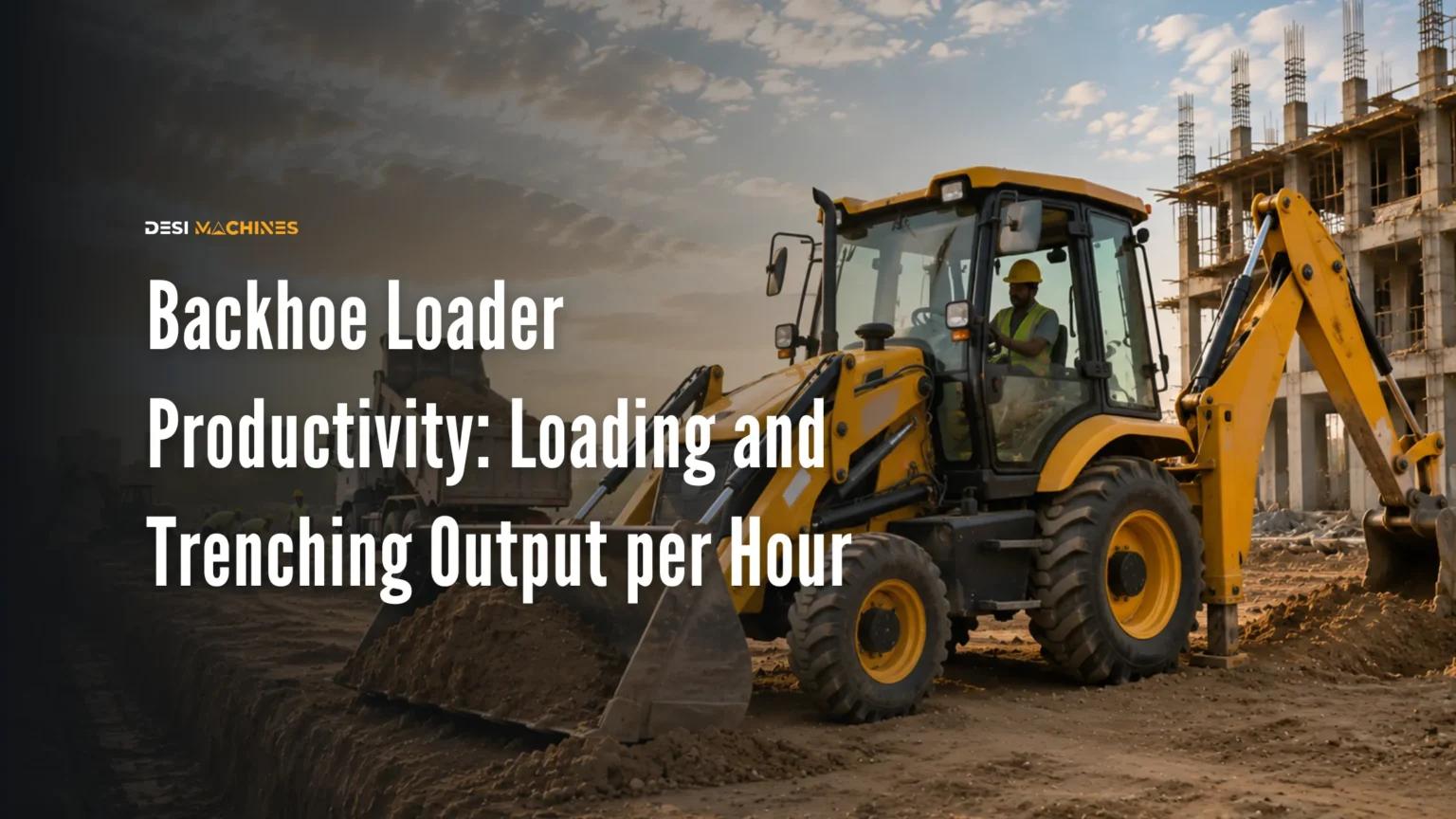
Backhoe loader productivity is how much material the machine actually moves in an hour, written in cubic metres per hour (m³/hr). A backhoe loader is the yellow digger-cum-loader on almost every Indian site, with a wide loading shovel at the front and a narrow digging arm at the back. Because it carries two buckets, it has two output figures, not one: what the front shovel can load, and what the rear bucket can dig. You work each one out from four things you can measure yourself: the size of the bucket, how full it really gets, how many times it swings in an hour, and how much of that hour the machine is genuinely working.
The reason this matters is money. A hire rate, a tender quantity and a completion date are all bets on output per hour. Quote a trench at a rate built on 60 metres an hour when the machine gives you 35, and the loss is yours, not the client’s. Nobody hands you this number. You have to build it.
What follows is the arithmetic, the way to measure your own inputs, and the bucket sizes actually published for the 51 backhoe loaders listed on DesiMachines, so the sums start from real machines rather than a brochure.
What is the formula for backhoe output per hour?
Output per hour is bucket capacity multiplied by fill factor, multiplied by cycles per hour, multiplied by the share of the hour the machine really works.
Output (m³/hr) = bucket size × fill factor × cycles per hour × working-time factor
Take the four terms one at a time.
- Bucket size is the rated capacity in cubic metres, published on the specification sheet of every machine. One cubic metre is 1,000 litres.
- Fill factor is how full the bucket actually gets, written as a decimal. Loose sand and gravel heap up well and fill a shovel to about 0.9 of its rating. Sticky clay and firm soil sit lower, around 0.85, and blasted rock lower still. The excavator output guide explains fill factor in more detail, and the same figures apply here.
- Cycles per hour is 3,600 divided by your cycle time in seconds. A cycle is one complete round trip: dig, lift, swing, dump, come back.
- Working-time factor is the share of the hour the machine is moving material. Nobody works 60 minutes in 60. Refuelling, the operator’s break, waiting for a tipper and shifting the machine all come out of it.
Everything on the right-hand side is either printed on the machine’s specification sheet or timed by you with a phone. That is the whole point of the method: it does not need a single figure you cannot check.
How do you measure cycle time on your own site?
Stand where you can see the whole swing and time ten complete cycles back to back, then divide by ten. Ten is enough to smooth out one slow pass and short enough that the operator does not change how he works because he knows he is being watched.
Time the job as it is actually done, not as it should be done. If the tipper is parked fifteen metres away and the machine has to shuttle, that shuttle belongs inside the cycle time. If the trench is deep enough that the operator slows the arm coming out, that is in there too. A cycle time measured on a good morning with everything in place will flatter the machine and mislead the quote.
Measure separately for the two ends of the machine. Loading with the front shovel and trenching with the rear bucket are different jobs at different speeds, and averaging them gives a number that describes neither.
How much can the front shovel load in an hour?
Across the 51 backhoe loaders listed on DesiMachines, front shovels are rated from 0.60 to 1.26 m³ (600 to 1,260 litres), and 30 of the 51 carry exactly the same 1.1 m³ shovel. Take that mainstream 1.1 m³ machine loading loose soil at a fill factor of 0.9, so about 0.99 m³ leaves the ground on each pass.
| Situation | Measured cycle | Cycles per hour | Working-time factor | Loose output | In-ground output |
|---|---|---|---|---|---|
| Tipper standing alongside, no travel | 30 seconds | 120 | 0.83 (50 min worked) | about 99 m³/hr | about 79 m³/hr |
| Shuttling roughly 15 m to the stockpile | 60 seconds | 60 | 0.83 (50 min worked) | about 49 m³/hr | about 39 m³/hr |
Table 1: Worked loading example on a 1.1 m³ front shovel. Cycle times are inputs you measure; bucket size is from the machine’s own specification sheet.
Doubling the cycle time halves the output. That single line is worth more than any brochure figure, because the cycle time is the part you control. Moving the tipper ten metres closer is free and can be worth thirty or forty cubic metres an hour.
Loose volume and in-ground volume are not the same thing. Soil swells when you dig it: a cubic metre sitting in the ground becomes roughly 1.25 cubic metres once it is broken up and heaped in a bucket. Tenders and excavation quantities are almost always written as in-ground volume, so divide the loose figure by about 1.25 before you compare it against a quantity. That is why the last column above is lower than the one before it. If you are pricing the work rather than sizing the machine, the excavation rate per cubic metre guide takes it from here.
How much trench can the rear bucket dig in an hour?
Rear buckets are the smaller of the two. Across the same 51 machines they run from 0.18 to 0.36 m³ (180 to 360 litres) as standard, with 0.27 m³ the most common single size, on 20 of the 51. One machine, the CASE 851 NX, also lists a larger 0.40 m³ bucket as an option alongside its standard 0.36 m³.
Trenching is slower per cubic metre than loading, and it carries a cost that loading does not: the machine digs from a parked position on its outriggers, so every few metres of trench the operator lifts the legs, reverses, and sets down again. That repositioning has to come out of the working-time factor, which is why a trenching hour is worth about 42 working minutes rather than 50.
| Input | Value used |
|---|---|
| Rear bucket | 0.27 m³ (the most common size) |
| Fill factor, firm soil | 0.85 |
| Measured cycle time | 18 seconds (200 cycles per hour) |
| Working-time factor, including repositioning | 0.70 (about 42 min worked) |
| Loose output | about 32 m³/hr |
| In-ground output | about 26 m³/hr |
Table 2: Worked trenching example. The bucket size is from the specification sheet; the cycle time and fill factor are yours to measure.
Contractors usually want trenching in running metres, not cubic metres, and the conversion is simple. A trench 600 mm wide and 1,200 mm deep holds 0.72 cubic metres per running metre. At 26 in-ground cubic metres an hour, that machine gives you roughly 36 running metres of trench per hour. Cut the depth to 900 mm and the same output becomes about 48 metres. Widen the bucket and the metres fall again even though the cubic metres do not move.
Digging depth sets the limit on what you can attempt at all. Across the listed machines maximum digging depth runs from 3,020 mm on the JCB 2DX to 5,360 mm on the JCB 4DX, with most mainstream machines between 4,200 and 5,000 mm. Bucket sizes, dig depth and reach are set out fully in the backhoe loader bucket capacity and reach guide.
Does a bigger bucket mean more output?
On a backhoe loader, far less than you would expect, because the buckets barely differ from machine to machine. Of the 51 backhoe loaders listed on DesiMachines, 39 carry a front shovel of 1.0 to 1.1 m³, and 30 of those are the identical 1.1 m³. Rear buckets cluster just as tightly: 40 of the 51 sit between 0.24 and 0.27 m³.
| Model | Front shovel | Rear bucket | Max digging depth | Machine weight |
|---|---|---|---|---|
| JCB 2DX | 0.60 m³ | 0.18 m³ | 3,020 mm | 5,220 kg |
| JCB 3DX | 1.0 m³ | 0.26 m³ | 4,770 mm | 7,200 kg |
| Mahindra EarthMaster VX | 1.1 m³ | 0.27 m³ | 4,355 mm | 7,517 kg |
| Tata Hitachi Shinrai Prime | 1.1 m³ | 0.27 m³ | 4,700 mm | 8,120 kg |
| CASE 851 NX | 1.1 m³ | 0.36 m³ | 4,700 mm | 7,800 kg |
| JCB 4DX | 1.2 m³ | 0.32 m³ | 5,360 mm | 8,450 kg |
| Bull Grandia | 1.26 m³ | 0.22 m³ | 4,770 mm | 9,700 kg |
Table 3: Bucket sizes and digging depth on selected backhoe loaders, taken from each machine’s own specification sheet, September 2026.
Read down the front shovel column and the spread is small. Between the JCB 3DX at 1.0 m³ and the Bull Grandia at 1.26 m³ there is 26 per cent, and the Grandia is 2,500 kg heavier and rated at 100 HP against 49 HP to buy it. Meanwhile a thirty-second cycle against a sixty-second cycle is a difference of 100 per cent, on the same machine, on the same morning.
So the honest answer to “which backhoe loader gives more output” is that the machine is rarely the reason one contractor moves more soil than another. Site layout, operator skill, where the tipper parks and how long the machine waits decide it. Bucket size matters when you are choosing between a 0.60 m³ machine and a 1.1 m³ machine, which is a real gap; between two mainstream machines it is close to noise.
What actually reduces backhoe output on Indian sites?
The working-time factor is where the day is lost, and it is worth knowing what eats it.
- Waiting for tippers. The commonest single loss. A shovel that fills a tipper in five passes and then stands for four minutes is working at half its capability, and no machine change fixes it.
- Repositioning on outriggers. Unavoidable when trenching, but a straight, planned trench line costs fewer moves than one that wanders.
- Doing both jobs at once. A backhoe cannot load and dig in the same minute. Every switch between the front shovel and the rear bucket costs setting-up time, so a day split cleanly into a loading block and a digging block beats a day of swapping.
- Hard and wet ground. Dry, compacted soil in summer and sticky clay after rain both cut the fill factor. The bucket comes up part full, and the arithmetic follows it down.
- A tired machine. Worn bucket teeth, slow hydraulics and a slipping transmission all lengthen the cycle. A machine that has drifted from 30-second cycles to 40-second cycles has quietly lost a quarter of its output, and the backhoe maintenance schedule is what keeps that from happening. If the boom or shovel feels slow, the hydraulic system maintenance guide covers what to check.
- Travel between work areas. A backhoe drives itself, which is its great advantage, but road speed is modest. What it can do on the road is set out in backhoe loader speed and gears.
Fuel is the other half of the economics. Output tells you what the machine produces in an hour, and backhoe loader mileage and fuel consumption tells you what that hour costs to run. Put the two together and you have a rate per cubic metre you can actually quote from.
Compare the full range of backhoe loaders on specification, and check the numbers in the tables above against the specification tab on any model you are considering.
How do you use the number when buying or hiring?
Work backwards from the job. Start with the total quantity and the days you have, and the required output falls out of it. A 9,000 m³ excavation over 20 working days at 8 hours a day needs 56 in-ground cubic metres an hour. Compare that against what the machines in front of you would deliver at your own measured cycle times, and the answer usually is not “buy a bigger backhoe”.
At 56 m³/hr in-ground, the loading example above needs the tipper standing alongside and a disciplined thirty-second cycle. If the site layout forces a shuttle, one backhoe does not reach the target however large its shovel, and the real choices are a second machine, a better haul layout, or an excavator, which is built for continuous digging in a way a backhoe is not. Excavator output is worked out the same way in the excavator productivity guide.
For hiring, the number turns a day rate into a rate per cubic metre, which is the only way to compare two quotes honestly. A machine at a higher day rate that gives you 79 m³/hr is cheaper per cubic metre than a machine at a lower day rate stuck at 39. Ask what the cycle time was when the figure was measured, and on what ground.
Two other numbers belong in the same decision. Engine power sets how hard the machine can work without bogging down, and dimensions and site access decide whether it can reach the work at all. An output figure is worthless on a machine that cannot get through the gate.
Backhoe loader productivity, in short
- The formula: bucket size × fill factor × cycles per hour × working-time factor.
- Two buckets, two figures. Front shovels across the 51 listed machines run 0.60 to 1.26 m³; rear buckets run 0.18 to 0.36 m³ as standard.
- The class is uniform. 39 of 51 front shovels are 1.0 to 1.1 m³, and 40 of 51 rear buckets sit between 0.24 and 0.27 m³, so bucket size rarely separates one mainstream machine from another.
- Cycle time is the lever. Halving it doubles the output, and it costs nothing to move a tipper closer.
- Convert before you quote. Divide loose output by about 1.25 to get the in-ground volume that tenders are written in.
- Measure your own machine. Ten timed cycles on the ground you are actually working beat any published figure, including the worked examples above.
Ready to compare machines on numbers rather than on the salesman’s word? See every backhoe loader listed on DesiMachines, or return to the backhoe loader guide for the rest of the series, including oil and fluid capacities.
Output assumes the load is within rating; the weight limits on both ends of the machine are set out in backhoe loader lifting capacity.
Bucket capacities, digging depths and machine weights on this page are taken from the specification sheets published on DesiMachines product pages and were checked in September 2026. Cycle times, fill factors and working-time factors in the worked examples are illustrative inputs for you to measure on your own site, not machine ratings. Prices, specifications and features are indicative, vary by variant, location and date, and should always be confirmed with the official OEM or authorised dealer before any purchase decision. DesiMachines is not liable for decisions taken on the basis of information that may have changed after publication.
Machines, tenders and news for this industry: Pipelines and Water Supply · Power and Renewable Energy · Cable and OFC Laying

