Excavator
294 models
Excavator
294 models  Backhoe Loader
51 models
Backhoe Loader
51 models  Crane
68 models
Crane
68 models  Concrete Mixer
79 models
Concrete Mixer
79 models  Wheel Loader
54 models
Wheel Loader
54 models  Compactor / Roller
45 models
Compactor / Roller
45 models  Motor Grader
42 models
Motor Grader
42 models  Dozer
41 models
Dozer
41 models  Concrete Pump
66 models
Concrete Pump
66 models  Skid Steer Loader
11 models
Skid Steer Loader
11 models  Telehandler
13 models
Telehandler
13 models 


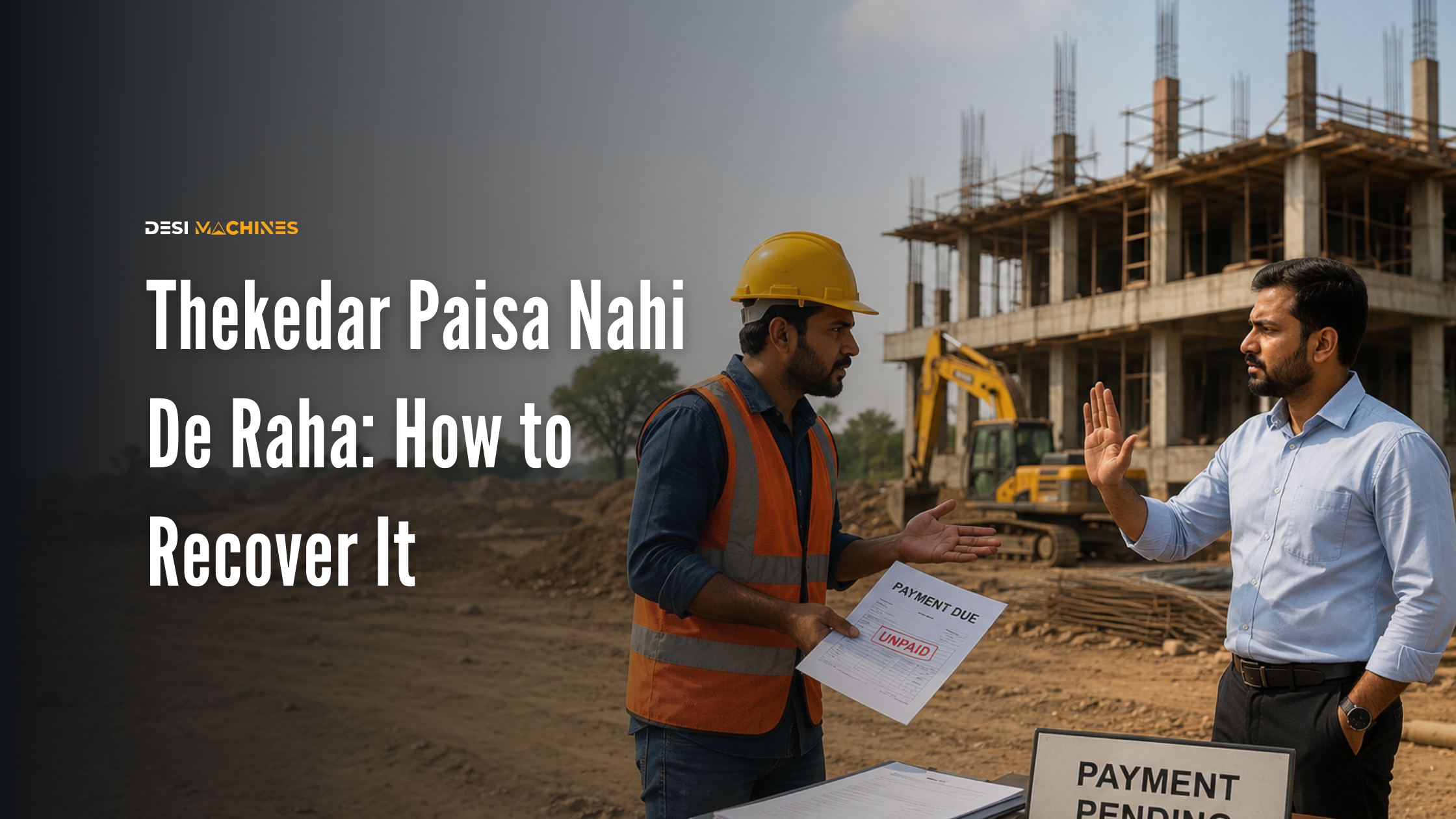
If the thekedar paisa nahi de raha after your machine has worked his site, you are not stuck just because nothing was signed. Section 70 of the Indian Contract Act, 1872 makes a person who enjoys the benefit of work done non-gratuitously liable to compensate you, so an unwritten hire is still a claim. If he has given you a cheque that bounced, section 138 of the Negotiable Instruments Act, 1881 is the sharper tool — but it runs on three tight deadlines, and the thirty-day notice window is the one people miss. Everything depends on the file you built while the machine was working: log sheets, signed challans and dated photographs.
Thekedar paisa nahi de raha: first work out which problem you have
“He is not paying” covers four different situations, and they do not have the same answer.
There is delay, where the money is coming but slowly, usually because he has not been paid either. There is a dispute, where he says the hours or the rate are not what you claim. There is refusal, where he acknowledges the amount and simply will not pay it. And there is disappearance, where the phone stops being answered.
Delay is a cash-flow problem and is often best handled commercially. The other three are recovery problems, and for those the clock starts running the day you decide that is what you are dealing with. The single most expensive habit in this trade is treating month four of a refusal as if it were still month one of a delay.
Be honest about which one you have, because the tools below cost time and goodwill, and using them on a genuine delay can end a working relationship that was actually fine.
The file decides the case, and you build it before the trouble
Whatever route you take, you will be asked to establish three things: that the machine worked, for how long, and at what rate. A claim fails on the second and third far more often than the first — nobody denies the excavator was there, they deny it did 240 hours at ₹1,600.
So the ordinary paperwork is the case:
The log sheet or hour meter record for each day, ideally initialled by his site supervisor. Work or delivery challans signed by someone on his side. Dated photographs of the machine on his site. Diesel bills for the deployment, which corroborate the hours independently. Any message where he acknowledges the machine, the rate or the outstanding figure.
A signature from a supervisor on a daily log sheet is worth more than a long argument later. If you are hiring machines out regularly and this is not already routine, the fix is at the front end — the terms you put in writing before the machine moves are what convert a dispute into a simple arithmetic question, and a written rate removes the second of the three things you would otherwise have to prove.
No written contract? You still have a claim
Most machine hire in India runs on a phone call and a rate everyone remembers differently. Owners assume that means nothing can be done. That is not the position.
Section 70 of the Indian Contract Act, 1872 reads: where a person lawfully does anything for another person, or delivers anything to him, not intending to do so gratuitously, and such other person enjoys the benefit thereof, the latter is bound to make compensation to the former in respect of, or to restore, the thing so done or delivered.
Read that against your situation. You sent a machine and an operator to his site — lawfully, and plainly not as a favour. He used it and got the benefit of the work. The section makes him liable to compensate you. This is the provision that stands behind recovery where there is no signed agreement at all.
Where there was an agreement, even an oral one, and he has broken it, section 73 entitles you to compensation for loss or damage that naturally arose in the usual course of things from the breach, or that both of you knew when contracting was likely to result from it. The same section expressly extends that measure to an obligation resembling those created by contract, which is the section 70 case. Note the limit in the same provision: compensation is not given for remote and indirect loss, so the claim is your dues and the losses that follow naturally, not every consequence you can trace.
If he gave you a cheque, use it properly
A bounced cheque changes your position completely, and it is the reason experienced owners ask for one even when they expect a transfer.
Section 138 of the Negotiable Instruments Act, 1881 makes it an offence where a cheque drawn on an account, for discharge in whole or in part of a debt or other liability, is returned unpaid because the balance is insufficient or exceeds the arrangement with the bank. The punishment provided is imprisonment which may extend to two years, or a fine which may extend to twice the amount of the cheque, or both.
The section only bites if you follow its three conditions in order:
| Step | Deadline | Source |
|---|---|---|
| Present the cheque to the bank | Within 6 months of its date, or its validity period, whichever is earlier | s.138 proviso (a) |
| Send a written demand notice to the drawer | Within 30 days of the bank telling you it was returned unpaid | s.138 proviso (b) |
| He pays | Within 15 days of receiving your notice | s.138 proviso (c) |
| If he does not pay, file the complaint in writing | Within 1 month of that cause of action | s.142(1)(b) |
Two details are worth holding on to. Section 139 presumes that the cheque was received for the discharge of a debt or liability unless the contrary is proved — so he has to displace that presumption, not you establish it. And the complaint must be made in writing by the payee or holder in due course, before a Metropolitan Magistrate or Judicial Magistrate of the first class, under section 142.
The thirty-day notice window is where these cases die. The bank return memo arrives, the owner spends three weeks calling and pleading, and by the time anybody mentions a notice the window has closed. Send the notice first; you can keep negotiating afterwards.
One honest caution: section 138 requires a legally enforceable debt or other liability. A cheque given as a blank security with no dues behind it is a weaker foundation than a cheque given for a stated outstanding amount.
When the payer is a government or EPC body
If the money is stuck with a government department, a PSU or a large EPC contractor rather than a local thekedar, do not use any of the above as your first move. That world runs on running bills, measurement books and retention, and there is a statutory time limit with interest behind delayed payments to registered small enterprises.
That is a different route with better odds, and we have set it out separately in what to do when government or EPC payment is delayed. Establish which kind of payer you are chasing before you spend anything on recovery.
Fix the next job, not just this one
Recovery is expensive even when it works. The owners who rarely need it have usually changed four things at the front end.
They take an advance before mobilising, and treat it as non-negotiable for a new client. They agree the rate and the basis in writing — per hour, per day or monthly, and what counts as an idle hour — instead of leaving it to memory; our indicative hire rate card is a useful reference for what the market bears when you set that number. They insist on signed log sheets every week rather than at the end. And they set an exposure limit in advance: a figure of unpaid dues at which the machine comes off site, decided before emotions and relationships get involved.
There is also a selection question. A client who pays badly is usually known to pay badly. Before deploying to a new thekedar, ask the other machine owners in your area — that informal check is worth more than any clause, and it costs one phone call. Widening where your work comes from helps too, and our note on finding better work for your machine covers the channels that reduce your dependence on any single contractor.
Your legal options when a contractor stops paying
When the thekedar paisa nahi de raha, the law is less of an obstacle than most owners assume and the calendar is more of one. An unwritten hire is still a claim under section 70. A bounced cheque is a strong claim under section 138 — provided the notice goes out inside thirty days. What decides both is the ordinary file you either built or did not build while the machine was on his site.
Do three things this week: put the outstanding amount in writing to him and ask for written acknowledgement, collect your log sheets, challans and photographs into one place, and check whether any cheque you hold is still inside its deadlines. Then decide whether this is a delay you can carry or a recovery you have to start.
If chasing dues has left you short of working capital for the season, look at your equipment finance options and talk to your bank early rather than after the EMI is due.
Statutory provisions cited here are from the Indian Contract Act, 1872 and the Negotiable Instruments Act, 1881.
This is general information about how these provisions work, not legal advice on your dispute. Limitation periods, procedure and outcomes depend on facts, documents and jurisdiction. Confirm your position with a qualified lawyer, and confirm commercial terms with the contractor in writing, before acting. DesiMachines is not liable for decisions taken on the basis of information that may have changed after publication.