Excavator
316 models
 Backhoe Loader
54 models
 Crane
68 models
 Concrete Mixer
79 models
 Wheel Loader
65 models
 Compactor / Roller
45 models
 Motor Grader
42 models

 Concrete Pump
66 models
 Skid Steer Loader
11 models


Dalmia Bharat took 60 days on average to pay for the goods and services it bought in 2025-26, up from 48 days the year before, according to its own sustainability report. Dalmia cement vendor registration has no public sign-up form behind that figure: the company onboards suppliers on SAP and Ariba after a technical qualification, and the only open forms on dalmiacement.com are for cement dealers. A machine owner, mining contractor or transporter gets in through the purchase or mines office of a plant, signs the Supplier Code of Conduct, and must show PF and ESI compliance on any service contract. No registration fee is published.
Anyone who searched for a form still needs to know who to talk to, what gets checked and how long the money takes. Dalmia Bharat’s 2025-26 Integrated Annual Report, its Supplier Code of Conduct and its mine filings answer most of it, as read on 20 November 2026.
Is there a Dalmia Cement vendor registration portal?
Not one a new supplier can open. The dalmiacement.com menu has “Become A Dealer”, “Find A Dealer” and “Login As Dealer”. That login leads to Dalmia Suvidha, an ordering and order-tracking system for cement dealers. The contact form asks you to pick an enquiry type from careers, marketing, corporate, sales, investors, media, dealership, independent home buyers and products. There is no vendor or supplier choice.
The system exists on the inside. The annual report says procurement runs on “integrated platforms such as SAP and Ariba”, with digital tools used “for vendor onboarding, tendering, auctions, and order management”. It also promises “operational assistance to smaller vendors” on digital procurement platforms and help with onboarding for suppliers who are not yet digital. A small fleet owner new to Ariba is not shut out, but that help arrives after the company decides to bring you on.
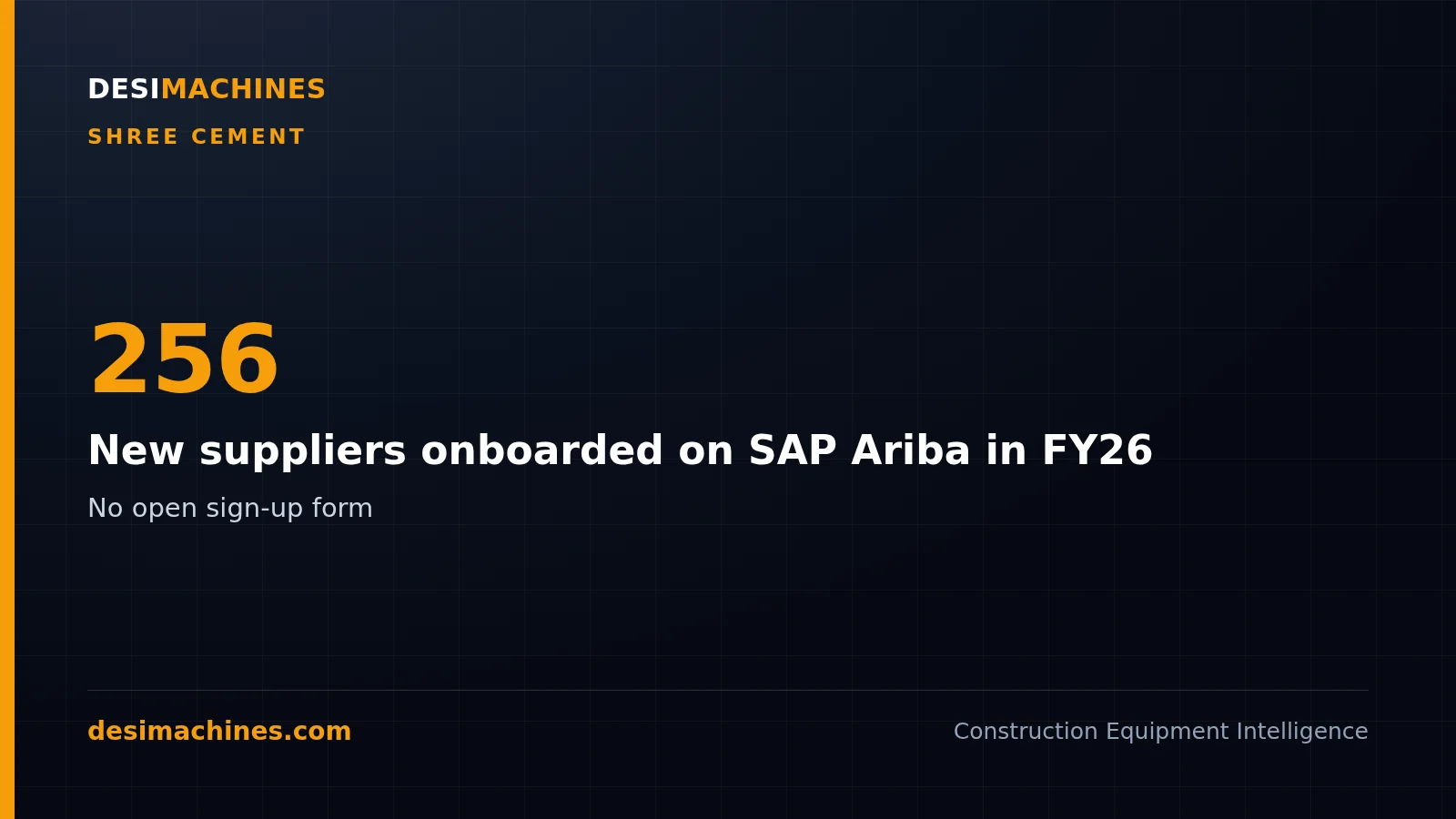
We found no public works tender or expression of interest from Dalmia Cement on dalmiacement.com or dalmiabharat.com. Other private cement makers handle new suppliers in much the same invitation-led way; see the Shree Cement vendor registration and UltraTech vendor registration guides.
How Dalmia buys, and which route fits a machine owner
The annual report sets out a sourcing method for each category of spend. The right-hand column below is our reading of who each line touches. Dalmia does not say it in those words.
| Dalmia’s buying method | What the report says it covers | Who it most concerns |
|---|---|---|
| Long-term contracts | Critical inputs such as slag and fuel | Bulk material suppliers |
| Annual contracts | Index-linked, globally traded commodities | Commodity traders and importers |
| E-auctions and competitive negotiation | MRO (maintenance, repair and operations), services and capex | Spares dealers, service contractors, equipment sellers |
| Rate contracts | “Competitive jobs” | The likeliest route for hire, loading and haulage work |
| Digital spot bidding on a Transport Management System | Freight | Truck owners and transport contractors |
Selection, the report says, “is preceded by rigorous technical qualification”. For a hire firm that means machine papers, operator licences and a safety record get looked at before your rate does. The buying is also mostly domestic. The BRSR puts 93% of input material by value as sourced from within India and 12% directly from MSMEs and small producers.
Transport is the biggest single door. The logistics section counts more than 8,600 trucks in the primary fleet and over 2,900 truck movements a day. It also says Dalmia shortened payment cycles and paid advances to transporters to keep trucks available when rates spiked.
What 60 payable days means for a fleet owner
Question 8 of the BRSR asks for “number of days of accounts payables”, worked out as accounts payable multiplied by 365 and divided by the cost of goods and services procured. Dalmia’s answer is 60 days for 2025-26, against 48 days for 2024-25. It is an average across everything the group buys, reported on a consolidated basis, so no single bill is promised that timing.
Put it on a calendar. A machine that starts work on 1 April and is billed at month end could see that first bill cleared near the end of June at the average pace. Diesel, operator wages and the EMI for April, May and June all fall due before then. If a Dalmia job needs one more machine than you own, price the equipment finance EMI against the hire you expect, with that gap built in.
Udyam registration helps here. Section 15 of the Micro, Small and Medium Enterprises Development Act, 2006 caps the agreed payment period for a micro or small supplier at 45 days from acceptance. Dalmia’s consolidated accounts show Rs 142 crore of principal due to micro and small enterprises on 31 March 2026 (Rs 105 crore a year earlier), with no interest due or paid for late payment under the Act.
What the Supplier Code of Conduct asks you to sign
The Dalmia Bharat Supplier Code of Conduct applies to “vendors, service providers, dealers and distributors, third parties” who sell goods or services to the company and its subsidiaries. It ends with a line for the supplier to sign, certifying that it has read the code and will comply at all times.
Several clauses bite on a contractor directly. Wages must be paid “in legal tender, at regular intervals, in full”, with records kept and deductions explained at each payment. Machinery and equipment under your control must be safe, with protective gear where needed. Dalmia runs a zero-tolerance rule on gifts and hospitality, down to lunches and dinners. You must declare if any Dalmia employee has an interest in your firm, and you should not hire a Dalmia employee who took part in procurement for one year after they leave. Sharing Dalmia’s confidential information with your own sub-contractor needs written consent.
Complaints have a ladder. A problem with a purchase order or service order goes first to the buyer named on it, then to a grievance mailbox given in the code, and anything about integrity goes to the ethics helpline under the Whistle Blower Policy. The company can audit or inspect a supplier and can end the relationship over a breach, with or without time to fix it.
The annual report adds a hard condition: all service contracts must require the supplier to provide provident fund and ESI contributions and pay at least the statutory minimum wage. The BRSR says specific clauses on PF, gratuity and other statutory dues go into contracts with value chain partners.
Safety checks at Dalmia mines and plants
Most hands at a Dalmia site come through contractors. The BRSR counts 15,285 contract workers against 1,406 permanent workers at the end of 2025-26. It reports ISO 45001 certification at all 15 units, a permit-to-work system, and a contractor safety management system. Its safety standards list includes one for “Mines And HEMM”, the heavy earth-moving machinery that a hire contractor brings.
The checks are real. Value chain partners making up 100% of business by value were assessed on health and safety and on working conditions. The follow-up list names contractor field safety audits, work-stop notices and a penalty matrix for high-severity violations. The report records 5 worker fatalities in 2025-26, up from 3, and says the analysis “underscores the need to intensify efforts in risk identification, strengthen contractor safety management”. At the plant gate, drivers face a breath analyser test and vehicles a compliance check.
Where the limestone and plant work is
Dalmia ended 2025-26 with 49.5 million tonnes a year (MnTPA) of cement capacity from 15 plants across 10 states. A results release dated 24 July 2026 took that to 54.7 MnTPA after it bought Jaiprakash Associates’ cement business: four plants in Madhya Pradesh and Uttar Pradesh. The 2.5 MnTPA Chunar grinding unit began commercial production on 20 June 2026 and the 3.3 MnTPA Rewa clinker unit started trial runs in July. A 3.6 MnTPA clinker unit at Belgaum is under construction for the end of 2026-27.
Running mines named in the BRSR include Murli Pahari at Rohtas in Bihar, New Umrongso in Assam and Lanjiberna at Rajgangpur in Odisha. The bigger opportunity is the pipeline of blocks that have not started.
| Limestone block | District, state | Status in the filing |
|---|---|---|
| Kottameta (802.25 ha) | Malkangiri, Odisha | Lease granted 26 May 2023; mining not begun at the Indian Bureau of Mines inspection of 8 January 2026; 97.51 million tonnes of probable reserves |
| Kesla-II (357.067 ha) | Raipur, Chhattisgarh | Environmental clearance of 4 October 2021 for 4.0 million tonnes a year of total excavation, with a 1,000 TPH crusher; lease yet to be executed in May 2026 |
| Gojoli-Somanpalli-Dongargaon (646.55 ha) | Chandrapur, Maharashtra | Environmental and wildlife clearances in progress |
| Naranda (71.01 ha) | Chandrapur, Maharashtra | Stage-I forest approval obtained |
| Yadwad and Kunnal expansion (1,048.24 ha) | Karnataka | EIA for higher limestone output dated 12 February 2026 |
| Ramgarh auctioned block | Jaisalmer, Rajasthan | EIA listed with a proposed clinker plant at Ramgarh |
A block whose lease is about to be executed is heading towards haul roads, box cuts and overburden removal. That is the time to be known at the nearest Dalmia unit. Live work from other buyers is listed on opportunities for machine owners.
Sizing machines for a Dalmia limestone pit
The Kesla-II compliance report says excavated limestone will reach the crusher “by haul road through dumpers”. Work the clearance figures through. The approved split is 3.0 million tonnes of limestone, 0.85 million tonnes of rejects and waste, and 0.15 million tonnes of topsoil a year. If the mine works 300 days a year (our assumption), that is about 13,300 tonnes moved a day, and about 10,000 tonnes of limestone a day, roughly 10 hours of running for a 1,000 TPH crusher.
Loading dumpers at that pace is 35-tonne class excavator work. The SDLG E6350H weighs 35,200 kg with a 288 HP engine and a 2 cubic metre bucket, at around Rs 89-101 lakh (indicative, as of Nov 2026). The Tata Hitachi EX 350LC Prime weighs 33,800 kg with 260 HP and a 1.3 to 2.0 cubic metre bucket range, at around Rs 1.13-1.27 crore (indicative, as of Nov 2026). Specs are as listed in November 2026. Match the bucket to the dumper body the mine runs before you quote, and see which other makers have plants nearby in cement companies in India.
Before you walk into a Dalmia mines office, shortlist 35-tonne excavator models and prices that suit the dumpers its pit runs.
Facts come from dalmiacement.com (menu, contact form, careers notice and Corporate Policies page), the Dalmia Bharat Supplier Code of Conduct, the Integrated Annual Report 2025-26 with its Business Responsibility and Sustainability Report, the results release of 24 July 2026, the Kesla-II half-yearly environmental compliance report of May 2026 and the Indian Bureau of Mines inspection report for Kottameta, as read on 20 November 2026. Machine prices are indicative and vary by variant, location and date. Portals, policies and supplier terms change. Confirm the current process with Dalmia’s procurement team at the unit, and check the official source, before you apply or quote as a contractor. DesiMachines is not liable for decisions taken on information that may have changed after publication.