Excavator
316 models
 Backhoe Loader
51 models
 Crane
68 models
 Concrete Mixer
79 models
 Wheel Loader
54 models
 Compactor / Roller
45 models
 Motor Grader
42 models

 Concrete Pump
66 models
 Skid Steer Loader
11 models


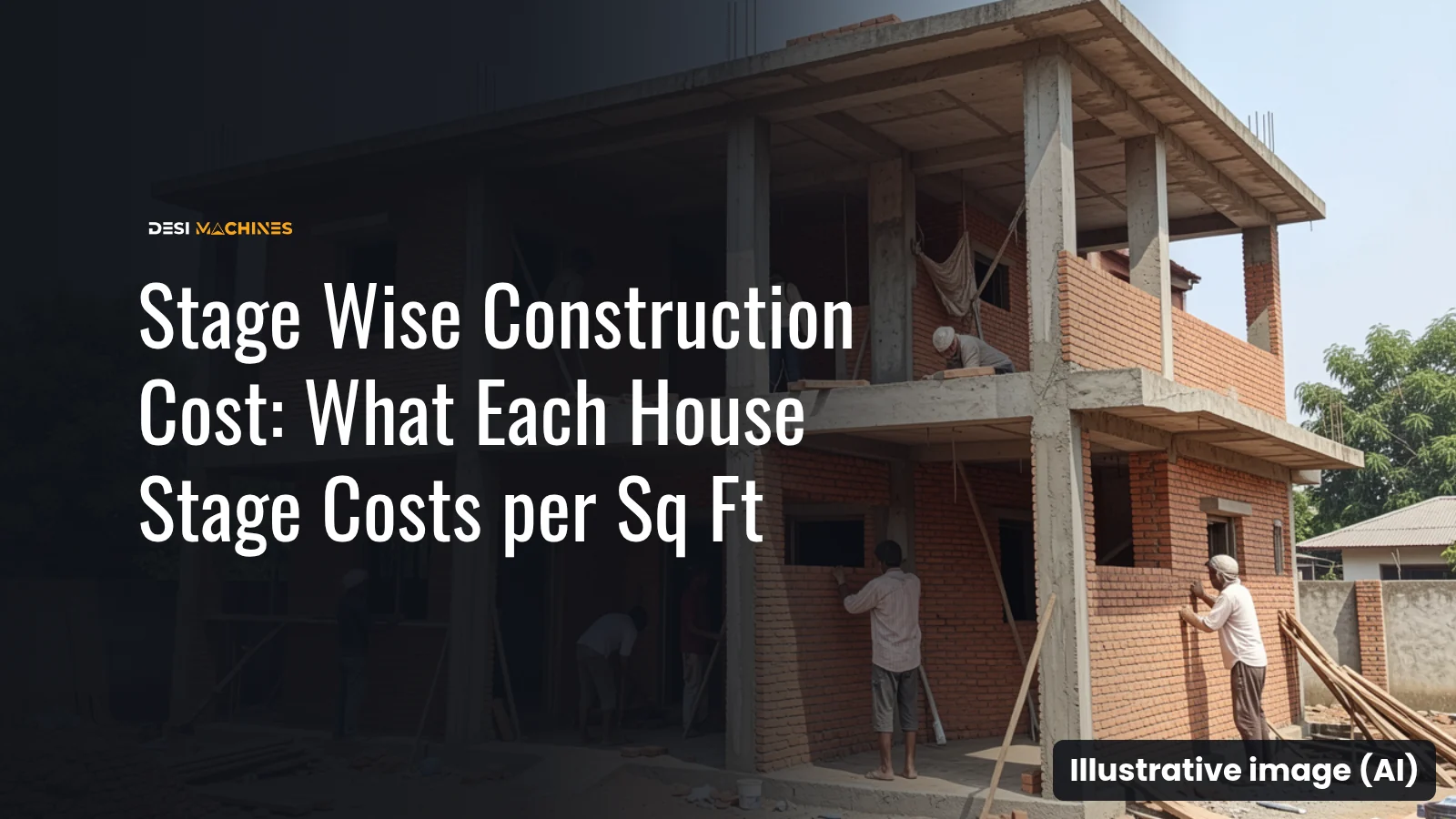
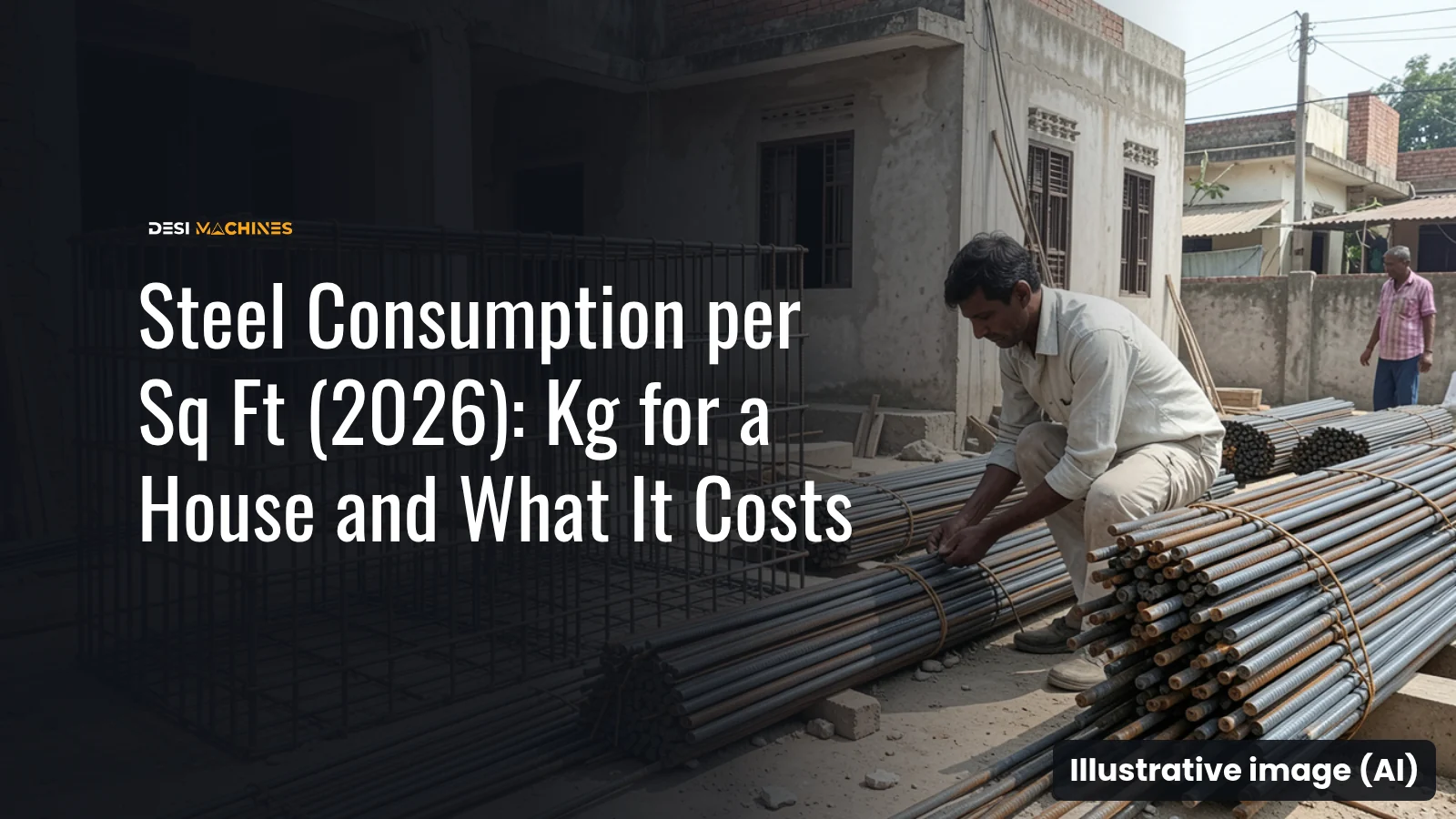
Rs 982 to Rs 1,331 a sq ft is the stage wise construction cost we get for a plain 1,000 sq ft single-storey RCC house when every stage is priced from two state rate books: Chhattisgarh’s Building SOR of 10 June 2026 and Haryana’s HSR. The RCC frame and roof slab take the biggest share, 22 to 27% (Rs 217 to 354 a sq ft), followed by foundation and plinth at 18 to 20% (Rs 172 to 265). Brickwork takes 10 to 11%, flooring 9 to 10%, plaster 3 to 4% and excavation just 1 to 2%. Doors, windows, painting and roof waterproofing add 14 to 15%, and plumbing and wiring, at CPWD’s 9% and 12.5%, another 18%. The split is our arithmetic on official item rates; apply it to your own contractor’s quote to plan stage payments.
A rate per square foot tells you how big the bill is, not when each part of it falls due. An owner paying in instalments, or a small contractor carrying the work until the next running bill, needs the second answer. So we priced one ordinary house item by item from schedules of rates anyone can download. Every rate is the book’s own; the quantities, and so the shares, are ours.
Stage wise construction cost of a 1,000 sq ft house
The house uses the same frame as the worked example in steel consumption per sq ft: 16 columns of 230 x 300 mm, 230 x 450 mm beams, a 125 mm roof slab and isolated footings 1.5 m square at 1.5 m depth. The plinth is 0.45 m high and the storey 3.0 m. Outer walls and the main partitions are 230 mm brick; toilet walls and a 0.9 m parapet are half brick. It has seven doors, seven 1.5 x 1.2 m windows and two toilet ventilators, 600 x 600 mm vitrified tiles in the rooms, and ceramic tiles with a 2.1 m dado in two toilets.
| Stage | Haryana rates: Rs per sq ft (share) | Chhattisgarh 2026: Rs per sq ft (share) |
|---|---|---|
| 1. Site clearing, excavation, backfill | 14 (1.1%) | 22 (2.3%) |
| 2. Foundation and plinth (PCC, footings, plinth beams, sand fill, DPC) | 265 (19.9%) | 172 (17.5%) |
| 3. RCC frame and roof slab (columns, beams, slab, lintels) | 354 (26.6%) | 217 (22.1%) |
| 4. Brickwork | 129 (9.7%) | 107 (10.9%) |
| 5. Plaster (outside, inside, ceiling) | 36 (2.7%) | 39 (4.0%) |
| 6. Flooring and wall tiles | 117 (8.8%) | 101 (10.3%) |
| 7. Doors, windows, painting, roof waterproofing | 181 (13.6%) | 149 (15.2%) |
| 8. Services: 9% water and sanitary, 12.5% electrical (CPWD method) | 235 (17.7%) | 174 (17.7%) |
| Total, 1,000 sq ft | Rs 13,30,846 (1,331) | Rs 9,82,068 (982) |
Our arithmetic, Nov 2026, on item rates dated 2023 to 2026; rows are rounded. Haryana’s column uses the HSR 2026 concrete chapter and HSR 2023 for the rest, because the 2026 edition on the state portal covers only a few chapters. Chhattisgarh’s book has deleted its painting items, so both columns use Haryana’s painting rates.
The two totals sit about Rs 350 a sq ft apart, yet the shares move far less. In both books everything up to the roof slab takes 42 to 48% of the money, and finishing plus services close to a third. Prices change with the state and the year; the proportions of an ordinary house change far less, which is why the shares are the part worth carrying to your own quote.
There is no official split to lean on. CPWD’s Plinth Area Rates 2023, the book government engineers use for rough estimates, gives one rate per square metre for the building and lists only the services as percentages. The stage shares above are our own calculation.
Which rate-book items sit behind each stage?
| Item | Haryana HSR | Chhattisgarh SOR 10.06.2026 |
|---|---|---|
| Excavation for foundations, all soils, per cum | 4.14: Rs 83 (2023) | 1.1.1: Rs 157 |
| PCC 1:4:8 below footings, per cum | 6.1.6: Rs 2,735 (2026) | 3.1.2: Rs 2,260 |
| RCC 1:1.5:3 up to plinth, per cum | 6.14.1: Rs 4,898 (2026) | 3.2.1: Rs 3,539 |
| RCC 1:1.5:3 in beams and slab above plinth, per cum | 6.16: Rs 6,845 (2026) | 3.2.1 + 3.4: Rs 3,622 |
| TMT Fe-500D bars fixed in place, per kg | 6.34.6: Rs 68 (2026) | 3.12.2: Rs 46 |
| Slab formwork, per sq m | 6.30.3: Rs 233 (2026) | 2.1.7: Rs 200 |
| 230 mm brickwork in CM 1:6 above plinth, per cum | 7.22.2: Rs 3,961 (2023) | 7.1.4 + 7.6: Rs 3,351 |
| 12 mm inside plaster 1:6, per sq m | 11.8.2: Rs 66 (2023) | 11.2.4: Rs 78 |
| 600 x 600 mm vitrified floor tiles, per sq m | 10.63.2: Rs 987 (2023) | 12.76.1: Rs 819 |
| 35 mm flush door shutter, per sq m | 12.37.1: Rs 1,400 (2023) | 8.13.2: Rs 1,165 |
| uPVC two-track sliding window, 1.75 to 2.5 sq m, per sq m | 12.134.3: Rs 5,613 (2023) | 8.166 D.3: Rs 4,952 |
Chhattisgarh’s general notes say its rates exclude GST and are complete rates, inputs included. Haryana’s online report does not state a GST basis. Both books are open: the Chhattisgarh PWD schedule of rates page still lists the 10 June 2026 building SOR as current, and the Haryana HSR report tool prints any chapter on request.
Where the early money goes
By the time the roof slab is cast, the house has used Rs 4.1 to 6.3 lakh of its Rs 9.8 to 13.3 lakh in our example. That is the heaviest stretch for anyone paying in stages, and it comes in the first part of the job, before a single wall is up.
Steel drives it. The frame and foundation carry about 3,440 kg of bars, and steel is 42 to 46% of the frame stage’s money. This is also where the two books part company. Chhattisgarh’s schedule says it was built on base rates, as on 1 January 2015, of Rs 40 a kg for Fe-500D bars and Rs 4,845 a tonne for cement. Kerala PWD’s market rates for October to December 2026 put Fe-500D at Rs 6,700 to 7,500 a quintal and OPC 43 cement at Rs 7,000 to 8,000 a tonne, about Rs 350 to 400 a bag. Price the Chhattisgarh house’s steel at Haryana’s Rs 68 a kg and it costs Rs 76 a sq ft more. Read the Chhattisgarh column as a floor.
The plinth line is easy to underestimate because it ends up buried. The plinth beam cost guide breaks that one item down if you want to check it separately.
The two stages where machines do the work
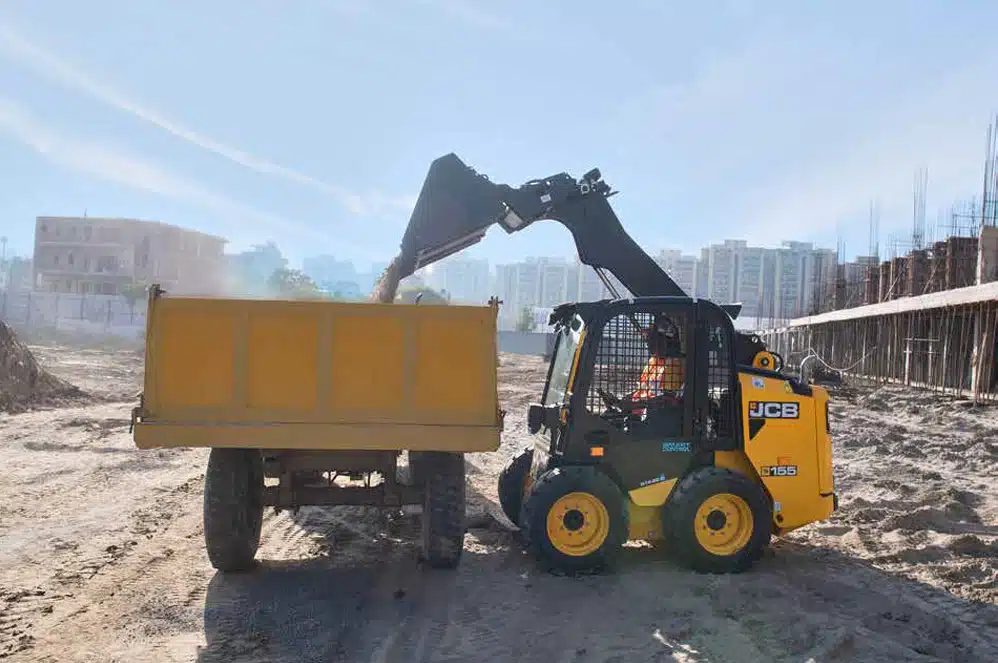
Excavation is the cheapest stage on paper. Our 16 footing pits come to about 106 cubic metres of digging, and the whole stage, including backfill and dressing the site, is Rs 14,297 at Haryana’s rates. Haryana’s item 4.14 assumes a hydraulic excavator or manual digging, and Rs 63 of its Rs 83 a cubic metre is the machine. A backhoe loader such as the JCB 3DX, with a 4.77 m maximum digging depth on its current spec, reaches a 1.5 m footing with depth to spare. The rupees are small; the cost of delay is not, because nothing else starts until the pits are dug and passed. Day rates and per-cubic-metre quotes are compared in excavation rate per cubic metre.
Concrete is the other machine stage. The house takes about 43 cubic metres of RCC, and the roof slab alone is 11.6. A self-loading mixer like the AJAX ARGO 2000, with a 2.0 cubic metre drum, would need about six batches for that slab. Haryana’s own book hints at where the savings lie: it prices pumped M25 ready-mix above plinth at Rs 5,051 a cubic metre, against Rs 6,845 for nominal-mix 1:1.5:3, mostly because the labour line falls from Rs 3,259 to Rs 719.
From brickwork to floor tiles
Brickwork costs Rs 107 to 129 a sq ft here, about 25.5 cubic metres of 230 mm wall plus 57 square metres of half-brick work. Plaster is only Rs 36 to 39, even though the house has about 440 square metres of it.
Take that plaster figure carefully. It is a small share because these two books price plaster low, and other states do not. The plaster rate per sq ft comparison found Maharashtra’s 2022-23 schedule paying Rs 204 a square metre in labour alone for a 12 mm coat, about three times Haryana’s complete rate. Plaster is mostly labour, so your local labour rate per day moves it more than cement does.
Flooring is Rs 101 to 117 a sq ft, and the tile you pick swings it. Moving the 70 square metres of room flooring from 600 x 600 mm to 800 x 800 mm vitrified tiles at Haryana’s rates (Rs 987 to Rs 1,164 a square metre) adds about Rs 12,400, roughly Rs 12 a sq ft.
Finishing and services: the last third
Once the floors are laid, about one third of the money is still to come. Doors, windows, painting and roof waterproofing are Rs 149 to 181 a sq ft. Windows are the largest single item in that group: 12.6 square metres of uPVC sliding windows cost Rs 62,395 to 70,724 before glass.
For plumbing and wiring we used the method CPWD uses. Its Plinth Area Rates 2023 adds internal water supply and sanitary installations at 9% of building cost for quarters, and internal electrical installations at 12.5%. On our civil totals that is Rs 174 to 235 a sq ft. This is the stage where house budgets most often break, because it arrives last and gets cut first.
Why a contractor’s quote will be higher
CPWD’s own rate for an RCC framed residential quarter is Rs 23,530 per square metre as on 1 April 2023, about Rs 2,186 a sq ft before services, and that rate allows for GST at 18%. Our rate-book house sits well under that. The schedules lag the market, Chhattisgarh’s most of all, and our example leaves out stairs, the water tanks, a septic tank, the compound wall, approvals and the contractor’s supervision.
So use the shares, not the rupees. If a contractor quotes, say, Rs 20 lakh for this house, about Rs 4.4 to 5.3 lakh of it should belong to the frame and slab, and about Rs 8 lakh should still be unpaid when the plaster is finished. How to build up the total itself, and what a turnkey rate should include, is covered in the house cost calculator guide.
What to check before you release each stage payment
- Excavation: pit sizes and depth measured against the drawing, and the engineer’s note on the founding soil.
- Foundation and plinth: steel checked against the bar bending schedule before each pour, with cube test results on file.
- Frame and slab: kg of steel billed compared with the schedule, and slab concrete quantity checked against the drawing.
- Brickwork and plaster: areas measured on site with openings deducted.
- Flooring and finishing: tile, door and window makes matching the specification sheet you signed.
- Services: a pressure test on the pipes and an insulation test on the wiring before they are tiled over.
If you build for a living, live building and civil tenders carry BOQ quantities you can split the same way before you bid.
Schedules of rates and market prices change — confirm current rates with your contractor or the state PWD before you fix a payment schedule.