Excavator
294 models
Excavator
294 models  Backhoe Loader
51 models
Backhoe Loader
51 models  Crane
68 models
Crane
68 models  Concrete Mixer
79 models
Concrete Mixer
79 models  Wheel Loader
54 models
Wheel Loader
54 models  Compactor / Roller
45 models
Compactor / Roller
45 models  Motor Grader
42 models
Motor Grader
42 models  Concrete Pump
66 models
Concrete Pump
66 models  Skid Steer Loader
11 models
Skid Steer Loader
11 models  Telehandler
13 models
Telehandler
13 models 


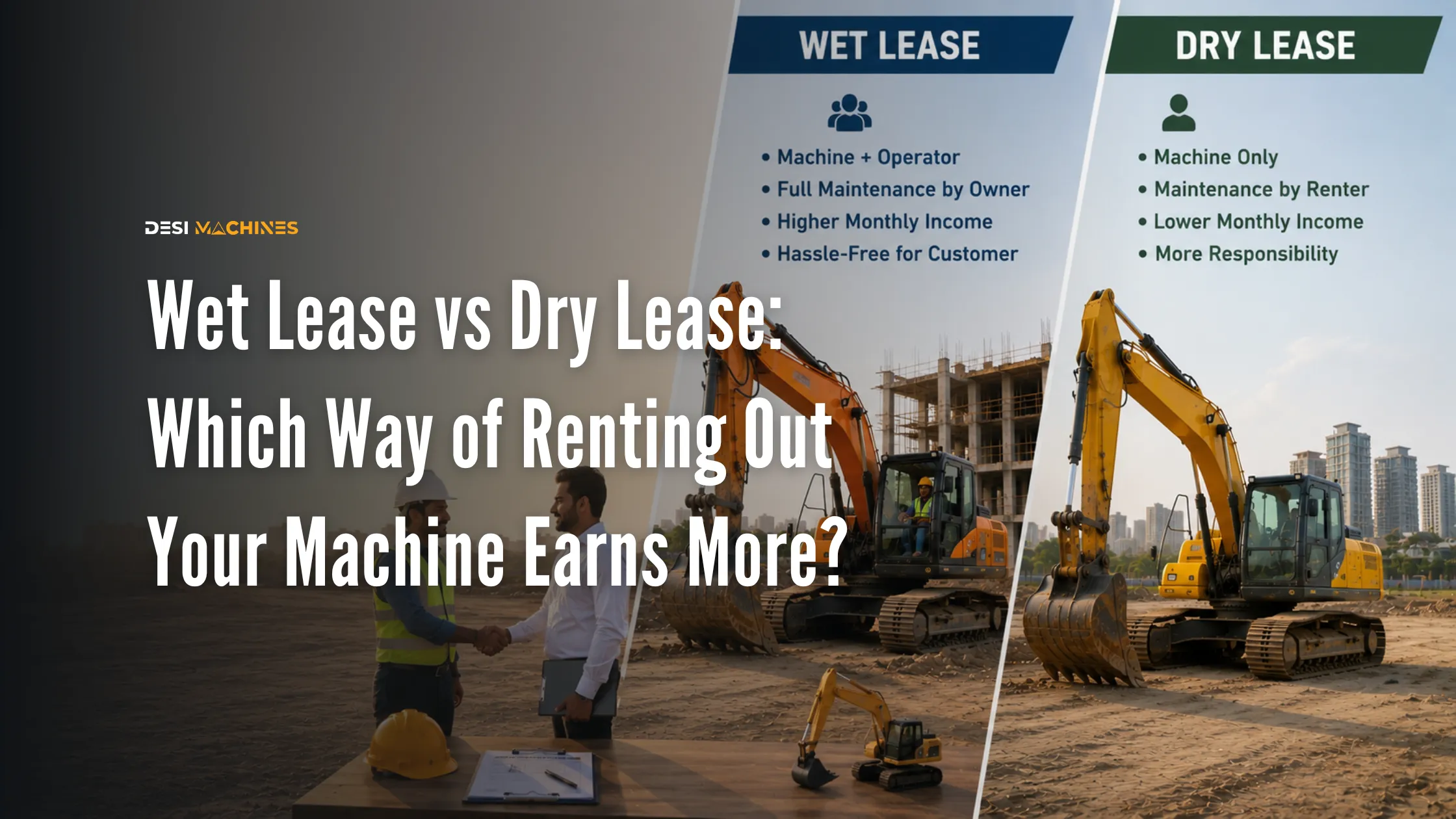
In short: the wet lease vs dry lease equipment decision is a wage calculation, not a rate calculation. A backhoe loader hires dry at about Rs 550-900 an hour and wet at about Rs 900-1,300 an hour (indicative, as of Jul 2026), so the wet premium is roughly Rs 350-400 an hour. An operator with two to five years’ experience costs Rs 18,000-28,000 a month, and that wage is due whether the machine works or sits. Divide one by the other and you need somewhere around 45 to 80 paid hours a month before wet hire beats dry hire. Below that line, the higher rate is an illusion.
Wet lease vs dry lease equipment: what you are actually selling
The words are borrowed from aviation and they cause more confusion than they need to.
On a dry lease, sometimes called dry hire, you hand over the machine and nothing else. The hirer brings the operator, arranges the diesel and runs the work. You are selling iron by the hour, the day or the month.
On a wet lease, you supply the machine with your own operator, and frequently the diesel too. You are selling a working crew. The rate is higher because you have taken on the wage, the supervision and a share of the risk that used to sit with the hirer.
Owners drift into wet hire because the headline rate looks better. It usually is better. The question is whether it is better by enough.
The rate gap is thinner than it looks
Our own equipment rental rate card puts real numbers on both structures for a backhoe loader of the JCB 3DX class.
| Basis | Indicative rate (Jul 2026) | What it includes |
|---|---|---|
| Per hour, dry | Rs 550-900 | Machine only; hirer brings operator and diesel |
| Per day, dry (8 hours) | Rs 5,000-9,000 | Machine only; daily minimum common |
| Per month, dry hire | Rs 90,000-1,40,000 | Machine only; long deployment |
| Per hour, wet | Rs 900-1,300 | Machine plus operator, often diesel as well |
Read the two hourly rows against each other. The wet rate carries a premium of roughly Rs 350-400 an hour over the dry rate. That figure is the entire economic content of the decision, and everything below is about what it has to cover.
Larger machines are quoted differently. A 20-tonne excavator is generally hired wet at Rs 1,400-2,200 an hour and a 30-tonne-plus machine at Rs 2,200-3,500, because few hirers have an operator competent on that class sitting spare. On the backhoe and mini classes, both structures are genuinely available to you.
What the wet premium has to pay for
Three things come out of that Rs 350-400, and only one of them is obvious.
The wage is first. From our figures on JCB operator salary in India, a fresher costs Rs 12,000-18,000 a month, an operator with two to five years’ experience Rs 18,000-28,000, and a skilled hand with five years or more Rs 28,000-45,000. The temptation is to hire at the bottom of that ladder. Resist it on a machine you own, because the cheapest operator is usually the most expensive one once the hydraulics and the undercarriage are counted. Finding and keeping that man is its own job — our playbook on how to hire a JCB operator covers where owners actually find operators, the half-day trial that settles it, and the pay structure that keeps a good one.
Second is the cost of the wage continuing when the work stops. This is the part owners consistently miss. On dry hire your cost falls close to zero on an idle day. On wet hire you pay the operator for that idle day exactly as you pay him for a working one. A monthly salary against hourly income is a mismatch, and it is the reason wet hire punishes low utilisation so hard.
Third is liability. Your man, on someone else’s site, under your employment. Damage he causes tends to land on you rather than on the hirer, which changes what your equipment insurance needs to cover and makes a written contract worth the trouble of drafting.
The break-even: how many paid hours justify an operator
Put the premium and the wage together and the answer falls out.
| Operator | Monthly wage | Paid hours a month to cover it at Rs 350-400/hr premium |
|---|---|---|
| Fresher / trainee | Rs 12,000-18,000 | About 30-50 hours |
| Operator, 2-5 years | Rs 18,000-28,000 | About 45-80 hours |
| Skilled, 5 years plus | Rs 28,000-45,000 | About 70-130 hours |
Wages and rates indicative, as of Jul 2026. Add food, travel and any statutory contributions you pay on top of the wage before you use these figures.
A machine getting steady work at 150 to 200 hours a month clears every row in that table comfortably, and wet hire is the better structure. A machine picking up 40 or 50 hours in a slow month does not clear even the trainee row, and every idle day is money leaving your account for no return.
Which is really a statement about utilisation, the same number that decides most ownership questions. The buy versus rent decision turns on it too, and it is worth knowing your own figure before you commit to a payroll.
The diesel trap inside a wet rate
The rate card notes that wet hire “often” includes diesel. Look hard at that word before you agree to it.
At Rs 95-104 a litre (indicative, as of Jul 2026), a machine burning eight litres an hour costs Rs 760-830 an hour in fuel. Set that against a wet premium of Rs 350-400 an hour and the arithmetic is brutal: the diesel alone is more than twice the premium, so a diesel-inclusive wet rate at these levels eats the premium and starts on your base rate as well.
There are only three safe ways to handle it. Bill diesel separately against measured consumption. Reimburse it against pump slips. Or build a rate specifically constructed to absorb the fuel, which for a machine burning eight litres an hour means something well above Rs 1,300. What you should never do is accept a standard wet rate and quietly carry the fuel, which is how owners end up working a full month for less than a dry hire would have paid them. Whichever route you choose, write it into the hire note — the equipment rental agreement terms that protect the owner put diesel, idle hours and the payment date on one page.
If you do not know your machine’s burn rate, measure it before you quote. Our guide to measuring fuel consumption per hour takes a pump, a notebook and two tankfuls.
Which structure suits your month
A reasonable rule for an owner with one or two machines: run wet where the work is regular and dry where it is not.
Wet hire earns more from repeat clients, long deployments and site contracts that run for weeks, because the operator stays busy and the premium keeps arriving. It also protects the machine, since your own man treats it better than a stranger does, and it opens up work with contractors who have no operator of their own.
Dry hire earns better in a patchy month, on short jobs, and when the hirer already employs operators. It also caps your exposure: no wage on idle days, and no liability for how the machine is driven, provided you have a deposit, a signed condition report at handover and return, and hour-meter readings agreed in writing at both ends.
Most owners running a single machine end up doing both, which is the right answer. What sinks people is keeping a full-time operator on the payroll for work that only turns up a few days a month.
If you are still choosing the machine itself, the class you buy sets the structures available to you. Compare current backhoe loader models and prices against the rate card above before you decide.
The bottom line
Wet hire pays roughly Rs 350-400 an hour more than dry hire on a backhoe loader, and an operator costs Rs 18,000-28,000 a month. Those two numbers, divided, give you a break-even of about 45 to 80 paid hours a month. Above it, wet hire is clearly the better business. Below it, the higher rate is paying your operator rather than you.
Then check the diesel question separately, because a fuel-inclusive wet rate can turn a good structure into a losing one on its own. And whichever way you go, get it in writing: rate basis, fuel, working hours, overtime, idle-day treatment and who carries damage.
Rate cards and wages both move faster than most owners update their quotes. Look at what the machines in your class are earning on the current rental rate card, and check that your machinery insurance matches the structure you are actually running.
Rates, wages, prices and terms are indicative, vary by machine, location, season and date, and should always be confirmed with the dealer, hirer, insurer or contractor before you commit to a hire agreement. DesiMachines is not liable for decisions taken on the basis of information that may have changed after publication.