
 Excavator
294 models
 Backhoe Loader
51 models
 Crane
68 models
 Concrete Mixer
79 models
 Wheel Loader
54 models
 Compactor / Roller
45 models
 Motor Grader
42 models

 Concrete Pump
66 models
 Skid Steer Loader
11 models


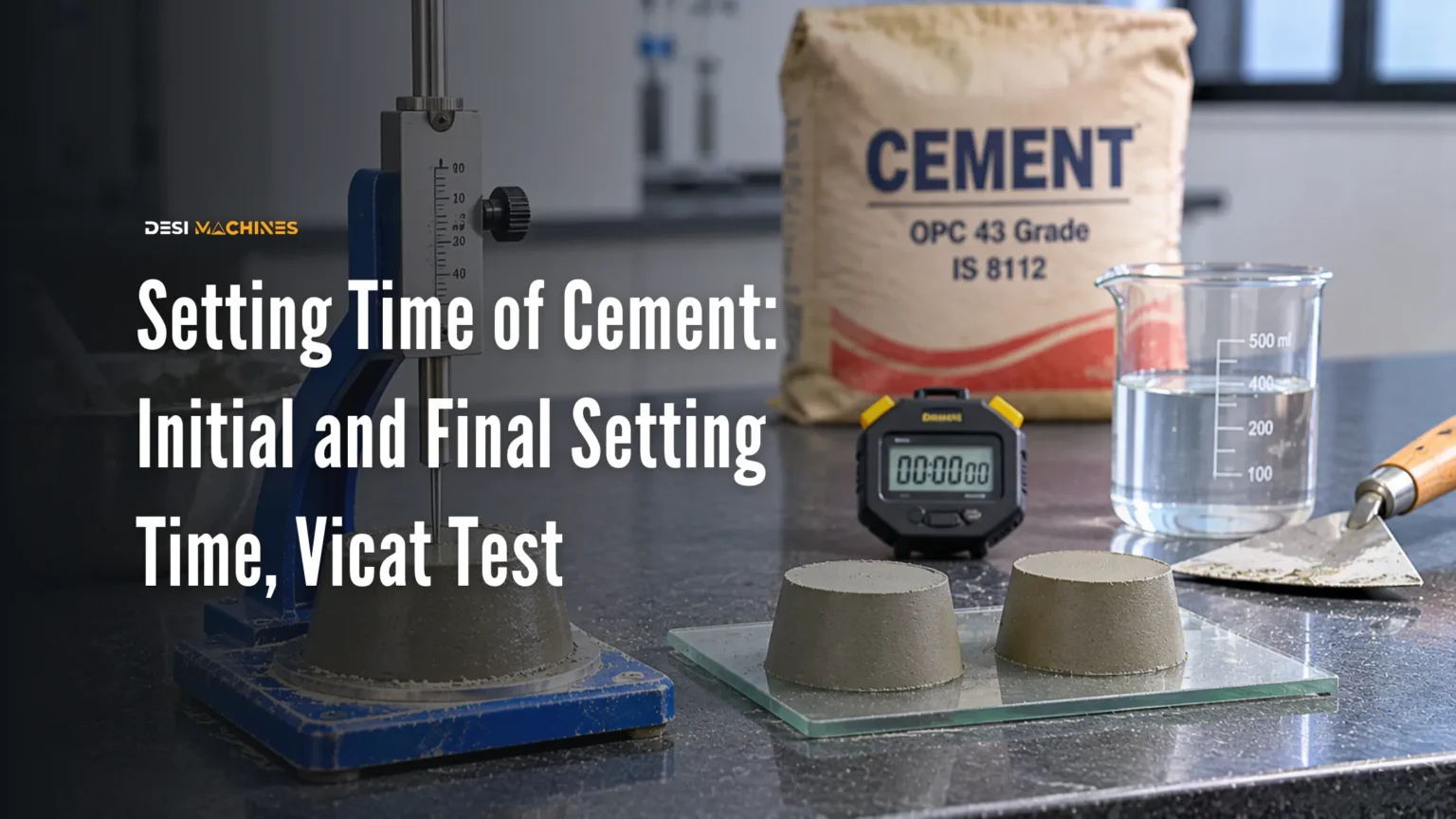
Ordinary Portland cement sold in India must not start to set before 30 minutes and must be fully set within 600 minutes, or 10 hours, of meeting water. Those two limits are the initial and final setting time of cement, and Portland pozzolana cement (PPC) and Portland slag cement (PSC) carry the same pair.
They are measured in a laboratory with a Vicat apparatus, a small stand that drops a weighted needle into a mould of cement paste, by the method in IS 4031 (Part 5). This guide explains what the two times mean, the limits for each type of cement, how the test is done step by step, and what the numbers do and do not tell you on a building site.
What is the setting time of cement?
Setting time is how long cement paste takes to lose its softness and turn stiff after water is added. Mix cement with water and for a while you can stir it, pour it and shape it. Then it starts to stiffen. A little later it is hard enough to hold its shape and resist a needle pressed into it.
The standards split this into two moments:
- Initial setting time is when the paste starts to stiffen. After this point it should not be disturbed, mixed again or moved.
- Final setting time is when the paste has fully lost its plasticity (its ability to be moulded) and has become a firm solid.
Both are counted from the moment water touches the cement, not from when the mixing finishes.
Setting is not the same as hardening. Setting is the change from soft to stiff, and it is over within hours. Hardening is the slow gain in strength that follows for weeks. IS 269 checks that second part separately, by crushing mortar cubes at 3, 7 and 28 days (72, 168 and 672 hours). The cube test of concrete does the same job for concrete on site.
Initial and final setting time of cement as per IS code
Every Indian cement standard sets its own limits, but most share the same pair: initial set no sooner than 30 minutes and final set no later than 600 minutes. The exceptions are cements made to set slowly on purpose.
Table 1: Setting time limits by cement type (Vicat method, IS 4031 Part 5)
| Cement | Indian Standard | Initial setting time, not less than | Final setting time, not more than |
|---|---|---|---|
| Ordinary Portland cement, 33, 43 and 53 grade | IS 269:2015 (earlier IS 269, IS 8112 and IS 12269) | 30 minutes | 600 minutes (10 hours) |
| OPC sleeper grades, 43-S and 53-S (for railway sleepers) | IS 269:2015 (earlier IS 8112 and IS 12269) | 60 minutes | 600 minutes |
| Portland pozzolana cement, fly ash based | IS 1489 (Part 1):2015 | 30 minutes | 600 minutes |
| Portland slag cement | IS 455:2015 | 30 minutes | 600 minutes |
| Rapid hardening Portland cement | IS 8041:1990 | 30 minutes | 600 minutes |
| Low heat Portland cement | IS 12600:1989 | 60 minutes | 600 minutes |
| Masonry cement (made for masonry mortar) | IS 3466:1988 | 90 minutes | 24 hours |
Notice that the grade does not change the setting time limits. A 53 grade bag gains strength faster than a 33 grade bag and can set and heat up sooner in a thin slab, but both have to meet the same 30 and 600 minute limits. Rapid hardening cement is the same: it gains early strength quickly but carries the same setting limits.
Two things in this table often get mixed up. First, these are limits, not the actual time. A bag that sets in 140 minutes and one that sets in 45 minutes both pass. Second, the minimum matters more to you than the maximum. A cement that sets too early leaves no time to place and compact the concrete. If you want proof for a particular batch, the manufacturer has to give you a test certificate on request (IS 269 clause 8.1) confirming the cement meets the standard, setting time included. Our guide to the best cement for house construction covers the grade and type choice itself.
What is the Vicat apparatus?
The Vicat apparatus is a small stand with a sliding vertical rod. The rod carries a pointer that moves over a 40 mm scale marked in millimetres. Different tips clamp onto the bottom of the rod, and the whole moving part weighs 300 grams. You lower the tip onto a mould full of cement paste, let it go, and read how far it sinks. IS 5513 lays down every size.
Table 2: Parts of the Vicat apparatus as per IS 5513:1996
| Part | Size | Used for |
|---|---|---|
| Plunger G | Polished brass, 10 mm diameter, 50 mm long, flat end | Finding standard consistency (how much water the paste needs) |
| Needle C | Hardened steel, 1.13 mm diameter, 50 mm long, flat end | Initial setting time |
| Needle F (annular collar) | Same needle, 30 mm long, inside a brass collar with a 5 mm cutting edge; the needle sticks out 0.5 mm beyond the edge | Final setting time |
| Moving part | 300 grams in total with any one tip fitted (each tip about 9 g) | Gives every drop the same weight |
| Vicat mould | Cone-shaped ring, 70 mm across at the top, 80 mm at the bottom, 40 mm high, resting on a non-porous plate | Holds the test block of paste |
The same stand runs three tests in turn. That is why a lab technician talks about one apparatus but swaps tips between readings.
How much water? The standard consistency test comes first
You cannot test setting time on any random paste. Add more water and the needle sinks further; add less and it sets sooner. So the water is fixed first, by a separate test in IS 4031 (Part 4).
The lab mixes trial pastes with different amounts of water, fills the mould each time, and drops the 10 mm plunger into it. The right paste, called the paste of standard consistency, is the one that lets the plunger sink to a point 5 to 7 mm above the bottom of the mould. The water in that paste is written as a percentage of the cement’s weight, to one decimal place. Call it P.
Mixing, called gauging in the standard, must take between 3 and 5 minutes, counted from adding water until the mould starts to be filled. The setting time test then uses less water: 0.85 times P. If standard consistency came out at 30 percent (an example figure), the setting time paste would use 0.85 × 30 = 25.5 percent, that is 25.5 grams of water for every 100 grams of cement.
Initial and final setting time of cement: test procedure step by step
The method below is IS 4031 (Part 5):1988. The room, the dry cement and the water are kept at 27 ± 2 °C and 65 ± 5 percent relative humidity, because heat and dry air change the answer.
- Weigh the cement and measure water equal to 0.85 P, using clean drinking water or distilled water.
- Start a stopwatch at the moment the water touches the cement. Every reading is timed from here.
- Gauge the paste the way the consistency test does, then fill the Vicat mould on its non-porous plate. Fill it completely and level the top with the mould’s rim. This filled mould is the test block.
- Put the block straight into a moist closet or moist room held at 27 ± 2 °C and at least 90 percent humidity. Take it out only to take a reading.
- For the initial set, fit needle C. Lower it until it just touches the paste, then release it quickly. At first it goes right through to the bottom.
- Repeat at intervals. The initial setting time is the moment the needle first fails to go deeper than 5.0 ± 0.5 mm from the bottom of the mould.
- For the final set, swap to needle F with its collar. The final setting time is when the needle leaves a mark on the surface but the collar does not.
- If a scum forms on top, turn the block over and test the underside.
- Report both times to the nearest 5 minutes.
The stand must sit free of vibration and the needle must be kept straight; a bent needle or a shaking bench gives an early or late reading.
Figure 1. What each Vicat reading looks like in the 40 mm mould
5-7 mm15 mm2collar clear3
- Standard consistency: the 10 mm plunger stops 5 to 7 mm above the bottom of the mould. That paste fixes the water, P.
- Initial set: the 1.13 mm needle no longer reaches closer than 5 ± 0.5 mm to the bottom.
- Final set: the needle marks the surface, but the collar around it leaves no impression.
Why does setting time matter on site?
The lower limit is there to give you working time. Concrete has to be mixed, carried, poured into the formwork and compacted with a vibrator while it can still move. Once the cement starts to set, working it again breaks the bonds that have begun to form.
The upper limit keeps the job moving. A cement that took a day to set would hold up formwork, finishing and the start of curing, and the concrete would sit soft and exposed for far longer than it should.
What the lab number is not is the time you have on site. The test uses neat cement paste at 27 °C. Real concrete has sand, stone and often fly ash, slag or admixtures, sits in a hot truck or under the sun, and stiffens on its own timetable. The rules for site work are separate. For ready-mixed concrete, IS 4926 clause 5.2.2 says the load should be discharged from the truck mixer within 2 hours of loading, counted from when water was added to the dry mix. A longer time is allowed only with retarding admixtures, in cool humid weather or with chilled concrete.
A transit mixer such as the Tata Prima 2830.K REPTO RMC or the BharatBenz 2828C RMC keeps the drum turning on the road, which keeps the concrete mixed. It does not stop the cement from setting. That is why plant distance and traffic matter so much, as our RMC vs site mix concrete guide shows, and why a truck held up for hours should be checked again before it is poured. The transit mixer guide explains how the drum and its water tank work.
Two site problems trace straight back to setting time. One is the cold joint: IS 7861 (Part 1) defines it as a joint that forms when a concrete surface hardens before the next batch is placed against it, and it bonds poorly unless treated. The other is retempering, adding water to a load that has started to stiffen so it pours again. The same standard calls this undesirable, and it raises the water cement ratio, which lowers strength. A slump test on arrival is the quick way to see whether a load has stiffened too far.
Planning a pour where the concrete has to travel or wait? Compare concrete mixer and transit mixer models and match the drum size to how fast your crew can place.
What increases or decreases the setting time of cement?
The most important control is already in the bag. Cement makers grind a few percent of gypsum into the clinker. Without it the cement could set almost at once after meeting water, a fault called flash set. IS 269 allows gypsum as one of the few materials that may be added after burning. The other main causes of change are heat, cold and admixtures.
Table 3: What speeds up or slows down setting
| Factor | Effect on setting | What the standard says |
|---|---|---|
| Gypsum in the cement | Slows the first reaction and prevents flash set | Permitted addition under IS 269 clause 4 |
| Hot weather | Speeds setting and shortens the time concrete can be handled | IS 7861 (Part 1): hot weather concreting means air or concrete above 40 °C; concrete should reach the forms no hotter than 40 °C |
| Cold weather | Delays setting and early strength once temperature falls to about 5 °C or below | IS 7861 (Part 2): concrete should be placed at not less than 5 °C |
| Retarding admixture | Delays setting, giving more time for long hauls and hot days | A type listed in IS 9103; IS 7861 (Part 1) allows it to offset heat |
| Accelerating admixture | Speeds setting and early strength | A type listed in IS 9103; IS 7861 (Part 2) allows it in cold weather after trials |
| Type of cement | Low heat and sleeper-grade cements are made to start setting later | 60 minute minimum in IS 12600 and IS 269 (43-S, 53-S) |
In May and June heat on a north Indian site, that first row of the table is what you feel: the mix stiffens in the pan before the last of it reaches the slab. Working early in the morning, shading the aggregate, using cool water and asking for a retarding admixture all buy time. The concrete admixtures guide covers the types and the risk of an overdose, which can hold up the set for many hours. Slag and fly ash also change how a mix behaves; the GGBS guide covers how much can replace cement.
False set and flash set: what is the difference?
Sometimes a fresh paste stiffens within a few minutes of mixing and looks as if it is setting. If further mixing with the trowel breaks that stiffness and the paste goes soft again and then sets at a normal time, it was a false set. IS 4031 (Part 14) is the test for it, and its foreword says plainly that false set is totally distinct from flash set.
Flash set is real and does not mix back. The paste goes hard quickly and stays hard. It is the problem gypsum exists to prevent.
The cement standards handle false set with a rule. If a cement shows it, the paste is remixed to break the false set, and the initial and final setting times measured after that must still meet the limits in Table 1. A false-set cement that passes after remixing is acceptable.
Setting time of cement vs setting time of concrete
These are two different tests. The Vicat method in IS 4031 (Part 5) works on neat cement paste only, with no sand or stone. It tells you whether the cement in the bag behaves the way its standard says.
Concrete is tested by a different method, IS 8142. Mortar is sieved out of the fresh concrete and a probe is pushed into it at intervals. Initial set is when the resistance reaches 3.43 N/mm² (35 kgf/cm²), final set when it reaches 26.97 N/mm² (275 kgf/cm²). Under IS 4926 clause 8.2, a ready-mix supplier using an admixture must, when asked, give the buyer the initial and final setting time of the concrete at the planned dose, tested this way. So if a contractor asks how long a particular RMC mix stays usable, the answer comes from the supplier’s IS 8142 result for that mix, not from the 30 minutes printed in the cement standard.
What a builder can check without a lab
Nobody runs a Vicat test at a house site, and you do not need to. What you can do:
- Read the bag. IS 269 clause 10.1 requires the batch and the week, month and year of packing to be printed on it, along with the type and grade.
- Ask for the test certificate. The manufacturer must give it on request within ten days of testing (the 28-day strength follows later).
- Store bags in a dry, weather-tight shed, as IS 269 asks (it points to IS 4082 for the detail), so the cement does not take in damp before use.
- Plan the pour around the clock that starts when water goes in: mixer close to the work, enough labour to place and vibrate quickly, and no topping up with water.
For how much cement a job needs, see the cement bag weight guide, and for current market rates the cement price guide. More materials guides sit on the building materials guide hub.
Sources and standards used
Limits and the test method in this guide come from the Indian Standards themselves: IS 4031 (Part 4) and IS 4031 (Part 5):1988, determination of initial and final setting times, IS 4031 (Part 14) on false set, IS 5513:1996 for the Vicat apparatus, IS 269, IS 8112 and IS 12269 (2013 editions, now combined in IS 269:2015), IS 1489 (Part 1):2015, IS 455:2015, IS 8041, IS 12600, IS 3466, IS 4926:2003 and IS 7861 (Parts 1 and 2). The role of gypsum is described in the Portland cement article.
When you are ready to plan the pour itself, compare concrete mixers and transit mixers by drum size and talk to a dealer near you.
Specifications, test limits and features are indicative, vary by product, edition of the standard, location and date, and should always be confirmed with the cement manufacturer, the official OEM or an authorised dealer before any purchase or construction decision. DesiMachines is not liable for decisions taken on the basis of information that may have changed after publication.
Machines, tenders and news for this industry: Building Construction