
 Excavator
294 models
Excavator
294 models  Backhoe Loader
51 models
Backhoe Loader
51 models  Crane
68 models
Crane
68 models  Concrete Mixer
79 models
Concrete Mixer
79 models  Wheel Loader
54 models
Wheel Loader
54 models  Compactor / Roller
45 models
Compactor / Roller
45 models  Motor Grader
42 models
Motor Grader
42 models  Concrete Pump
66 models
Concrete Pump
66 models  Skid Steer Loader
11 models
Skid Steer Loader
11 models  Telehandler
13 models
Telehandler
13 models 


What is a mini roller, and why does everyone call it a baby roller?
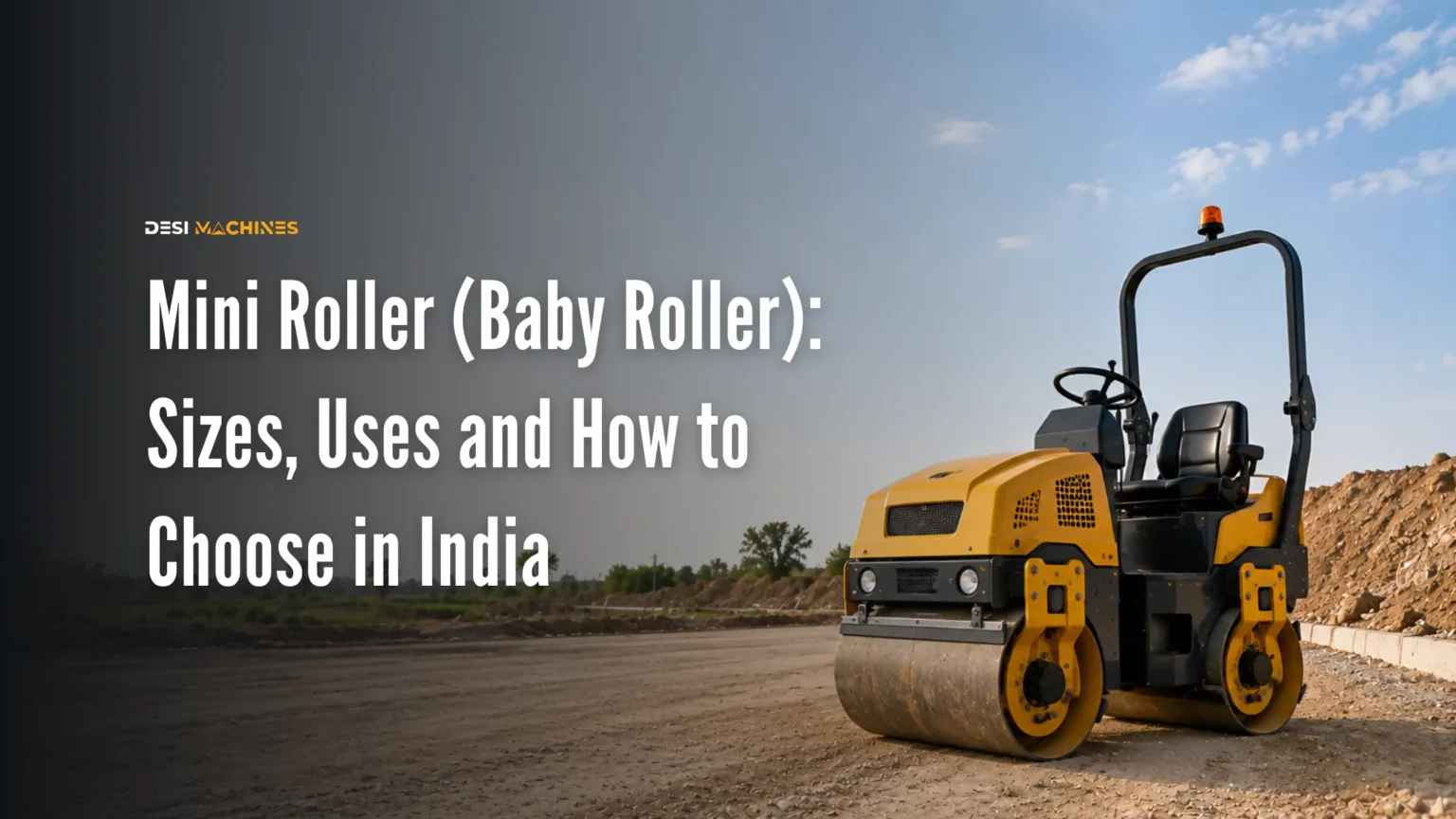
A mini roller is a ride-on roller with two smooth steel drums, one in front and one at the back, joined by an articulated joint in the middle so the machine can bend as it turns. Both drums vibrate. That vibration is what does the compaction: the drum shakes the soil or the asphalt so the small particles settle into the gaps between the big ones and the layer becomes dense and stable.
The name “baby roller” comes from the size, not from any technical class. Once contractors started seeing 10 Tonne soil compactors on highway work, the 3 Tonne machine doing the internal roads became the baby, and the name stuck across states and languages. A dealer will also call the same machine a mini tandem roller. Tandem means the two drums sit one behind the other, both of them driving and both of them vibrating, unlike a soil compactor which has one big drum at the front and rubber tyres at the back. The full tandem roller guide sets this class beside the 9 Tonne machines that share the same two-drum layout.
Where it fits in the family is easy to see once you compare machine types side by side. The types of compactors guide covers every category from hand-guided plates up to 12 Tonne machines, and the road rollers guide goes deeper into drum design and specifications.
How much does a baby roller weigh, and how wide is the drum?
Operating weight in this class runs from about 1,575 kg to 3,535 kg, and drum width from 800 mm to 1,250 mm. Those two numbers decide most of what the machine can and cannot do. Weight decides how hard it presses down; drum width decides how much ground one pass covers and, more importantly, whether the machine fits down the lane you bought it for.
| Model | Operating weight | Drum width | Engine power | Centrifugal force | Water tank |
|---|---|---|---|---|---|
| Dynapac CC800 | 1,575 kg (1.6 Tonne) | 800 mm | 24 HP (18 kW) | 17 kN | 110 L |
| Dynapac CC125 CEV-V | 2,800 kg (2.8 Tonne) | 1,200 mm | 24.8 HP (18.5 kW) | 27 kN | 160 L |
| CASE 450NX | 2,900 kg (2.9 Tonne) | 1,000 mm | 25 HP (18.5 kW) | 28.4 / 16.2 kN | 150 L |
| Dynapac CC1250 CEV-V | 3,000 kg (3 Tonne) | 1,200 mm | 35 HP (26.1 kW) | 27 kN | 160 L |
| JCB VMT330 | 3,300 kg (3.3 Tonne) | 1,250 mm | 45 HP (33 kW) | 45 kN | 210 L |
| Escorts EC 3664 | 3,300 kg (3.3 Tonne) | 1,200 mm | 47 HP (35 kW) | 47 / 35 kN | 200 L |
| Ammann ARX 32.2 | 3,375 kg (3.4 Tonne) | 1,200 mm | 48.5 HP (36.2 kW) | 47 / 39 kN | 340 L |
| L&T 491 | 3,450 kg (3.5 Tonne) | 1,225 mm | 48.5 HP (36 kW) | 45 / 31 kN | 170 L |
Table 1: Mini roller (baby roller) sizes on live models, India (figures as of August 2026)
Two figures in that table need explaining. Centrifugal force, measured in kilonewtons (kN), is the extra downward punch the vibrating drum adds on top of the machine’s own weight, so a 3.5 Tonne roller with 45 kN behind it hits the ground far harder than its weight alone suggests. The water tank feeds the sprinkler that wets the drums; without it, hot bitumen sticks to the steel and tears the surface you just laid. On a full day of asphalt work a 150 to 200 litre tank usually needs one refill.
Where two figures are shown, as in 47 / 35 kN, the machine has two vibration settings. High for thicker layers and base material, low for the finish pass and for thin bituminous work.
What is the difference between a baby roller and a full-size road roller?
The honest answer is a factor of three in weight and a factor of five in vibration. A baby roller compacts thin layers well and deep layers badly. A full-size soil compactor does the opposite, and the specifications show exactly why.
| Specification | L&T 491 (mini tandem) | JCB VM117 (soil compactor) |
|---|---|---|
| Operating weight | 3,450 kg (3.5 Tonne) | 11,525 kg (11.5 Tonne) |
| Drum width | 1,225 mm | 2,100 mm |
| Engine power | 48.5 HP (36 kW) | 74 HP (55 kW) |
| Centrifugal force | 45 / 31 kN | 256 / 146 kN |
| Nominal amplitude | 0.6 mm | 1.8 / 0.8 mm |
| Vibration frequency | 65 / 55 Hz | 32 / 36 Hz |
| Static linear load | 14 kg/cm | 30.96 kg/cm |
Table 2: Mini roller against a full-size soil compactor (figures as of August 2026)
Amplitude is how far the drum lifts off the ground on each shake, measured in millimetres, and it is the single number that decides how deep the compaction reaches. At 0.6 mm the energy of a mini roller works the top 100 to 150 mm of a layer. At 1.8 mm a soil compactor drives that energy down through 300 mm or more of loose earth. Frequency runs the other way: the small machine shakes faster, at 55 to 70 Hz against roughly 30 to 36 Hz on the big one, which gives a smoother, tighter surface finish on a thin layer.
So the choice is not about which machine is better. Use the baby roller for the last 150 mm and the finish, and the full range of soil compactors and rollers for the earth layers underneath. If you want the physics behind lifts and passes in more detail, the soil compaction guide explains how density is actually achieved and tested.
Where does a mini roller actually earn its money in India?
It earns it in the places a 10 Tonne machine cannot go, and there are more of those than most first-time buyers expect. Internal colony roads and gali work, where the road is 3 metres wide with drains on both sides. Footpaths, cycle tracks and paver-block bases in municipal work. Patch repair and overlay on existing bitumen roads, where a heavy machine would crack the old surface. Trench backfill after a water or cable line, compacted in layers so the road does not sink six months later. Parking areas, petrol pump forecourts, factory yards and the approach roads inside a housing project.
Two commercial realities go with that list. Municipal and Smart City tenders frequently specify a small roller by weight class, so owning one qualifies you for work a soil compactor cannot bid for. And because the machine is small enough to load onto a tractor trolley or a light truck, moving it between three sites in a week costs a fraction of what a 12 Tonne machine costs to shift on a low-bed trailer.
The limitation is equally clear. A baby roller is not the machine for a highway embankment, a canal bank or any deep fill. Put it on 300 mm of loose earth and it will polish the top while the layer below stays soft, and the failure will show up as settlement within a year.
Can a baby roller compact soil, or is it only for asphalt?
It compacts both, provided you lay the soil in thin layers. The rule that matters is layer thickness, not the material. Spread earth in lifts of 100 to 150 mm, run four to six passes with vibration on, and a 3 Tonne tandem roller reaches the density a small road needs. Spread it in one 300 mm lift and no number of passes will fix the layer underneath.
A pass means one travel of the drum over the same strip, and each strip should overlap the last by about a quarter of the drum width so no line is left soft. On soil, keep the vibration on high; on the finish pass, and on any thin bituminous layer, switch to low amplitude or run static, or the drum will start loosening what it has already compacted. That trade-off is the whole subject of the static versus vibratory roller guide, and the vibratory roller guide explains how the eccentric weight inside the drum generates the force in the first place.
One caution for wet clay and black cotton soil, common across Maharashtra, Madhya Pradesh and parts of Gujarat and Karnataka. A smooth drum works these soils poorly at high moisture, whatever the machine size, because the clay simply moves under the drum instead of densifying. That is padfoot and sheepsfoot territory, and there is no small-machine shortcut around it.
Mini roller or plate compactor: which one for a small job?
Pick by area and by access, not by price. A plate compactor is a walk-behind machine weighing 60 to 500 kg that one man carries into a trench or a basement. A mini roller is a ride-on machine that needs a lane to drive down and a way to get onto site.
For a narrow trench, a foundation pit, a small patch of paver blocks or work behind a boundary wall, the plate wins on access every time and costs a fraction as much. For a continuous stretch of road, a footpath running a few hundred metres, or any surface where the finish will be visible, the roller wins on both speed and quality, because a plate leaves overlapping marks that a smooth drum irons out. Many contractors end up owning both, and the plate compactor guide sets out where the smaller machine is genuinely the right answer.
What does a baby roller cost in India?
Mini rollers in this class sit roughly between ₹11 Lakh and ₹21 Lakh (indicative, as of August 2026), against ₹30 Lakh and upwards for a full-size soil compactor. Engine power and drum width move the figure more than brand name does: the 24 HP machines sit at the bottom of the band and the 45 to 48.5 HP machines at the top.
| Model | Indicative price | Engine power | Drum width |
|---|---|---|---|
| Escorts EC 3664 | ₹11.4–16.8 Lakh | 47 HP (35 kW) | 1,200 mm |
| Dynapac CC800 | ₹12.4–17.9 Lakh | 24 HP (18 kW) | 800 mm |
| Dynapac CC125 CEV-V | ₹13.3–17.9 Lakh | 24.8 HP (18.5 kW) | 1,200 mm |
| Dynapac CC1250 CEV-V | ₹13.3–17.9 Lakh | 35 HP (26.1 kW) | 1,200 mm |
| L&T 491 | ₹14.3–17.9 Lakh | 48.5 HP (36 kW) | 1,225 mm |
| CASE 450NX | ₹14.3–18.9 Lakh | 25 HP (18.5 kW) | 1,000 mm |
| JCB VMT330 | ₹14.3–21.0 Lakh | 45 HP (33 kW) | 1,250 mm |
| Ammann ARX 32.2 | ₹14.3–21.0 Lakh | 48.5 HP (36.2 kW) | 1,200 mm |
Budget beyond the machine itself. Transport to site, an operator who understands passes and amplitude rather than one who only knows forward and reverse, and the running items: diesel, filters, drum scrapers and the sprinkler system, which blocks quickly on hard water and needs the filter cleaned weekly. Most buyers in this bracket pay in instalments, and you can work out what the monthly outgo looks like through construction equipment finance before committing.
Compare live specifications and current prices across the full tandem roller range and talk to our team before you fix a number, because variant, state taxes and attachments all move it.
How to choose the right mini roller for your work
Five questions settle it, in this order.
How wide is the narrowest job you take? Measure it. If you work 3 metre colony lanes with drains, an 800 mm or 1,000 mm drum turns and finishes where a 1,250 mm machine has to reverse repeatedly. If your work is open ground and municipal roads, the wider drum covers more in every pass and pays for itself in time.
Soil, bitumen, or both? Mostly earth and base layers, take the higher centrifugal force and the two-stage vibration. Mostly bitumen overlay and finishing, a smaller machine with a good sprinkler and low amplitude is the better buy.
How will the machine reach site? A 1.6 Tonne roller loads onto a tractor trolley. A 3.5 Tonne machine usually needs a truck with a ramp. If you shift sites weekly, that difference is a real monthly cost.
Who services it in your district? A compaction job stops dead when the vibration bearing or the water pump fails. Ask the dealer where the nearest service engineer sits and what the parts turnaround is, and ask two existing owners in your area rather than only the showroom.
What do local tenders specify? If municipal work in your area asks for a machine of a stated weight class, buy to that specification. A machine that cannot be entered in the tender you were counting on is an expensive lesson.
Mini roller, in short
The baby roller is a 1.5 to 3.5 Tonne double-drum vibratory roller with a drum 800 to 1,250 mm wide, built for thin layers, tight access and finish quality rather than for deep earth compaction. Lay soil in 100 to 150 mm lifts, run four to six overlapping passes, keep the sprinkler working on bitumen, and it will do everything a colony road, a footpath or a patch repair needs. Anything deeper belongs to a full-size soil compactor.
Ready to compare machines? Browse the tandem roller range and the wider compactor and road roller range, or start with the complete compactor guide if you are still learning how compaction works.
Many contractors hire a baby roller before they buy one; the guide to road roller rental in India covers what a roller costs per day and what to check before you accept it.
The tightest corner a machine can reach is a published figure, and mini rollers turn inside roughly half the radius a full size tandem needs; the class-by-class numbers are in road roller steering and turning radius.
Specifications and prices on this page are taken from the manufacturer data listed on DesiMachines at the time of writing. Prices, specifications and features are indicative, vary by variant, location and date, and should always be confirmed with the official OEM or authorised dealer before any purchase decision. DesiMachines is not liable for decisions taken on the basis of information that may have changed after publication.