
 Excavator
316 models
 Backhoe Loader
54 models
 Crane
68 models
 Concrete Mixer
79 models
 Wheel Loader
54 models
 Compactor / Roller
45 models
 Motor Grader
42 models

 Concrete Pump
66 models
 Skid Steer Loader
11 models


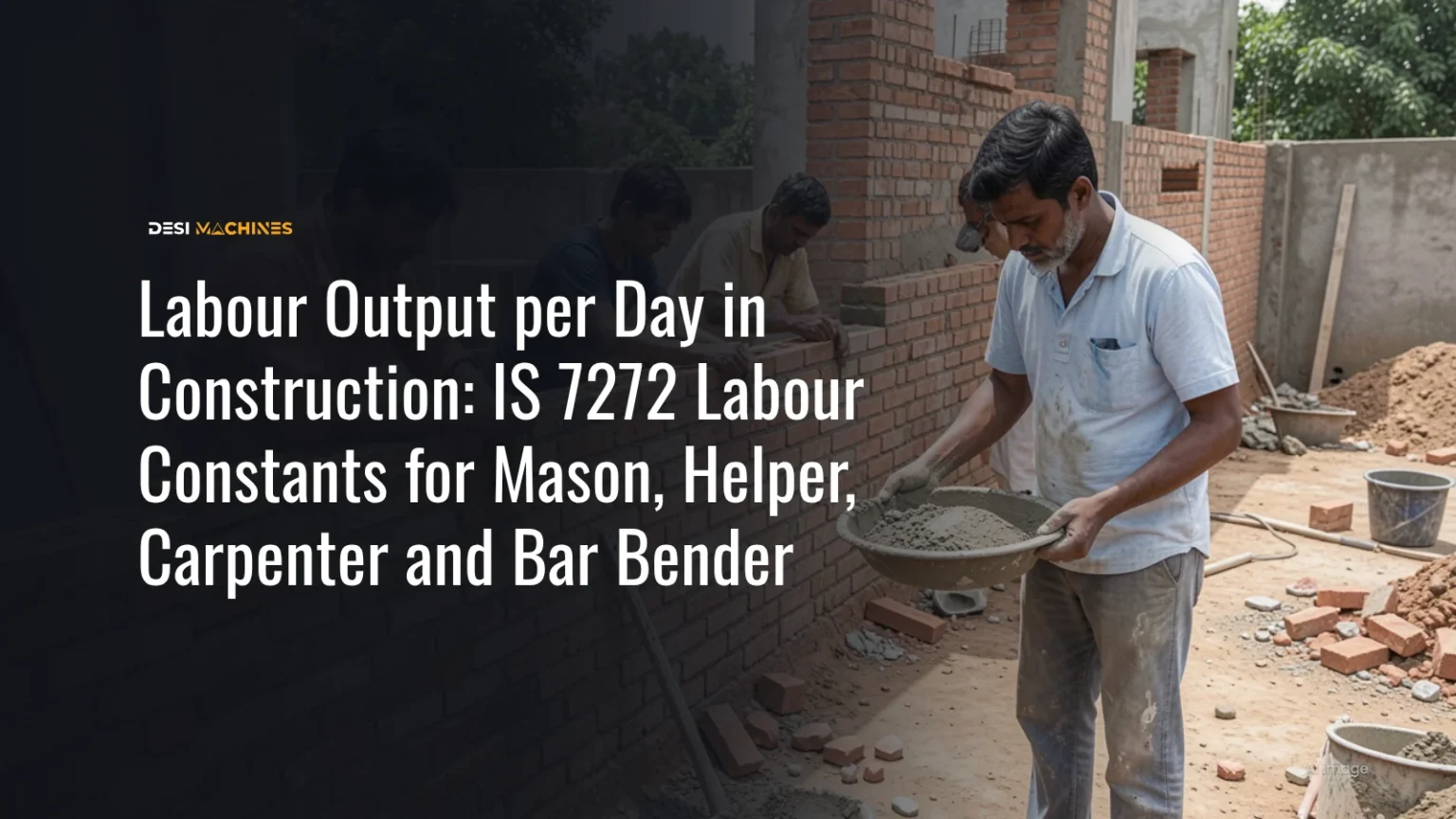
A mason in north India lays about 4 m² (43 sq ft) of 230 mm brick wall in an 8-hour day, with 1.6 helpers working alongside. That figure comes from IS 7272 (Part 1), the Indian Standard that sets labour output for building work. It gives each item as a labour constant, the days of work one unit takes, and output per day is that constant turned upside down.
The standard covers digging, concrete, brickwork, shuttering, steel, plaster and flooring. This guide puts its figures in one table, converts each one to work per day in metric and feet units, and then shows how the constants are used in a rate analysis and a labour estimate for one room.
There are no rupee figures here. Wages change by state and season; the days a square metre of plaster takes do not.
What is labour output per day in construction?
Labour output per day is the quantity of one item of work that one worker finishes in a normal working day. IS 7272 writes the same fact the other way round, as a labour constant: the days of each trade needed for one unit of work. Amendment No. 1 (February 1979) fixes that day at 8 working hours.
The two numbers are reciprocals, so either one gives you the other:
- Output per day = 1 ÷ labour constant. A plaster constant of 0.08 mason-days per m² means 1 ÷ 0.08 = 12.5 m² per mason per day.
- Labour days for a job = quantity × labour constant. 60 m² of that plaster takes 60 × 0.08 = 4.8 mason-days.
Estimators prefer the constant because it multiplies straight into a quantity. Site supervisors prefer output per day because it tells them how many people to put on a job tomorrow morning.
Every item names more than one trade. A brick wall needs a mason, helpers who carry bricks and mortar, and a water carrier for wetting and curing. The standard’s own words for the last two are mazdoor and bhisti. This guide calls them helper and water carrier.
Labour output constants for building work (IS 7272 table)
The table below takes the main items from Table 1 of IS 7272 (Part 1) : 1974. The first two columns are the standard’s constants. The last column is our arithmetic: 1 ÷ the lead trade’s constant.
| Item of work (unit) | Lead trade, days per unit | Helper days per unit | Water carrier days per unit | Lead trade output per day |
|---|---|---|---|---|
| Trench excavation, soft soil, up to 1.5 m deep (m³) | Mate 0.05 | 0.50 | – | 2.0 m³ (70.6 cft) per helper |
| Area excavation, hard soil, up to 1.5 m deep (m³) | Mate 0.06 | 0.62 | – | 1.6 m³ (57 cft) per helper |
| Brickwork, one brick (230 mm) thick (m²) | Mason 0.25 | 0.40 | 0.10 | 4.0 m² (43 sq ft) |
| Brickwork, half brick (115 mm) thick, cement mortar (m²) | Mason 0.12 | 0.20 | 0.07 | 8.3 m² (90 sq ft) |
| Brickwork thicker than one brick (m³) | Mason 0.94 | 1.80 | 0.20 | 1.06 m³ (37.6 cft) |
| Shuttering, columns and walls (m²) | Carpenter 0.25 | 0.20 | – | 4.0 m² (43 sq ft) |
| Shuttering, slabs and roofs (m²) | Carpenter 0.23 | 0.20 | – | 4.3 m² (47 sq ft) |
| Shuttering, sides and soffits of beams (m²) | Carpenter 0.30 | 0.20 | – | 3.3 m² (36 sq ft) |
| Bar reinforcement, cut, bent, placed and tied (quintal, 100 kg) | Bar bender 1.00 | 1.00 | – | 100 kg |
| RCC in footings, mixer mixed (m³) | Mason 0.17 | 2.00 | 0.90 | see the concrete section |
| RCC in slabs and roofs, mixer mixed (m³) | Mason 0.24 | 2.50 | 0.90 | see the concrete section |
| 15 mm cement plaster, inside wall (m²) | Mason 0.08 | 0.10 | 0.10 | 12.5 m² (135 sq ft) |
| 15 mm cement plaster, outside wall (m²) | Mason 0.06 | 0.10 | 0.10 | 16.7 m² (179 sq ft) |
| 15 mm cement plaster, ceiling (m²) | Mason 0.08 | 0.10 | 0.10 | 12.5 m² (135 sq ft) |
| 40 mm PCC floor in alternate bays (m²) | Mason 0.08 | 0.12 | 0.10 | 12.5 m² (135 sq ft) |
| Precast terrazzo tiles on 10 mm mortar, laying (m²) | Mason 0.12 | 0.20 | 0.10 | 8.3 m² (90 sq ft) |
Read the notes in the standard before you use a line, because they change what the figure covers. Brickwork constants include scaffolding but not the mixing of mortar, which is extra at 0.75 helper-days and 0.07 water-carrier days per m³ of hand-mixed mortar. Plaster figures include mixing. The amendment says that for plaster and flooring, the water carrier’s time includes curing. Mixing the concrete for the PCC floor is extra.
Reading the chart
Each bar is 1 ÷ the lead trade’s labour constant from the table above, in square metres per worker per day. Finishing work such as plaster and floors moves three to four times faster per skilled worker than shuttering or a full-brick wall, so the same mason-day buys very different amounts of work.
How much brickwork can a mason do in a day?
About 4 m² (43 sq ft) of 230 mm wall, or 8.3 m² (90 sq ft) of 115 mm partition wall, per mason per 8-hour day. For walls thicker than one brick the standard measures by volume: 0.94 mason-days per m³, which is 1.06 m³ (37.6 cft) a day.
The two ways of measuring agree. A 230 mm wall at 0.25 days per m² works out to about 1.09 mason-days per m³ of wall, close to the 0.94 for thick walls, where a mason spends less time per brick on corners and faces.
The helper count matters as much as the mason. One-brick work needs 0.40 helper-days per m², which is 1.6 helpers for every mason. Put one helper on a mason and the mason waits for bricks. The standard says these figures hold for any mortar mix, and that its brickwork constants include the labour for scaffolding.
How much concrete can a gang place in a day?
For concrete, the helpers set the pace, not the mason. A cubic metre of mixer-mixed RCC in a roof slab takes 0.24 mason-days but 2.50 helper-days and 0.90 water-carrier days, so a gang of one mason, ten helpers and three or four water carriers places roughly 4 m³ (141 cft) in a day. The constants for RCC include mixing, pouring, compacting and curing, and leave out shuttering and steel.
| RCC member, mixer mixed (per m³) | Mason | Helper | Water carrier | Mixer operator, mixer and vibrator (each) |
|---|---|---|---|---|
| Footings and column bases | 0.17 | 2.00 | 0.90 | 0.07 |
| Slabs and roofs | 0.24 | 2.50 | 0.90 | 0.07 |
| Beams | 0.20 | 3.00 | 0.90 | 0.07 |
| Columns, ground floor | 0.23 | 3.50 | 0.90 | 0.10 |
| Chajjas (sunshades) up to 150 mm thick | 0.30 | 3.50 | 0.90 | 0.10 |
| Stairs | 0.30 | 4.30 | 0.90 | 0.07 |
The pattern is easy to see. Narrow, high or awkward members need more carrying and placing per cubic metre, so stairs take more than twice the helper time of a footing.
Machine mixing cuts the helper time. For plain concrete in foundations, hand mixing takes 2.13 helper-days per m³ and mixer mixing 1.63, a saving of 0.50 helper-days, or about 23 per cent. The standard assumes the concrete travels up to 30 metres from where it is mixed to where it is placed; a longer haul means more carrying. That is why a large slab pour is where a contractor starts to look at concrete mixers, from small self-loading units such as the Schwing Stetter SLM 2100, AJAX ARGO 2000 and CONMAT CSLM 2500 to ready-mixed supply; the guide to RMC vs site-mixed concrete covers that choice.
How much shuttering and steel can a carpenter and bar bender do?
A carpenter fabricates and erects about 4.3 m² (47 sq ft) of slab shuttering a day, 4.0 m² (43 sq ft) for columns and walls, and 3.3 m² (36 sq ft) for the sides and soffits of beams. Each needs 0.20 helper-days per m² on top. The figures cover fabrication and erection with all props, struts and braces, and oiling the form. The 1979 amendment says they are for formwork with wooden planks. To get the square metres, use the method in shuttering area calculation.
For steel, the standard counts in quintals of 100 kg: one bar-bender day and one helper day per quintal. That covers cutting to length, hooks, cranks and bends, lifting the bars into place, and tying them firmly enough that they do not move while the concrete goes in. So a bar bender with one helper handles about 100 kg a day. Your steel weight comes from the bar bending schedule.
What is the plaster and flooring output of a mason per day?
For 15 mm cement plaster, a mason does about 12.5 m² (135 sq ft) a day on an inside wall or ceiling and 16.7 m² (179 sq ft) on an outside wall. Each square metre also needs 0.10 helper-days and 0.10 water-carrier days. A two-coat outside finish, a 10 mm cement-sand base with 5 mm of marble powder and stone grit on top, is much slower at 0.15 mason-days per m², about 6.7 m² (72 sq ft) a day. The standard has no separate line for 12 mm plaster, so the guide to plaster quantity uses the 15 mm figure for planning.
Floors follow the same logic. A 40 mm PCC floor laid in alternate bays takes 0.08 mason-days per m², or 12.5 m² (135 sq ft) a day; 25 mm PCC takes 0.07. Precast terrazzo tiles laid on 10 mm mortar take 0.12 mason-days per m², about 8.3 m² (90 sq ft) a day, with cutting, grinding and polishing as a separate item.
The 1974 table has no line for ceramic or vitrified tiles, AAC blocks or gypsum plaster, because those were not common building materials then. For those, use your contractor’s measured output or your state’s schedule of rates, and treat any thumb rule you are given as a figure to check on site. The tile quantity guide covers the materials side of tiling.
How do labour constants enter a rate analysis?
A rate analysis prices one unit of one item. The labour part of that rate is each trade’s constant multiplied by that trade’s daily wage, then added up. For one square metre of inside plaster:
Labour cost per m² = 0.08 × mason wage + 0.10 × helper wage + 0.10 × water-carrier wage
The constant stays fixed. The wage is the local one and changes from place to place and year to year, which is why the standard gives days and not money. Materials, machine hire, sundries, and overheads and profit are then added to get the full rate, as the guide to the construction estimate format explains line by line. For this year’s daily wages by trade, see labour rate per day in India.
The standard’s foreword explains why it exists. Different departments in the same town were using different labour constants for the same item, so the same work carried different rates. IS 7272 was issued to bring those constants into line, which is why a schedule of rates built on it can be checked.
Earthwork works the same way, but a machine changes it. Digging a trench by hand at 0.50 helper-days per m³ is fine for a few cubic metres. For a long foundation trench, the hourly output of a backhoe loader such as the JCB 3DX or JCB 2DX replaces the helper days. The excavation rate per cubic metre builds that machine rate from start to finish, and excavator productivity explains how machine output is measured.
Worked example: labour days for one room
Take one room with these quantities off the drawing: 32 m² (344 sq ft) of 230 mm brick wall, a 1.6 m³ (56.5 cft) RCC roof slab, 13.6 m² (146 sq ft) of slab shuttering, 130 kg of steel and 60 m² (646 sq ft) of inside plaster. Multiply each quantity by its constants:
| Item | Quantity | Mason | Helper | Water carrier | Carpenter | Bar bender |
|---|---|---|---|---|---|---|
| Brick wall, 230 mm | 32 m² | 8.0 | 12.8 | 3.2 | – | – |
| RCC slab, mixer mixed | 1.6 m³ | 0.4 | 4.0 | 1.4 | – | – |
| Slab shuttering | 13.6 m² | – | 2.7 | – | 3.1 | – |
| Steel | 1.3 quintal | – | 1.3 | – | – | 1.3 |
| Inside plaster, 15 mm | 60 m² | 4.8 | 6.0 | 6.0 | – | – |
| Total, worker-days | 13.2 | 26.8 | 10.6 | 3.1 | 1.3 |
The slab also needs about 0.1 days each of mixer operator, mixer and vibrator. Mixing the mortar for the brickwork is extra, at 0.75 helper-days per m³ of mortar your material calculation gives.
Two things stand out. Helpers outnumber masons two to one across the room, so a contractor who brings one helper per mason will run late. And a worker-day total is not a calendar time: 13 mason-days is one mason for a little over two six-day weeks, or three masons for under a week, as long as the work in front of them is ready. The house cost calculator shows where this labour line sits in the full estimate.
Why your site will not match the table exactly
The constants are averages measured with care, not promises. The Central Building Research Institute, Roorkee, timed work on building sites in Delhi and Roorkee, on buildings up to 10 m high, and took enough readings for an accuracy of ±5 per cent at 95 per cent confidence. The figures already include rest time, normal hold-ups and extra time for small jobs, so they are not the output of a mason working flat out for one hour.
Four things move your real output away from them:
- Region. Part 1 covers the north zone only: Punjab, Haryana, Delhi, Uttar Pradesh and Rajasthan. The standard says other zones would be covered in separate parts.
- Height and access. Work above 10 m, or with long carries, takes longer than the measured sites did.
- Small or broken-up work. A wall full of openings, or a job that starts and stops, loses time the average does not show.
- Methods since 1974. Machine mixing, pumps, steel props and power tools change the helper count most of all.
Use the table to check a quote or plan a gang, then track your own crew’s output for a week and use that figure from then on. If a labour-only quote implies a mason laying twice the standard’s brickwork a day, ask how. More estimating guides sit under construction cost. When the concrete work comes up, compare concrete mixer models and talk to a dealer near your site.
Prices, specifications and features are indicative, vary by variant, location and date, and should always be confirmed with the official OEM or authorised dealer before any purchase decision. DesiMachines is not liable for decisions taken on the basis of information that may have changed after publication.
Code reference: IS 7272 (Part 1) : 1974 (recommendation for labour output constants for building work, north zone, reaffirmed 2010), foreword clauses 0.2 to 0.4, clause 1.1 and Table 1 items (i) to (viii), with Amendment No. 1 (February 1979: 8 working hours a day, units in m² and m³, wooden-plank formwork, water carrier time includes curing). Output per day and the worked example are our arithmetic from those constants.
Machines, tenders and news for this industry: Building Construction