
 Excavator
316 models
 Backhoe Loader
54 models
 Crane
68 models
 Concrete Mixer
79 models
 Wheel Loader
65 models
 Compactor / Roller
45 models
 Motor Grader
42 models

 Concrete Pump
66 models
 Skid Steer Loader
11 models


Builder hoists on Indian sites lift 250 kg to 1 tonne on a wire rope if they are the winch type that Indian Standard IS 12466 covers, and 2 to 3 tonnes in a closed cage if they are rack-and-pinion hoists that climb a toothed mast. The winch type is built to carry material only. The rack-and-pinion type is the one built to carry workers, and that one difference decides its parts, its safety devices and the checks you run on it.
This guide names the parts of both kinds, gives their capacities from the standard and from a maker’s sheet, lists the safety devices India’s construction safety rules ask for, and ends with a daily checklist. Which floors call for a hoist at all, against a telehandler or a tower crane, is set out in the guide to equipment used in high rise building construction, so it is only touched on here.
What is a builder hoist, and what are its two types?
A builder hoist is a lift that is put up for the length of a building job and taken down when the building is done. It runs up and down a steel mast fixed beside the structure. On Indian sites the name covers two different machines.
The first is the winch-type hoist, the one most small and mid-size builders use. IS 12466:2012, the Bureau of Indian Standards’ code for builder’s hoists, defines it as a platform hoist “with or without tilting bucket” and says it is made “for hoisting building material”. A diesel engine or an electric motor turns a winch drum, the drum winds a wire rope, and the rope runs over a pulley at the top of the mast and pulls the platform up. The standard lists it as stationary or mobile, with a single or double platform. On a double-platform hoist, one platform comes down while the other goes up.
The second is the rack-and-pinion hoist. Here the motors ride on the cage itself. Each motor turns a small gear wheel (the pinion) that meshes with a toothed bar (the rack) bolted up the mast, so the cage climbs the mast the way a gear walks along a toothed rail. There is no lifting rope to break. These hoists come with a closed car and are the ones used to move people on tall towers.
| Point | Winch-type builder hoist | Rack-and-pinion hoist |
|---|---|---|
| How it lifts | Winch winds a wire rope over a head pulley | Motors on the cage drive pinions up a rack on the mast |
| Rated load | 0.25, 0.5, 0.75 or 1 tonne (IS 12466, clause 5.1) | 2,000 or 3,000 kg on the Alimak Levato 650 |
| Speed | 0.3 to 0.5 m/s, about 18 to 30 m a minute (IS 12466) | 40, 60 or 90 m a minute, by model (Levato 650) |
| Height | Mobile (portable) hoist normally up to 15 m (IS 12466, clause 5.3); a stationary tower is tied to the building and goes higher | 150 to 200 m on the Levato 650; more on request |
| Carries | Material only: bricks, cement bags, steel, mortar in barrows | Workers and material, in a closed car |
| Load space | Open platform, with or without a tilting bucket | Car 1.5 m wide, 3.2 to 5.0 m long, 2.3 or 2.5 m high (Levato 650) |
| Power | Diesel engine, electric motor or both (IS 12466, clause 7.1.1) | Two or three electric motors of 9.1 to 22 kW with frequency control (Levato 650) |
The two columns are not two sizes of the same machine. A winch hoist is a simple machine of a mast, a rope and a small engine, so it suits a block of a few floors where the only cargo is material. Once workers have to go up and down every day, or the building runs past what a rope hoist can safely serve, the job needs a rack-and-pinion car.
What are the parts of a builder hoist?
IS 12466 splits a winch-type hoist into three parts: the winch unit, the mast, and the platform. Figure 1 numbers them, with the parts of a rack-and-pinion hoist beside them for comparison.
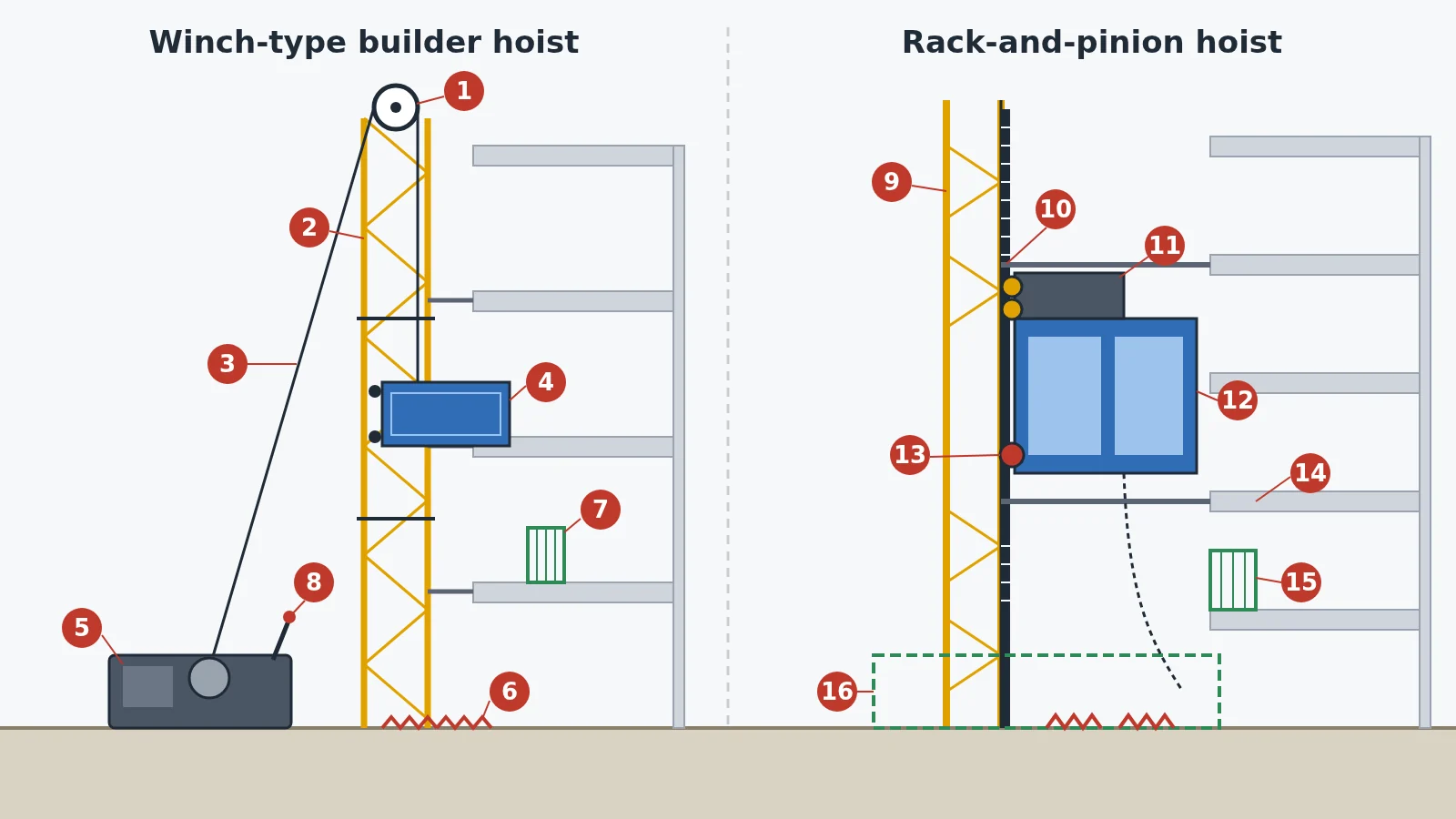
Winch-type hoist (1 to 8)
- Head pulley: fixed on the top mast section, which also carries the anchor for the rope.
- Mast sections: steel sections of not more than 3 m each (clause 7.1.3), socketed and bolted one on top of the next, made in jigs so every section is an exact copy.
- Wire rope: galvanised, hemp-cored, of 6 × 19 or 6 × 37 construction to IS 2266, with a factor of safety of at least 4. That means the rope’s breaking load is at least four times the most it is asked to hold.
- Platform: it slides on four hardened steel rollers running in gunmetal bushes, and can carry a tilting bucket for loose material.
- Winch unit: the engine or motor drives the winch drum through V-belts and pulleys. The usual kind is a friction winch, in which fibre rollers press the rope drum to lift and release it to stop.
- Buffer springs: heavy helical springs in the bottom mast section, there to take the shock if the platform falls.
- Landing gate: one at each floor where material is loaded or taken off.
- Brakes: a hand-lever brake and a foot brake on the winch, with adjustable shoes that can be locked on.
The standard adds an emergency brake that holds the platform if the rope fails. In the standard’s own test, serrated cam blocks (blocks with a toothed face) jam on to the mast when the rope goes slack. A crane hook at the top of the mast is an option the buyer and maker can agree on.
Rack-and-pinion hoist (9 to 16)
- Mast sections: on the Levato 650 these are 650-type tubular steel sections 1.508 m long.
- Rack: the toothed bar fixed along each mast section (module 5 on the Levato).
- Drive unit: electric motors, gearbox and pinions that climb the rack, on frequency control for a smooth start and stop.
- Cage or car: closed, with doors on the landing side.
- Safety device: a separate brake on the rack that stops the car if it runs too fast.
- Mast ties: steel arms that fix the mast to the building slab at set heights.
- Landing gates: one at every floor served.
- Base enclosure and buffers: a fence round the bottom of the mast, with buffers under the car.
Both kinds need a steady power supply. A winch hoist may run off its own diesel engine; a rack-and-pinion hoist needs a three-phase connection or a diesel generator on the construction site sized for its motors, the same sum worked through for the tower crane power supply.
How much load can a builder hoist lift?
A winch-type builder hoist is rated for 0.25, 0.5, 0.75 or 1 tonne of safe working load under IS 12466. Safe working load means the material on the platform, not counting the platform and bucket. The standard asks for the real capacity to be 10 percent above that rating, and it proof-tests each class at a higher load: 0.3 tonne for the 0.25-tonne hoist, 0.6 for the 0.5, 0.9 for the 0.75 and 1.25 for the 1-tonne hoist.
Put that into site terms. Ten 50 kg cement bags weigh 500 kg, so they fill a 0.5-tonne hoist on their own. A barrow of wet mortar, the barrow itself and the worker’s habit of adding “one more bag” are how a hoist ends up over its rating. Weigh a typical load once, and paint the answer on the platform beside the capacity notice.
The construction safety rules add margins of their own. The Building and Other Construction Workers Central Rules, 1998, the Labour Ministry’s site safety rules under the BOCW Act, ask in rule 65 that:
- the hoisting engine is rated for at least one and a half times the heaviest load it will move;
- the platform can carry its maximum load with a factor of safety of at least three;
- overhead beams and their supports carry the full live and dead load with a factor of safety of at least five.
A rack-and-pinion hoist is rated in kilograms per car by its maker. The Alimak Levato 650 sheet gives 2,000 kg or 3,000 kg per car, at 40 to 90 m a minute depending on the model. If the car also carries people, the maker’s plate gives the number allowed, and the rules ask for that number on a notice in the car.
What safety devices must a builder hoist have?
Most of the devices the rules ask for guard the landings, because that is where a worker stands beside an open shaft to load and unload. Table 2 lists them with the rule that asks for each one.
| Device | What it does | Required by |
|---|---|---|
| Landing gates with interlock | Gates at least 2 m high and gridded so you can see through them. The platform cannot leave the landing until the gate is shut, and the gate cannot open unless the platform is there. | BOCW Central Rules, rule 65(d) |
| Shaft fencing | Rigid panels on all sides at ground level and round the access at every other level; walls at least 2 m above each floor except at the approach | Rule 65(b) and (c) |
| Upper limit stop | Stops the hoisting engine as soon as the platform reaches its highest stopping place | Rule 65(p) |
| Overrun space | Clear travel above the top stop and below the bottom stop, so a platform that overruns hits nothing | Rule 65(h) |
| Safety gear (rope-break brake) | Holds the loaded platform if the hoisting rope breaks; on test the platform must not slip more than 1 m | Rule 65(x); IS 12466, clauses 7.1.5 and 9.2 |
| Landing lock | Stops the cage or platform moving while a worker steps on or off | Rule 65(z) |
| Toe-boards and mesh | On the sides of the platform not used for loading, so nothing falls off | Rule 65(za) |
| Capacity notices | Load in kg on the platform and on the engine; the number of persons on a passenger hoist; “not for persons” on a goods hoist; written in Hindi and the local language | Rule 65(zf) |
| Cover and guards | A cover over the top of the shaft; all gearing on the hoisting engine enclosed; electrical equipment earthed | Rule 65(i), (m) and (o) |
| Bottom stop on a passenger hoist | An automatic device that brings the cage to rest above the lowest point it can travel to | Rule 78(c) |
The upper limit stop and the interlocks on the gates are the same family of devices as the limit switches on cranes, and they fail the same way: someone ties a gate switch shut to save a few seconds at every landing. A hoist with a bypassed interlock should be stopped until it is fixed, because the interlock is the only thing between a worker and an open shaft.
Can workers ride a builder hoist?
Not on a material hoist. Rule 65(u) of the BOCW Central Rules says a hoist not designed to carry persons must not be set in motion from its own platform, and its notice must say it is not meant for carrying persons. That is why a winch hoist is worked from the ground, by an operator at the winch.
Rule 77 allows a worker to be raised by a power-driven lifting appliance in a few places only: the driver’s platform of a crane, a hoist built for people, or an approved suspended scaffold. Rule 78 then sets what a hoist built for people needs: a closed cage that stops riders falling out or being trapped or struck, a gate on every side that opens to a landing, interlocks on the cage gates and on every gate in the hoistway enclosure, and the automatic bottom stop in Table 2. A rack-and-pinion passenger hoist is built round exactly those points, which is why it is the machine to hire when the crew itself has to go up.
For work at height on a facade or a ceiling, where the worker needs to stay up at the work and not ride between floors, the choices are set out in man lift vs crane vs telehandler.
Builder hoist checklist: daily, after erection and yearly
The BOCW Central Rules set two fixed checks in rule 56. A competent person must test and examine a lifting appliance, which includes a hoist, before it is first used, after any repair or alteration that could affect its strength, after it is erected on a site, and at least once every five years. The same appliance must also be thoroughly examined by a competent person at least once every twelve months. For a hoist that is moved from job to job, “after it is erected on a site” means a test at every new site. Rule 56 sets the minimum. A building code or the client’s contract can ask for shorter intervals, so follow whichever is shorter.
| When | Check | Why |
|---|---|---|
| Every day, before the first lift | Each landing gate shuts and the hoist will not move with it open; the upper limit stops the platform at the top floor | Rule 65(d) and (p); a gate switch tied shut is the commonest bypass |
| Every day | Hand and foot brakes hold a loaded platform; brake shoes are adjusted | IS 12466 clause 6.8; the brake is the only thing holding the load when the winch stops |
| Every day | Wire rope: no broken wires, kinks, flattening or crushing at the drum; at least three dead turns stay on the drum with the platform at the bottom | Rule 55(b)(ii); IS 3973 governs rope care and discard |
| Every day | Capacity and “not for persons” notices in place and readable | Rule 65(zf) |
| Every week | Mast bolts and ties tight; rollers and bushes greased and turning; buffer springs whole | IS 12466 clauses 6.9 and 7.1.4 |
| After erection, repair or a move | Test and examination by a competent person, including the rope-break brake with the test load | Rule 56(a); IS 12466 clause 9.2 (slip not more than 1 m) |
| At least every 12 months | Thorough examination by a competent person, with parts taken apart where needed | Rule 56(b) |
Keep a register on site with each test date and the examiner’s name. The wire rope checks follow the same discard signs as a crane rope, set out in the guide to crane wire rope specification, and the yearly examination works like the one in the tower crane inspection checklist.
Who runs the hoist matters as much as the machine. Rule 64 says no one under eighteen may control a lifting appliance or give signals to its operator, and that the operator must be trained on that particular appliance. Rule 81 adds that the operator must be competent and reliable, know the risks of lifting work, and be medically examined at set intervals. The wider rules for lifting crews are covered under crane safety rules and training.
Why will a builder hoist not move?
A hoist that will not start from a landing has usually done what it was built to do. Work through these before calling the hoist’s fitter:
- A landing gate or the cage door is not fully shut. The interlock in rule 65(d) holds the platform until every gate on the run is closed, so check all of them, not only the one at your floor.
- The platform is already at the top limit. The upper limit stop in rule 65(p) cuts the drive up; it will still come down.
- The landing lock is still engaged after loading, the device rule 65(z) asks for while workers step on and off.
- On a rack-and-pinion hoist, the safety device has tripped after an overspeed. It has to be reset by a trained person, and the reason it tripped found first.
- On a winch hoist, the brake is locked on, or the V-belts from engine to winch are slipping or broken.
If none of these explain it, stop and get the hoist checked before it carries another load. A hoist that moves in fits and starts can have a worn rope, a failing brake or a mast that has moved at a tie.
Builder hoist, telehandler or tower crane: which does your site need?
Below about three floors, a telehandler often does the hoist’s job and does the yard work as well. The JCB 530-70 lifts 3,000 kg to a height of 7,000 mm, and the JCB 530-110 the same load to 11,000 mm, as per the current Nov 2026 spec. Past that height, or on a tight city plot where a telehandler cannot get close to the face of the building, a hoist tied to the structure takes over, because it grows with the building one mast section at a time. The tower crane comes in when the floor plate is too wide to serve from one side or the loads are steel, formwork and precast that no hoist cage takes.
The floor-by-floor pick, with the National Building Code’s rules on tying a hoist tower to the building, is set out in the guide to equipment used in high rise building construction. Compare telehandler models for the low-rise end, and for the cranes that work beside a hoist on a tall job, see the crane models and dealers. More lifting guides sit in the crane guide section.
Sources: Bureau of Indian Standards, IS 12466:2012 Builder’s Hoist, General Requirements; Building and Other Construction Workers (Regulation of Employment and Conditions of Service) Central Rules, 1998, rules 55, 56, 64, 65, 77, 78 and 81; Alimak Levato 650 technical specifications (Aug 2026).
Prices, specifications and features are indicative, vary by variant, location and date, and should always be confirmed with the official OEM or authorised dealer before any purchase decision. DesiMachines is not liable for decisions taken on the basis of information that may have changed after publication.
