
 Excavator
294 models
 Backhoe Loader
51 models
 Crane
68 models
 Concrete Mixer
79 models
 Wheel Loader
54 models
 Compactor / Roller
45 models
 Motor Grader
42 models

 Concrete Pump
66 models
 Skid Steer Loader
11 models


A building in India becomes a high-rise at 15 m, which with 3 m storeys is about its fifth storey (G+4), and that is roughly where the equipment list changes. Below that height a backhoe loader, a concrete mixer and a telehandler can build most houses and small blocks; above it, the equipment used in high rise building construction adds a concrete pump with a vertical pipeline, a builder’s hoist tied to the structure and, on a large floor plate, a tower crane.
This guide works floor by floor. It takes the height rules from the National Building Code of India 2016 and sets them against how high the telehandlers, hydra cranes and concrete pumps we list can actually reach.
What equipment is used in high rise building construction?
The short answer depends on how tall the building is, because every machine on a building site is limited by the height it can reach.
Equipment plan by building height (3 m storeys)
| Building | Height to terrace | Digging | Concrete | Lifting material to the floors |
|---|---|---|---|---|
| House, G+1 or G+2 | 6 to 9 m | Backhoe loader for footing trenches | Self-loading mixer or transit mixer; pump optional | Telehandler of the 7 m class, or a small material hoist |
| Small block, G+3 | 12 m | Backhoe loader; excavator if there is a basement | Transit mixers and a stationary pump | Telehandler of the 10 to 13 m class, or a material hoist |
| High-rise, G+4 to G+9 | 15 to 30 m | Excavator for the basement | Transit mixers and a stationary pump with a vertical line | Builder’s hoist tied to the building; tower crane on a large floor plate |
| Tall tower, G+10 and above | 33 m and up | Excavators for deep basements | Pump on its high-pressure setting, or a second pump part-way up | Tower crane and builder’s hoist |
Read the table as a planning guide, not a rule. A G+3 block on a narrow city plot may still use a hoist and a pump, and a G+6 block on open land may manage without a tower crane. What the table does show is the pattern: the digging machines barely change with height, while the concreting and lifting machines change at every step.
How many floors make a high-rise building in India?
Under the National Building Code of India 2016, any building 15 m or above in height is a high-rise, whatever it is used for (Part 4, clause 2.38).
The code measures that height from the average ground level around the building up to the terrace of the last livable floor (Part 3, clause 2.10). It does not count floors. To turn metres into floors you need a storey height, and the code sets a minimum for that too: a habitable room must be at least 2.75 m from floor to the underside of the slab (Part 3, clause 12.2.1). Add a slab and its finish, and 3 m per storey is a fair working figure for an Indian house or flat. Your architect’s drawing has the real number.
On 3 m storeys, a G+3 building reaches 12 m and stays below the line; a G+4 building reaches 15 m and crosses it. That one storey matters for more than machines, because the code puts high-rise buildings through a two-stage building sanction (Part 2, clause 12.2.5.1) and a separate set of fire and lift rules. It also matters for your equipment, because 15 m is about where a fixed-boom telehandler runs out of reach.
Which machines dig the foundation and basement?
A backhoe loader digs the footings for most houses and small blocks, and an excavator takes over when there is a basement.
For a G+1 or G+2 house, the trenches for isolated or strip footings are shallow and narrow, and a backhoe loader such as the JCB 3DX or JCB 4DX digs them, loads the spoil and levels the plot. A basement changes the job into bulk digging, with spoil loaded into trucks, and a 20-tonne class excavator such as the Tata Hitachi EX 210 Infra or the Hyundai R210 Smart Plus is the usual choice. The digging machine is the one item on a building site whose size follows the plot and the basement depth, not the number of floors.
How high can a telehandler lift on a building site?
The 13 telehandlers we list lift from 7.0 m to 34.7 m, which is enough to land a pallet of blocks anywhere from the second floor to the eleventh.
A telehandler (a telescopic handler: a four-wheel machine with a boom that extends like a telescope, carrying forks or a bucket) is the machine that most often decides whether a low-rise site needs a hoist at all. To set a load down on a slab, the forks have to clear the slab level plus the edge barrier, so the table below allows about 1 m above the slab. That allowance is our working assumption, not a code figure.
Highest slab a telehandler can reach, by lift height
Each bar is a maximum lifting height from our own product data, read in October 2026. The floor beside it is the highest slab that height clears with 1 m to spare, on 3 m storeys.
| Maximum lifting height | Telehandlers we list | Highest slab (3 m storeys) |
|---|---|---|
| 7.0 to 7.6 m | JCB 530-70, JCB 540-70, Manitou MXT 840 K, Manitou MXT 840 K IND | Second floor (6 m) |
| 10.4 to 11.2 m | SANY STH634A, JCB 530-110, ACE AT 30 | Third floor (9 m) |
| 13.4 to 15.8 m | SANY STH844A, Manitou MRT-X 1645 (rotating) | Fourth floor (12 m) |
| 17.1 to 17.4 m | SANY STH1056A, Manitou MXT 1740 K | Fifth floor (15 m) |
| 24.8 m | Manitou MRT-X 2570 (rotating) | Seventh floor (21 m) |
| 34.7 m | Manitou MRT-X 3570 (rotating) | Eleventh floor (33 m) |
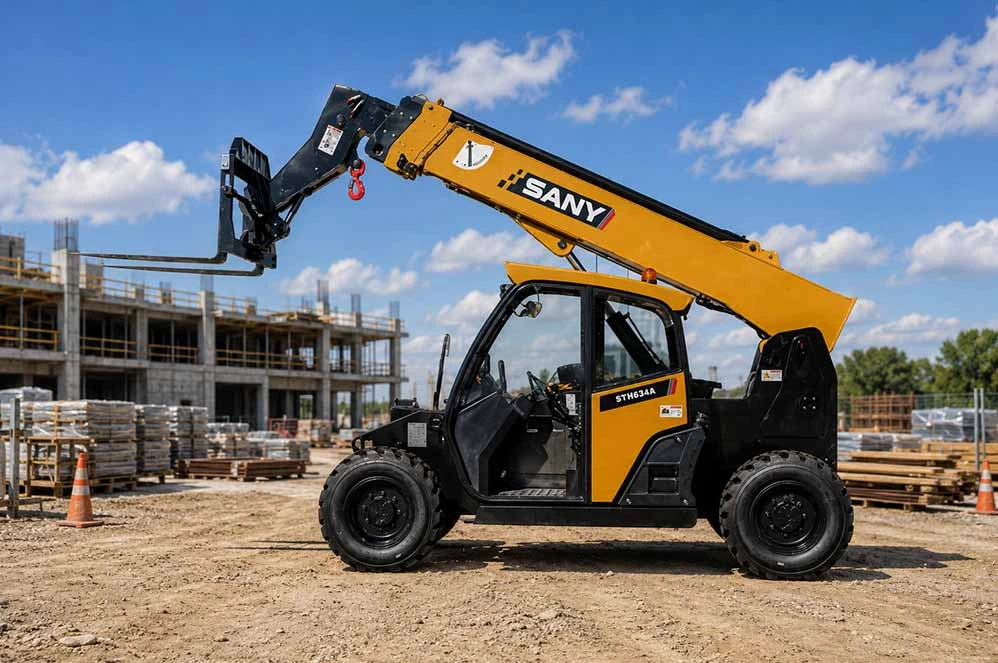
Two warnings sit behind those numbers. First, height and weight trade against each other: a telehandler lifts its full rated load only with the boom short and low, and at full height and reach it carries much less, so read the telehandler load chart for the exact model before you plan a lift. Second, the fixed-boom machines run out at about the fifth floor. Only two machines go past it, both of them rotating telehandlers that turn on a slewing base like a small crane.
The telehandler vs crane comparison explains when each is the better lifter. Compare live telehandler models and prices, and our team will bring you the current offers from the authorised dealer.
Can a hydra crane lift material to the upper floors?
A hydra can lift steel, shuttering and precast items to the lower floors, but it is a ground crane with a short reach, not a high-rise lifter.
Across the 56 hydra cranes in our list whose two spec records agree, boom height runs from 9.0 m on the ACE Rhino 90C to 24.31 m on the Indo Power 30FNX, with a median of 19.2 m. Boom height is the height of the boom tip, not the height you can land a load at. The hook and load hang below the tip, the load has to clear the slab edge, and a hydra’s rated load falls quickly as the boom is extended and lowered outward. The headline tonnage is a short-boom, close-in figure. In practice a hydra is a G+2 or G+3 tool: unloading trucks, setting rebar cages, lifting a beam onto the first slab. The hydra crane boom height guide and the crane load chart guide show how to read the real capacity at a given height and radius.
Twelve hydras are left out of the range above: ten whose two spec records give different boom heights, and two that publish several heights in one field. They are named nowhere on this page.
How high can a concrete pump pump concrete?
The NBC 2016 says a pump may normally lift concrete up to 30 m, and that higher lifts may need a secondary pump placed at an intermediate level.
That line comes from the code’s practice notes for concreting floor decks (Part 6, Section 7, Annex B, clause B-2.2), which also note pump lines of normally 150 mm diameter and flow of about 0.5 to 1 m³ of concrete per minute, slower as the lines get longer and the lift gets higher. On 3 m storeys, 30 m is the slab of the tenth floor, which is why the table at the top splits at G+9.
The pumps we list are stationary pumps: a pump that sits at ground level and pushes concrete up a steel pipeline fixed to the building. All 66 publish a theoretical output, from 27 m³ per hour on the Schwing Stetter BP 250 HDE to 116 m³ per hour on the Schwing Stetter SP 8800, and a maximum concrete pressure from 57 bar to 243 bar. None of them publishes a vertical pumping height, so we do not quote one.
Most of the larger pumps have two settings, and their figures show it. The Aquarius 1400 HPD is rated at 52 m³ per hour and 106 bar on its rod side, or 35 m³ per hour and 157 bar on its piston side; the Putzmeister BSA 1407 D eSmart at 72 m³ per hour and 71 bar, or 48 m³ per hour and 106 bar. The piston side gives up output for pressure, and pressure is what a tall lift asks for.
Here is a piece of arithmetic that shows where the pressure goes. Plain concrete weighs about 24 kN per cubic metre (the IS 456 figure our unit weight guide uses), so every metre of vertical pipe needs about 0.24 bar just to hold the column of concrete up. At 30 m that is about 7.2 bar. Even the lowest-rated pump we list, at 57 bar, is far above that, so the weight of the concrete column is not what limits the lift. Friction in the long pipeline, the bends and a stiff mix use up most of the pressure, which is why the code warns that higher pumping runs slower. The concrete pump output and pressure guide explains both figures in more depth, and the boom pump guide covers the truck-mounted type, which places concrete with its own folding arm and which we do not list.
On a G+1 or G+2 house a pump is optional. A self-loading mixer or a transit mixer can feed a small slab by chute and by hand, and a pump only starts to pay where the slab is large or the pour has to finish in one go.
When does a site need a tower crane or a builder’s hoist?
A builder’s hoist is needed as soon as material has to go above the reach of a telehandler, and a tower crane once the floor plate is too large to serve from one side. Before choosing one, check the tower crane’s load chart at the far corner of the slab, not its headline capacity.
The NBC defines a materials handling hoist as a platform, bucket or similar enclosure meant only for lifting or lowering construction material, worked from outside the cage (Part 7, clause 2.2.5). Its rules for a hoist on site are specific (Part 7, clause 9.11.4):
- The hoist tower is tied to the building at every floor level, or at least every 3 m, and must not stand more than 6 m above the last tie.
- Gates at every landing are at least 2 m high where possible and interlocked, so the hoist cannot move with a gate open.
- A goods hoist carries a notice of its safe working load and that passengers must not ride on it.
- The hoist is tested by a competent person before use and at least every six months, and inspected every week.
Because the tower climbs with the building and is tied at every floor, a hoist grows with a high-rise in a way no ground machine can.
A tower crane is different again. It stands on its own foundation, lifts over the whole site and sets loads anywhere on the floor plate. The code notes that tower cranes are usually supplied on hire, with the client responsible for designing the base from the loads the crane supplier gives, both while working and while standing idle in high wind (Part 7, clause 7.3). We do not list tower cranes or builder’s hoists, so both come from a specialist hire firm; the tower crane guide explains the types and parts.
Which machines should a builder own, and which should be hired?
Own the machines that work on every project you build, and hire the ones tied to one tall building.
For a builder doing G+1 to G+3 houses and blocks, the backhoe loader and a telehandler of the 7 m or 10 m class work on every site, every month. A stationary pump starts to earn its keep once you pour slabs every few weeks. The rotating telehandler, the tower crane and the builder’s hoist belong to the tall project, and most builders hire them for its duration. The builders and developers guide explains how larger developers organise this, and the road machinery guide works through the same own-or-hire question for a road package.
The building construction application page gathers the machine models, tenders and news for this sector, and the construction equipment applications guide explains what each machine does across all project types.
About the figures on this page
The height rules come from the National Building Code of India 2016, Volume 1 (Part 2 clause 12.2.5.1, Part 3 clauses 2.10 and 12.2.1, Part 4 clause 2.38, Part 6 Section 7 Annex B-2.2) and the National Building Code of India 2016, Volume 2 (Part 7 clauses 2.2.5, 7.3 and 9.11.4), each read in full for this page. The 3 m storey and the 1 m clearance over the slab are our own working assumptions, stated where they are used.
Lifting heights, boom heights, pump outputs and pressures are read from our own product data in October 2026, and only where the two spec records for a machine agree. One pump whose two settings read the wrong way round is left out and named nowhere.
To plan a pour, compare live concrete pump models and prices, and the heavy equipment guide indexes the rest of this section.
Prices, specifications and features are indicative, vary by variant, location and date, and should always be confirmed with the official OEM or authorised dealer before any purchase decision. DesiMachines is not liable for decisions taken on the basis of information that may have changed after publication.